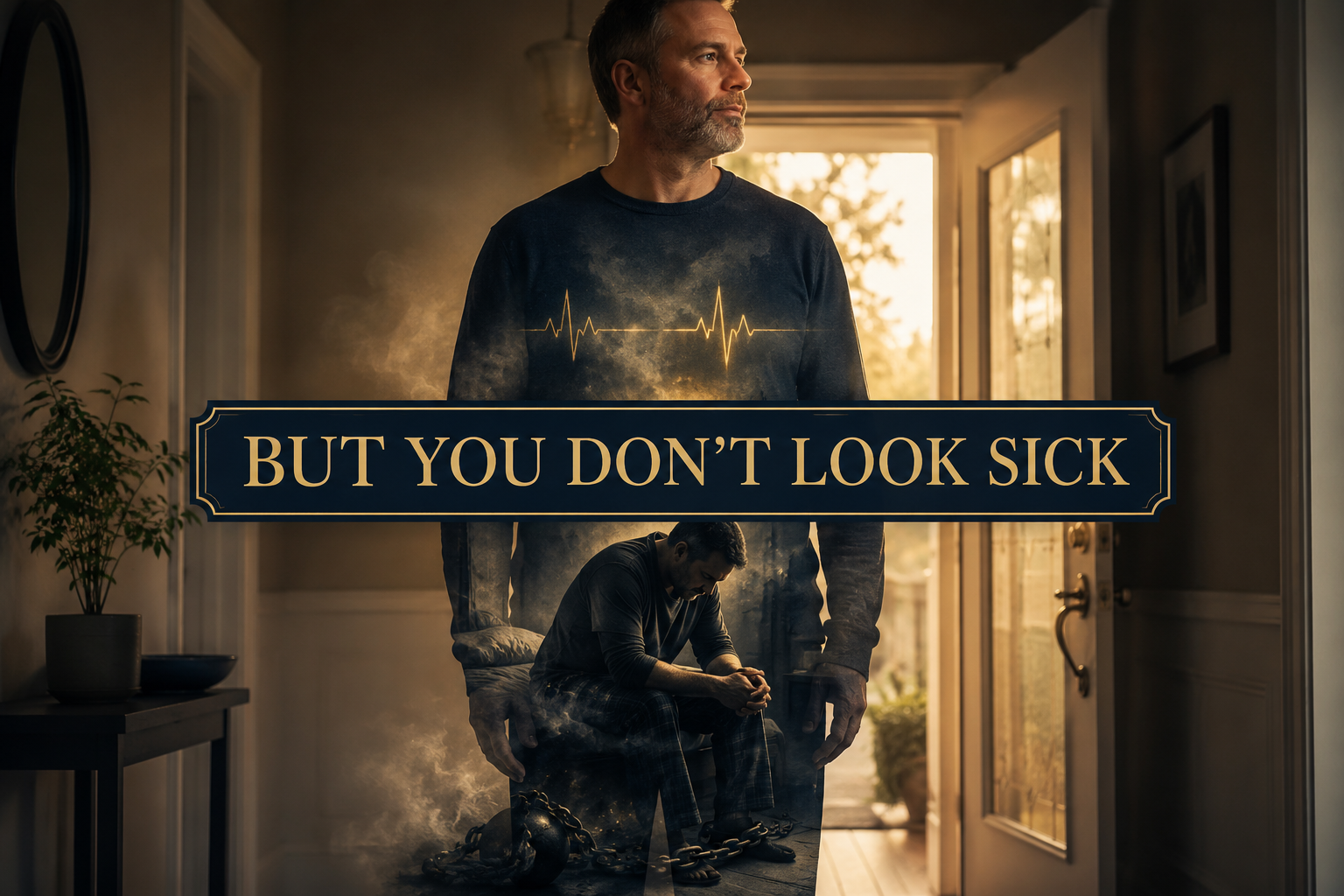
”But you don’t look sick”
I understand why people say it. From the outside, I may appear okay. I can still drive, carry on a conversation, laugh, and have days when I seem like my old self. What people cannot see is how much effort those ordinary things can require—or how physically and emotionally exhausted I may be underneath the surface.
I live with persistent atrial fibrillation, heart failure, and left bundle branch block. I also have severe arthritis in my hips. Together, these conditions have changed what my body can do and how much energy I have available each day.
Walking even a short distance can wear me out. The pain in my hips is part of it, but my heart also does not tolerate exertion the way it once did. A rollator or walker can provide support, but using one still requires energy and stamina. Some days, I simply do not have enough of either.
There are good days, and I try to celebrate them. Lately, though, the difficult days have outnumbered the good ones. That can be hard for other people to understand because chronic illness does not always change the way someone looks.
People Remember Who You Used to Be
Friends and family remember the person I was before all of this—the person who could go almost anywhere, work on things around the house, walk through a store, and handle everyday problems without having to calculate the physical cost first.
I remember that person too. I miss him.
I want to be able to walk through a grocery store without wondering whether I will make it back to the car. I want to go to Home Depot, find a part, come home, and fix a toilet without turning it into a major undertaking. Those used to be ordinary errands. Now the walking, standing, hip pain, and fatigue can make them impossible.
My appearance may not have changed dramatically, but the way my body operates has.
That difference can be difficult for friends, family members, and even strangers to recognize. They see what I look like today and compare it with what they remember me being able to do. They cannot feel my heart working, the weakness in my body, the pain in my hips, or the exhaustion that can arrive without warning.
No one else can fully know what living inside my body feels like.
Learning Different Ways to Live
I have had to find ways around some of these limitations. I order many household items from Amazon. We order groceries through Walmart, and I use curbside pickup so I do not have to walk through the entire store.
I can still drive, which gives me some independence. The real difficulty usually begins when I have to get out of the car and walk, stand, lift something, or remain active for very long.
These changes may look like conveniences from the outside, but for me they are adaptations. They allow me to keep participating in life while respecting what my body can currently handle.
Adapting does not mean I am lazy, and it does not mean I have given up. It means I am learning how to live within limits I never expected to have.
The Recovery I Expected
When I learned that I needed my aortic valve replaced, I believed the process would be straightforward: have the procedure, take some time to recover, and eventually return to being myself.
That is not how things unfolded.
The valve replacement addressed an important problem, but it did not erase every other condition or return my body to the way it once was. Life still had more challenges waiting for me. I continue to live with heart failure, atrial fibrillation, LBBB, arthritis, fatigue, and uncertainty.
That realization has been difficult. Recovery is not always a straight line, and a successful procedure does not necessarily mean everything goes back to normal.
What Comes Next?
That is a question I ask myself often.
I do not know exactly what life has in store for me. I know my artificial valve requires lifelong monitoring, and I know my health may continue to change. Some days I wonder whether this is the best I am going to feel. Other days I still hope there are adjustments that could help.
I am working with my doctors to see whether different medications, treatments, or other changes might improve my symptoms and quality of life. There are no guarantees, but I am not finished looking for answers.
For now, I take things one day at a time. I adjust. I rest when I need to. I appreciate the good days when they arrive, and I try not to let the difficult ones convince me that there will never be another good one.
I am not sharing this because I want pity. I am sharing it because appearances rarely tell the entire story.
Someone can look fine and still be fighting exhaustion, pain, fear, grief, and a body that no longer works the way it once did. If someone tells you they are struggling, believe them—even if they do not look sick.
Leave a Reply