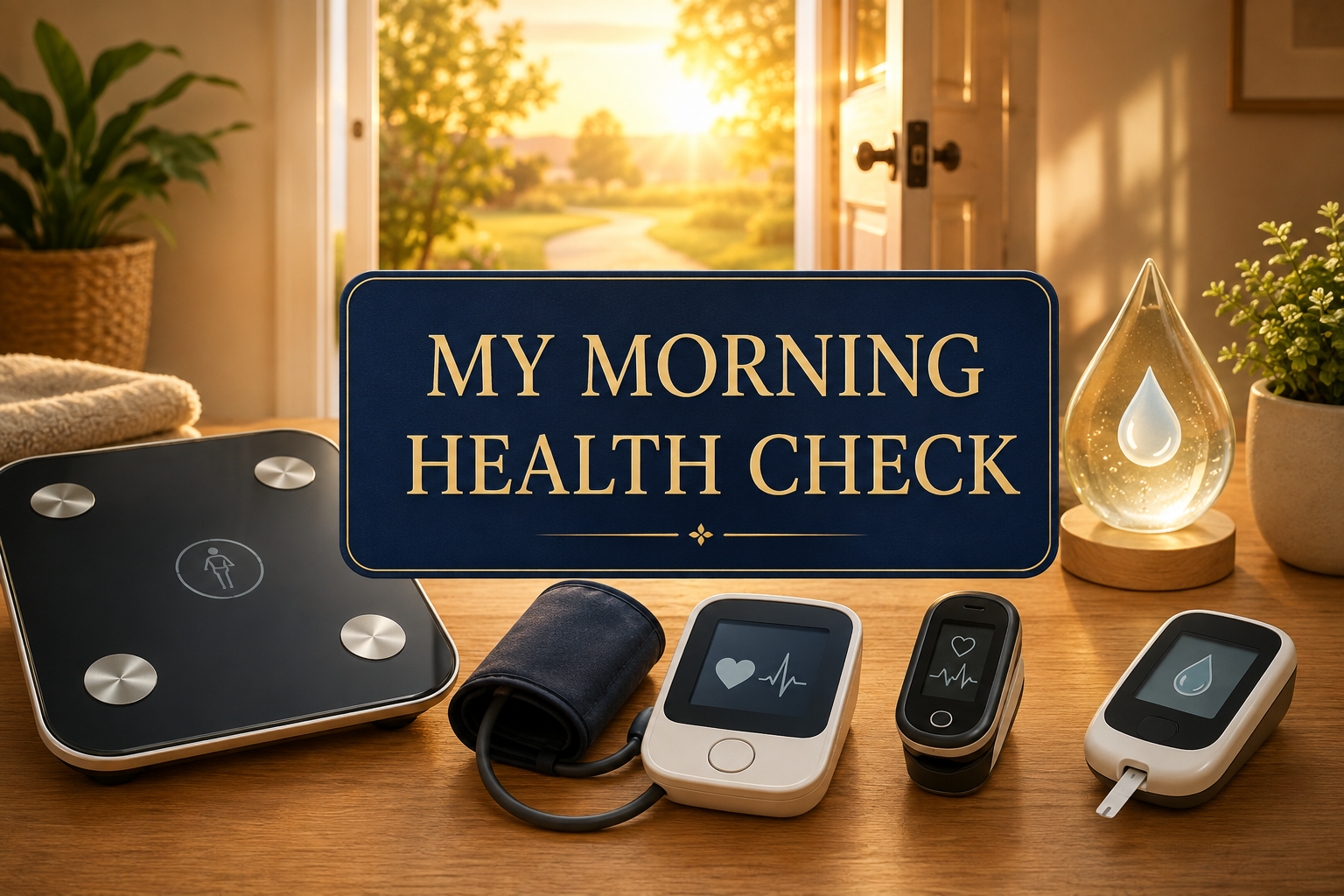
Living with heart failure and kidney disease means that every morning begins with a small collection of measurements. The process can be tedious, but it has become an important part of understanding what my body is doing and recognizing changes before they become larger problems.
This is the routine developed for me with guidance from my medical team. It is not medical advice or a monitoring plan for everyone. Your doctors should determine which measurements and warning signs matter for you.
Starting with a Consistent Weigh-In
My routine begins after I use the bathroom and before I eat or drink anything. I try to wear approximately the same amount of clothing each time and always use the same scale in the same location.
These details may sound overly particular, but consistency makes it easier to tell whether a change on the scale is likely real or simply caused by different clothing, food, fluids, or the time of day.
The American Heart Association recommends weighing yourself each morning after urinating, before breakfast, without shoes, and while wearing the same type of clothing.
I record my weight and compare it with both the previous day and the preceding week. The general warning levels I watch for are:
- A gain of approximately 2–3 pounds in one day
- A gain of 5 pounds or more in one week
- Any different threshold my medical team has instructed me to follow
A sudden increase does not automatically prove that I am retaining fluid, but it is a reason to look more closely at my other numbers and symptoms. The American Heart Association explains that rapid weight gain can be an early sign of fluid retention in people with heart failure.
Tracking Body-Water Percentage
My scale also estimates my body-water percentage. I convert that percentage into pounds using this formula:
Body weight × body-water percentage = estimated pounds of body water
For example, if someone weighs 200 pounds and the scale reports 50% body water:
200 × 0.50 = 100 pounds of estimated body water
I do not treat this number as a precise measurement or as proof that I am retaining fluid. Consumer body-composition scales can be affected by hydration, food, skin contact, time of day, and other factors. I use it as another trend to compare with my previous readings.
If my weight and estimated body water rise together—especially if I also notice swelling, shortness of breath, or other changes—that gives me more information to discuss with my medical team.
An Important Scale-Safety Warning
Body-composition scales use bioelectrical impedance analysis, or BIA. They send a very small electrical signal through the body to estimate measurements such as body fat, muscle mass, and body water.
People with pacemakers or certain other implanted electronic medical devices should not use impedance-based features unless the device manufacturer and their medical team have confirmed that it is safe. Some compatible scales provide a weight-only or pacemaker-safety mode that disables these features.
I have a loop recorder and an artificial heart valve rather than a pacemaker. Even so, I checked with my cardiologist before using this type of scale. Anyone with an implanted medical device should check the instructions for the exact scale and speak with a qualified medical professional before using its body-composition functions. Withings explains how BIA and its weight-only safety mode work here.
Blood Pressure and Heart Rate
Next, I record my blood pressure and heart rate.
For me, a higher-than-usual blood pressure reading can be one clue that my heart is working harder or that something has changed. A lower-than-usual reading—especially when accompanied by dizziness, weakness, or lightheadedness—can raise questions about dehydration, medication effects, or whether too much fluid has been removed.
A single reading does not tell the complete story. I look at the measurement alongside my weight, symptoms, medication use, and recent trends. I do not change my diuretics or other medications based only on my spreadsheet unless my medical team has given me specific instructions to do so.
Glucose
I also record my glucose. Tracking it alongside my other measurements gives me a more complete daily picture and helps me notice patterns that might otherwise be missed.
Blood glucose can be affected by food, medication, illness, stress, activity, and sleep, so the context surrounding the number matters. As with my other readings, I follow the targets and reporting instructions given to me by my health care team.
Recording Everything in One Place
I currently track all these measurements in an Excel workbook:
- Weight
- Daily and weekly weight changes
- Body-water percentage
- Estimated pounds of body water
- Blood pressure
- Heart rate
- Glucose
- Symptoms and other notes
Google Sheets would work well for the same purpose. The most important part is keeping the information organized and easy to review over time.
My cardiologist and nephrologist review these records regularly. Having the information collected in one place makes it easier for them to see patterns and understand what has been happening between appointments.
What I Want to Build Next
My next goal is to create a dashboard within the spreadsheet. I would like it to use green, yellow, and red indicators:
- Green: Measurements are within my usual range
- Yellow: I am approaching a threshold and should pay closer attention
- Red: A measurement has reached a limit established by my medical team and may require action
The thresholds will need to be personalized. A number that is normal for one person may not be normal for someone else, particularly when heart disease, kidney disease, diabetes, and medications are involved.
Eventually, I would like to turn this system into an app that makes daily tracking easier. When I finish the spreadsheet dashboard—and if I develop the app—I will share what I learn.
Tedious, but Worth Doing
I will be honest: completing this routine every morning can feel repetitive. There are days when I would rather step off the scale, forget the numbers, and get on with my morning.
However, these measurements give me a clearer picture of my health. One isolated number may not mean very much, but changes across several days can reveal a trend worth paying attention to.
This is what I personally do to monitor my health each day. It does not replace professional medical care, and I follow the thresholds and instructions established by my cardiologist and nephrologist. Anyone who wants to begin a similar routine should first ask their medical team what to measure, how often to measure it, and which changes should prompt a phone call or urgent care.
Leave a Reply