Tag: Mobility

  • Daily Journal #23 — Good Numbers, Less Anxiety, and a Better Day at the Beach

    Daily Journal #23 — Good Numbers, Less Anxiety, and a Better Day at the Beach

    This morning’s health checks were good.

    My blood pressure was good.

    My pulse was good.

    My weight was up 1.1 pounds, but I’m not particularly concerned about it right now.

    My body-water reading was basically the same as yesterday, which makes me think this probably isn’t fluid.

    There are a couple of pretty ordinary explanations.

    I was wearing a heavier shirt this morning than I was yesterday, and I definitely ate more for dinner last night than I normally do.

    I had a pretty good-sized salad and some of our low-sodium Mexican casserole.

    It’s kind of like beans and rice with chicken, and it is really good.

    And really filling.

    I’ll probably post that recipe in the next few days.

    So for now, I’m just going to monitor the weight and see what tomorrow looks like.

    One pound by itself doesn’t have me worried.

    Feeling Better After the Nephrologist

    I also feel better mentally today after meeting with my nephrologist.

    The appointment was very encouraging.

    Everything he told me was positive, including his explanation that the upcoming kidney MRI is really there to get a closer, more detailed look at what they already saw on the ultrasound.

    He didn’t seem overly concerned.

    That helped.

    It’s funny how much your mind can wander when you are waiting for medical tests.

    You start with one unanswered question.

    Then your brain creates ten more.

    Then twenty.

    Before long, you are mentally diagnosing yourself with every possible outcome.

    Anxiety can really take over if you let it.

    I’m still anxious about the MRI, but I’m feeling much better about it than I was a few days ago.

    Chronic Illness Doesn’t Only Affect You

    Something else I’ve been thinking about lately is how chronic illness doesn’t only affect the person who has it.

    Your family lives with it too.

    In my case, my wife has been incredibly patient with me.

    Because of my sodium and fluid restrictions, we haven’t been out to eat in quite some time.

    That used to be something we really enjoyed.

    We moved to an area with new restaurants, new foods, and tons of fresh seafood.

    Going out and trying new places was supposed to be part of living here.

    Then life changed.

    Over the last year and a half, there have been surgeries, hospital stays, tests, labs, doctors, medications, restrictions, good days, and bad days.

    And no, it isn’t over.

    Not even close.

    But that doesn’t mean we stop living and sit around waiting for whatever comes next.

    We still need to find ways to enjoy ourselves.

    So Today We Went to the Beach

    We decided to go to the beach today.

    We live about 30 minutes from Sanibel Island, which is a beautiful area with great beaches and plenty of shelling for my wife to enjoy.

    I was a little apprehensive about going.

    The last time we went to the beach, it didn’t go very well.

    I had one of my near-passing-out episodes while walking back to the car.

    It was hot.

    I was exhausted.

    The car was only about 500 feet away, but it felt considerably farther than that.

    I had to stop several times just to make it back.

    I eventually got there without passing out, but the experience stuck with me.

    So I was definitely thinking about that today.

    Today Went Better

    Today turned out okay.

    We only stayed for about two hours because it got hot pretty quickly.

    The walk back to the car was still difficult.

    The sand was really soft and fluffy, which makes walking with a walker much harder.

    Even with my homemade sand shoes.

    Yep.

    I made sand shoes for my walker on my 3D printer.

    A cane sinks right into soft sand.

    Walker legs do too.

    So I designed pieces that fit over the existing walker legs and give them a much larger footprint.

    They actually work pretty well.

    They don’t magically turn walking through beach sand into something easy, but they definitely help.

    The photo above is my walker sitting on the beach with the sand shoes attached.

    Three Stops, But I Made It

    Getting back to the car still took some effort.

    I had to stop about three times along the way.

    I was sweating pretty heavily by the time I got there.

    But there was one very important difference compared with the last trip.

    I never felt like I was going to pass out.

    No tunnel vision.

    No feeling like I was about to collapse.

    Just tired.

    And hot.

    I’ll take that.

    It probably sounds like a very small accomplishment to somebody else.

    We went to the beach for two hours and I walked back to the car.

    Big deal.

    But when your world gets smaller because of chronic illness, sometimes those small things become pretty damn important.

    Today we went to the beach.

    My wife got to do some shelling.

    I got through the walk back to the car.

    And we had something that felt a little closer to a normal day.

    That counts as a win.

    Medical Disclaimer

    This journal reflects my personal experience living with chronic health conditions and following the treatment plan developed specifically for me by my healthcare providers. Nothing in this article should be considered medical advice, diagnosis, or a recommendation to change medications, fluid intake, sodium intake, activity levels, or treatment. Symptoms such as dizziness, near-fainting, excessive sweating, rapid weight changes, swelling, or exercise intolerance can have many causes and may require medical evaluation. Heat can also place additional stress on people with certain medical conditions. Always discuss symptoms, activity limits, hydration, and exercise with your own qualified healthcare professionals.

  • Living With Hip Arthritis: From a Limp to a Walker

    Living With Hip Arthritis: From a Limp to a Walker

    Arthritis has been part of my life for years.

    Like a lot of chronic problems, it didn’t happen all at once. There wasn’t one morning when I woke up and suddenly couldn’t walk.

    It was gradual.

    A little more pain.

    A little more difficulty walking.

    A limp.

    Then a cane.

    And eventually, a walker.

    I have arthritis in both hips, but my right hip is by far the worst.

    The simplest way my doctors have described the right one is:

    Bone on bone.

    There’s essentially no longer the cushioning there that a healthy hip joint should have. With osteoarthritis, the cartilage in the joint progressively wears away, and in severe cases that can eventually result in bone rubbing against bone. 

    I can tell you from experience:

    It hurts exactly as pleasant as it sounds.

    It Didn’t Start With a Walker

    That’s probably the part of this story that’s easiest to forget.

    I didn’t go from walking normally to using a walker overnight.

    For a long time, I just dealt with the pain.

    Then I started limping.

    You compensate.

    You change how you walk.

    You figure out which movements hurt and which ones don’t.

    Without really thinking about it, your entire way of moving starts changing.

    Eventually, the limp wasn’t enough.

    I moved to a cane.

    The cane helped for a while, but as the arthritis continued progressing, there came a point where I needed more support.

    Now I use a walker or rollator.

    Looking backward, I can almost chart the progression of my arthritis by what I needed to get around:

    Walking → Limping → Cane → Walker

    That’s not a progression I ever expected to make.

    What Does “Bone on Bone” Actually Mean?

    The hip is a ball-and-socket joint.

    Normally, cartilage covers the surfaces of the bones and allows the joint to move smoothly.

    With osteoarthritis, that cartilage deteriorates over time. As it becomes increasingly damaged, movement can become painful and stiff. When the cartilage is severely worn away, bone can essentially rub against bone. 

    That’s where my right hip has ended up.

    My left hip has arthritis too.

    It isn’t good.

    It’s just that compared with the right one, the left hip sometimes seems like the good hip.

    That’s a pretty low bar.

    I’ve Tried to Avoid Getting Here

    It isn’t as though my first response to hip pain was:

    “Okay, let’s replace the thing.”

    I’ve tried different approaches over the years hoping to control the pain and keep functioning.

    One of them was radiofrequency nerve ablation.

    The idea was to target nerves involved in transmitting the pain signals.

    I tried it.

    It didn’t provide the lasting relief I was hoping for.

    I also tried stem cell injections.

    Again, I was hoping it might provide some relief and allow me to keep going without surgery.

    It didn’t work for me either.

    That’s an important distinction.

    I’m not saying those treatments will or won’t work for somebody else. I’m only describing my experience.

    For me, neither one changed where this was eventually heading.

    Arthritis Changes More Than Your Hip

    Pain is the obvious part.

    But one thing I don’t think people appreciate until they’ve experienced severe arthritis is how much it changes everyday life.

    Walking through a grocery store becomes difficult.

    Walking through a large store can become impossible.

    Standing for too long hurts.

    Sitting in the wrong chair hurts.

    Getting comfortable at night can be difficult.

    Sometimes even finding a position where the hip isn’t screaming at me becomes a challenge.

    Then there’s something else.

    You start planning your life around distance.

    Where am I parking?

    How far is the entrance?

    How much walking is involved once I get inside?

    Is there somewhere to sit?

    Can I use my walker?

    Do I have enough energy to get back to the car?

    Those weren’t questions I used to ask.

    Now they’re part of leaving the house.

    The Walker Helps — But It Also Creates Another Problem

    The walker gives me stability.

    I need it.

    But there’s an interesting complication in my situation.

    I also have heart failure.

    Using a walker isn’t effortless.

    I’m supporting myself with my arms. I’m pushing the walker. I’m walking while moving another piece of equipment along with me.

    That requires effort.

    And when exertion is already difficult, that additional work matters.

    So I have two problems working against each other.

    My hip says:

    You need the walker.

    My heart says:

    Why are you making me work harder?

    It’s a perfect example of something I’ve written about before:

    Chronic illnesses don’t exist in separate little boxes.

    What helps one problem can make another problem more difficult to manage.

    “Just Walk More” Isn’t Always That Simple

    Walking is good for you.

    I understand that.

    I want to move.

    I want to exercise.

    I want to rebuild my stamina.

    But there’s a big difference between knowing that exercise is beneficial and having a body capable of doing it.

    Walking hurts because of my hip.

    Using the walker requires additional effort.

    Exertion can leave me exhausted.

    Sometimes I have to stop and recover after walking a relatively short distance. Especially recently with the nearly passing out episodes.

    That doesn’t mean I’ve given up on moving.

    It means I’ve had to adjust what movement looks like for me.

    And that’s something I wish more people understood about chronic illness.

    Sometimes doing your best doesn’t look very impressive from the outside.

    Losing Mobility Changes Your Independence

    This may be the hardest part.

    I’ve always been someone who would just do things myself.

    Need something from the store?

    Go get it.

    Something breaks?

    Go to Home Depot, get the part and fix it.

    Walk around a grocery store?

    I wouldn’t have even considered that an activity.

    Now I have to think about all of those things differently.

    Fortunately, I’ve found ways around some of it.

    I can order things online.

    I can use grocery pickup.

    I can drive.

    I can use my walker when I need to go somewhere.

    I’m still doing things.

    I’m just doing them differently.

    And learning to accept that has probably been as difficult as dealing with the physical pain.

    There Is Hopefully an End to This Part of the Story

    My right hip has reached the point where the next step is a total hip replacement.

    That sounds like a major event.

    And it is.

    But at this point, I’m looking forward to it.

    That’s probably a strange thing to say about having a joint surgically replaced.

    But after years of progressively worsening pain, limping, using a cane and eventually needing a walker, the possibility of being able to walk with less pain sounds pretty damn good.

    Hip replacement is a recognized option when severe hip osteoarthritis causes significant pain and loss of function despite other treatment approaches. 

    I’m realistic about it.

    I’m not expecting to wake up after surgery and run a marathon.

    Actually, let’s be honest.

    I wasn’t running a marathon before the arthritis either.

    But I’d love to walk through a grocery store again.

    I’d love to walk into Home Depot and get the part I need.

    I’d love to take a walk without calculating how far I can make it before I need to stop.

    Those sound like little things.

    They’re not little things when you lose them.

    ❤️ Greg’s Take

    One of the strange things about chronic illness is that you don’t always notice how much you’ve lost while you’re losing it.

    You adapt.

    First you limp.

    Then you grab a cane.

    Then the cane isn’t enough, so you get a walker.

    You order your groceries instead of walking through the store.

    You order the part online instead of going to Home Depot.

    You find another way.

    And eventually that new way becomes normal.

    My arthritis didn’t take away my mobility in one dramatic moment.

    It took it a little bit at a time.

    That’s probably what bothers me most when I look back at it.

    But I’m still adapting.

    I’m still moving.

    And hopefully, I’m getting closer to the point where I can start taking some of that mobility back.

    I’ve tried treatments that didn’t work.

    I’ve lived with the pain.

    I’ve progressed from walking normally to a limp, a cane and finally a walker.

    Now I’m getting ready for the next step.

    A new hip.

    I’ve already had the heart plumbing replaced.

    Apparently now we’re moving on to the suspension.

    At this rate, I’m eventually going to be mostly aftermarket parts.

  • But You Don’t Look Sick

    But You Don’t Look Sick

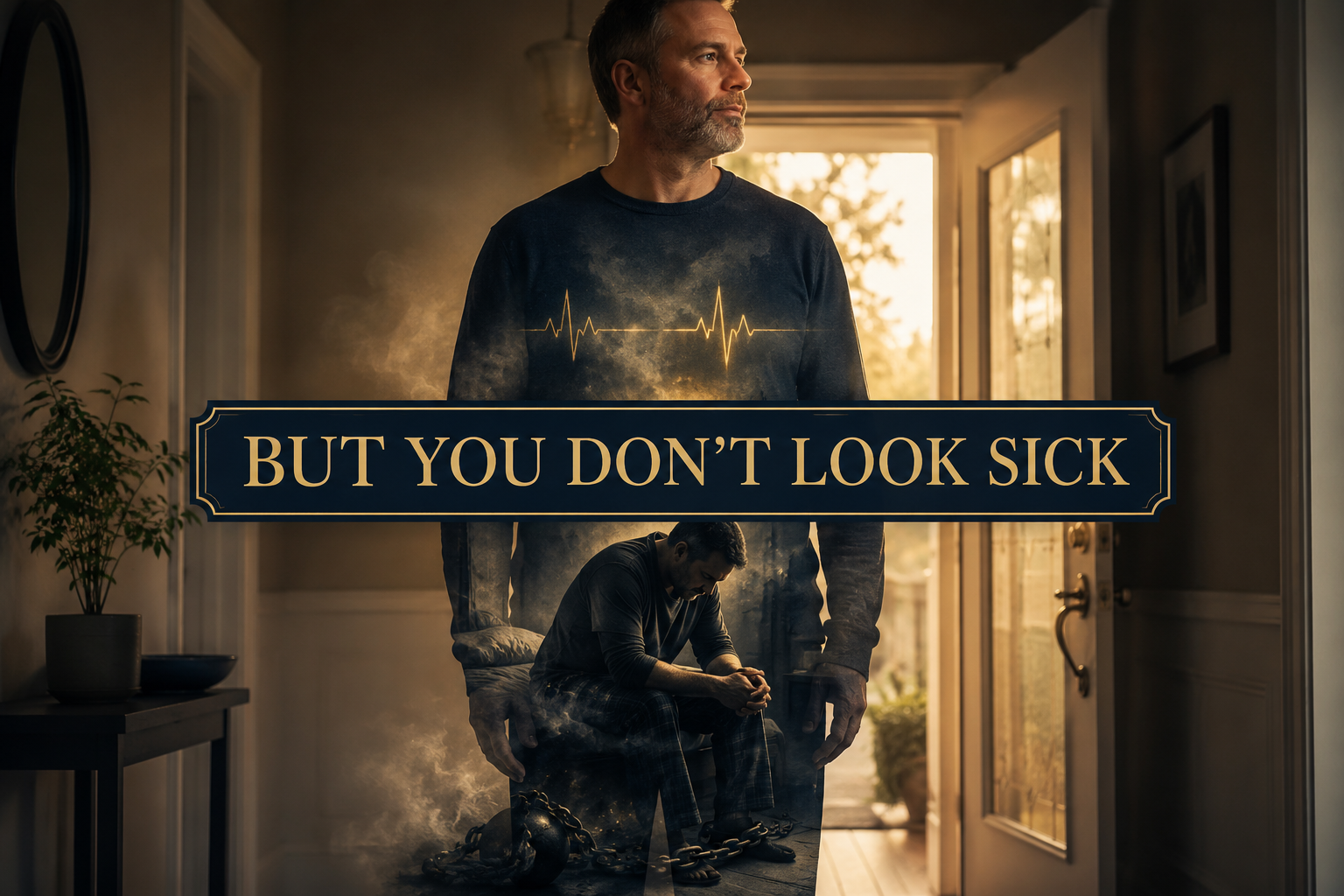
    ”But you don’t look sick”

    I understand why people say it. From the outside, I may appear okay. I can still drive, carry on a conversation, laugh, and have days when I seem like my old self. What people cannot see is how much effort those ordinary things can require—or how physically and emotionally exhausted I may be underneath the surface.

    I live with persistent atrial fibrillation, heart failure, and left bundle branch block. I also have severe arthritis in my hips. Together, these conditions have changed what my body can do and how much energy I have available each day.

    Walking even a short distance can wear me out. The pain in my hips is part of it, but my heart also does not tolerate exertion the way it once did. A rollator or walker can provide support, but using one still requires energy and stamina. Some days, I simply do not have enough of either.

    There are good days, and I try to celebrate them. Lately, though, the difficult days have outnumbered the good ones. That can be hard for other people to understand because chronic illness does not always change the way someone looks.

    People Remember Who You Used to Be

    Friends and family remember the person I was before all of this—the person who could go almost anywhere, work on things around the house, walk through a store, and handle everyday problems without having to calculate the physical cost first.

    I remember that person too. I miss him.

    I want to be able to walk through a grocery store without wondering whether I will make it back to the car. I want to go to Home Depot, find a part, come home, and fix a toilet without turning it into a major undertaking. Those used to be ordinary errands. Now the walking, standing, hip pain, and fatigue can make them impossible.

    My appearance may not have changed dramatically, but the way my body operates has.

    That difference can be difficult for friends, family members, and even strangers to recognize. They see what I look like today and compare it with what they remember me being able to do. They cannot feel my heart working, the weakness in my body, the pain in my hips, or the exhaustion that can arrive without warning.

    No one else can fully know what living inside my body feels like.

    Learning Different Ways to Live

    I have had to find ways around some of these limitations. I order many household items from Amazon. We order groceries through Walmart, and I use curbside pickup so I do not have to walk through the entire store.

    I can still drive, which gives me some independence. The real difficulty usually begins when I have to get out of the car and walk, stand, lift something, or remain active for very long.

    These changes may look like conveniences from the outside, but for me they are adaptations. They allow me to keep participating in life while respecting what my body can currently handle.

    Adapting does not mean I am lazy, and it does not mean I have given up. It means I am learning how to live within limits I never expected to have.

    The Recovery I Expected

    When I learned that I needed my aortic valve replaced, I believed the process would be straightforward: have the procedure, take some time to recover, and eventually return to being myself.

    That is not how things unfolded.

    The valve replacement addressed an important problem, but it did not erase every other condition or return my body to the way it once was. Life still had more challenges waiting for me. I continue to live with heart failure, atrial fibrillation, LBBB, arthritis, fatigue, and uncertainty.

    That realization has been difficult. Recovery is not always a straight line, and a successful procedure does not necessarily mean everything goes back to normal.

    What Comes Next?

    That is a question I ask myself often.

    I do not know exactly what life has in store for me. I know my artificial valve requires lifelong monitoring, and I know my health may continue to change. Some days I wonder whether this is the best I am going to feel. Other days I still hope there are adjustments that could help.

    I am working with my doctors to see whether different medications, treatments, or other changes might improve my symptoms and quality of life. There are no guarantees, but I am not finished looking for answers.

    For now, I take things one day at a time. I adjust. I rest when I need to. I appreciate the good days when they arrive, and I try not to let the difficult ones convince me that there will never be another good one.

    I am not sharing this because I want pity. I am sharing it because appearances rarely tell the entire story.

    Someone can look fine and still be fighting exhaustion, pain, fear, grief, and a body that no longer works the way it once did. If someone tells you they are struggling, believe them—even if they do not look sick.