Tag: Heart Failure

  • Daily Journal #20 — Three Pounds Down, Missing Labs, and One Test I’m Not Looking Forward To

    Daily Journal #20 — Three Pounds Down, Missing Labs, and One Test I’m Not Looking Forward To

    This morning’s health check is moving in the right direction.

    I’m down three pounds from yesterday, which pretty much confirms what I suspected yesterday — I definitely had some fluid buildup.

    That’s good news.

    My blood pressure was still slightly high, and my pulse was significantly elevated. I’m not really sure why. I had been sitting and resting before I took the reading, so it wasn’t like I had just been walking around or doing anything strenuous.

    I’m still dealing with some anxiety about all of the testing coming up, so maybe that is playing a role. I honestly don’t know.

    For now, I’m watching it.

    Another Near-Passing-Out Episode

    I also had another episode yesterday that got my attention.

    I was getting out of my recliner to go eat dinner when I suddenly became extremely lightheaded. My vision started closing in — that tunnel-vision feeling — and for a moment I really thought I was going to pass out.

    I didn’t.

    Thankfully, this episode passed pretty quickly. Within a few moments, I was feeling better.

    It also felt different from some of the other episodes I’ve had. I wasn’t sweaty this time, and it didn’t linger nearly as long.

    My first thought was that maybe my blood pressure dropped when I stood up too quickly. That would make sense, but that is only my guess. With everything else going on, I’m not going to pretend I know exactly what caused it.

    It is another thing I’ll be mentioning to my medical team.

    These are the kinds of symptoms that make all of the tracking feel worthwhile. If something happens, I can look back at my blood pressure, pulse, weight, medications and everything else instead of trying to remember it later.

    The Blood Work Came Back… Mostly

    I received the results from my blood tests.

    Well, most of them.

    I had something like eight different tests ordered, but somehow the renal blood work wasn’t run.

    Of course.

    That’s probably the test I’m most interested in right now.

    I’m guessing the person who drew my blood somehow missed that order. I have my nephrology appointment on Thursday, so there is a pretty good chance I’ll end up having it drawn after the appointment.

    It’s frustrating because, with everything that has been going on with my kidneys, those are the numbers I really wanted to see.

    But there was another result I had been anxiously waiting for.

    My PSA.

    And thankfully, it was normal.

    One Less Thing to Freak Out About

    Prostate cancer runs in my family, so I was definitely jonesing for that PSA result.

    Between the recent acute kidney injury and the blood I had in my urine, my mind had already gone down every possible road.

    That’s what anxiety does.

    You know there are probably several explanations for something, but your brain immediately starts working its way toward the worst one.

    So seeing a normal PSA was a relief.

    One less thing to worry about.

    I still need additional testing on my bladder, though.

    And there is one procedure in particular that I am not exactly rushing to schedule.

    The Cystoscopy

    Eventually I need to have a cystoscopy.

    A cystoscopy is a procedure where a doctor uses a thin, lighted tube called a cystoscope to look inside the urethra and bladder.

    Yep.

    That means it goes from the outside into the bladder.

    There is really only one route available for that journey.

    Let’s just say I am not terribly excited about it.

    I’m planning to wait until after my hip surgery before dealing with that one.

    Is that partly because I have other medical priorities right now?

    Absolutely.

    Is it also because the procedure sounds like about as much fun as you would imagine?

    Absolutely.

    The Next Few Days

    So now the schedule looks like this:

    Nephrologist on Thursday.

    MRI on Monday.

    Hopefully, between those appointments and the missing renal blood work eventually getting done, we’ll have a much better idea of where things stand with my kidneys.

    My hope is that we can finally put this AKI behind me.

    Yesterday I was worried about fluid buildup and had another near-passing-out episode.

    Today I’m three pounds lighter.

    The PSA was normal.

    There are still unanswered questions, but at least this morning there are a couple of things moving in the right direction.

    I’ll take the wins when I can get them.

    Medical Disclaimer

    This journal documents my personal health experiences and the treatment plan developed specifically for me by my healthcare providers. Nothing in this article is medical advice or a recommendation to diagnose, treat, monitor, delay, or change the treatment of any medical condition. Symptoms such as rapid weight changes, swelling, elevated heart rate, dizziness, tunnel vision, fainting or near-fainting, blood in the urine, or changes in kidney function can have many causes, including potentially serious ones, and should be evaluated by qualified healthcare professionals. Do not assume that symptoms similar to mine have the same cause, and do not change medications or delay recommended testing or treatment based on anything you read here. Seek prompt medical attention for new, severe, persistent, or worsening symptoms, especially actual fainting, chest pain, significant shortness of breath, new neurological symptoms, or other symptoms that concern you. Always discuss your individual situation with your own healthcare team.

  • Daily Journal #13: The Scale Is Heading the Wrong Way

    Daily Journal #13: The Scale Is Heading the Wrong Way

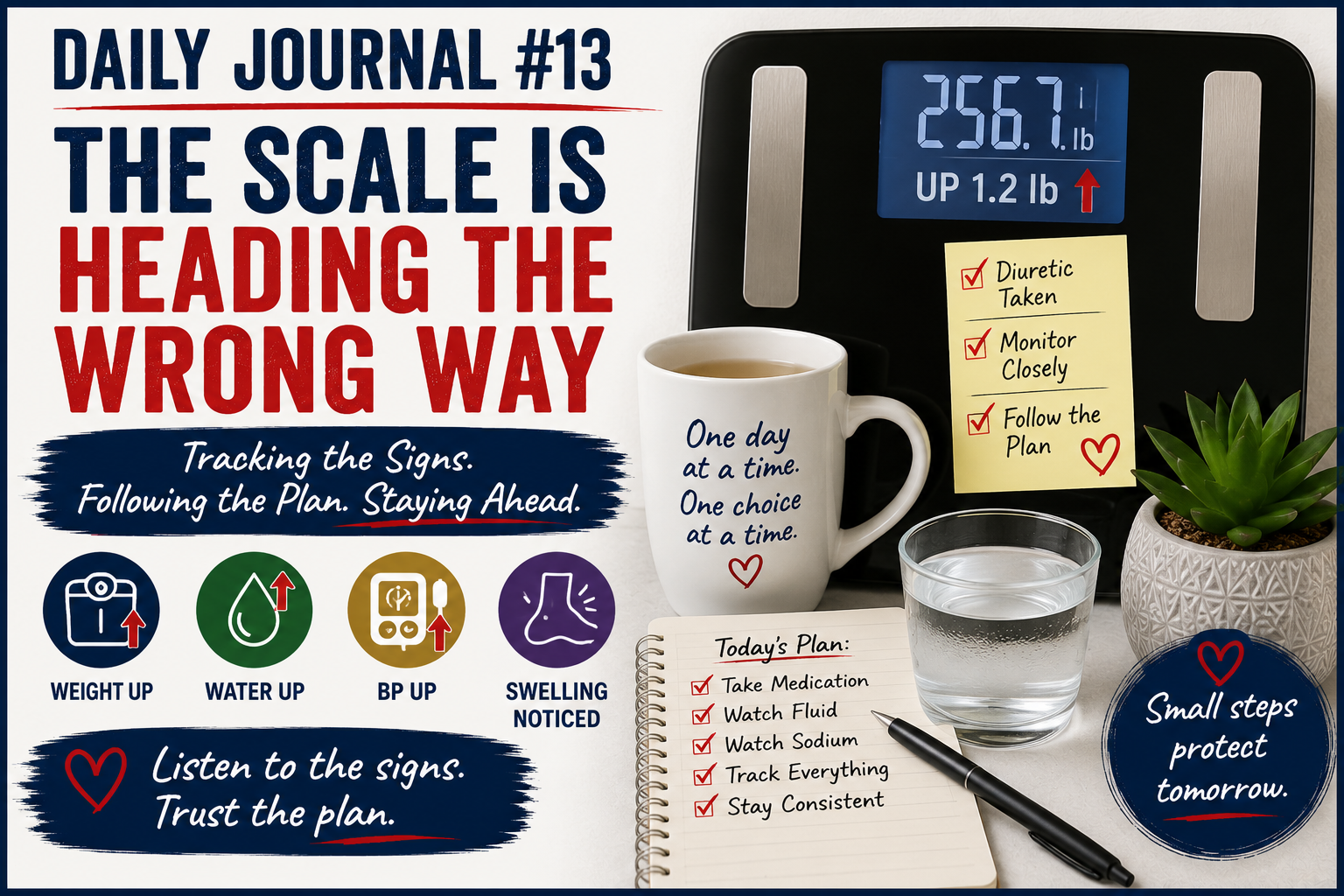
    Well, my morning health checks are continuing to move in the wrong direction.

    I gained more than a pound again this morning. That’s now two days in a row with a gain of more than a pound.

    This time, there were some other signs along with it.

    My BIA scale showed an increase in body water. My blood pressure was slightly elevated, and when I looked at my feet, I could see some mild swelling.

    One number by itself might not concern me much.

    Several things pointing in the same direction get my attention.

    It looks like I’m retaining fluid.

    First Things First

    The first thing I did was follow the plan my cardiologist has given me and take my prescribed diuretic.

    Anyone who has dealt with heart failure and diuretics probably knows what that means.

    A good portion of today’s schedule will revolve around knowing exactly where the nearest bathroom is.

    Not particularly exciting, but that’s part of managing this.

    Now I watch what happens.

    Does the swelling decrease?

    Does my weight start moving back down?

    Does the extra water come off?

    Tomorrow morning’s numbers will be especially interesting.

    Now Comes the Detective Work

    The next thing I do when this happens is start retracing my steps.

    What changed?

    Did I drink too much?

    I don’t think so. I didn’t have any extra water yesterday. I did have a couple of peaches, which obviously contain water, but I don’t think that alone explains what I’m seeing.

    Then I started thinking about dinner from a couple of nights ago.

    The steak and shrimp rice bowls.

    They were one of my favorite meals, and I’ll admit it:

    I overindulged.

    The meal itself wasn’t necessarily the problem. We make it at home, so I have a pretty good idea of what’s going into the steak, rice, vegetables and seasonings.

    The question mark is the shrimp.

    Shrimp Can Be Tricky

    Shrimp naturally contains some sodium, but packaged shrimp can contain considerably more depending on how it was processed.

    Unfortunately, we already threw away the package.

    So I can’t go back and check the label.

    That’s frustrating because I’d really like to know exactly what I ate.

    Maybe we bought a different shrimp than usual. Maybe it contained more sodium from processing or packaging. Maybe the larger portion I ate was enough to push me over the edge.

    Or maybe it wasn’t the shrimp at all.

    I don’t know.

    That’s important for me to say because it’s very easy to see the scale move and immediately blame the last suspicious thing I ate.

    All I can do is look at the information I have and try to identify the most likely explanation.

    Maybe Fresh Shrimp Is the Better Answer

    One thing I’m considering going forward is buying more of our shrimp fresh from a seafood market.

    Living in Southwest Florida, we’re certainly not lacking seafood markets.

    That would give me another option when I’m trying to avoid some of the sodium that can be added during processing.

    But even then, I’ll still need to ask questions and pay attention to what I’m buying. “Fresh” doesn’t automatically tell me everything about how seafood was handled before it reached the counter.

    That’s one lesson I keep learning:

    Never assume. Ask. Read. Check.

    Sodium Doesn’t Always Give Me an Immediate Warning

    This is one of the frustrating parts of tracking everything.

    I don’t necessarily eat something salty at dinner and wake up the next morning several pounds heavier.

    Sometimes the pattern takes longer to become apparent.

    That’s why looking at trends has become more useful to me than reacting to one isolated number.

    Yesterday I was up.

    Today I’m up again.

    Now I’m also seeing increased body water on the scale and some swelling in my feet.

    That’s a trend worth paying attention to.

    I’m Watching — Not Panicking

    I’m still nowhere near the point where I think I need to head to the hospital.

    But I’m also not ignoring what’s happening.

    I’ve followed the medication plan my cardiologist gave me, and now I’ll monitor things more closely.

    That’s really what all of this daily tracking is about.

    It’s not about panicking every time the scale moves.

    It’s about noticing when several things start changing together and knowing when I need to pay closer attention.

    Hopefully, the diuretic does what it’s supposed to do today.

    Hopefully, the swelling improves.

    And hopefully tomorrow morning I step on the scale and finally see that number traveling in the other direction.

    ❤️ Greg’s Take

    This is exactly why I do morning health checks every day.

    Yesterday’s weight gain was something to watch.

    Today’s second consecutive gain, increased body water, slightly swollen feet and higher blood pressure gave me more information.

    Now I can respond according to the plan my cardiologist has already given me instead of waiting until things get significantly worse.

    I may never know whether those delicious steak and shrimp rice bowls were responsible.

    But I learned something anyway.

    Next time, don’t throw away the shrimp package until after I’ve survived the meal.

    And maybe don’t eat quite so much of it either.

    That second lesson may be the harder one.

    Medical Disclaimer: This journal reflects my personal experience living with chronic illness and how I manage my health based on guidance from my own healthcare team. It is not medical advice. Medications, including diuretics, should only be taken as prescribed by your healthcare provider. If you notice changes in your weight, swelling, blood pressure, breathing, or other symptoms, contact your healthcare provider for guidance. Seek immediate medical attention for symptoms that may be an emergency.

  • Left Bundle Branch Block: An Unexpected Part of My TAVR Journey

    Left Bundle Branch Block: An Unexpected Part of My TAVR Journey

    When I went into the hospital for my TAVR procedure, my attention was focused on one thing: my aortic valve.

    I had severe aortic stenosis, and the goal was to replace the failing valve and get my heart working better.

    What I didn’t fully appreciate beforehand was just how close the heart’s electrical system is to where that new valve would be placed.

    I learned about that very quickly.

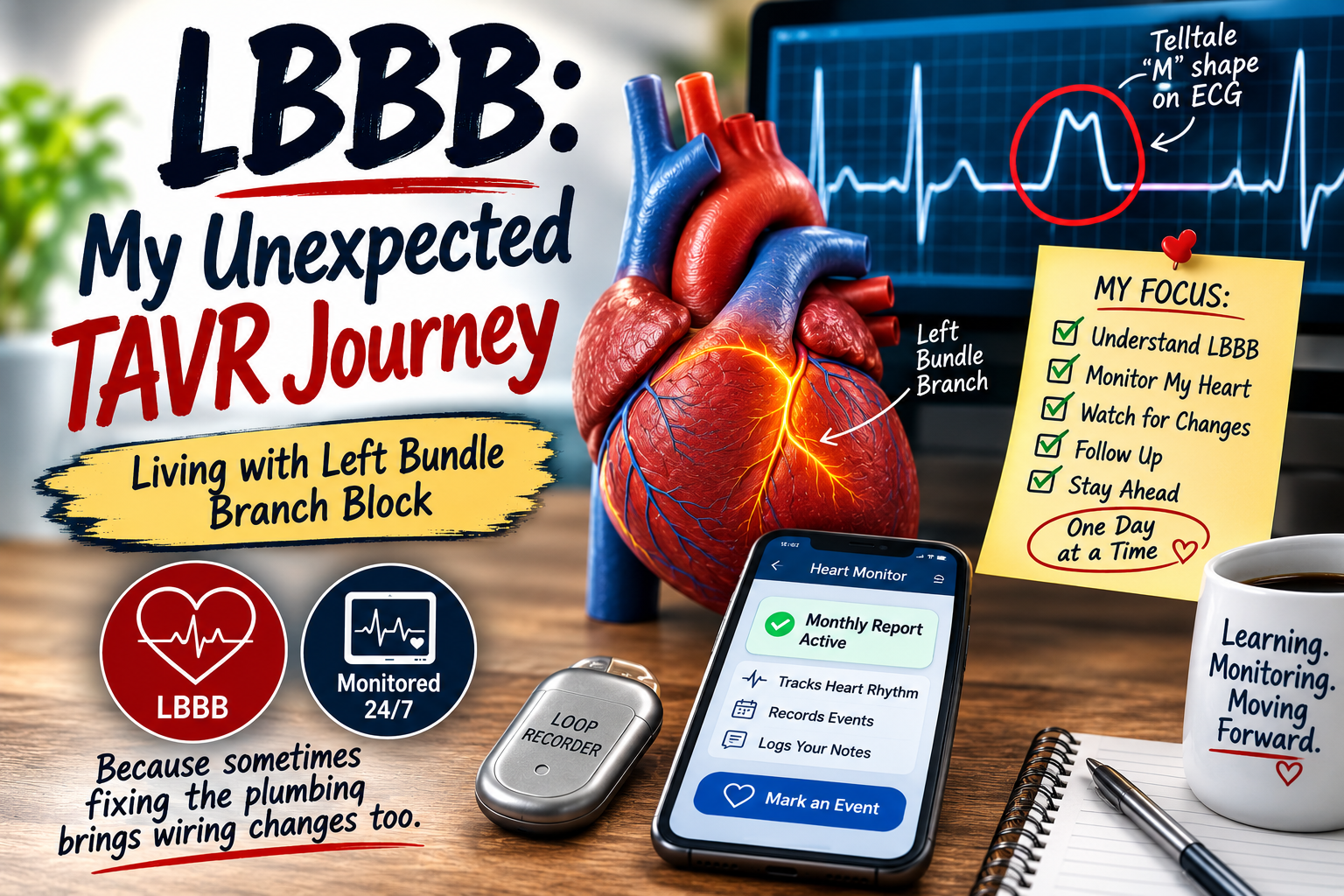
    After my TAVR, I developed something called a left bundle branch block, or LBBB.

    And before anyone scheduled for a TAVR starts worrying, let me make something clear:

    Not everyone who has a TAVR develops LBBB.

    It is a known complication of the procedure, but it certainly isn’t something that happens to everyone. In one large U.S. registry analysis involving more than 200,000 TAVR patients, about 16% developed a new LBBB after the procedure. The exact risk can vary depending on the patient, the valve and other factors.

    Apparently, I was one of the lucky ones.

    Maybe I should start buying lottery tickets too.

    What Is a Left Bundle Branch Block?

    Before all of this happened, “left bundle branch block” wasn’t exactly something that came up in everyday conversation.

    The easiest way I’ve learned to think about it is that the heart doesn’t just pump—it also has its own electrical wiring system.

    Electrical signals travel through pathways in the heart that tell the chambers when to contract. Part of that electrical system divides into a right bundle branch and a left bundle branch.

    Normally, the electrical signal travels through these pathways in a coordinated way.

    With LBBB, the electrical signal doesn’t travel normally through the left bundle. Instead, the impulse has to take a different route to activate the left ventricle.

    The result is that the ventricles don’t receive their electrical signal in quite the same synchronized way they normally would.

    I tend to think of it as an electrical detour.

    The signal still gets there, but it isn’t traveling down the normal road.

    Why Can LBBB Happen After TAVR?

    My doctors gave me a pretty simple explanation.

    The replacement aortic valve sits very close to some of the heart’s electrical conduction system.

    When the new valve is placed, that nearby electrical system can sometimes be disturbed. That’s why conduction problems such as LBBB are recognized complications following TAVR.

    That’s what happened to me.

    My new valve addressed one major problem, but I left the procedure with a new electrical issue that needed to be monitored.

    Chronic illness seems to have a sense of humor like that.

    They Saw Something Different on My ECG

    After my TAVR, my doctors noticed that my heartbeat looked different on the ECG.

    That was the first indication that something had changed electrically.

    When LBBB is present, the electrical delay changes the shape and duration of the QRS complex on an ECG. One characteristic that can appear is a broad or notched, sometimes M-shaped, pattern in certain leads. That’s one of the things that was pointed out to me on my ECG.

    The American Heart Association also describes this characteristic M-shaped appearance in its educational material about LBBB.

    That doesn’t mean you can look for an “M” on an ECG and diagnose yourself with LBBB. Doctors use several ECG measurements and characteristics to make the diagnosis.

    For me, the important part was much simpler:

    That electrical pattern wasn’t there before my TAVR. Now it was.

    My Hospital Stay Just Got Four Days Longer

    I certainly wasn’t expecting that.

    Instead of going home and beginning my recovery, I ended up staying in the hospital for four additional days while they monitored my heart.

    The concern was whether this new conduction problem would progress.

    Would my electrical system stabilize?

    Would it get worse?

    Would I need a pacemaker?

    Those weren’t questions anyone could answer immediately.

    So we waited and watched.

    Pacemaker or Monitoring?

    Ultimately, I didn’t receive a permanent pacemaker at that time.

    Instead, I was given a choice about continued heart-rhythm monitoring.

    One option was an external heart monitor that I would wear for a period of time.

    The other was an implantable loop recorder.

    I chose the loop recorder.

    For me, I liked the idea of having something continuously monitoring my heart over the long term rather than wearing an external monitor temporarily.

    The loop recorder is a small device implanted under the skin that records information about my heart rhythm.

    And now it has become another part of my everyday life.

    My Heart Sends in a Monthly Report Card

    I receive a report each month showing anything unusual the monitoring system has detected.

    That can include things such as pauses or unusual rhythms.

    And yes, apparently my heart occasionally likes submitting some interesting material for the report.

    I’ve had pauses detected, which is one of the reasons this continued monitoring is important.

    The system also gives me another useful feature.

    If I’m experiencing something unusual—maybe I’m lightheaded or just feel that something isn’t right—I can use my phone to mark the event.

    I can enter what I was doing and describe what I’m experiencing.

    That creates a record associated with the event so it can be reviewed later.

    I really like having that ability because it provides context.

    Instead of simply saying at my next appointment, “I felt really strange one afternoon a few weeks ago,” there can be a record of when it happened and information about what I was experiencing.

    What My Loop Recorder Does NOT Do

    This is an important distinction.

    My loop recorder is a monitoring device. It is not a treatment device.

    It isn’t a pacemaker.

    It isn’t an implanted defibrillator.

    And it isn’t going to shock my heart or correct a dangerous rhythm if something happens.

    It records information.

    If I’m experiencing what could be a medical emergency, pressing a button on my phone isn’t a substitute for getting emergency medical care.

    An emergency still means getting emergency help.

    The recorder’s job is to help capture information that my doctors can use to understand what’s happening with my heart.

    I Still Have Pauses

    Since the loop recorder was implanted, it has detected pauses in my heartbeat.

    That obviously gets my attention.

    A pause doesn’t automatically mean that I need a pacemaker, but it’s one of the electrical findings my doctors can follow along with everything else that’s happening.

    That’s especially important because I also experience symptoms.

    The Lightheadedness Is What Concerns Me

    There are periods when I become extremely lightheaded.

    Sometimes I get the feeling that I’m getting close to passing out.

    I haven’t completely lost consciousness, but I’ve experienced that tunnel-vision, I’m-about-to-black-out feeling.

    That’s difficult to ignore.

    Bundle branch block itself may cause no symptoms, but fainting or feeling as though you’re going to faint can occur in some people with conduction problems and deserves medical evaluation.

    But there’s an important distinction in my situation:

    We don’t know that my LBBB is causing these episodes.

    I have several things happening with my heart.

    I have persistent atrial fibrillation.

    I have heart failure.

    I have LBBB.

    I’ve had pauses recorded.

    There are also medications and blood-pressure changes that can potentially affect how I feel.

    So I’m not going to pick one condition and declare that I’ve found the culprit.

    That’s exactly why having long-term rhythm monitoring can be useful.

    If I report an episode and there’s a corresponding rhythm abnormality at the same time, that’s useful information for my doctors.

    Then There’s the Sweating

    Another strange symptom I’ve been experiencing is profuse sweating, particularly with exertion or heat.

    And I don’t mean getting a little sweaty because it’s hot outside.

    Sometimes I’m drenched.

    Is that LBBB?

    Heart failure?

    Medication?

    Blood pressure?

    Something completely different?

    I don’t know.

    And I’m deliberately not going to claim that LBBB causes it just because LBBB happens to be one of my diagnoses.

    One thing chronic illness has taught me is:

    Having a symptom and having a diagnosis doesn’t necessarily mean the diagnosis caused the symptom.

    Sometimes figuring out that connection is the hardest part.

    Will I Eventually Need a Pacemaker?

    That’s the question hanging over all of this.

    The answer right now is:

    Maybe.

    Developing LBBB after TAVR doesn’t automatically mean someone needs a pacemaker.

    Guidance from the American College of Cardiology describes monitoring patients who develop new conduction disturbances following TAVR and considering additional testing or a permanent pacemaker depending on how those abnormalities progress.

    My doctors are monitoring the electrical activity of my heart, the pauses, my symptoms and whether anything changes.

    If the conduction system deteriorates further, or if my doctors determine that the electrical abnormalities and symptoms warrant pacing, then a pacemaker could become part of my future.

    But we’re not there yet.

    For now, I have the loop recorder.

    We collect information.

    We watch.

    And we make decisions based on what that information shows.

    ❤️ Greg’s Take

    When I went in for my TAVR, my thinking was pretty straightforward:

    Bad valve. New valve. Recover. Move on.

    Yeah.

    It didn’t exactly work that way.

    The new valve addressed the severe aortic stenosis, but somewhere along the way the electrical wiring of my heart decided it wanted to join the story.

    I developed LBBB.

    My hospital stay became four days longer.

    I had to make a decision about long-term heart monitoring.

    I chose a loop recorder.

    Now my heart essentially sends in a monthly report card, I’ve had pauses recorded, and I have a way to mark the times when I’m experiencing something unusual.

    And someday I may need a pacemaker.

    Or maybe I won’t.

    That’s one of the frustrating things about chronic illness. Sometimes there isn’t an immediate answer.

    Sometimes the answer is:

    We’re going to watch it.

    Before all of this, I probably would have found that incredibly frustrating.

    Now I’m beginning to understand it.

    Not every decision needs to be made today.

    Sometimes collecting information is the next step.

    So my loop recorder keeps watching.

    My doctors keep monitoring.

    And I keep learning more about the electrical system of a heart that I never expected to know this much about.

    Apparently replacing the plumbing wasn’t enough. I needed to learn about the wiring too.


    Learn More About LBBB and TAVR

    These are some good resources if you’d like to learn more about LBBB, heart conduction problems and what can happen after TAVR:

    Mayo Clinic — Bundle Branch Block: Symptoms & Causes
    A straightforward explanation of bundle branch block, the heart’s electrical system and possible symptoms.
    Mayo Clinic: Bundle Branch Block Symptoms & Causes

    Mayo Clinic — Bundle Branch Block: Diagnosis & Treatment
    Information about diagnosing bundle branch block and situations in which treatment such as a pacemaker may be considered.
    Mayo Clinic: Bundle Branch Block Diagnosis & Treatment

    American College of Cardiology — Conduction Disturbances After TAVR
    A more technical resource discussing monitoring and management of conduction problems that develop following TAVR.
    ACC: Conduction Disturbances After TAVR

    American College of Cardiology — New LBBB After TAVR
    Information from a large registry analysis looking specifically at patients who developed new LBBB after TAVR.
    ACC: New LBBB After TAVR

    Medical Disclaimer: I am not a doctor or medical professional. This article describes my personal experience with TAVR, left bundle branch block, heart-rhythm monitoring and chronic illness. Everyone’s medical situation is different, and my experience should not be used to diagnose or treat a medical condition or determine whether someone needs a pacemaker or other treatment. Always discuss symptoms, test results and treatment decisions with your doctor or other qualified healthcare professional. If you experience symptoms that may represent a medical emergency, seek emergency medical care rather than relying on a monitoring device or information on this website.

  • My Health Tracker

    My Health Tracker

    The Five Minutes Every Morning That Help Me Stay Ahead of My CHF

    Living with congestive heart failure has taught me something important.

    Your body is constantly giving you information.

    The question is whether you’re paying attention.

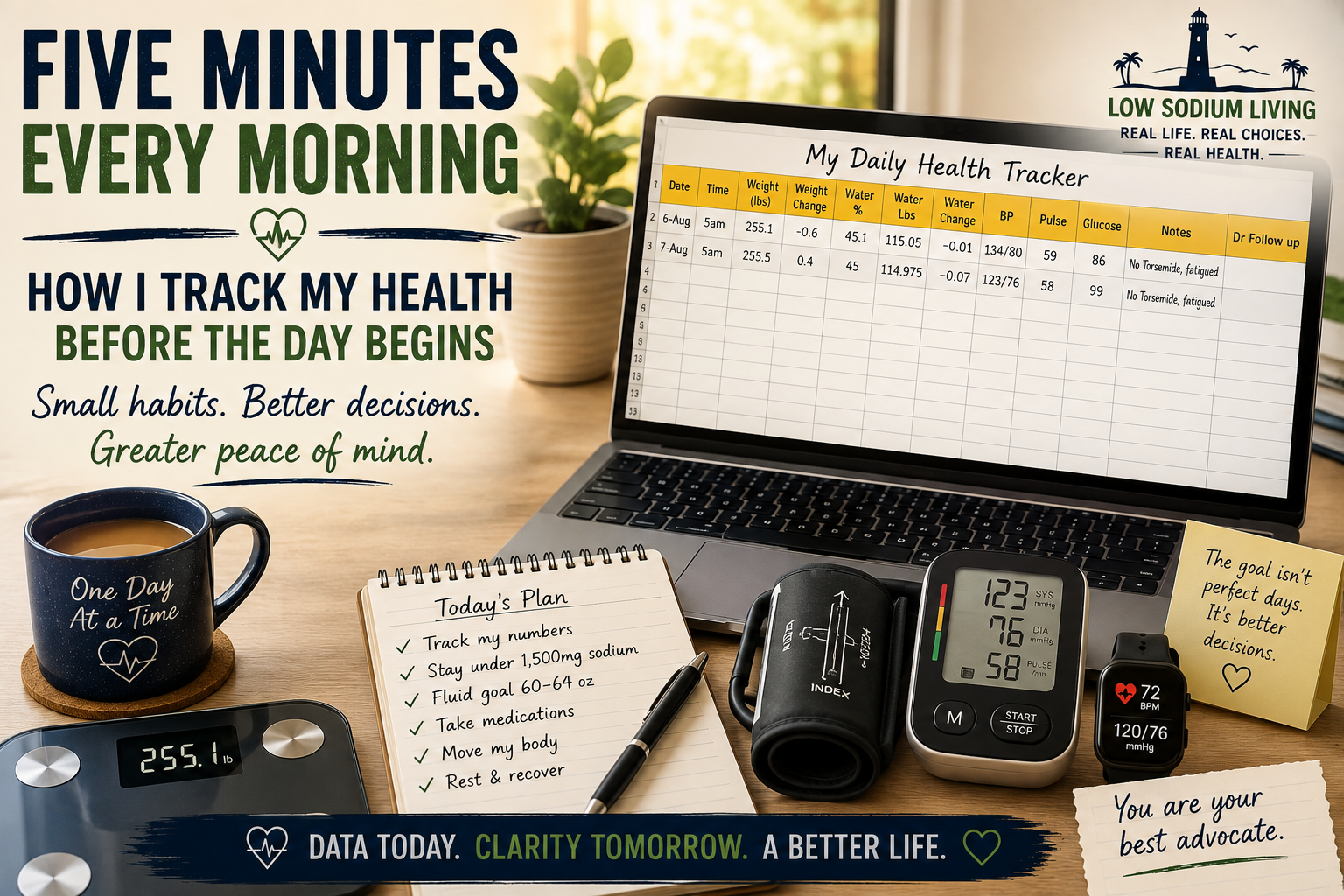
    Every morning, before I drink my morning water or begin my day, I spend about five minutes checking in with my body.

    To some people, it probably looks like I’m filling out a simple spreadsheet.

    To me, it’s much more than that.

    It’s an early warning system.

    Over time, I’ve learned that it’s much easier to recognize a problem before it becomes serious than it is to recover after the problem has already happened.

    That’s why I track my health every single morning.

    Not because my doctors told me to.

    Because it helps me understand my own body.

    One of the most important lessons I’ve learned while living with chronic illness is this:

    Nobody will ever know your body as well as you do.

    The more information I collect, the better conversations I have with my doctors, and the more confident I feel when something doesn’t seem right.


    Download My Daily Health Tracker

    If you’d like to use the same spreadsheet I use every morning, I’ve made an example version available for you to download.

    📥 Download the Daily Health Tracker (Excel)

    Feel free to customize it for your own health conditions. What I track may not be exactly what you need, but hopefully it gives you a good starting point for building your own daily routine.


    What I Track Every Morning

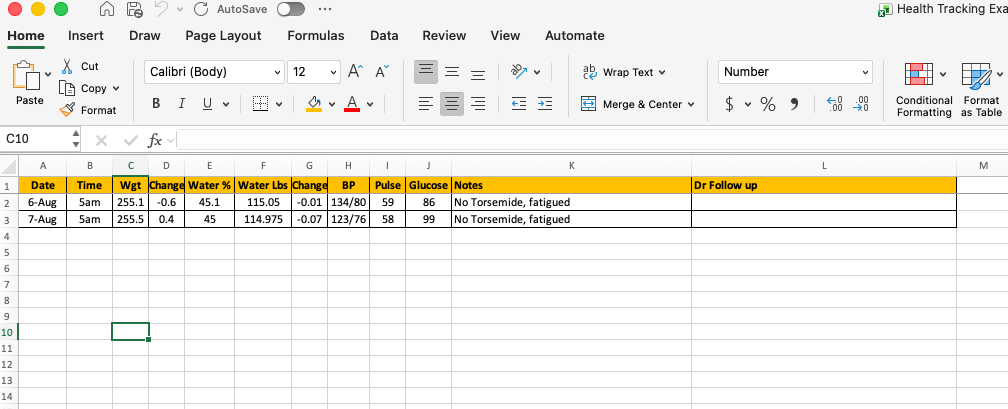
    Below is a screenshot of the actual spreadsheet I use every day.

    Screenshot of the example of the health tracking Excel Sheet that I use

    It isn’t complicated.

    In fact, that’s intentional.

    The easier something is to use, the more likely you’ll continue using it.

    Each column serves a purpose, and together they give me a quick snapshot of how my body is doing each morning.


    📅 Date

    The first column simply records the date.

    It sounds obvious, but dates become incredibly important when you’re looking for trends over several days, weeks, or even months.

    Sometimes a doctor will ask,

    “When did this start?”

    Instead of guessing, I simply look back at my spreadsheet.


    🕒 Time

    I try to record my information at approximately the same time every morning.

    For me, that’s usually around 5:00 AM, after using the restroom but before eating breakfast.

    Keeping everything consistent makes it easier to compare one day to the next.


    ⚖️ Weight

    Weight is probably the most important number I track.

    For someone living with congestive heart failure, sudden weight gain often isn’t body fat.

    It’s fluid.

    That’s why I weigh myself every morning under the same conditions. After using the washroom and wearing the same type of clothes.

    A sudden increase can be one of the earliest signs that my body is retaining fluid.


    📈 Daily Weight Change

    The next column calculates the difference between today’s weight and yesterday’s.

    I’m watching for one thing in particular.

    Have I gained 2–3 pounds overnight or about 5 pounds in a week?

    Those numbers can be an early warning sign of fluid retention and may indicate that it’s time to contact my healthcare provider.

    Instead of trying to remember yesterday’s weight, Excel does the math for me automatically.


    💧 Water Percentage

    My scale also estimates my body water percentage.

    While I know this isn’t a perfect medical measurement, I still find it useful.

    The spreadsheet uses that percentage to estimate approximately how many pounds of my body weight are water.

    Is it exact?

    No.

    But it’s another piece of information I can use.

    If you have a pacemaker, ICD or an implantable device, please see the warning at the bottom of the page on BIA scales.


    💧 Water Weight Change

    This is another calculated field.

    It compares today’s estimated water weight to yesterday’s.

    Again, I don’t make medical decisions based on this number alone.

    Instead, I use it as another indicator alongside my weight, blood pressure, and how I’m feeling that day.

    Sometimes several small clues together tell a much bigger story.


    ❤️ Blood Pressure

    Every morning I record my blood pressure.

    If I’m feeling unusually tired, dizzy, or lightheaded, this number often helps explain why.

    Looking back over weeks or months also helps me recognize trends that a single reading might not reveal.


    ❤️ Pulse

    Since I live with persistent atrial fibrillation, my pulse is another number I pay close attention to.

    Knowing what’s normal for me makes it easier to recognize when something feels different.


    🍬 Blood Glucose

    Because I also have diabetes, I record my morning glucose reading.

    Like everything else in this spreadsheet, I’m more interested in trends than any single day’s number.

    Consistently improving numbers are much more meaningful than one good morning.


    📝 Notes

    This might actually be the most valuable column in the entire spreadsheet.

    Numbers only tell part of the story.

    The notes tell the rest.

    This is where I write things like:

    • Poor night’s sleep
    • Feeling unusually tired
    • Increased hip pain
    • Didn’t take Torsemide today
    • Swelling in my ankles
    • Shortness of breath
    • Walked farther than usual

    Months later, these notes often explain why certain numbers changed.

    They’ve become incredibly valuable when preparing for doctor appointments.


    👨‍⚕️ Doctor Follow-Up

    The last column is one I added for myself.

    Whenever one of my doctors changes a medication or gives me a new instruction, I write it down.

    For example:

    • Stop taking Torsemide until next appointment.
    • Reduce blood pressure medication.
    • Repeat blood work in two weeks.
    • Schedule MRI.

    When you’re seeing multiple specialists, it’s easy to forget exactly when something changed.

    Writing it down removes the guesswork.


    Why I Spend Five Minutes Every Morning

    Some people may look at this spreadsheet and think it seems like a lot of work.

    Honestly…

    It isn’t.

    It takes me about five minutes every morning.

    Those five minutes give me peace of mind for the rest of the day.

    More importantly, they help me become an active participant in my own healthcare instead of simply reacting when something goes wrong.

    One of the biggest lessons I’ve learned is that trends are much more important than individual numbers.

    One slightly elevated blood pressure reading usually isn’t a big deal.

    Five straight days of gradual weight gain?

    That gets my attention.

    Having this information also makes my doctor appointments much more productive.

    Instead of trying to remember how I’ve been feeling over the past month, I can look back at actual data.

    It makes our conversations more meaningful and helps my healthcare team see the bigger picture.


    Could This Help You?

    I’m not suggesting everyone should track the exact same information I do.

    Your health conditions may be completely different from mine.

    But I do believe that anyone living with a chronic illness can benefit from keeping some type of health journal.

    Whether it’s on paper…

    In Excel…

    Or through an app…

    The important thing is consistency.

    Your future self—and your doctors—will appreciate having the information.


    Takeaways

    One of the biggest things chronic illness has taught me is that good healthcare doesn’t only happen in the doctor’s office.

    It happens every morning when I choose to pay attention to my own body.

    This little spreadsheet has become much more than a collection of numbers.

    It’s helped me recognize patterns before they became problems.

    It’s helped me prepare for doctor appointments.

    It’s helped me ask better questions.

    And most importantly…

    It’s helped me become my own best advocate.

    For something that only takes about five minutes each morning…

    I’d say that’s time well spent.

    ⚠️ A Note About Pacemakers, ICDs, and Implantable Devices

    If you have a pacemaker, ICD (implantable cardioverter-defibrillator), CRT device, or other implanted cardiac device, some consumer smart scales that measure body composition use a small electrical current (bioelectrical impedance analysis, or BIA) to estimate body fat, muscle mass, and body water.

    Before using these features, follow the manufacturer’s safety instructions for your specific scale and ask your cardiologist or electrophysiologist if they’re appropriate for you.

    If your healthcare team recommends avoiding these measurements, you can still use this tracker by recording your weight and the other health information without using the body composition features.

    Medical Disclaimer

    This spreadsheet is intended as a personal tracking tool only. It should never replace the advice of your healthcare providers or be used to make medication changes without their guidance.

    The information in this article reflects my personal experience living with chronic illnesses, including congestive heart failure, atrial fibrillation, chronic kidney disease, and diabetes. It is shared for educational purposes only and is not medical advice.

    Always follow the recommendations of your own healthcare providers regarding medications, diet, fluid restrictions, and health monitoring. If you notice sudden weight gain, worsening shortness of breath, chest pain, fainting, or any other concerning symptoms, contact your healthcare provider or seek emergency medical care as appropriate.

    Suggested External Links

  • Eating Out with CHF Isn’t Easy

    Eating Out with CHF Isn’t Easy

    Finding a Balance Between Protecting Your Health and Living Your Life

    One of the biggest changes I wasn’t prepared for after being diagnosed with congestive heart failure wasn’t taking medication or weighing myself every morning.

    It was eating out.

    For most people, going to a restaurant is just another meal.

    For me, it became a decision.

    Is this restaurant going to have something I can safely eat?

    How much sodium is hidden in the food?

    Will this one meal cause me to retain fluid for the next two days?

    Those questions have changed the way I look at restaurants forever.

    The hardest part isn’t actually the food.

    It’s what restaurants represent.

    Restaurants are where families celebrate birthdays.

    They’re where friends catch up over lunch.

    They’re where couples enjoy date nights.

    Sharing a meal is one of the ways we stay connected to one another, and when chronic illness forces you to think twice about every menu, it can feel like you’re slowly becoming disconnected from that part of life.

    I’ve experienced that feeling more than once.

    There have been times when I’ve simply decided it was easier to stay home than spend the entire meal worrying about sodium.

    While that protects my heart, it also means saying no to moments with family and friends.

    That isn’t an easy trade-off.

    Some of My Favorite Foods Are Now Memories

    One of the reasons my wife and I moved to Southwest Florida was the seafood.

    We couldn’t wait to enjoy fresh fish, shrimp, and all of the wonderful waterfront restaurants this area has to offer.

    One of my favorite meals was blackened fish or blackened shrimp.

    Today, those meals are mostly memories.

    The seasonings that give blackened seafood its incredible flavor also bring a tremendous amount of sodium. While there may be exceptions, I’ve learned that it’s usually not a risk worth taking.

    Another favorite of mine has always been clam chowder.

    I honestly can’t remember the last time I had a bowl.

    Restaurant soups are often loaded with sodium, and clam chowder is probably one of those foods I’ll simply never enjoy again.

    Those may seem like small sacrifices to some people.

    But they’re reminders that chronic illness changes more than your health.

    It changes traditions.

    It changes favorite meals.

    It changes experiences you once took for granted.

    Preparation Starts Before I Leave Home

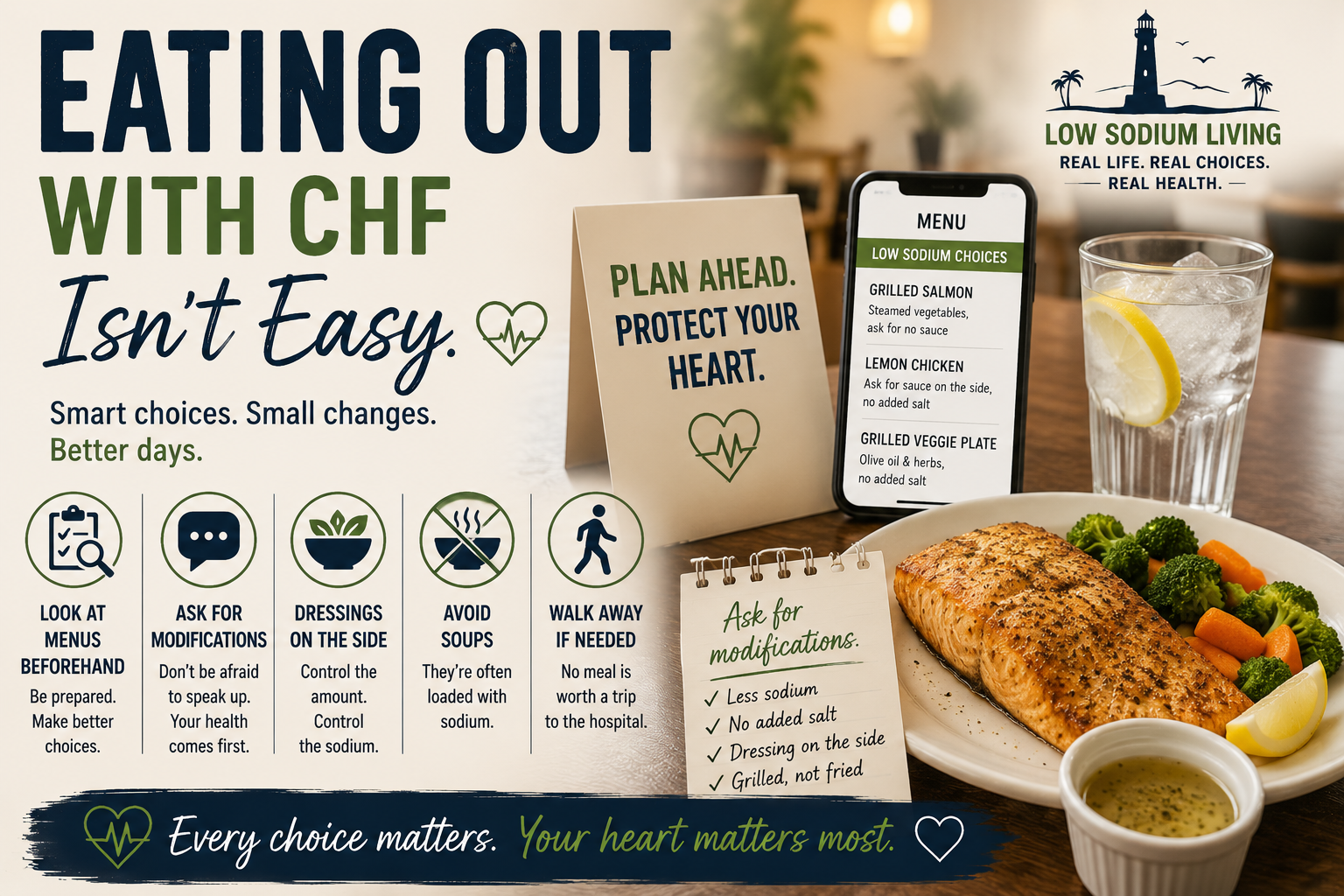
    One of the best habits I’ve developed is looking at the restaurant’s menu before I ever get in the car.

    Many restaurants now publish their menus online, and some even provide nutrition information. That gives me the opportunity to look for grilled foods, fresh vegetables, simple salads, or meals that can be modified before I ever sit down.

    Walking into a restaurant with a plan removes a lot of the stress.

    Sometimes I already know exactly what I’m going to order before I walk through the front door.

    Don’t Be Afraid to Ask Questions

    I’ve learned that it’s okay to ask.

    Can the chicken be grilled without seasoning?

    Can the vegetables be prepared without added salt?

    Can the sauce be served on the side?

    Most servers genuinely want to help if they understand why you’re asking.

    You’re not being difficult.

    You’re simply trying to take care of your health.

    Dressing on the Side

    Salads seem like the obvious healthy choice.

    Unfortunately, many bottled dressings contain surprising amounts of sodium.

    I’ll often order my dressing on the side so I can control how much I use.

    I’ll admit something else.

    There have even been times when I’ve quietly brought my own homemade low-sodium dressing with me.

    Some restaurants don’t allow outside food because they can’t guarantee its safety or accept responsibility if someone becomes ill. I completely understand and respect their position.

    When I can’t bring my own dressing, I’ll often ask for olive oil and lemon wedges instead.

    It’s a simple solution that still lets me enjoy the salad.

    Soup Is Usually Off My List

    This one still bothers me.

    I love soup.

    Unfortunately, soup is one of the biggest hidden sources of sodium in many restaurants.

    Even a small bowl can contain more sodium than I’d like to eat in an entire day.

    As much as I enjoy it, soup has become something I almost always skip.

    It’s Not Just the Sodium

    One thing people often don’t realize is that my challenge isn’t only sodium.

    It’s fluids too.

    Because of my heart failure, I’m limited to about 1.5 liters of fluid each day.

    That means every drink counts.

    Water.

    Coffee.

    Tea.

    Soft drinks.

    Even healthy beverages.

    They’re all part of the same daily limit.

    Then there’s alcohol.

    For many people, meeting friends for a drink is just another way to socialize.

    For me, alcohol is no longer part of the equation.

    When friends gather around a table with drinks in hand, it reminds me that chronic illness changes more than what you eat.

    Sometimes it changes how you participate in life’s social moments.

    I’ll be honest…

    That’s something I still haven’t learned how to manage very well.

    Sometimes the Best Decision Is to Walk Away

    This has probably been the hardest lesson.

    There have been times when I looked over a menu and realized there simply wasn’t a good option.

    Instead of convincing myself that “one meal won’t matter,” I’ve learned it’s okay to leave and find another restaurant.

    Years ago, I probably wouldn’t have done that.

    Today, I remind myself that protecting my health is more important than protecting my pride.

    I’m Still Learning

    If I’m being completely honest…

    I haven’t figured this out yet.

    Eating out with CHF remains one of the biggest challenges in my life.

    I still miss the freedom of ordering whatever sounds good.

    I miss seafood dinners without worrying about sodium.

    I miss a bowl of clam chowder on a cool afternoon.

    I miss walking into a restaurant without studying the menu before I leave home.

    But I’m learning that living with chronic illness isn’t about finding perfect solutions.

    It’s about making the best decisions you can with the information you have.

    Most days that means eating at home.

    Some days it means asking a dozen questions before ordering.

    And sometimes…

    It means deciding that spending time with the people you love is worth the extra effort it takes to find a meal you can enjoy safely.

    I still believe there has to be a compromise.

    A way to protect my health without completely giving up one of the most important ways people connect with each other.

    I haven’t found that balance yet.

    But I’m still looking.

    Screen capture this and carry it with you when you go out

    🍽️ My Restaurant Checklist

    ✔️ Read the menu online first.

    ✔️ Look for grilled or baked options.

    ✔️ Ask for sauces and dressings on the side.

    ✔️ Skip soups and heavily seasoned foods.

    ✔️ Watch both sodium and fluids.

    ✔️ Don’t be afraid to ask questions.

    ✔️ If there isn’t a good option, choose another restaurant.

  • The Hidden Sodium Trap

    The Hidden Sodium Trap

    10 Foods That Shocked Me the Most

    When I was diagnosed with congestive heart failure (CHF), I thought I knew what my biggest challenge would be.

    The salt shaker.

    I figured if I stopped adding salt to my food, I’d be well on my way to a healthier lifestyle.

    I couldn’t have been more wrong.

    The real problem wasn’t the salt I was adding.

    It was the sodium that had already been added before I ever bought the food.

    That realization completely changed the way I shop, cook, and eat.

    Today, I spend more time reading nutrition labels than I ever imagined possible. At first it felt overwhelming. Every trip to the grocery store became an investigation. I’d pick up one product after another, flip it over, and immediately look for one thing:

    How much sodium is in this?

    What I discovered surprised me.

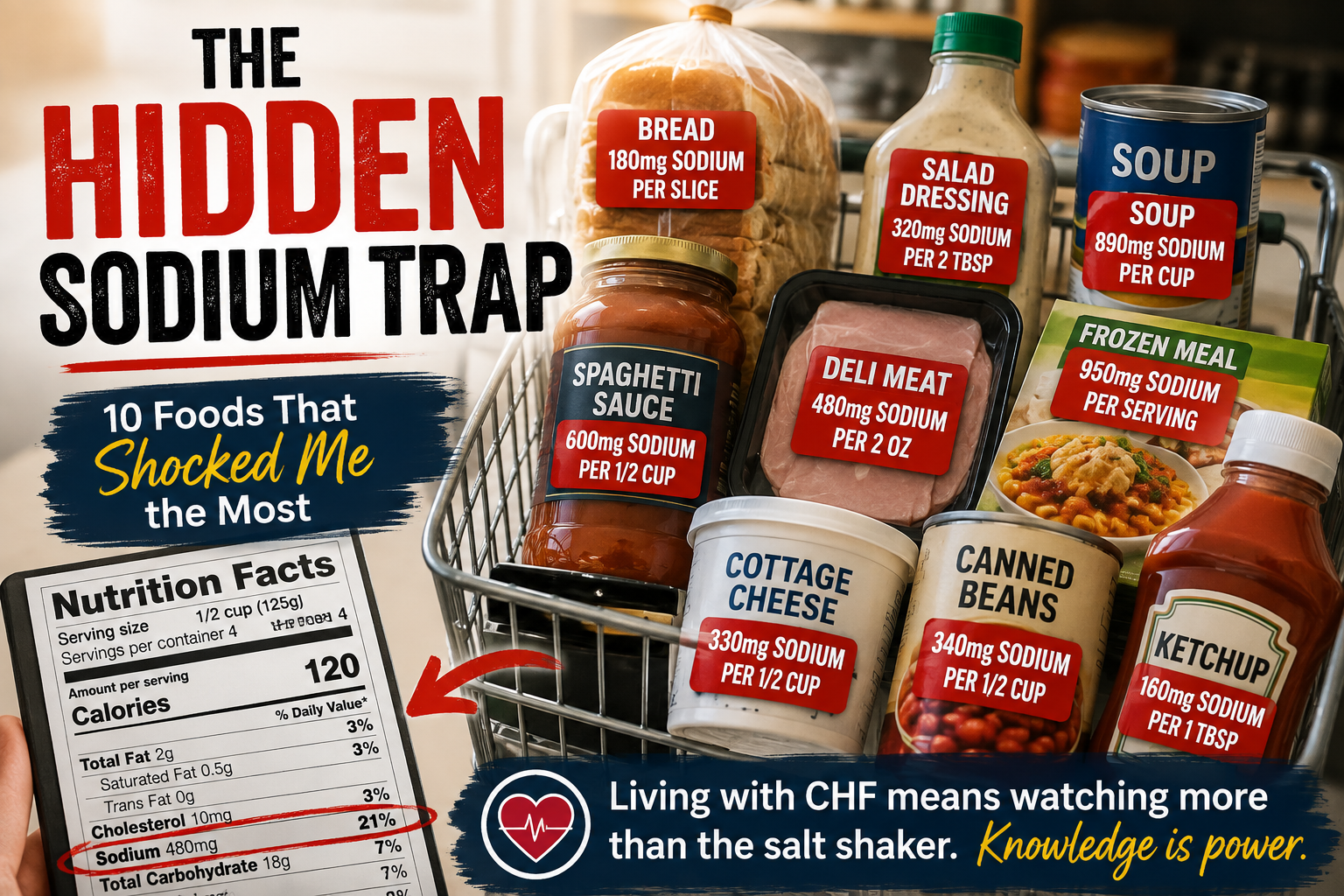
    Some of the biggest sources of sodium weren’t the foods I expected. They were foods that most of us buy every week without giving them a second thought.

    Here are ten foods that completely changed the way I grocery shop.


    1. Bread

    Many sandwich breads contain well over 150–200 mg of sodium per slice. That means a simple sandwich can provide several hundred milligrams of sodium before you even add the meat, cheese, or condiments.

    Bread was probably my biggest surprise. I never imagined something that didn’t even taste salty could contain so much sodium. After comparing label after label, I finally decided to buy a bread machine. Instead of giving up bread altogether, I learned to make my own. Now I know exactly what goes into every loaf, I can control the sodium, and I get to enjoy fresh bread again.

    If you don’t make your own, make sure you read labels and look for lower-sodium options whenever possible.


    2. Salad Dressing

    Salads are supposed to be healthy.

    Unfortunately, many bottled dressings aren’t.

    A couple of tablespoons can contain more sodium than the salad itself.

    These days I often make my own dressings at home. Not only are they lower in sodium, but I actually enjoy the flavor more because I can control the ingredients.


    3. Jarred Spaghetti Sauce

    This one hurt.

    Spaghetti has always been one of my favorite comfort foods.

    Some jarred sauces contain several hundred milligrams of sodium in just a half-cup serving.

    Instead of giving up spaghetti, I learned to make my own sauce using no-salt-added tomatoes and fresh herbs.

    Check out my article here on LOSO Spaghetti Sauce

    Problem solved.


    4. Canned Soup

    This one probably won’t surprise many people.

    Some soups contain nearly an entire day’s worth of sodium in one bowl.

    If I buy soup today, it’s almost always a low-sodium or no-salt-added version—or better yet, homemade.


    5. Deli Meats

    Ham.

    Turkey.

    Roast beef.

    Chicken.

    I thought I was making healthy sandwich choices.

    Then I learned these meats are often preserved with large amounts of sodium.

    Today I prefer freshly cooked chicken or turkey whenever possible.


    6. Cottage Cheese

    This one really caught me off guard.

    Cottage cheese seems like the perfect healthy snack.

    Unfortunately, many brands are surprisingly high in sodium.

    Fortunately, more companies are beginning to offer lower-sodium versions if you’re willing to look for them.

    The one I found that is low in sodium is by Friendship at Publix


    7. Frozen Meals

    Convenience often comes with a price.

    Many frozen dinners are loaded with sodium because it’s used for preservation and flavor.

    That’s one of the reasons I cook extra portions whenever I can.

    My freezer has become my own “frozen food aisle”—except I know exactly what’s in every meal.


    8. Canned Vegetables

    This one is easy to fix.

    Instead of regular canned vegetables, I buy no-salt-added versions whenever they’re available.

    Sometimes frozen vegetables are an even better choice.


    9. Condiments

    Ketchup.

    Mustard.

    Barbecue sauce.

    Soy sauce.

    Teriyaki sauce.

    You don’t use much at one time, but the sodium adds up quickly.

    I’ve learned that sometimes a squeeze of lemon juice, fresh herbs, or homemade sauces add just as much flavor without the extra sodium.

    Or check out the link to our homemade stir-fry sauce


    10. Restaurant Meals

    This has probably been the hardest adjustment for me.

    Restaurants aren’t trying to make unhealthy food.

    They’re trying to make food that tastes great.

    Unfortunately, that often means using generous amounts of salt.

    Before I go out to eat, I almost always look at the menu online. If nutrition information is available, I read it before I ever walk through the door.

    Planning ahead helps me make better choices.


    What I Learned

    Looking back, I realized something important.

    The biggest source of sodium in my diet wasn’t the salt shaker sitting on my kitchen table.

    It was the food I was buying at the grocery store without ever reading the labels.

    Once I understood that, everything changed.

    Today I still enjoy sandwiches.

    I still eat spaghetti.

    I still have salads.

    I simply prepare them differently.

    Living with CHF hasn’t meant giving up the foods I love.

    It has meant learning how to make better choices.

    And honestly…

    I’m healthier because of it.


    ❤️ Greg’s Tip

    Don’t start by changing your entire pantry.

    Instead, the next time you’re grocery shopping, pick one product you buy regularly and compare three different brands.

    You might be amazed at how much the sodium content varies.

    Small changes, repeated over time, become healthier habits.

    Keep an eye out for a new article where I will compare 3 of the same products and pick the best option


    My Challenge to You

    The next time you’re in the grocery store, don’t look at the front of the package first.

    Turn it over.

    Read the Nutrition Facts label.

    Take a close look at the sodium.

    It may completely change what goes into your shopping cart.

  • Low Sodium Spaghetti Sauce

    Low Sodium Spaghetti Sauce

    ⭐ Greg’s Kitchen Rating

    Taste: ⭐⭐⭐⭐⭐
    Difficulty: ⭐⭐☆☆☆
    Would I Make Again? Absolutely.
    Family Approved: Yes
    Freezer Friendly: Yes

    You Don’t Have to Give Up Spaghetti Night

    If you had told me a few years ago that one day I’d be paying more attention to the sodium in spaghetti sauce than the flavor, I probably would have laughed.

    Then congestive heart failure changed everything.

    Like so many people living with CHF, one of the first things I learned was how much sodium is hiding in everyday foods. One of the biggest surprises for me was spaghetti sauce. I picked up a few jars at the grocery store and started reading the nutrition labels.

    I couldn’t believe the numbers.

    Some sauces contained hundreds of milligrams of sodium in just a half-cup serving. By the time you added pasta, meat, garlic bread, and maybe a salad, one dinner could account for a huge portion of the sodium I was trying to avoid.

    That wasn’t going to work for me.

    But I also wasn’t ready to give up spaghetti.

    One of the things I’ve learned on this journey is that living with chronic illness doesn’t mean giving up the foods you love. It often means finding a better way to make them.

    After searching online, I came across an excellent Low Sodium Spaghetti Sauce recipe from Kelly Jensen at Low So Recipes. What caught my attention was how simple it was. Instead of depending on salt for flavor, it relies on ingredients like no-salt-added tomatoes, garlic, basil, olive oil, white wine, and Italian herbs to create a rich, satisfying sauce. 

    I’ve made this recipe several times, and it has earned a permanent place in my kitchen.

    The best part?

    It doesn’t taste like “low sodium food.”

    It tastes like homemade spaghetti sauce.

    That’s an important distinction.

    When people first hear “low sodium,” they often imagine bland food that’s missing something. I’ve found the opposite to be true. Cooking from scratch allows me to control exactly what’s going into my meals while letting fresh ingredients do the work.

    For me, that’s become one of the biggest lessons of living with heart failure.

    Cooking at home gives me control.

    I know exactly what’s in my sauce.

    I know exactly how much sodium I’m eating.

    And I don’t spend the next two days wondering if one meal is going to leave me retaining fluid or watching the scale climb.

    One thing I especially appreciate about this recipe is how versatile it is. You can enjoy it exactly as written, or customize it with lean ground turkey, lean ground beef, mushrooms, peppers, or spinach. It’s one of those recipes that becomes your own over time while still keeping sodium under control. 

    Another bonus is that it freezes beautifully.

    Whenever I make it, I prepare a double batch and freeze individual portions. On nights when I’m tired or not feeling my best, I already have homemade sauce waiting in the freezer.

    If you’re beginning a low sodium lifestyle, don’t feel like you have to change everything overnight.

    Start with one recipe.

    One dinner.

    One small victory.

    Those small victories have a way of adding up.

    Today, spaghetti night is back at our house.

    It’s just a little healthier than it used to be.

    And honestly…

    I don’t miss the jar.


    ❤️ Greg’s Tip

    Don’t just freeze the sauce—label each container with the date and the estimated sodium per serving. On days when you’re tired or having a flare-up, you’ll have a heart-healthy meal ready to go without having to think twice.


    Recipe Credit

    This is not my original recipe. Full credit goes to Kelly Jensen at Low So Recipes, whose recipe inspired this meal. I’ve shared it because it’s become one of my favorite low sodium staples and I think others living with heart failure or following a low sodium lifestyle will enjoy it as much as I have. You can find the complete recipe here:

    Low Sodium Spaghetti Sauce Recipe by Low So Recipes

  • You Are Your Best Advocate

    You Are Your Best Advocate

    You Are Your Best Advocate

    One thing I’ve learned through this journey is that no one is going to advocate for my health more than I will.

    Living with chronic illnesses means I don’t just have one doctor. I have a cardiologist, nephrologist, primary care physician, specialists, nurses, technicians, pharmacists, therapists, and the occasional emergency room physician. Every one of them is an important part of my healthcare team.

    But they’re exactly that—a team.

    Each of them sees only a piece of the puzzle.

    They may have access to my medical records, but they don’t live in my body. They don’t know how I felt when I walked across the grocery store yesterday. They don’t know that I woke up at 12:30 this morning and never got back to sleep. They don’t know the subtle changes I’ve noticed over the past week unless I tell them.

    That’s why I’ve learned to speak up.

    When I was first diagnosed with congestive heart failure (CHF), atrial fibrillation (AFib), chronic kidney disease (CKD), diabetes, and arthritis, the medical terminology felt like learning a foreign language. I assumed the doctors would simply tell me what to do and everything would work out.

    It doesn’t work that way.

    Healthcare is often a partnership, and partnerships only work when both sides participate.

    I’ve spent countless hours learning about my conditions. I read. I ask questions. I research. Before appointments, I often use ChatGPT to help me understand medical terms, learn about upcoming tests, organize my thoughts, and build a list of questions I want to ask. It doesn’t replace my doctors or medical advice, but it helps me have more informed conversations with them.

    I’ve found that understanding why something is being recommended is just as important as knowing what is being recommended.

    One experience really drove this lesson home.

    During a recent trip to the emergency room, the staff was preparing to start intravenous fluids. That’s a routine treatment for many patients, but because I have congestive heart failure and carefully monitor my fluid intake, I stopped them and explained my situation.

    They listened.

    They reviewed my history.

    The plan changed.

    No one was upset. In fact, it became a reminder that even excellent healthcare professionals are caring for many patients, each with unique medical histories. They simply can’t know every detail unless we tell them.

    That’s why our voice matters.

    Advocating for yourself doesn’t mean arguing with your doctor or pretending you know more than they do. It doesn’t mean refusing treatment because you read something on the internet.

    It means asking questions.

    It means saying, “Can you help me understand why we’re doing this?”

    It means telling them when something doesn’t feel right.

    It means making sure they know about every condition, every medication, every symptom, and every concern.

    I’ve also learned there is a fine line to walk.

    Some medical professionals welcome questions. Others may seem rushed or uncomfortable when patients ask too many. I’ve experienced both. My goal has never been to challenge someone’s expertise or prove them wrong. My goal is much simpler than that.

    I want to understand the decisions being made about my body.

    Because at the end of the day, I live with the consequences—not my doctor.

    If you are living with one chronic illness—or several—don’t be afraid to become a student of your own health. Learn the terminology. Keep good records. Ask respectful questions. Speak up when something doesn’t seem right.

    One habit that has helped me tremendously is keeping notes on my iPhone. Whenever I think of a question, notice a new symptom, experience a side effect, or want to remember something for my next appointment, I open the Notes app and write it down.

    I’ve learned that I never trust my memory anymore. If I don’t write it down, there’s a good chance I’ll forget it when I’m sitting in the exam room. That’s not because I’m getting older—it’s because living with multiple chronic illnesses means there are simply too many things to keep straight in my head.

    By the time I see my doctor, I have an organized list instead of trying to remember everything from memory.

    The same notes are invaluable when a doctor’s office calls unexpectedly. Instead of scrambling to remember what I wanted to ask, I already have my questions, symptoms, medications, and concerns right in front of me. It helps me stay focused and makes sure I don’t forget something important once the conversation starts.

    I’ve found that walking into an appointment prepared not only helps me, but it helps my doctors too. Our conversations become more productive because we’re discussing facts instead of trying to remember details from weeks ago.

    Bring someone with you if it helps, especially if you’re facing an important diagnosis or a difficult decision. Another set of ears can catch details you might miss and help you remember what was discussed after the appointment is over.

    Being your own advocate isn’t about distrusting doctors or challenging every recommendation. It’s about partnership. The best care happens when knowledgeable medical professionals and informed patients work together toward the same goal.

    Your doctors bring years of education and experience.

    You bring the one thing no one else can.

    You live this life every single day.

    That makes your voice one of the most important ones in the room.

    If there’s one thing I hope you take away from my story, it’s this:

    No one will ever care more about your health than you do.

    So ask the question.

    Take the note.

    Speak up.

    Because your voice matters.

  • But You Don’t Look Sick

    But You Don’t Look Sick

    ”But you don’t look sick”

    I understand why people say it. From the outside, I may appear okay. I can still drive, carry on a conversation, laugh, and have days when I seem like my old self. What people cannot see is how much effort those ordinary things can require—or how physically and emotionally exhausted I may be underneath the surface.

    I live with persistent atrial fibrillation, heart failure, and left bundle branch block. I also have severe arthritis in my hips. Together, these conditions have changed what my body can do and how much energy I have available each day.

    Walking even a short distance can wear me out. The pain in my hips is part of it, but my heart also does not tolerate exertion the way it once did. A rollator or walker can provide support, but using one still requires energy and stamina. Some days, I simply do not have enough of either.

    There are good days, and I try to celebrate them. Lately, though, the difficult days have outnumbered the good ones. That can be hard for other people to understand because chronic illness does not always change the way someone looks.

    People Remember Who You Used to Be

    Friends and family remember the person I was before all of this—the person who could go almost anywhere, work on things around the house, walk through a store, and handle everyday problems without having to calculate the physical cost first.

    I remember that person too. I miss him.

    I want to be able to walk through a grocery store without wondering whether I will make it back to the car. I want to go to Home Depot, find a part, come home, and fix a toilet without turning it into a major undertaking. Those used to be ordinary errands. Now the walking, standing, hip pain, and fatigue can make them impossible.

    My appearance may not have changed dramatically, but the way my body operates has.

    That difference can be difficult for friends, family members, and even strangers to recognize. They see what I look like today and compare it with what they remember me being able to do. They cannot feel my heart working, the weakness in my body, the pain in my hips, or the exhaustion that can arrive without warning.

    No one else can fully know what living inside my body feels like.

    Learning Different Ways to Live

    I have had to find ways around some of these limitations. I order many household items from Amazon. We order groceries through Walmart, and I use curbside pickup so I do not have to walk through the entire store.

    I can still drive, which gives me some independence. The real difficulty usually begins when I have to get out of the car and walk, stand, lift something, or remain active for very long.

    These changes may look like conveniences from the outside, but for me they are adaptations. They allow me to keep participating in life while respecting what my body can currently handle.

    Adapting does not mean I am lazy, and it does not mean I have given up. It means I am learning how to live within limits I never expected to have.

    The Recovery I Expected

    When I learned that I needed my aortic valve replaced, I believed the process would be straightforward: have the procedure, take some time to recover, and eventually return to being myself.

    That is not how things unfolded.

    The valve replacement addressed an important problem, but it did not erase every other condition or return my body to the way it once was. Life still had more challenges waiting for me. I continue to live with heart failure, atrial fibrillation, LBBB, arthritis, fatigue, and uncertainty.

    That realization has been difficult. Recovery is not always a straight line, and a successful procedure does not necessarily mean everything goes back to normal.

    What Comes Next?

    That is a question I ask myself often.

    I do not know exactly what life has in store for me. I know my artificial valve requires lifelong monitoring, and I know my health may continue to change. Some days I wonder whether this is the best I am going to feel. Other days I still hope there are adjustments that could help.

    I am working with my doctors to see whether different medications, treatments, or other changes might improve my symptoms and quality of life. There are no guarantees, but I am not finished looking for answers.

    For now, I take things one day at a time. I adjust. I rest when I need to. I appreciate the good days when they arrive, and I try not to let the difficult ones convince me that there will never be another good one.

    I am not sharing this because I want pity. I am sharing it because appearances rarely tell the entire story.

    Someone can look fine and still be fighting exhaustion, pain, fear, grief, and a body that no longer works the way it once did. If someone tells you they are struggling, believe them—even if they do not look sick.

  • My Morning Health Check: The Numbers I Track Every Day

    My Morning Health Check: The Numbers I Track Every Day

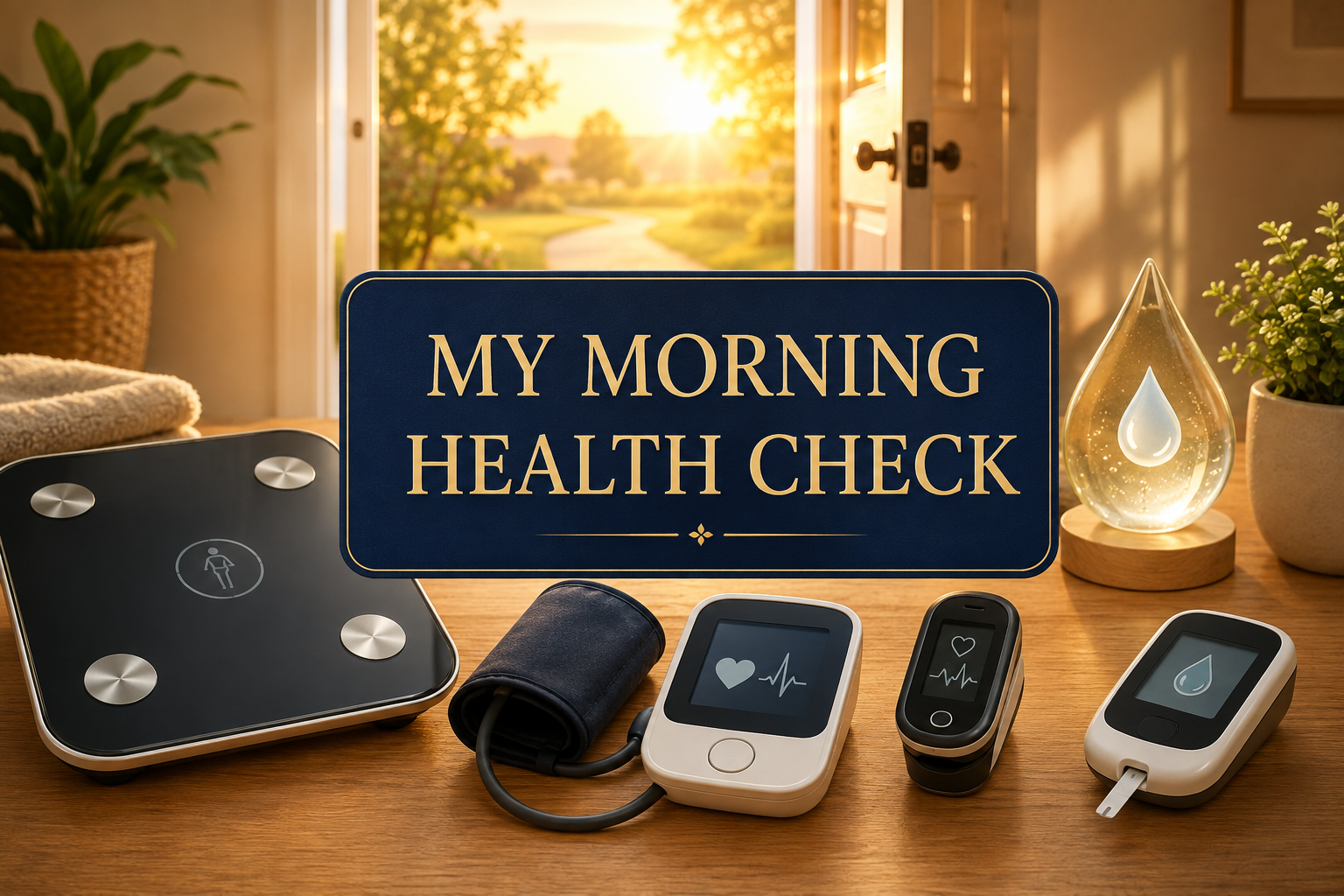
    Living with heart failure and kidney disease means that every morning begins with a small collection of measurements. The process can be tedious, but it has become an important part of understanding what my body is doing and recognizing changes before they become larger problems.

    This is the routine developed for me with guidance from my medical team. It is not medical advice or a monitoring plan for everyone. Your doctors should determine which measurements and warning signs matter for you.

    Starting with a Consistent Weigh-In

    My routine begins after I use the bathroom and before I eat or drink anything. I try to wear approximately the same amount of clothing each time and always use the same scale in the same location.

    These details may sound overly particular, but consistency makes it easier to tell whether a change on the scale is likely real or simply caused by different clothing, food, fluids, or the time of day.

    The American Heart Association recommends weighing yourself each morning after urinating, before breakfast, without shoes, and while wearing the same type of clothing.

    I record my weight and compare it with both the previous day and the preceding week. The general warning levels I watch for are:

    • A gain of approximately 2–3 pounds in one day
    • A gain of 5 pounds or more in one week
    • Any different threshold my medical team has instructed me to follow

    A sudden increase does not automatically prove that I am retaining fluid, but it is a reason to look more closely at my other numbers and symptoms. The American Heart Association explains that rapid weight gain can be an early sign of fluid retention in people with heart failure.

    Tracking Body-Water Percentage

    My scale also estimates my body-water percentage. I convert that percentage into pounds using this formula:

    Body weight × body-water percentage = estimated pounds of body water

    For example, if someone weighs 200 pounds and the scale reports 50% body water:

    200 × 0.50 = 100 pounds of estimated body water

    I do not treat this number as a precise measurement or as proof that I am retaining fluid. Consumer body-composition scales can be affected by hydration, food, skin contact, time of day, and other factors. I use it as another trend to compare with my previous readings.

    If my weight and estimated body water rise together—especially if I also notice swelling, shortness of breath, or other changes—that gives me more information to discuss with my medical team.

    An Important Scale-Safety Warning

    Body-composition scales use bioelectrical impedance analysis, or BIA. They send a very small electrical signal through the body to estimate measurements such as body fat, muscle mass, and body water.

    People with pacemakers or certain other implanted electronic medical devices should not use impedance-based features unless the device manufacturer and their medical team have confirmed that it is safe. Some compatible scales provide a weight-only or pacemaker-safety mode that disables these features.

    I have a loop recorder and an artificial heart valve rather than a pacemaker. Even so, I checked with my cardiologist before using this type of scale. Anyone with an implanted medical device should check the instructions for the exact scale and speak with a qualified medical professional before using its body-composition functions. Withings explains how BIA and its weight-only safety mode work here.

    Blood Pressure and Heart Rate

    Next, I record my blood pressure and heart rate.

    For me, a higher-than-usual blood pressure reading can be one clue that my heart is working harder or that something has changed. A lower-than-usual reading—especially when accompanied by dizziness, weakness, or lightheadedness—can raise questions about dehydration, medication effects, or whether too much fluid has been removed.

    A single reading does not tell the complete story. I look at the measurement alongside my weight, symptoms, medication use, and recent trends. I do not change my diuretics or other medications based only on my spreadsheet unless my medical team has given me specific instructions to do so.

    Glucose

    I also record my glucose. Tracking it alongside my other measurements gives me a more complete daily picture and helps me notice patterns that might otherwise be missed.

    Blood glucose can be affected by food, medication, illness, stress, activity, and sleep, so the context surrounding the number matters. As with my other readings, I follow the targets and reporting instructions given to me by my health care team.

    Recording Everything in One Place

    I currently track all these measurements in an Excel workbook:

    • Weight
    • Daily and weekly weight changes
    • Body-water percentage
    • Estimated pounds of body water
    • Blood pressure
    • Heart rate
    • Glucose
    • Symptoms and other notes

    Google Sheets would work well for the same purpose. The most important part is keeping the information organized and easy to review over time.

    My cardiologist and nephrologist review these records regularly. Having the information collected in one place makes it easier for them to see patterns and understand what has been happening between appointments.

    What I Want to Build Next

    My next goal is to create a dashboard within the spreadsheet. I would like it to use green, yellow, and red indicators:

    • Green: Measurements are within my usual range
    • Yellow: I am approaching a threshold and should pay closer attention
    • Red: A measurement has reached a limit established by my medical team and may require action

    The thresholds will need to be personalized. A number that is normal for one person may not be normal for someone else, particularly when heart disease, kidney disease, diabetes, and medications are involved.

    Eventually, I would like to turn this system into an app that makes daily tracking easier. When I finish the spreadsheet dashboard—and if I develop the app—I will share what I learn.

    Tedious, but Worth Doing

    I will be honest: completing this routine every morning can feel repetitive. There are days when I would rather step off the scale, forget the numbers, and get on with my morning.

    However, these measurements give me a clearer picture of my health. One isolated number may not mean very much, but changes across several days can reveal a trend worth paying attention to.

    This is what I personally do to monitor my health each day. It does not replace professional medical care, and I follow the thresholds and instructions established by my cardiologist and nephrologist. Anyone who wants to begin a similar routine should first ask their medical team what to measure, how often to measure it, and which changes should prompt a phone call or urgent care.