Category: Articles

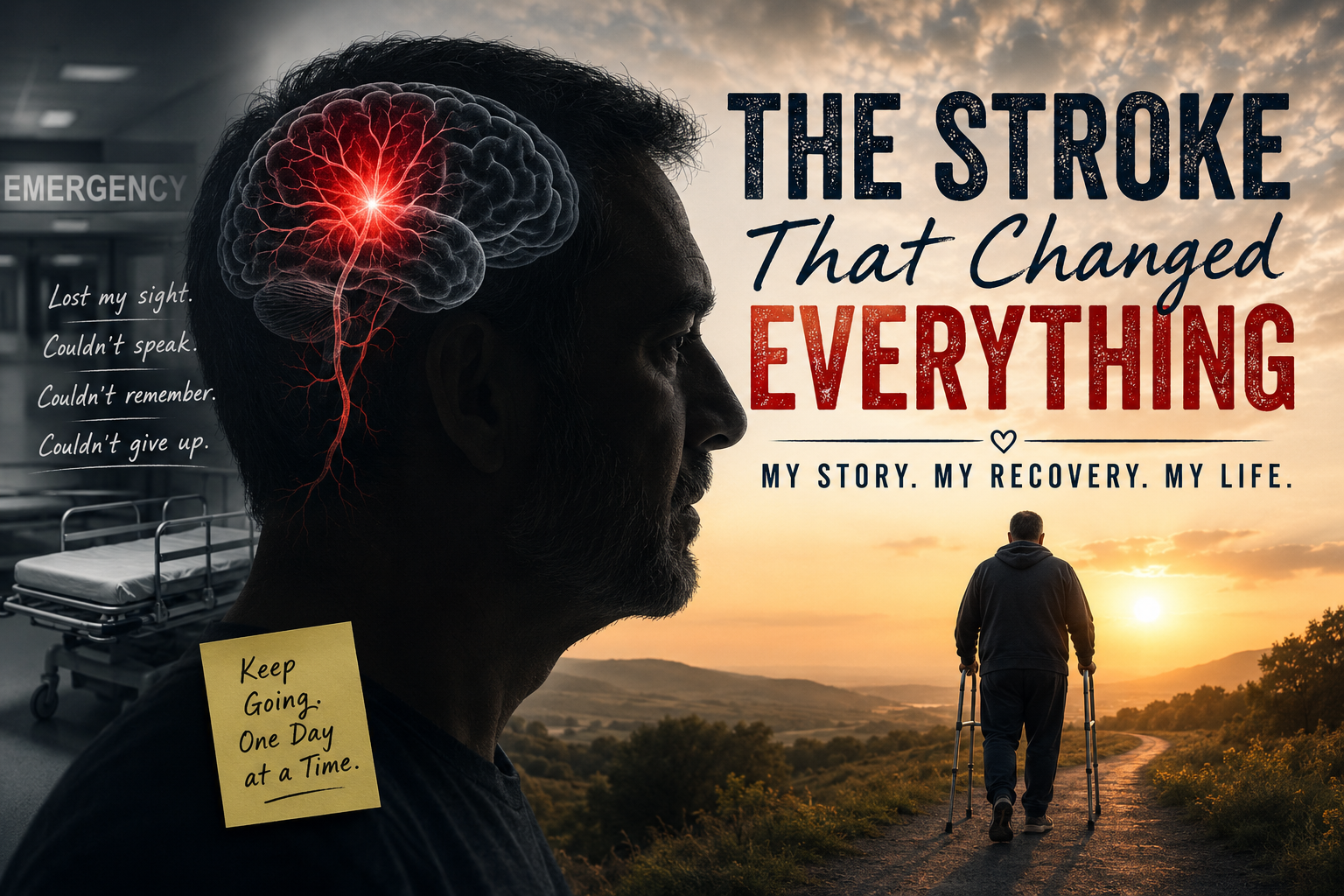
  • The Stroke That Changed Everything

    The Stroke That Changed Everything

    My stroke happened in November 2020.

    It was during COVID, and I was still going into the office. Almost nobody else was there.

    One day I went to use the bathroom and, all of a sudden, I lost my eyesight.

    Completely.

    It came back moments later.

    And somehow my reaction was basically:

    Well, wasn’t that weird?

    Looking back now, that should have been a giant flashing warning sign.

    At the time, I shrugged it off.

    Nothing else really happened for the rest of the workday, so I drove home.

    That drive was about an hour and a half.

    Yes, I drove an hour and a half after temporarily losing my vision.

    I know.

    Not exactly one of my smarter decisions.

    Then Things Got Worse

    I got home, had dinner, and made myself a drink.

    My wife and I decided to watch a movie.

    At some point during the movie, I dropped my drink.

    I tried to pick the ice cubes up and put them back into the glass.

    I couldn’t.

    I kept missing.

    Then I tried to talk.

    What I was trying to say in my head was not what was coming out of my mouth.

    It was gibberish.

    It sounded like another language.

    My brilliant plan at that point was to go to bed.

    Thankfully, my wife had a better plan.

    She stopped me because she knew something was seriously wrong.

    She wanted to call 911.

    Somehow I managed to get the word “no” out.

    So she drove me to the hospital.

    We lived about a mile away.

    Looking back, yes, that was dumb too.

    If you think you are having a stroke, call 911.

    The Emergency Room

    My wife dropped me at the emergency room entrance and went to park the car.

    I could still walk.

    I went inside and tried to tell the person at the desk that I thought I was having a stroke.

    Unfortunately, I couldn’t talk properly, and I had alcohol on my breath from the drink I had made at home.

    So at first, they thought I was drunk.

    My wife came in a few minutes later and explained what had actually happened.

    Things moved pretty quickly after that.

    They still tested my blood alcohol level.

    Yes, I had been drinking.

    No, I was nowhere near legally intoxicated.

    They started doing neurological checks.

    Follow this with your eyes.

    Smile.

    Move this.

    Lift that.

    Then my face started drooping.

    I remember a nurse telling me to squeeze his fingers as hard as I could.

    In my head, I was yelling:

    I AM! I AM!

    But apparently my body wasn’t cooperating.

    Now several people were looking at me.

    My wife too.

    They were all trying to determine whether one side of my face was drooping.

    It was.

    I was having a stroke.

    When It Finally Hit Me

    I don’t remember the exact order of everything after that.

    There were scans.

    There were medications.

    I was given a clot-busting treatment, although I honestly don’t remember exactly which medication they used.

    I remember being told afterward that because of the bleeding risk, I was not going to be allowed to get out of bed for a while.

    That was the moment when it really sank in.

    WTF. This is serious.

    And I couldn’t communicate.

    That may have been the scariest part.

    I knew what I wanted to say.

    I knew what I wanted to ask.

    I just couldn’t get the words out.

    Luckily, the hospital staff that day was excellent.

    Between my wife recognizing something was wrong and the medical team acting quickly, I have no doubt they changed the outcome for me.

    They may have saved my life.

    Then Came All the Tests

    I had several scans of my head.

    There is nothing quite like spending a long time inside a scanner when you can’t communicate properly.

    Thankfully, I’m not claustrophobic.

    Then my kidneys decided to join the party.

    My kidney function dropped significantly while I was hospitalized.

    That was my first experience with a nephrologist.

    There were more tests.

    Eventually, my kidney function improved to around 50 percent.

    Looking back at everything I know now, I sometimes wonder if that was around the time my right kidney stopped functioning normally.

    I didn’t follow up with nephrology as well as I probably should have.

    My primary care doctor took the lead for a while.

    I had enough other problems being discovered.

    They found atrial fibrillation.

    They found sleep apnea.

    And then they tried putting me on the hospital CPAP machine.

    This thing looked like it was approximately the size of a Volkswagen.

    My CPAP today is about the size of a shoebox.

    Whatever prehistoric machine they brought into that hospital room was not happening.

    I already had so much going on that I basically said:

    We’ll deal with that later.

    I Was Also Over 400 Pounds

    Have I mentioned that I was fat?

    When all of this happened, I was tipping the scales at somewhere around 410 pounds.

    My diabetes was poorly controlled.

    My blood pressure was high.

    My cholesterol was terrible.

    My triglycerides were so high that at one point they couldn’t even calculate them normally.

    So now you have a 400-pound guy lying flat in a hospital bed while they are pumping fluids into him.

    Which means one thing.

    I had to pee.

    A lot.

    Because I had received clot-busting treatment, they weren’t letting me just get out of bed whenever I wanted.

    Try being over 400 pounds, lying nearly flat, and attempting to pee into one of those little hospital urinals.

    It wasn’t happening.

    During the day, my wife helped me.

    At night, I had to call the nurses.

    I cannot explain how humiliating that felt at the time.

    I apologized constantly.

    I was embarrassed about my weight.

    Embarrassed that I needed help.

    Embarrassed that someone had to help me do something as basic as urinating.

    Eventually, after a few days, I was allowed to get up and use the bathroom myself.

    At that point, that felt like a major victory.

    What the Stroke Did to My Brain

    The physical problems were only part of it.

    The stroke affected my ability to communicate and process information.

    At one point, I got my phone back.

    I remember wanting to dial a number.

    The problem was that I didn’t know what the number 7 was.

    I knew how to count.

    So I would start at one.

    One.

    Two.

    Three.

    Four.

    Five.

    Six.

    Seven.

    Then I would press what I thought was the seven.

    I did that for every digit.

    Eventually, I pressed send.

    Of course, the number was wrong.

    I also couldn’t remember what I had eaten for breakfast.

    It was French toast.

    I probably asked my wife a hundred times:

    What did I have for breakfast again?

    French toast.

    A few minutes later:

    What did I have for breakfast?

    French toast.

    I couldn’t remember my kids’ names.

    They managed to sneak in to see me during COVID restrictions.

    I smiled when I saw them.

    They were scared.

    They were younger then.

    And I was only 53 years old.

    Teaching Myself to Talk Again

    Once I got my phone back, I stayed awake practicing.

    For two days I worked on trying to teach myself how to speak again.

    By about the third day, I could start getting some words out.

    Not great words.

    Not necessarily the right words.

    But words.

    I still couldn’t dial a phone properly.

    But I was learning to communicate.

    Eventually I was moved out of the ICU and into a regular room.

    That felt like progress.

    Then came the next battle.

    They Wanted to Send Me to Rehabilitation

    A few days later, the hospital started talking about sending me to a rehabilitation facility.

    I wanted to go home.

    They didn’t think that was a particularly good idea.

    They asked how many stairs I had in my house.

    Like an idiot, I told them the truth.

    Thirteen.

    So they said I had to prove I could safely go up and down 13 stairs before they would let me go home.

    Great.

    I had barely walked farther than the bathroom in five or six days.

    Now I was going to climb stairs.

    At 400 pounds.

    After a stroke.

    A therapist strapped herself to me before we started.

    I remember looking at her and thinking:

    Lady, if I go down, you are coming with me.

    There was absolutely no way she was catching 400 pounds.

    I asked if we could go down first because we were already on an upper floor.

    She agreed.

    Truthfully, I don’t think anyone expected me to complete the test.

    If I couldn’t do the stairs, the decision was easy.

    Off to rehab.

    It probably took me 15 or 20 minutes just to get down.

    Then came the hard part.

    Going back up.

    I was exhausted.

    I was sweating.

    My heart rate was apparently going through the roof because people started looking for me after seeing what was happening on my heart monitor.

    But I kept going.

    One stair at a time.

    And I made it.

    All thirteen.

    I wasn’t going to rehab.

    Going Home Was Only the Beginning

    A day or so later, I was discharged.

    Then the real work started.

    I practiced walking.

    I practiced talking.

    And suddenly I had what felt like a million doctor appointments.

    I needed a cardiologist.

    A neurologist.

    A nephrologist.

    Speech therapy.

    Physical therapy.

    Occupational therapy to make sure I could safely take care of myself.

    The cardiologist explained that I had atrial fibrillation.

    I started taking Eliquis.

    His opinion was that the stroke was most likely caused by previously undiagnosed AFib.

    Sleep apnea may also have contributed to the overall cardiovascular picture.

    Unfortunately, that cardiologist and I never really clicked.

    I felt like all he saw when he looked at me was an extremely overweight guy who was lucky to still be alive.

    I was given blood thinners and metoprolol.

    We met a couple of times and then scheduled another appointment about six months later.

    During those six months, I lost around 80 pounds.

    When I went back, his reaction was basically:

    Wow. I didn’t think you would actually do that.

    Thanks for the confidence.

    By then, though, some of the treatment options for getting me back into a normal rhythm were apparently less straightforward.

    To this day, I remain in atrial fibrillation essentially all the time.

    Therapy Was Brutal

    The hardest part for me was therapy.

    Not because the exercises looked difficult.

    Quite the opposite.

    Some of them looked ridiculously simple.

    That made it even more frustrating.

    They would give me questions like:

    You walk into a building.

    Go up three floors.

    Down one floor.

    Then up three more.

    What floor are you on?

    That sounds easy.

    Before the stroke, I wouldn’t have given it a second thought.

    After the stroke, exercises like that could completely exhaust me.

    The therapy sessions where I had to really use my brain were the worst.

    I would finish completely wiped out.

    I also had to relearn how to participate in conversations.

    Talking with one person was difficult enough.

    Talking with two or three people at the same time?

    That was an entirely different skill.

    I had to learn how to follow who was talking.

    Process what they said.

    Remember what had already been said.

    Formulate my response.

    And then actually get the words out.

    It took me well over a year before I felt remotely comfortable having normal conversations again.

    Going Back to Work Showed Me How Much Had Changed

    Eventually, I tried going back to work.

    COVID was still going on, and in a strange way that probably helped me.

    For the first four to six months, I was able to work from home.

    That gave me some protection from the things I was still struggling with.

    But I still had meetings.

    And meetings became a whole different experience after the stroke.

    My memory was so bad that I sometimes couldn’t remember the names of the people I was talking to.

    These were people I worked with.

    People I knew.

    Yet during a meeting, their names could simply disappear from my brain.

    So I came up with a workaround.

    I put Post-it notes around my computer screen with people’s names on them.

    If I was in a meeting with someone, I could glance at the screen and remind myself who I was talking to.

    Before the stroke, that would have sounded ridiculous to me.

    After the stroke, it was how I got through the day.

    And those days wiped me out mentally.

    I could sit at a computer all day and look like I hadn’t done anything physically demanding, but my brain felt like it had run a marathon.

    Trying to listen.

    Trying to remember.

    Trying to follow the conversation.

    Trying to respond correctly.

    Trying not to let anyone see how hard I was working just to do things that had once been automatic.

    I desperately wanted to get back to where I had been before the stroke.

    I wanted the old me back.

    I kept thinking that if I pushed hard enough, worked hard enough, and practiced enough, eventually everything would return to normal.

    It didn’t.

    And eventually I had to accept that it wasn’t going to.

    Aphasia Never Completely Left

    I still deal with aphasia today.

    My brain mixes up letters.

    B and D are big ones.

    Throw in some P’s and G’s just to make things interesting.

    My texting skills still suck.

    Autocorrect saves me constantly.

    Just imagine trying to write these articles.

    I use voice dictation a lot.

    My wife helps me more than I could ever explain.

    She has been a godsend through all of my health problems, but especially after the stroke.

    I pushed myself very hard during therapy.

    Every day I practiced.

    I wanted to get back to the person I had been before the stroke.

    Eventually, I had to understand something much harder.

    That person was gone.

    Not dead.

    Not destroyed.

    But changed.

    I could improve.

    I could adapt.

    I could relearn things.

    But there wasn’t going to be a magical morning where I woke up and everything was exactly like it had been before November 2020.

    Learning to Do Things Again

    After a couple of months of formal therapy, I was eventually released.

    I could talk.

    I could think reasonably well.

    And eventually, I was cleared to drive again.

    Driving was a big one for me.

    For a while, I couldn’t do much of anything independently.

    And I hated asking for help.

    Absolutely hated it.

    I wanted to do everything myself.

    I laugh at that now.

    I am very much over that.

    Today, I know there are things I simply cannot do without help.

    Accepting that has been its own form of rehabilitation.

    Trying to Work Again

    I couldn’t return to the type of position I had before the stroke.

    Eventually, I took an early retirement.

    Later I tried working at a school fixing Chromebooks.

    The old version of me wanted to do more.

    Looking back, I probably should have been satisfied that I was able to work at all.

    But while I was working there, another problem began showing itself.

    My hips started hurting badly.

    Years of carrying more than 400 pounds had taken a toll.

    Today, both hips are severely arthritic.

    Both are essentially bone-on-bone.

    The right is worse than the left.

    I now use a walker to get around.

    Around the same time, I noticed something else.

    Walking to a classroom would leave me sweating profusely.

    Not a little sweaty.

    Buckets.

    Then I started noticing chest pain.

    That eventually opened the door to everything that came next with my heart.

    If you’ve read other articles on this site, you already know where that road eventually led.

    More doctors.

    More diagnoses.

    Aortic stenosis.

    Heart failure.

    A valve replacement.

    Kidney problems.

    And plenty of things I never expected to be dealing with before I turned 60.

    The Stroke Was the Beginning of a Different Life

    When I look back now, November 2020 feels like the point where my old life ended and this one began.

    At the time, I thought surviving the stroke was the finish line.

    It wasn’t.

    It was the starting line.

    I had to relearn how to talk.

    How to think.

    How to communicate.

    How to trust my body.

    How to ask for help.

    And eventually, how to accept that recovery doesn’t always mean becoming exactly who you were before.

    I still have aphasia.

    My left foot still doesn’t work normally.

    I still become mentally exhausted when I push my brain too hard.

    I still type the wrong letters.

    I still occasionally know exactly what I want to say and can’t find the damn word.

    But I’m still here.

    I’m writing.

    I’m talking.

    I’m driving.

    I’m learning.

    And somehow, almost six years later, I can look back at the guy who couldn’t remember what he had for breakfast and realize just how far he came.

    French toast, by the way.

    I finally remembered.

    Medical Disclaimer

    This article describes my personal experience with an ischemic stroke, atrial fibrillation, rehabilitation, and other medical conditions. It is not medical advice and should not be used to diagnose or treat stroke symptoms or any other condition. Stroke is a medical emergency. Sudden trouble speaking, facial drooping, arm or leg weakness or numbness, vision loss, severe dizziness, loss of coordination, or other sudden neurological changes require immediate emergency evaluation. Do not drive yourself or have someone else drive you if a stroke is suspected; call emergency services so treatment can begin as quickly as possible. Individual treatment, recovery, and long-term outcomes vary, and medical decisions should be made with qualified healthcare professionals.
  • I Thought the Surgery Would Give Me My Life Back

    I Thought the Surgery Would Give Me My Life Back

    When I found out I needed my aortic valve replaced, I knew it was serious.

    But in my mind, there was also a pretty straightforward plan.

    My valve was bad. They were going to replace it. I would recover. And eventually, I would get my life back.

    Simple enough.

    Except chronic illness apparently didn’t get a copy of my plan.

    I Thought I Was Getting Fixed

    I had a TAVR to replace my severely narrowed aortic valve.

    Going into it, I knew recovery wasn’t going to happen overnight. I wasn’t expecting to leave the hospital and run a marathon.

    Hell, I wasn’t running one before the surgery.

    But I did expect that once my heart wasn’t trying to pump blood through a severely narrowed valve anymore, I would gradually start feeling like myself again.

    That hasn’t happened.

    The new valve is doing its job.

    Unfortunately, my heart apparently decided that wasn’t enough excitement.

    I still have atrial fibrillation. After the procedure I developed a left bundle branch block. Heart failure became part of my medical vocabulary.

    And instead of getting my old life back, I’ve had to learn how to live a very different one.

    Walking Shouldn’t Be This Hard

    Walking used to be something I never thought about.

    You wanted to go somewhere?

    You walked there.

    Now I think about distance.

    Where is the car?

    How far is the entrance?

    Is there somewhere I can sit down?

    Can I use my walker?

    How far am I going to have to walk once I get inside?

    There are times when I can walk a few hundred yards with my walker and then my body basically tells me:

    That’s enough.

    I get incredibly fatigued. Sometimes I sweat so much that my clothes are soaked. I’ve had other episodes where I’ve become lightheaded and felt like I might pass out.

    Recently, the near-fainting hasn’t been happening as much.

    I’ll take that victory.

    But the fatigue is still very real.

    The frustrating part is that mentally, I’m ready to go.

    I’ll get somewhere and think, Okay, let’s do this.

    Then reality catches up with me.

    My brain remembers the person I used to be.

    My body has other ideas.

    Maybe I’m Just Out of Shape

    I’ve asked myself that question plenty of times.

    Maybe I’m deconditioned.

    Maybe I just need to exercise more.

    And there probably is some truth to that.

    But I am exercising.

    I can do controlled exercises where I determine the pace and workload. I can stop before I overdo it. I’ve been working on getting stronger.

    Walking is different.

    Walking with a walker, bad hips and a heart that doesn’t particularly enjoy being asked to work harder can become an exercise all by itself.

    Eventually I hit a wall.

    And I’ve learned that pushing through that wall isn’t always determination.

    Sometimes it’s just stupid.

    That’s something I’m still working on.

    This Might Not Go Away

    This may be the hardest part for me to accept.

    I’m getting older.

    I have chronic medical conditions.

    Heart failure isn’t something you take an antibiotic for and it’s gone next Tuesday.

    Atrial fibrillation isn’t going anywhere at the moment.

    The electrical system in my heart isn’t working the way it used to.

    My hips aren’t magically repairing themselves.

    There are things my doctors may still be able to improve. There are medications that can be adjusted. There are still questions about why my exercise tolerance is so limited. Hopefully replacing my hip eventually makes walking considerably easier.

    I’m not giving up on getting better.

    But I’m also beginning to understand something I didn’t understand when this started:

    Getting better and getting my old life back aren’t necessarily the same thing.

    That’s a difficult realization.

    So What Do You Do With That?

    That’s the question I’ve been trying to answer.

    You can spend every day thinking about everything you can’t do anymore.

    I’ve done plenty of that.

    It’s depressing.

    There are places I don’t go because walking is too difficult. Eating at restaurants has become an exercise in studying sodium content. Things that used to be completely spontaneous now require planning.

    Even something as stupid as going to Home Depot for a part isn’t simple anymore.

    So I’ve adapted.

    I order things online.

    I use grocery pickup.

    I use a walker.

    I sit when I need to sit.

    I’m learning to stop before my body forces me to stop.

    And somewhere along the way, I started writing.

    That’s Why This Website Exists

    He’s Knocking on My Door started as a place for me to talk about what was happening to me.

    It has become something more important than I expected.

    It helps me cope.

    There are a lot of things about chronic illness that I can’t control.

    I can’t decide tomorrow morning that I’m done having atrial fibrillation.

    I can’t tell heart failure that it has overstayed its welcome.

    Believe me, I’ve considered it.

    But I can write.

    I can talk about what this actually feels like.

    I can complain about low-sodium food.

    I can share a recipe that doesn’t taste like cardboard.

    I can tell you about something I bought that made my life easier.

    I can write about the frustration of looking perfectly fine while feeling completely exhausted inside.

    And sometimes I can simply say:

    This fucking sucks today.

    Writing gives me somewhere to put all of that.

    I’m Still Trying

    Acceptance is a strange word.

    Sometimes people hear it and think it means giving up.

    I don’t think it does.

    I’m still working with my doctors.

    I’m still exercising.

    I’m still working on my weight.

    I’m still trying to get stronger.

    I’m still looking for answers.

    I absolutely want things to improve.

    But I’m also trying to stop measuring every day against the person I was before all of this happened.

    That’s an impossible competition.

    Maybe I’ll never walk through a giant store for an hour again.

    Maybe restaurants will always require planning.

    Maybe I’ll always have days when simply doing something ordinary leaves me completely wiped out.

    I don’t know.

    Nobody does.

    But I do know one thing.

    I’m still here.

    I thought surgery was going to give me my old life back.

    It didn’t.

    So now I’m figuring out what to do with the life I have.

    And strangely enough, that’s part of why you’re reading this website.

    Medical Disclaimer

    This article describes my personal experience with severe aortic stenosis, heart failure and TAVR. It is not medical advice and should not be used to decide whether TAVR, open-heart surgery or any other treatment is appropriate for you. Every patient’s heart condition, anatomy, surgical risk and medical history are different. Treatment decisions should be made with your cardiologist and heart-valve team. If you have chest pain, fainting, severe shortness of breath or symptoms that may represent a medical emergency, seek immediate medical care.

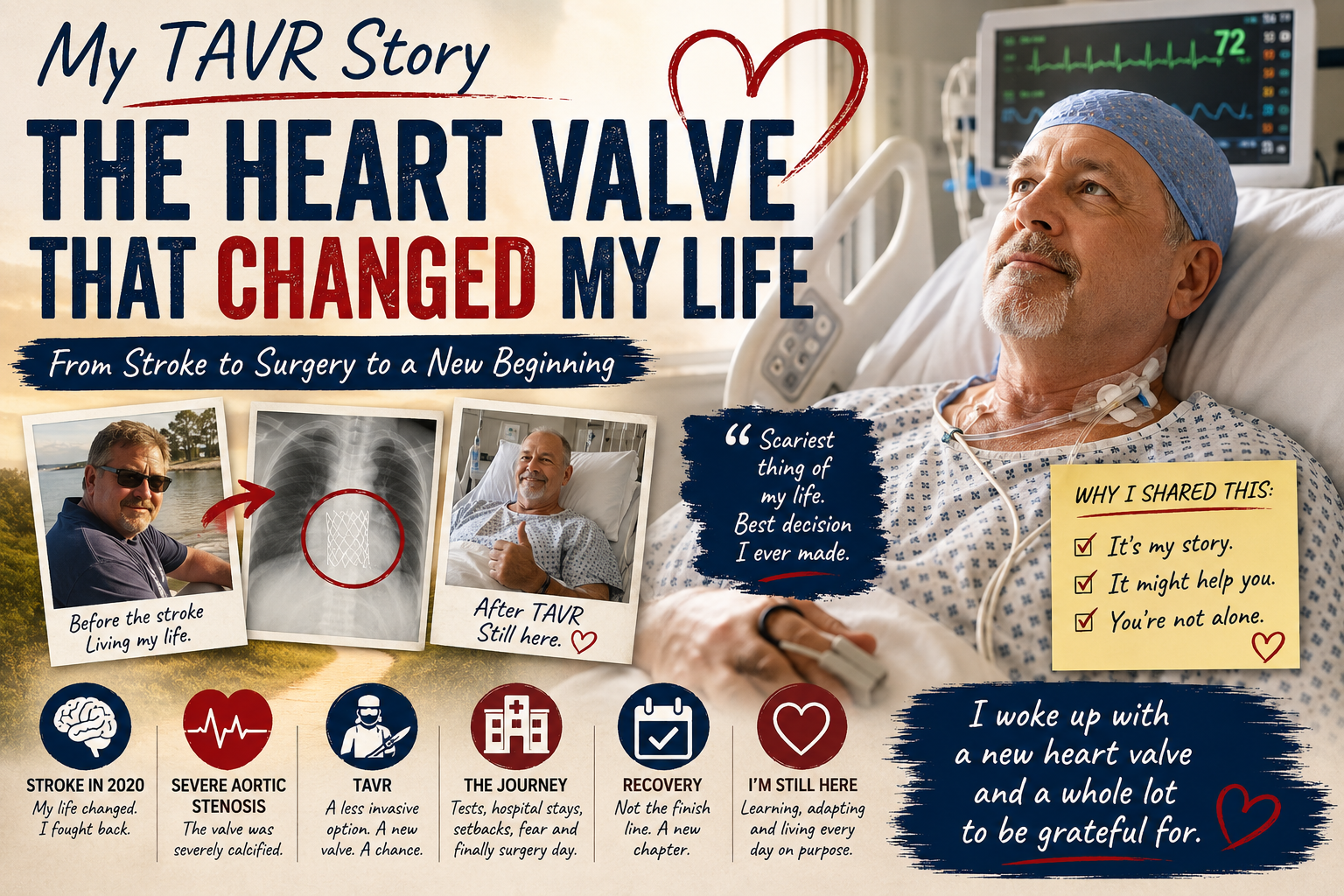
  • TAVR: The Heart Valve That Changed My Life

    TAVR: The Heart Valve That Changed My Life

    This is probably the hardest thing I’ve ever written about.

    I’ve talked about pieces of my health story before. I’ve written about heart failure, LBBB, medications, hospital stays, daily health checks and what it’s like trying to live with all of this.

    But this is the story that connects most of those pieces.

    My TAVR.

    And to really explain how I got there, I have to go back a little further.

    I Thought I Was Pretty Healthy

    I’ve been overweight pretty much my entire life.

    I’m not going to sugarcoat that.

    But until 2020, I considered myself relatively healthy and surprisingly limber for a big guy.

    I mean, I wasn’t Chris Farley limber, but I could hold my own.

    I took some preventative medications. I worked. I drove an hour and a half each way to work. I had hobbies. I did woodworking. I took care of things around the house.

    I lived my life.

    Then, in 2020, I had a stroke.

    Everything changed.

    The First Time My Body Changed the Rules

    Recovering from my stroke required some major lifestyle changes.

    Exercise.

    Eating better.

    No more alcohol.

    And suddenly, a whole lot more doctors.

    Did it suck?

    Hell yeah, it did.

    But there was one thing I didn’t have to do.

    I didn’t need surgery.

    I needed rehabilitation and a tremendous amount of work.

    I still remember sitting at my computer playing that card-matching game we played as kids. Two cards flip over. Try to remember where the matching card is.

    I did it for hours. It was so frustrating. I couldn’t match a card if my life depended on it.

    I was exercising my brain because I wanted it to come back faster.

    It didn’t come back faster.

    That’s another lesson I’ve learned through all of this. You can push your body as hard as you want, but sometimes your body has its own schedule.

    I desperately wanted to get back to being the person I was before the stroke.

    Eventually, I had to understand that some things had changed.

    But again:

    No surgery.

    That distinction was going to become pretty important a few years later.

    Then Came the Chest Pain

    After we moved to Southwest Florida, I had some chest pain and went to the emergency room.

    We’d only been living here for a few months, and I didn’t even have all my doctors established yet.

    Eventually, I got in with a cardiologist.

    He wanted tests.

    Lots of tests.

    One test led to another, which led to another.

    Eventually, I got the answer.

    Severe aortic stenosis.

    The aortic valve is essentially the doorway that allows blood to leave the heart and enter the body’s main artery, the aorta. With aortic stenosis, that doorway becomes narrowed. In my case, the valve had become severely calcified and wasn’t opening properly.

    This wasn’t something I could fix by eating better.

    There wasn’t a pill that was going to make my severely calcified valve normal again.

    I needed a valve replacement.

    My reaction was basically:

    Fuck. I have to have heart surgery.

    And Then I Learned I Had Heart Failure

    The testing continued.

    One piece of good news surprised the hell out of me.

    I didn’t have the coronary plaque buildup I expected.

    I’ve eaten plenty of terrible food in my lifetime.

    And plenty of bacon.

    So I’ll take the win.

    But there was another finding that wasn’t so great.

    I had heart failure—more specifically, heart failure with preserved ejection fraction, or HFpEF.

    At the time, my thinking was pretty simple:

    Fix the valve.

    Fix the problem.

    Go back to normal.

    Unfortunately, my heart had apparently not read the same brochure I had.

    I Was Terrified of Open-Heart Surgery

    I keep using the word surgery because you have to understand something about me.

    I’d never really had surgery.

    The worst things I’d dealt with were stitches and a broken hand.

    Easy fixes compared with someone opening my chest and operating on my heart.

    Then there was another complication.

    I already had significant trouble walking.

    My doctors and I discussed what recovery from open-heart surgery could look like for me. Because of my mobility problems, there was a real possibility that I would need rehabilitation afterward before I could safely manage at home.

    So now, in my head, this wasn’t just:

    Heart surgery.

    It was:

    Heart surgery + hospital + rehabilitation facility + who knows what comes after that.

    Emotionally, I was thinking:

    WTF. I’m not doing this.

    The problem was that doing nothing wasn’t exactly a great alternative.

    My father died at 54.

    I was 58.

    I’d beaten him by four years.

    That puts things into perspective pretty quickly.

    Eventually, the decision becomes remarkably simple:

    Deal with it or eventually let it kill you.

    Then We Started Talking About TAVR

    My doctors discussed another possibility with me:

    TAVR — Transcatheter Aortic Valve Replacement.

    Instead of opening the chest to replace the valve surgically, TAVR allows doctors to deliver a replacement valve through a catheter, commonly through an artery in the groin, and expand it inside the diseased aortic valve.

    It is still a major heart procedure.

    But it isn’t the same operation or recovery as traditional open-heart valve replacement.

    Because of my overall situation—including my mobility limitations—my heart team considered whether TAVR was an appropriate option.

    Then came more testing.

    Would my anatomy work?

    Were my blood vessels suitable?

    What size valve would I need?

    Was I an appropriate candidate?

    Fortunately, those answers came back in my favor.

    After the heart team reviewed everything, I was approved for TAVR.

    For the first time in a while, I felt like maybe there was a path through this.

    But First, I Had to Wait

    Living in Southwest Florida means there are plenty of people with heart problems.

    I wasn’t the only person who needed a valve.

    My procedure got pushed back.

    More than once.

    Meanwhile, my health continued deteriorating.

    I was hospitalized several times with heart-failure problems.

    My blood pressure could get extremely low.

    I struggled to manage my fluid levels.

    Diuretics created their own problems, including episodes involving my kidneys.

    I became unbelievably fatigued.

    I had episodes where I felt like I might pass out.

    Eventually, simply getting to the bathroom became an accomplishment.

    Driving was out of the question.

    I had originally been told we were looking at around June 2025.

    I finally got my new valve on:

    December 16, 2025.

    That was a long wait.

    And it gave me plenty of time to think about absolutely everything that could possibly go wrong.

    Surgery Day

    By the time December 16 arrived, I had been carrying around anxiety about this for months.

    Then suddenly it was real.

    I was scared to death.

    I was emotional.

    All sorts of thoughts were going through my head.

    Is this the last time I’m going to see my wife?

    Am I going to see my kids again?

    What if something goes wrong?

    I’m tearing up even writing this now.

    Eventually, there’s nothing left to do except put on your big-boy pants and go to the hospital.

    So that’s what I did.

    There Is No Modesty in a Hospital

    First, everything comes off.

    You get the gown.

    Then people start coming in.

    Vitals.

    Questions.

    Preparation.

    Of course, one of the nurses taking care of me was extremely attractive.

    Because why wouldn’t she be?

    Then another person comes in to shave me.

    Chest.

    Armpits.

    Down below.

    Meanwhile, the attractive nurse just keeps doing her job like absolutely nothing unusual is happening.

    There is no modesty in a hospital.

    At some point you just accept that your dignity has left the building and hope somebody gives it back at discharge.

    Heck of as first experience, naked, shaven and scared.

    Then Came the IV Disaster

    This was where my fear temporarily turned into anger.

    I’ve had trouble with IVs before, so I asked them from the beginning to use ultrasound guidance.

    They were confident they wouldn’t need it.

    Fine.

    There was supposedly a rule: two unsuccessful attempts and somebody else tries.

    Well…

    Person number one.

    Person number two.

    Person number three.

    By the time we got to person number four, I had been stuck eight times.

    These weren’t tiny little blood-draw pokes either. They needed substantial IV access for the procedure.

    My arms were up in the air.

    People were slapping them, searching for veins.

    I was pissed.

    And I wasn’t exactly keeping my opinion to myself.

    My doctors walked in while this was happening.

    They looked at me.

    Looked at each other.

    And essentially decided:

    We’ll see you in there.

    Eventually somebody brought out the ultrasound.

    They found the vein.

    I remember someone saying something along the lines of:

    “Oh, look. We were close.”

    That did not improve my mood.

    Then My Wife Came In

    Eventually, the chaos stopped.

    My wife came in.

    We talked.

    We said what we needed to say.

    And once again that thought entered my head:

    What if this is the last time I see her?

    Then she left.

    And not long after that…

    I was out.

    Apparently, I Went to Visit SpongeBob

    I don’t do recreational drugs.

    But whatever they gave me for this procedure?

    Wow.

    My memory of it is bizarre.

    I was hanging out with SpongeBob SquarePants. It must have been on the TV. I don’t even watch the show.

    Colors everywhere.

    Having a great time.

    Apparently my brain decided that if we were going to have heart surgery, we might as well spend part of it in Bikini Bottom.

    Then suddenly…

    I woke up.

    There was something like a sheet or drape over my head.

    My first thought was:

    Holy crap. Am I dead?

    So I yelled:

    “Hello?”

    I tried moving my arms.

    Couldn’t.

    Then I heard voices.

    My doctors were still there.

    They had just finished the procedure.

    I remember saying:

    “There’s a sheet over my head.”

    Then:

    “Are my hands tied?”

    There were other people in the room too.

    Here’s the important part:

    I apparently wasn’t supposed to be awake yet.

    They gave me some more medication.

    And off I went.

    Back to SpongeBob.

    Unfortunately, round two hit me considerably harder.

    I was nauseated for about three days afterward.

    “Does That Happen Often?”

    The next day I needed an echocardiogram.

    I asked the person performing it whether they had been in the room when I woke up.

    They had.

    First thing they said, “Wow, you remember that?”

    Naturally, my first question was:

    “Did I say anything bad?” I am kind of a jokester and very sarcastic.

    Because if I’m going to wake up unexpectedly while still under the influence of whatever they gave me, this seems like useful information.

    Apparently I behaved myself.

    Later I asked my surgeon whether people wake up like that very often.

    He told me he’d never personally seen it happen before.

    I was his first.

    Lucky me.

    Yet another reason I apparently need to start buying lottery tickets.

    The Valve Was In — But We Weren’t Done

    One of the attractions of TAVR is that many patients can go home relatively quickly after an uncomplicated procedure.

    That wasn’t going to be me.

    Afterward, I had to remain flat for hours while they monitored the access sites and allowed the medications used during the procedure to wear off.

    I also had temporary pacing available after the procedure.

    At this hospital, the pacing wire was through my neck.

    For a day?

    Okay.

    For several days?

    Pretty freaking uncomfortable.

    And I needed it because my heart’s electrical system wasn’t particularly happy about its new neighbor.

    My Heart Started Pausing

    After the TAVR, I developed a new electrical conduction problem:

    Left bundle branch block, or LBBB.

    I’ve written an entire article about that because it deserves its own explanation.

    The short version is that the heart’s electrical conduction system runs very close to the aortic valve. Implanting a replacement valve can sometimes disturb that system.

    My heart also started having pauses.

    Basically, there were periods when the electrical activity wasn’t doing what it was supposed to do.

    That’s why I stayed in the hospital for four days instead of heading home the next day.

    The question became:

    Do I need a permanent pacemaker?

    Fortunately, after several days of monitoring, my doctors decided I didn’t need one at that point.

    But they weren’t going to send me home and simply hope everything behaved.

    Meet My Loop Recorder

    I was given a choice about longer-term monitoring.

    I decided to have an implantable loop recorder placed under the skin in my chest.

    A loop recorder isn’t a pacemaker.

    It doesn’t pace my heart.

    It doesn’t shock me like a defibrillator.

    It watches.

    Mine communicates with my phone and allows heart-rhythm information to be transmitted for review.

    I get reports showing unusual events, including pauses and rhythm abnormalities.

    I can also mark symptoms when something unusual happens so the event can be correlated with what my heart was doing around that time.

    My heart still has pauses.

    So far, based on the monitoring and my doctors’ assessment, they haven’t resulted in a recommendation for a permanent pacemaker.

    That could change someday.

    For now?

    We watch.

    So I Got the New Valve. Am I Fixed?

    This is where reality didn’t quite match what I expected.

    The good news is very good:

    My replacement aortic valve is working well.

    Follow-up imaging has shown that the valve is functioning properly.

    That’s a huge win.

    But I still have HFpEF.

    For whatever reason, I had come away from some of those early conversations believing that replacing the valve might essentially resolve the heart failure.

    That wasn’t what happened.

    Whether I misunderstood, heard what I wanted to hear, or simply couldn’t process the enormous amount of information being thrown at me at the time, I don’t know.

    And that’s another lesson:

    Bring somebody with you.

    Appointments and hospital stays can involve an overwhelming amount of information.

    Medications.

    Numbers.

    Procedures.

    Risks.

    Options.

    Follow-ups.

    You’re scared, tired, uncomfortable and trying to remember everything someone just said.

    Having another set of ears in the room is incredibly valuable.

    Eight Months Later

    As I write this, I’m about eight months out from TAVR.

    The valve is doing its job.

    But I still have LBBB.

    I still have HFpEF.

    I still have episodes where I become extremely lightheaded and feel like I might pass out.

    Sometimes I sweat profusely.

    I’ve noticed that exertion and heat seem to play a role.

    I’m working with my doctors to understand exactly what’s happening.

    We’ve adjusted medications.

    My loop recorder continues watching my rhythm.

    When I experience something unusual, I can mark the event so there’s information available to review later.

    This isn’t something I’m trying to diagnose myself.

    That’s what my doctors and the monitoring are for.

    If you want to follow that part of the story as it happens, that’s really what my Daily Journal has become.

    Would I Do It Again?

    This was the scariest medical experience of my life.

    And this article is still the abridged version.

    There are pieces of this story that deserve their own articles, and I’ll eventually write them.

    But would I have the TAVR again?

    That’s kind of a funny question.

    Because someday, I may actually have to.

    Bioprosthetic replacement valves don’t necessarily last forever. How long an individual TAVR valve lasts depends on many factors, and because TAVR is relatively newer than surgical valve replacement, long-term durability continues to be studied.

    I’m younger than the traditional TAVR patient.

    I was 58 when mine was implanted.

    Fortunately, my anatomy and the size of the valve that was implanted may leave options if the valve eventually deteriorates.

    One possibility in selected patients is another transcatheter valve placed inside the first one—sometimes called TAVR-in-TAVR or valve-in-valve TAVR.

    Whether that’s what happens to me someday?

    Who knows.

    That’s a conversation for future me and whatever heart team is taking care of me at that point.

    Medicine changes.

    Technology changes.

    Procedures improve.

    There are treatments available today that weren’t available a generation ago.

    I’m not going to spend the next decade worrying about what valve technology might look like when I’m in my 70s.

    I’ll deal with that when I get there.

    ❤️ Greg’s Take

    I went into this thinking the new valve was going to fix me.

    That’s probably the biggest misconception I carried through the whole process.

    I imagined a finish line.

    Get the valve. Recover. Go back to normal.

    Instead, the TAVR became another starting line.

    My valve works.

    That’s something I’m incredibly grateful for.

    But I still have heart failure.

    I still have LBBB.

    I still have a loop recorder watching my heart.

    I still have pauses.

    I still have symptoms we’re trying to understand.

    I still have good days and bad days.

    And I’m still here.

    That’s really what this website is about.

    It isn’t about somebody who got sick, found the magical treatment and went back to exactly the life he had before.

    That isn’t my story.

    My story is learning how to live when the finish line keeps moving.

    It is learning what I can control and what I can’t.

    It’s learning to ask questions.

    It’s learning to bring someone with me when there are too many answers to remember.

    It’s learning that sometimes the thing you’re absolutely terrified of doing is also the thing that gives you the chance to keep going.

    On December 16, 2025, I walked—or more accurately, was wheeled—into a hospital terrified that I might never see my wife and kids again.

    I woke up with a new heart valve.

    Okay…

    I woke up with a new heart valve and apparently spent some quality time with SpongeBob SquarePants.

    Eight months later, life still isn’t easy.

    I’m not fixed.

    I’m not the person I was before my stroke.

    I’m not even the person I thought I’d be after TAVR.

    But I’m still here.

    And for now?

    That’s enough.


    Medical Disclaimer

    This article describes my personal experience with severe aortic stenosis, heart failure and TAVR. It is not medical advice and should not be used to decide whether TAVR, open-heart surgery or any other treatment is appropriate for you. Every patient’s heart condition, anatomy, surgical risk and medical history are different. Treatment decisions should be made with your cardiologist and heart-valve team. If you have chest pain, fainting, severe shortness of breath or symptoms that may represent a medical emergency, seek immediate medical care.

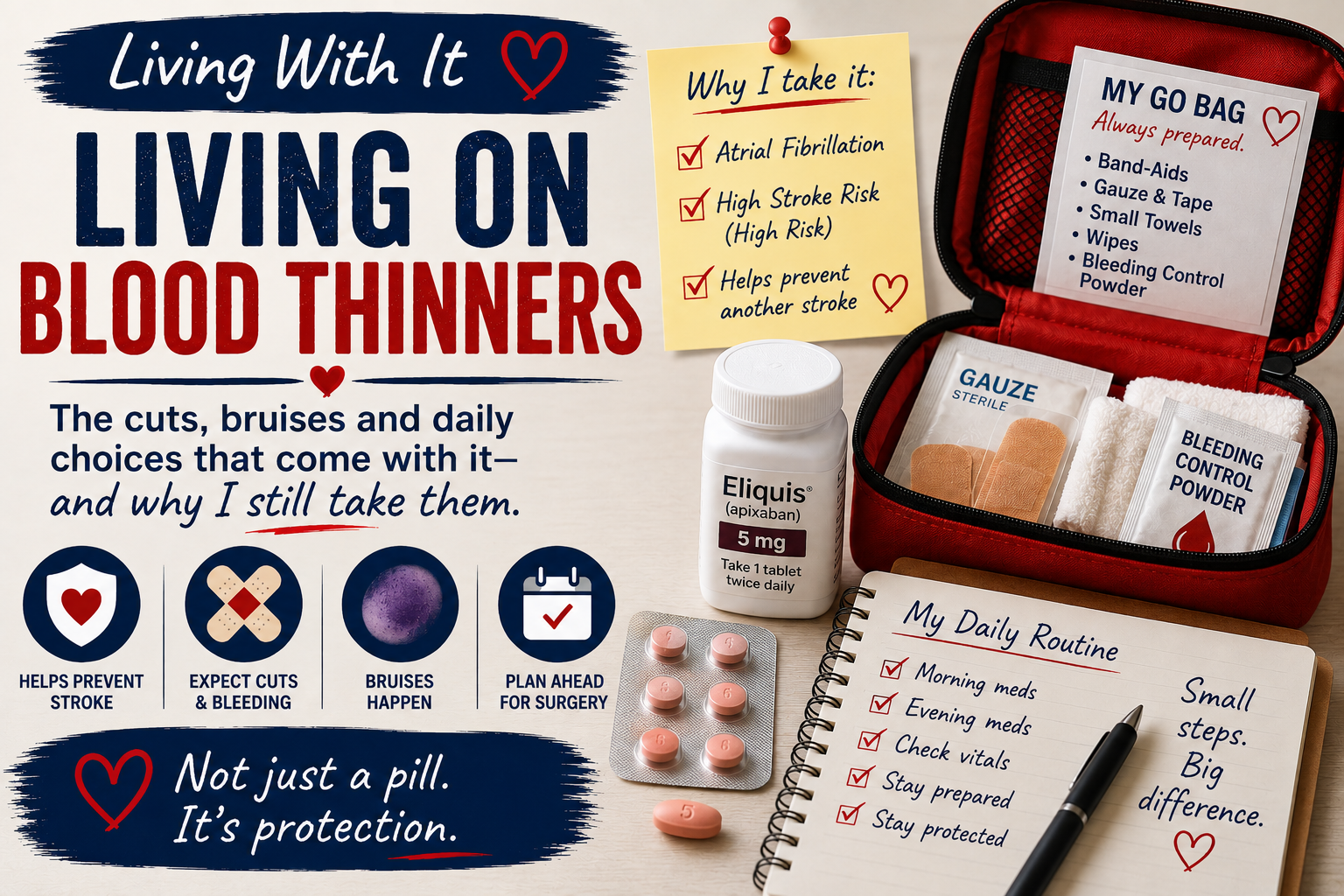
  • Living With Blood Thinners: The Cuts, Bruises and Why I Still Take Them

    Living With Blood Thinners: The Cuts, Bruises and Why I Still Take Them

    I never expected a dropped drink to change my life.

    It was 2020, and I was sitting at home watching a movie with my wife when I dropped what I was drinking.

    I bent over and tried to put the ice cubes back into the cup.

    I couldn’t do it.

    I kept missing.

    I remember thinking:

    That’s weird.

    Then I tried to say something to my wife.

    I knew exactly what I wanted to say. The words were perfectly clear in my head.

    But what came out of my mouth was garbled and made absolutely no sense.

    My wife immediately knew something was wrong.

    She wanted to call 911.

    I refused.

    Yes, I know. She was right.

    I’m a guy. Going to the hospital was apparently the compromise I was willing to make at the time.

    Another story for another day.

    Fortunately, we lived less than a mile from the hospital. It was basically down the street and a left at the next stoplight.

    I was having a stroke.

    That’s When I Found Out I Had AFib

    During everything that followed, I learned something else:

    I had atrial fibrillation, commonly called AFib.

    AFib is an abnormal heart rhythm in which the heart’s upper chambers—the atria—don’t beat in a normal, coordinated rhythm. Instead, the electrical activity becomes irregular.

    One of the serious risks associated with AFib is stroke.

    When blood isn’t moving normally through the atria, it can pool and form a clot. If a clot leaves the heart and travels to the brain, it can block blood flow and cause an ischemic stroke.

    That was suddenly no longer an abstract medical explanation to me.

    I had lived it.

    I was fortunate that I was sitting at home when my stroke happened.

    I sometimes think about what could have happened if I’d been driving instead.

    Another Medication Gets Added to the List

    After some time in the hospital, I learned that I was going to need an anticoagulant—what most of us simply call a blood thinner.

    At that point, medications weren’t exactly new to me.

    I was already taking medications for diabetes, blood pressure and cholesterol.

    Now I had another one.

    Eliquis.

    I take it twice a day.

    One dose is part of my morning routine, and the other is part of my evening routine. Everything is organized in my pill box, and after doing it for years, taking my medications has become almost automatic.

    It’s simply part of my day.

    Why I Take It

    This is the part that makes everything else I’m about to complain about worthwhile.

    The purpose of my anticoagulant is to reduce my risk of another stroke from AFib.

    My CHA₂DS₂-VASc score, which is one of the tools used to estimate stroke risk in people with AFib, is high enough that stroke prevention is something I take very seriously.

    I’ve already had one.

    I don’t want another.

    And that’s the perspective I try to keep when dealing with the annoying parts of living on a blood thinner.

    Because there definitely are annoying parts.

    A Tiny Cut Isn’t Always a Tiny Event

    I have somehow developed an amazing ability to cut myself doing ordinary things.

    Maybe I’m trimming something outside.

    Maybe I’m moving something around in the garage.

    Maybe I bump into something.

    I’ll look down and think:

    Where did that come from?

    Then I notice blood running down my hand or arm.

    Anticoagulants don’t literally make your blood thinner. They interfere with the body’s clotting process, which is exactly why they help prevent dangerous clots—but it also means bleeding can take longer to stop.

    I’ve learned that even a relatively minor cut sometimes requires patience, pressure and a Band-Aid.

    Or two.

    Or five.

    The Truck Stop Incident

    I learned the Band-Aid lesson while traveling.

    We stopped at a Love’s truck stop. I went inside to use the restroom before getting gas.

    Apparently, I bumped my arm against the corner of a door while walking in.

    I barely thought about it.

    I went back outside and started pumping gas.

    A little while later, some of the employees or security staff came over and asked:

    “Are you okay?”

    I was confused.

    “Yeah. Why?”

    Then they told me to look at my arm.

    Blood was running down it.

    Apparently, my insignificant little bump had opened my skin enough that I had bled while walking through the store and hadn’t even realized it.

    That was the day I learned an important lesson:

    Carry Band-Aids.

    My Little Blood-Thinner Go Bag

    Actually, I’ve gone considerably beyond Band-Aids now.

    We carry a small go bag with us almost everywhere.

    Mine includes things that can help deal with minor cuts and scrapes:

    Hopefully I don’t need any of it.

    But I’ve learned that being prepared is considerably easier than standing in a parking lot bleeding while wondering if anyone has a Band-Aid.

    It’s just part of life now.

    For anything that won’t stop bleeding with firm pressure, is deep or serious, or involves significant injury, that’s obviously beyond the job of my little go bag.

    And Then There Are the Bruises

    Bruising has become another normal part of life.

    Bump my arm?

    Bruise.

    Get blood drawn?

    Bruise.

    Have an IV in the hospital?

    There’s a pretty good chance I’ll have a colorful reminder of exactly where it was for days afterward.

    I also occasionally notice small discolored spots on my arms that come and go.

    As I get older, I expect skin changes may make some of this even more noticeable.

    I’ve seen protective sleeves designed for the arms, and that’s something I may eventually consider.

    For now, I’ve mostly accepted that unexplained bruises are occasionally going to be part of the scenery.

    Surgery Requires More Planning

    Blood thinners also make surgery and some medical procedures more complicated.

    It’s not necessarily a reason you can’t have them.

    It just means everybody involved needs to know you’re taking an anticoagulant.

    Depending on the procedure and the person’s individual risks, a doctor may instruct someone to temporarily stop an anticoagulant beforehand. Exactly when—or whether—to stop it depends on the medication, procedure, kidney function, bleeding risk and risk of developing a clot.

    That’s why this isn’t something I decide on my own.

    If I’m having surgery or a procedure, the physicians involved—including the doctor managing my anticoagulation—need to coordinate the plan.

    I don’t just stop taking Eliquis because surgery is coming up.

    The same goes for restarting it afterward.

    I follow the instructions I’m given.

    The Inconveniences Are Worth It

    I’ve mentioned quite a few negatives.

    Cuts bleed more.

    Bruises appear more easily.

    Blood draws can leave impressive marks.

    I carry first-aid supplies.

    Medical procedures require additional planning.

    And I have another medication that I need to remember twice every single day.

    But here’s the thing:

    I’ll take all of that over another stroke.

    My stroke was one of the worst experiences of my life.

    I was 53.

    I had a great job.

    I had a woodworking side hustle that I loved.

    I had great neighbors and a ton of friends.

    I was independent.

    I was self-sufficient.

    And then, sitting on the couch watching a movie, my life changed.

    The Lesson I Wish I’d Learned Earlier

    Before my stroke, I wasn’t exactly great about going to doctors.

    That’s something I look back on very differently now.

    Afterward, I also learned that I had sleep apnea. Sleep apnea is associated with AFib, and treating underlying health problems is another piece of managing cardiovascular risk.

    Could things have gone differently if I’d been getting regular medical care and my AFib had been discovered before the stroke?

    I’ll never know exactly what would have happened.

    But I certainly wish we’d had the opportunity to find it first.

    Being proactive sounds a whole lot better to me now than being reactive.

    That’s one of the biggest lessons I’ve taken from all of this.

    Go for the checkup.

    Get your blood pressure checked.

    Talk to someone about the snoring.

    Don’t ignore something because you feel fine.

    Sometimes the first sign that something is wrong is a sign you really don’t want.

    ❤️ Greg’s Take

    I’ve seen people talk about not wanting to take blood thinners because of the bleeding, bruising and inconvenience.

    I understand it.

    Nobody gets excited about adding another medication to their life.

    And anticoagulants aren’t medications to take casually. They have real risks that need to be discussed with the person prescribing them.

    But I can only speak from my experience.

    I’ve had the cuts.

    I’ve had the bruises.

    I’ve bled through a truck stop without realizing it.

    I carry Band-Aids everywhere.

    I’ve turned taking Eliquis twice a day into a ritual.

    And I’ll keep doing it.

    Because I’ve also had a stroke.

    The Band-Aids are easier.

    If taking a couple of pills every day, carrying some first-aid supplies and dealing with an occasional ugly bruise helps reduce my risk of going through that again, I know which one I’m choosing.

    Every single time.


    Affiliate Disclosure

    This article contains Amazon affiliate links. If you purchase something through one of these links, I may earn a small commission at no additional cost to you. I personally use the products I’ve linked in this article and am sharing them because they’ve been useful to me. I have purchased these with my own money. Purchasing through my links helps support He’s Knocking on My Door and allows me to continue creating content.

    Medical Disclaimer

    This article describes my personal experience with atrial fibrillation, stroke and anticoagulant medication. It is not medical advice. Anticoagulants can cause serious bleeding and should be taken exactly as prescribed. Never stop, skip, restart or change an anticoagulant because of something you read here. If you’re preparing for surgery or another procedure, your healthcare team should provide specific instructions about your medication. Seek urgent medical attention for serious or uncontrolled bleeding, a significant head injury, or symptoms of a possible stroke.

  • Living With Hip Arthritis: From a Limp to a Walker

    Living With Hip Arthritis: From a Limp to a Walker

    Arthritis has been part of my life for years.

    Like a lot of chronic problems, it didn’t happen all at once. There wasn’t one morning when I woke up and suddenly couldn’t walk.

    It was gradual.

    A little more pain.

    A little more difficulty walking.

    A limp.

    Then a cane.

    And eventually, a walker.

    I have arthritis in both hips, but my right hip is by far the worst.

    The simplest way my doctors have described the right one is:

    Bone on bone.

    There’s essentially no longer the cushioning there that a healthy hip joint should have. With osteoarthritis, the cartilage in the joint progressively wears away, and in severe cases that can eventually result in bone rubbing against bone. 

    I can tell you from experience:

    It hurts exactly as pleasant as it sounds.

    It Didn’t Start With a Walker

    That’s probably the part of this story that’s easiest to forget.

    I didn’t go from walking normally to using a walker overnight.

    For a long time, I just dealt with the pain.

    Then I started limping.

    You compensate.

    You change how you walk.

    You figure out which movements hurt and which ones don’t.

    Without really thinking about it, your entire way of moving starts changing.

    Eventually, the limp wasn’t enough.

    I moved to a cane.

    The cane helped for a while, but as the arthritis continued progressing, there came a point where I needed more support.

    Now I use a walker or rollator.

    Looking backward, I can almost chart the progression of my arthritis by what I needed to get around:

    Walking → Limping → Cane → Walker

    That’s not a progression I ever expected to make.

    What Does “Bone on Bone” Actually Mean?

    The hip is a ball-and-socket joint.

    Normally, cartilage covers the surfaces of the bones and allows the joint to move smoothly.

    With osteoarthritis, that cartilage deteriorates over time. As it becomes increasingly damaged, movement can become painful and stiff. When the cartilage is severely worn away, bone can essentially rub against bone. 

    That’s where my right hip has ended up.

    My left hip has arthritis too.

    It isn’t good.

    It’s just that compared with the right one, the left hip sometimes seems like the good hip.

    That’s a pretty low bar.

    I’ve Tried to Avoid Getting Here

    It isn’t as though my first response to hip pain was:

    “Okay, let’s replace the thing.”

    I’ve tried different approaches over the years hoping to control the pain and keep functioning.

    One of them was radiofrequency nerve ablation.

    The idea was to target nerves involved in transmitting the pain signals.

    I tried it.

    It didn’t provide the lasting relief I was hoping for.

    I also tried stem cell injections.

    Again, I was hoping it might provide some relief and allow me to keep going without surgery.

    It didn’t work for me either.

    That’s an important distinction.

    I’m not saying those treatments will or won’t work for somebody else. I’m only describing my experience.

    For me, neither one changed where this was eventually heading.

    Arthritis Changes More Than Your Hip

    Pain is the obvious part.

    But one thing I don’t think people appreciate until they’ve experienced severe arthritis is how much it changes everyday life.

    Walking through a grocery store becomes difficult.

    Walking through a large store can become impossible.

    Standing for too long hurts.

    Sitting in the wrong chair hurts.

    Getting comfortable at night can be difficult.

    Sometimes even finding a position where the hip isn’t screaming at me becomes a challenge.

    Then there’s something else.

    You start planning your life around distance.

    Where am I parking?

    How far is the entrance?

    How much walking is involved once I get inside?

    Is there somewhere to sit?

    Can I use my walker?

    Do I have enough energy to get back to the car?

    Those weren’t questions I used to ask.

    Now they’re part of leaving the house.

    The Walker Helps — But It Also Creates Another Problem

    The walker gives me stability.

    I need it.

    But there’s an interesting complication in my situation.

    I also have heart failure.

    Using a walker isn’t effortless.

    I’m supporting myself with my arms. I’m pushing the walker. I’m walking while moving another piece of equipment along with me.

    That requires effort.

    And when exertion is already difficult, that additional work matters.

    So I have two problems working against each other.

    My hip says:

    You need the walker.

    My heart says:

    Why are you making me work harder?

    It’s a perfect example of something I’ve written about before:

    Chronic illnesses don’t exist in separate little boxes.

    What helps one problem can make another problem more difficult to manage.

    “Just Walk More” Isn’t Always That Simple

    Walking is good for you.

    I understand that.

    I want to move.

    I want to exercise.

    I want to rebuild my stamina.

    But there’s a big difference between knowing that exercise is beneficial and having a body capable of doing it.

    Walking hurts because of my hip.

    Using the walker requires additional effort.

    Exertion can leave me exhausted.

    Sometimes I have to stop and recover after walking a relatively short distance. Especially recently with the nearly passing out episodes.

    That doesn’t mean I’ve given up on moving.

    It means I’ve had to adjust what movement looks like for me.

    And that’s something I wish more people understood about chronic illness.

    Sometimes doing your best doesn’t look very impressive from the outside.

    Losing Mobility Changes Your Independence

    This may be the hardest part.

    I’ve always been someone who would just do things myself.

    Need something from the store?

    Go get it.

    Something breaks?

    Go to Home Depot, get the part and fix it.

    Walk around a grocery store?

    I wouldn’t have even considered that an activity.

    Now I have to think about all of those things differently.

    Fortunately, I’ve found ways around some of it.

    I can order things online.

    I can use grocery pickup.

    I can drive.

    I can use my walker when I need to go somewhere.

    I’m still doing things.

    I’m just doing them differently.

    And learning to accept that has probably been as difficult as dealing with the physical pain.

    There Is Hopefully an End to This Part of the Story

    My right hip has reached the point where the next step is a total hip replacement.

    That sounds like a major event.

    And it is.

    But at this point, I’m looking forward to it.

    That’s probably a strange thing to say about having a joint surgically replaced.

    But after years of progressively worsening pain, limping, using a cane and eventually needing a walker, the possibility of being able to walk with less pain sounds pretty damn good.

    Hip replacement is a recognized option when severe hip osteoarthritis causes significant pain and loss of function despite other treatment approaches. 

    I’m realistic about it.

    I’m not expecting to wake up after surgery and run a marathon.

    Actually, let’s be honest.

    I wasn’t running a marathon before the arthritis either.

    But I’d love to walk through a grocery store again.

    I’d love to walk into Home Depot and get the part I need.

    I’d love to take a walk without calculating how far I can make it before I need to stop.

    Those sound like little things.

    They’re not little things when you lose them.

    ❤️ Greg’s Take

    One of the strange things about chronic illness is that you don’t always notice how much you’ve lost while you’re losing it.

    You adapt.

    First you limp.

    Then you grab a cane.

    Then the cane isn’t enough, so you get a walker.

    You order your groceries instead of walking through the store.

    You order the part online instead of going to Home Depot.

    You find another way.

    And eventually that new way becomes normal.

    My arthritis didn’t take away my mobility in one dramatic moment.

    It took it a little bit at a time.

    That’s probably what bothers me most when I look back at it.

    But I’m still adapting.

    I’m still moving.

    And hopefully, I’m getting closer to the point where I can start taking some of that mobility back.

    I’ve tried treatments that didn’t work.

    I’ve lived with the pain.

    I’ve progressed from walking normally to a limp, a cane and finally a walker.

    Now I’m getting ready for the next step.

    A new hip.

    I’ve already had the heart plumbing replaced.

    Apparently now we’re moving on to the suspension.

    At this rate, I’m eventually going to be mostly aftermarket parts.

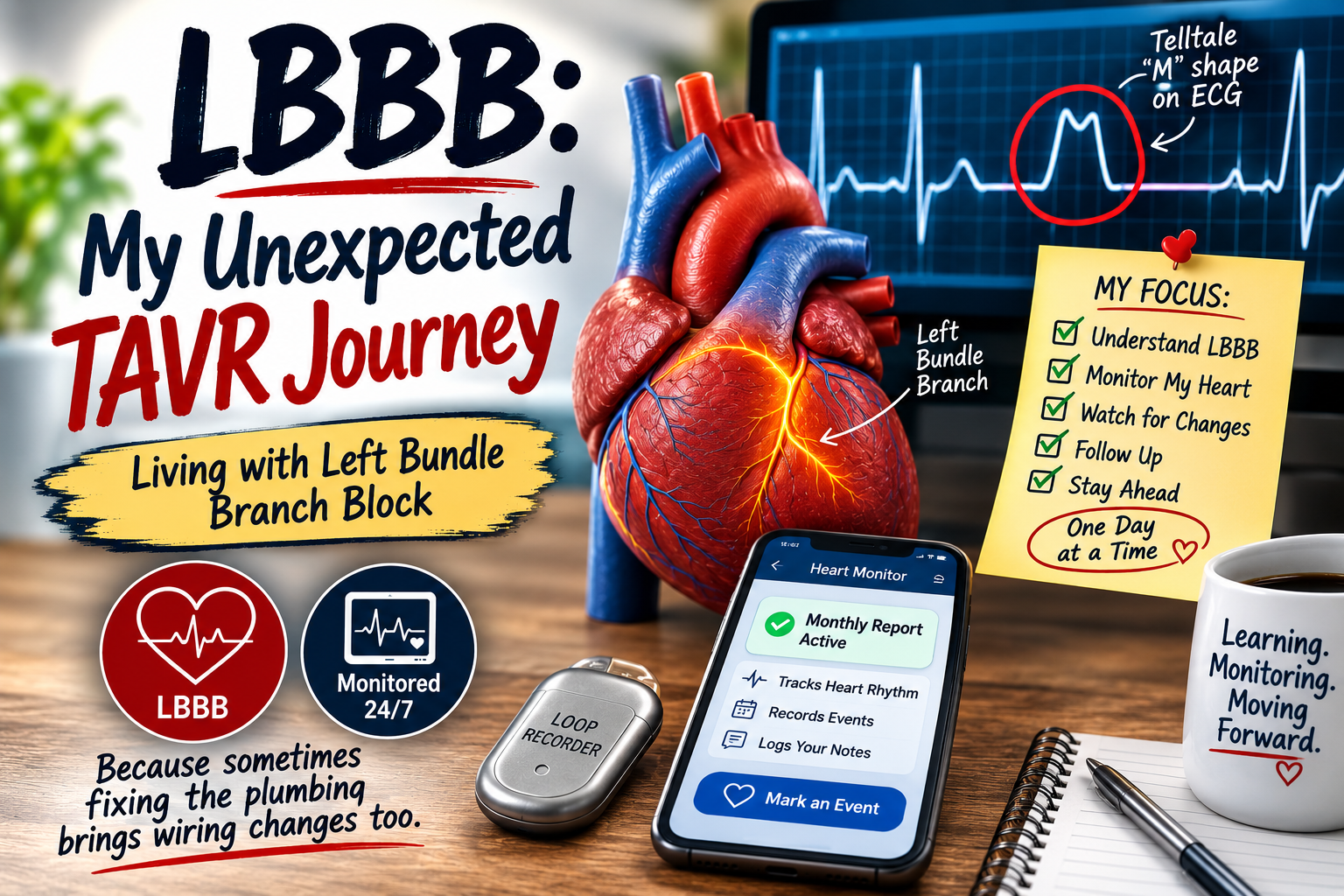
  • Left Bundle Branch Block: An Unexpected Part of My TAVR Journey

    Left Bundle Branch Block: An Unexpected Part of My TAVR Journey

    When I went into the hospital for my TAVR procedure, my attention was focused on one thing: my aortic valve.

    I had severe aortic stenosis, and the goal was to replace the failing valve and get my heart working better.

    What I didn’t fully appreciate beforehand was just how close the heart’s electrical system is to where that new valve would be placed.

    I learned about that very quickly.

    After my TAVR, I developed something called a left bundle branch block, or LBBB.

    And before anyone scheduled for a TAVR starts worrying, let me make something clear:

    Not everyone who has a TAVR develops LBBB.

    It is a known complication of the procedure, but it certainly isn’t something that happens to everyone. In one large U.S. registry analysis involving more than 200,000 TAVR patients, about 16% developed a new LBBB after the procedure. The exact risk can vary depending on the patient, the valve and other factors.

    Apparently, I was one of the lucky ones.

    Maybe I should start buying lottery tickets too.

    What Is a Left Bundle Branch Block?

    Before all of this happened, “left bundle branch block” wasn’t exactly something that came up in everyday conversation.

    The easiest way I’ve learned to think about it is that the heart doesn’t just pump—it also has its own electrical wiring system.

    Electrical signals travel through pathways in the heart that tell the chambers when to contract. Part of that electrical system divides into a right bundle branch and a left bundle branch.

    Normally, the electrical signal travels through these pathways in a coordinated way.

    With LBBB, the electrical signal doesn’t travel normally through the left bundle. Instead, the impulse has to take a different route to activate the left ventricle.

    The result is that the ventricles don’t receive their electrical signal in quite the same synchronized way they normally would.

    I tend to think of it as an electrical detour.

    The signal still gets there, but it isn’t traveling down the normal road.

    Why Can LBBB Happen After TAVR?

    My doctors gave me a pretty simple explanation.

    The replacement aortic valve sits very close to some of the heart’s electrical conduction system.

    When the new valve is placed, that nearby electrical system can sometimes be disturbed. That’s why conduction problems such as LBBB are recognized complications following TAVR.

    That’s what happened to me.

    My new valve addressed one major problem, but I left the procedure with a new electrical issue that needed to be monitored.

    Chronic illness seems to have a sense of humor like that.

    They Saw Something Different on My ECG

    After my TAVR, my doctors noticed that my heartbeat looked different on the ECG.

    That was the first indication that something had changed electrically.

    When LBBB is present, the electrical delay changes the shape and duration of the QRS complex on an ECG. One characteristic that can appear is a broad or notched, sometimes M-shaped, pattern in certain leads. That’s one of the things that was pointed out to me on my ECG.

    The American Heart Association also describes this characteristic M-shaped appearance in its educational material about LBBB.

    That doesn’t mean you can look for an “M” on an ECG and diagnose yourself with LBBB. Doctors use several ECG measurements and characteristics to make the diagnosis.

    For me, the important part was much simpler:

    That electrical pattern wasn’t there before my TAVR. Now it was.

    My Hospital Stay Just Got Four Days Longer

    I certainly wasn’t expecting that.

    Instead of going home and beginning my recovery, I ended up staying in the hospital for four additional days while they monitored my heart.

    The concern was whether this new conduction problem would progress.

    Would my electrical system stabilize?

    Would it get worse?

    Would I need a pacemaker?

    Those weren’t questions anyone could answer immediately.

    So we waited and watched.

    Pacemaker or Monitoring?

    Ultimately, I didn’t receive a permanent pacemaker at that time.

    Instead, I was given a choice about continued heart-rhythm monitoring.

    One option was an external heart monitor that I would wear for a period of time.

    The other was an implantable loop recorder.

    I chose the loop recorder.

    For me, I liked the idea of having something continuously monitoring my heart over the long term rather than wearing an external monitor temporarily.

    The loop recorder is a small device implanted under the skin that records information about my heart rhythm.

    And now it has become another part of my everyday life.

    My Heart Sends in a Monthly Report Card

    I receive a report each month showing anything unusual the monitoring system has detected.

    That can include things such as pauses or unusual rhythms.

    And yes, apparently my heart occasionally likes submitting some interesting material for the report.

    I’ve had pauses detected, which is one of the reasons this continued monitoring is important.

    The system also gives me another useful feature.

    If I’m experiencing something unusual—maybe I’m lightheaded or just feel that something isn’t right—I can use my phone to mark the event.

    I can enter what I was doing and describe what I’m experiencing.

    That creates a record associated with the event so it can be reviewed later.

    I really like having that ability because it provides context.

    Instead of simply saying at my next appointment, “I felt really strange one afternoon a few weeks ago,” there can be a record of when it happened and information about what I was experiencing.

    What My Loop Recorder Does NOT Do

    This is an important distinction.

    My loop recorder is a monitoring device. It is not a treatment device.

    It isn’t a pacemaker.

    It isn’t an implanted defibrillator.

    And it isn’t going to shock my heart or correct a dangerous rhythm if something happens.

    It records information.

    If I’m experiencing what could be a medical emergency, pressing a button on my phone isn’t a substitute for getting emergency medical care.

    An emergency still means getting emergency help.

    The recorder’s job is to help capture information that my doctors can use to understand what’s happening with my heart.

    I Still Have Pauses

    Since the loop recorder was implanted, it has detected pauses in my heartbeat.

    That obviously gets my attention.

    A pause doesn’t automatically mean that I need a pacemaker, but it’s one of the electrical findings my doctors can follow along with everything else that’s happening.

    That’s especially important because I also experience symptoms.

    The Lightheadedness Is What Concerns Me

    There are periods when I become extremely lightheaded.

    Sometimes I get the feeling that I’m getting close to passing out.

    I haven’t completely lost consciousness, but I’ve experienced that tunnel-vision, I’m-about-to-black-out feeling.

    That’s difficult to ignore.

    Bundle branch block itself may cause no symptoms, but fainting or feeling as though you’re going to faint can occur in some people with conduction problems and deserves medical evaluation.

    But there’s an important distinction in my situation:

    We don’t know that my LBBB is causing these episodes.

    I have several things happening with my heart.

    I have persistent atrial fibrillation.

    I have heart failure.

    I have LBBB.

    I’ve had pauses recorded.

    There are also medications and blood-pressure changes that can potentially affect how I feel.

    So I’m not going to pick one condition and declare that I’ve found the culprit.

    That’s exactly why having long-term rhythm monitoring can be useful.

    If I report an episode and there’s a corresponding rhythm abnormality at the same time, that’s useful information for my doctors.

    Then There’s the Sweating

    Another strange symptom I’ve been experiencing is profuse sweating, particularly with exertion or heat.

    And I don’t mean getting a little sweaty because it’s hot outside.

    Sometimes I’m drenched.

    Is that LBBB?

    Heart failure?

    Medication?

    Blood pressure?

    Something completely different?

    I don’t know.

    And I’m deliberately not going to claim that LBBB causes it just because LBBB happens to be one of my diagnoses.

    One thing chronic illness has taught me is:

    Having a symptom and having a diagnosis doesn’t necessarily mean the diagnosis caused the symptom.

    Sometimes figuring out that connection is the hardest part.

    Will I Eventually Need a Pacemaker?

    That’s the question hanging over all of this.

    The answer right now is:

    Maybe.

    Developing LBBB after TAVR doesn’t automatically mean someone needs a pacemaker.

    Guidance from the American College of Cardiology describes monitoring patients who develop new conduction disturbances following TAVR and considering additional testing or a permanent pacemaker depending on how those abnormalities progress.

    My doctors are monitoring the electrical activity of my heart, the pauses, my symptoms and whether anything changes.

    If the conduction system deteriorates further, or if my doctors determine that the electrical abnormalities and symptoms warrant pacing, then a pacemaker could become part of my future.

    But we’re not there yet.

    For now, I have the loop recorder.

    We collect information.

    We watch.

    And we make decisions based on what that information shows.

    ❤️ Greg’s Take

    When I went in for my TAVR, my thinking was pretty straightforward:

    Bad valve. New valve. Recover. Move on.

    Yeah.

    It didn’t exactly work that way.

    The new valve addressed the severe aortic stenosis, but somewhere along the way the electrical wiring of my heart decided it wanted to join the story.

    I developed LBBB.

    My hospital stay became four days longer.

    I had to make a decision about long-term heart monitoring.

    I chose a loop recorder.

    Now my heart essentially sends in a monthly report card, I’ve had pauses recorded, and I have a way to mark the times when I’m experiencing something unusual.

    And someday I may need a pacemaker.

    Or maybe I won’t.

    That’s one of the frustrating things about chronic illness. Sometimes there isn’t an immediate answer.

    Sometimes the answer is:

    We’re going to watch it.

    Before all of this, I probably would have found that incredibly frustrating.

    Now I’m beginning to understand it.

    Not every decision needs to be made today.

    Sometimes collecting information is the next step.

    So my loop recorder keeps watching.

    My doctors keep monitoring.

    And I keep learning more about the electrical system of a heart that I never expected to know this much about.

    Apparently replacing the plumbing wasn’t enough. I needed to learn about the wiring too.


    Learn More About LBBB and TAVR

    These are some good resources if you’d like to learn more about LBBB, heart conduction problems and what can happen after TAVR:

    Mayo Clinic — Bundle Branch Block: Symptoms & Causes
    A straightforward explanation of bundle branch block, the heart’s electrical system and possible symptoms.
    Mayo Clinic: Bundle Branch Block Symptoms & Causes

    Mayo Clinic — Bundle Branch Block: Diagnosis & Treatment
    Information about diagnosing bundle branch block and situations in which treatment such as a pacemaker may be considered.
    Mayo Clinic: Bundle Branch Block Diagnosis & Treatment

    American College of Cardiology — Conduction Disturbances After TAVR
    A more technical resource discussing monitoring and management of conduction problems that develop following TAVR.
    ACC: Conduction Disturbances After TAVR

    American College of Cardiology — New LBBB After TAVR
    Information from a large registry analysis looking specifically at patients who developed new LBBB after TAVR.
    ACC: New LBBB After TAVR

    Medical Disclaimer: I am not a doctor or medical professional. This article describes my personal experience with TAVR, left bundle branch block, heart-rhythm monitoring and chronic illness. Everyone’s medical situation is different, and my experience should not be used to diagnose or treat a medical condition or determine whether someone needs a pacemaker or other treatment. Always discuss symptoms, test results and treatment decisions with your doctor or other qualified healthcare professional. If you experience symptoms that may represent a medical emergency, seek emergency medical care rather than relying on a monitoring device or information on this website.

  • My Health Tracker

    My Health Tracker

    The Five Minutes Every Morning That Help Me Stay Ahead of My CHF

    Living with congestive heart failure has taught me something important.

    Your body is constantly giving you information.

    The question is whether you’re paying attention.

    Every morning, before I drink my morning water or begin my day, I spend about five minutes checking in with my body.

    To some people, it probably looks like I’m filling out a simple spreadsheet.

    To me, it’s much more than that.

    It’s an early warning system.

    Over time, I’ve learned that it’s much easier to recognize a problem before it becomes serious than it is to recover after the problem has already happened.

    That’s why I track my health every single morning.

    Not because my doctors told me to.

    Because it helps me understand my own body.

    One of the most important lessons I’ve learned while living with chronic illness is this:

    Nobody will ever know your body as well as you do.

    The more information I collect, the better conversations I have with my doctors, and the more confident I feel when something doesn’t seem right.


    Download My Daily Health Tracker

    If you’d like to use the same spreadsheet I use every morning, I’ve made an example version available for you to download.

    📥 Download the Daily Health Tracker (Excel)

    Feel free to customize it for your own health conditions. What I track may not be exactly what you need, but hopefully it gives you a good starting point for building your own daily routine.


    What I Track Every Morning

    Below is a screenshot of the actual spreadsheet I use every day.

    Screenshot of the example of the health tracking Excel Sheet that I use

    It isn’t complicated.

    In fact, that’s intentional.

    The easier something is to use, the more likely you’ll continue using it.

    Each column serves a purpose, and together they give me a quick snapshot of how my body is doing each morning.


    📅 Date

    The first column simply records the date.

    It sounds obvious, but dates become incredibly important when you’re looking for trends over several days, weeks, or even months.

    Sometimes a doctor will ask,

    “When did this start?”

    Instead of guessing, I simply look back at my spreadsheet.


    🕒 Time

    I try to record my information at approximately the same time every morning.

    For me, that’s usually around 5:00 AM, after using the restroom but before eating breakfast.

    Keeping everything consistent makes it easier to compare one day to the next.


    ⚖️ Weight

    Weight is probably the most important number I track.

    For someone living with congestive heart failure, sudden weight gain often isn’t body fat.

    It’s fluid.

    That’s why I weigh myself every morning under the same conditions. After using the washroom and wearing the same type of clothes.

    A sudden increase can be one of the earliest signs that my body is retaining fluid.


    📈 Daily Weight Change

    The next column calculates the difference between today’s weight and yesterday’s.

    I’m watching for one thing in particular.

    Have I gained 2–3 pounds overnight or about 5 pounds in a week?

    Those numbers can be an early warning sign of fluid retention and may indicate that it’s time to contact my healthcare provider.

    Instead of trying to remember yesterday’s weight, Excel does the math for me automatically.


    💧 Water Percentage

    My scale also estimates my body water percentage.

    While I know this isn’t a perfect medical measurement, I still find it useful.

    The spreadsheet uses that percentage to estimate approximately how many pounds of my body weight are water.

    Is it exact?

    No.

    But it’s another piece of information I can use.

    If you have a pacemaker, ICD or an implantable device, please see the warning at the bottom of the page on BIA scales.


    💧 Water Weight Change

    This is another calculated field.

    It compares today’s estimated water weight to yesterday’s.

    Again, I don’t make medical decisions based on this number alone.

    Instead, I use it as another indicator alongside my weight, blood pressure, and how I’m feeling that day.

    Sometimes several small clues together tell a much bigger story.


    ❤️ Blood Pressure

    Every morning I record my blood pressure.

    If I’m feeling unusually tired, dizzy, or lightheaded, this number often helps explain why.

    Looking back over weeks or months also helps me recognize trends that a single reading might not reveal.


    ❤️ Pulse

    Since I live with persistent atrial fibrillation, my pulse is another number I pay close attention to.

    Knowing what’s normal for me makes it easier to recognize when something feels different.


    🍬 Blood Glucose

    Because I also have diabetes, I record my morning glucose reading.

    Like everything else in this spreadsheet, I’m more interested in trends than any single day’s number.

    Consistently improving numbers are much more meaningful than one good morning.


    📝 Notes

    This might actually be the most valuable column in the entire spreadsheet.

    Numbers only tell part of the story.

    The notes tell the rest.

    This is where I write things like:

    • Poor night’s sleep
    • Feeling unusually tired
    • Increased hip pain
    • Didn’t take Torsemide today
    • Swelling in my ankles
    • Shortness of breath
    • Walked farther than usual

    Months later, these notes often explain why certain numbers changed.

    They’ve become incredibly valuable when preparing for doctor appointments.


    👨‍⚕️ Doctor Follow-Up

    The last column is one I added for myself.

    Whenever one of my doctors changes a medication or gives me a new instruction, I write it down.

    For example:

    • Stop taking Torsemide until next appointment.
    • Reduce blood pressure medication.
    • Repeat blood work in two weeks.
    • Schedule MRI.

    When you’re seeing multiple specialists, it’s easy to forget exactly when something changed.

    Writing it down removes the guesswork.


    Why I Spend Five Minutes Every Morning

    Some people may look at this spreadsheet and think it seems like a lot of work.

    Honestly…

    It isn’t.

    It takes me about five minutes every morning.

    Those five minutes give me peace of mind for the rest of the day.

    More importantly, they help me become an active participant in my own healthcare instead of simply reacting when something goes wrong.

    One of the biggest lessons I’ve learned is that trends are much more important than individual numbers.

    One slightly elevated blood pressure reading usually isn’t a big deal.

    Five straight days of gradual weight gain?

    That gets my attention.

    Having this information also makes my doctor appointments much more productive.

    Instead of trying to remember how I’ve been feeling over the past month, I can look back at actual data.

    It makes our conversations more meaningful and helps my healthcare team see the bigger picture.


    Could This Help You?

    I’m not suggesting everyone should track the exact same information I do.

    Your health conditions may be completely different from mine.

    But I do believe that anyone living with a chronic illness can benefit from keeping some type of health journal.

    Whether it’s on paper…

    In Excel…

    Or through an app…

    The important thing is consistency.

    Your future self—and your doctors—will appreciate having the information.


    Takeaways

    One of the biggest things chronic illness has taught me is that good healthcare doesn’t only happen in the doctor’s office.

    It happens every morning when I choose to pay attention to my own body.

    This little spreadsheet has become much more than a collection of numbers.

    It’s helped me recognize patterns before they became problems.

    It’s helped me prepare for doctor appointments.

    It’s helped me ask better questions.

    And most importantly…

    It’s helped me become my own best advocate.

    For something that only takes about five minutes each morning…

    I’d say that’s time well spent.

    ⚠️ A Note About Pacemakers, ICDs, and Implantable Devices

    If you have a pacemaker, ICD (implantable cardioverter-defibrillator), CRT device, or other implanted cardiac device, some consumer smart scales that measure body composition use a small electrical current (bioelectrical impedance analysis, or BIA) to estimate body fat, muscle mass, and body water.

    Before using these features, follow the manufacturer’s safety instructions for your specific scale and ask your cardiologist or electrophysiologist if they’re appropriate for you.

    If your healthcare team recommends avoiding these measurements, you can still use this tracker by recording your weight and the other health information without using the body composition features.

    Medical Disclaimer

    This spreadsheet is intended as a personal tracking tool only. It should never replace the advice of your healthcare providers or be used to make medication changes without their guidance.

    The information in this article reflects my personal experience living with chronic illnesses, including congestive heart failure, atrial fibrillation, chronic kidney disease, and diabetes. It is shared for educational purposes only and is not medical advice.

    Always follow the recommendations of your own healthcare providers regarding medications, diet, fluid restrictions, and health monitoring. If you notice sudden weight gain, worsening shortness of breath, chest pain, fainting, or any other concerning symptoms, contact your healthcare provider or seek emergency medical care as appropriate.

    Suggested External Links

  • You Are Your Best Advocate

    You Are Your Best Advocate

    You Are Your Best Advocate

    One thing I’ve learned through this journey is that no one is going to advocate for my health more than I will.

    Living with chronic illnesses means I don’t just have one doctor. I have a cardiologist, nephrologist, primary care physician, specialists, nurses, technicians, pharmacists, therapists, and the occasional emergency room physician. Every one of them is an important part of my healthcare team.

    But they’re exactly that—a team.

    Each of them sees only a piece of the puzzle.

    They may have access to my medical records, but they don’t live in my body. They don’t know how I felt when I walked across the grocery store yesterday. They don’t know that I woke up at 12:30 this morning and never got back to sleep. They don’t know the subtle changes I’ve noticed over the past week unless I tell them.

    That’s why I’ve learned to speak up.

    When I was first diagnosed with congestive heart failure (CHF), atrial fibrillation (AFib), chronic kidney disease (CKD), diabetes, and arthritis, the medical terminology felt like learning a foreign language. I assumed the doctors would simply tell me what to do and everything would work out.

    It doesn’t work that way.

    Healthcare is often a partnership, and partnerships only work when both sides participate.

    I’ve spent countless hours learning about my conditions. I read. I ask questions. I research. Before appointments, I often use ChatGPT to help me understand medical terms, learn about upcoming tests, organize my thoughts, and build a list of questions I want to ask. It doesn’t replace my doctors or medical advice, but it helps me have more informed conversations with them.

    I’ve found that understanding why something is being recommended is just as important as knowing what is being recommended.

    One experience really drove this lesson home.

    During a recent trip to the emergency room, the staff was preparing to start intravenous fluids. That’s a routine treatment for many patients, but because I have congestive heart failure and carefully monitor my fluid intake, I stopped them and explained my situation.

    They listened.

    They reviewed my history.

    The plan changed.

    No one was upset. In fact, it became a reminder that even excellent healthcare professionals are caring for many patients, each with unique medical histories. They simply can’t know every detail unless we tell them.

    That’s why our voice matters.

    Advocating for yourself doesn’t mean arguing with your doctor or pretending you know more than they do. It doesn’t mean refusing treatment because you read something on the internet.

    It means asking questions.

    It means saying, “Can you help me understand why we’re doing this?”

    It means telling them when something doesn’t feel right.

    It means making sure they know about every condition, every medication, every symptom, and every concern.

    I’ve also learned there is a fine line to walk.

    Some medical professionals welcome questions. Others may seem rushed or uncomfortable when patients ask too many. I’ve experienced both. My goal has never been to challenge someone’s expertise or prove them wrong. My goal is much simpler than that.

    I want to understand the decisions being made about my body.

    Because at the end of the day, I live with the consequences—not my doctor.

    If you are living with one chronic illness—or several—don’t be afraid to become a student of your own health. Learn the terminology. Keep good records. Ask respectful questions. Speak up when something doesn’t seem right.

    One habit that has helped me tremendously is keeping notes on my iPhone. Whenever I think of a question, notice a new symptom, experience a side effect, or want to remember something for my next appointment, I open the Notes app and write it down.

    I’ve learned that I never trust my memory anymore. If I don’t write it down, there’s a good chance I’ll forget it when I’m sitting in the exam room. That’s not because I’m getting older—it’s because living with multiple chronic illnesses means there are simply too many things to keep straight in my head.

    By the time I see my doctor, I have an organized list instead of trying to remember everything from memory.

    The same notes are invaluable when a doctor’s office calls unexpectedly. Instead of scrambling to remember what I wanted to ask, I already have my questions, symptoms, medications, and concerns right in front of me. It helps me stay focused and makes sure I don’t forget something important once the conversation starts.

    I’ve found that walking into an appointment prepared not only helps me, but it helps my doctors too. Our conversations become more productive because we’re discussing facts instead of trying to remember details from weeks ago.

    Bring someone with you if it helps, especially if you’re facing an important diagnosis or a difficult decision. Another set of ears can catch details you might miss and help you remember what was discussed after the appointment is over.

    Being your own advocate isn’t about distrusting doctors or challenging every recommendation. It’s about partnership. The best care happens when knowledgeable medical professionals and informed patients work together toward the same goal.

    Your doctors bring years of education and experience.

    You bring the one thing no one else can.

    You live this life every single day.

    That makes your voice one of the most important ones in the room.

    If there’s one thing I hope you take away from my story, it’s this:

    No one will ever care more about your health than you do.

    So ask the question.

    Take the note.

    Speak up.

    Because your voice matters.

  • But You Don’t Look Sick

    But You Don’t Look Sick

    ”But you don’t look sick”

    I understand why people say it. From the outside, I may appear okay. I can still drive, carry on a conversation, laugh, and have days when I seem like my old self. What people cannot see is how much effort those ordinary things can require—or how physically and emotionally exhausted I may be underneath the surface.

    I live with persistent atrial fibrillation, heart failure, and left bundle branch block. I also have severe arthritis in my hips. Together, these conditions have changed what my body can do and how much energy I have available each day.

    Walking even a short distance can wear me out. The pain in my hips is part of it, but my heart also does not tolerate exertion the way it once did. A rollator or walker can provide support, but using one still requires energy and stamina. Some days, I simply do not have enough of either.

    There are good days, and I try to celebrate them. Lately, though, the difficult days have outnumbered the good ones. That can be hard for other people to understand because chronic illness does not always change the way someone looks.

    People Remember Who You Used to Be

    Friends and family remember the person I was before all of this—the person who could go almost anywhere, work on things around the house, walk through a store, and handle everyday problems without having to calculate the physical cost first.

    I remember that person too. I miss him.

    I want to be able to walk through a grocery store without wondering whether I will make it back to the car. I want to go to Home Depot, find a part, come home, and fix a toilet without turning it into a major undertaking. Those used to be ordinary errands. Now the walking, standing, hip pain, and fatigue can make them impossible.

    My appearance may not have changed dramatically, but the way my body operates has.

    That difference can be difficult for friends, family members, and even strangers to recognize. They see what I look like today and compare it with what they remember me being able to do. They cannot feel my heart working, the weakness in my body, the pain in my hips, or the exhaustion that can arrive without warning.

    No one else can fully know what living inside my body feels like.

    Learning Different Ways to Live

    I have had to find ways around some of these limitations. I order many household items from Amazon. We order groceries through Walmart, and I use curbside pickup so I do not have to walk through the entire store.

    I can still drive, which gives me some independence. The real difficulty usually begins when I have to get out of the car and walk, stand, lift something, or remain active for very long.

    These changes may look like conveniences from the outside, but for me they are adaptations. They allow me to keep participating in life while respecting what my body can currently handle.

    Adapting does not mean I am lazy, and it does not mean I have given up. It means I am learning how to live within limits I never expected to have.

    The Recovery I Expected

    When I learned that I needed my aortic valve replaced, I believed the process would be straightforward: have the procedure, take some time to recover, and eventually return to being myself.

    That is not how things unfolded.

    The valve replacement addressed an important problem, but it did not erase every other condition or return my body to the way it once was. Life still had more challenges waiting for me. I continue to live with heart failure, atrial fibrillation, LBBB, arthritis, fatigue, and uncertainty.

    That realization has been difficult. Recovery is not always a straight line, and a successful procedure does not necessarily mean everything goes back to normal.

    What Comes Next?

    That is a question I ask myself often.

    I do not know exactly what life has in store for me. I know my artificial valve requires lifelong monitoring, and I know my health may continue to change. Some days I wonder whether this is the best I am going to feel. Other days I still hope there are adjustments that could help.

    I am working with my doctors to see whether different medications, treatments, or other changes might improve my symptoms and quality of life. There are no guarantees, but I am not finished looking for answers.

    For now, I take things one day at a time. I adjust. I rest when I need to. I appreciate the good days when they arrive, and I try not to let the difficult ones convince me that there will never be another good one.

    I am not sharing this because I want pity. I am sharing it because appearances rarely tell the entire story.

    Someone can look fine and still be fighting exhaustion, pain, fear, grief, and a body that no longer works the way it once did. If someone tells you they are struggling, believe them—even if they do not look sick.

  • My Morning Health Check: The Numbers I Track Every Day

    My Morning Health Check: The Numbers I Track Every Day

    Living with heart failure and kidney disease means that every morning begins with a small collection of measurements. The process can be tedious, but it has become an important part of understanding what my body is doing and recognizing changes before they become larger problems.

    This is the routine developed for me with guidance from my medical team. It is not medical advice or a monitoring plan for everyone. Your doctors should determine which measurements and warning signs matter for you.

    Starting with a Consistent Weigh-In

    My routine begins after I use the bathroom and before I eat or drink anything. I try to wear approximately the same amount of clothing each time and always use the same scale in the same location.

    These details may sound overly particular, but consistency makes it easier to tell whether a change on the scale is likely real or simply caused by different clothing, food, fluids, or the time of day.

    The American Heart Association recommends weighing yourself each morning after urinating, before breakfast, without shoes, and while wearing the same type of clothing.

    I record my weight and compare it with both the previous day and the preceding week. The general warning levels I watch for are:

    • A gain of approximately 2–3 pounds in one day
    • A gain of 5 pounds or more in one week
    • Any different threshold my medical team has instructed me to follow

    A sudden increase does not automatically prove that I am retaining fluid, but it is a reason to look more closely at my other numbers and symptoms. The American Heart Association explains that rapid weight gain can be an early sign of fluid retention in people with heart failure.

    Tracking Body-Water Percentage

    My scale also estimates my body-water percentage. I convert that percentage into pounds using this formula:

    Body weight × body-water percentage = estimated pounds of body water

    For example, if someone weighs 200 pounds and the scale reports 50% body water:

    200 × 0.50 = 100 pounds of estimated body water

    I do not treat this number as a precise measurement or as proof that I am retaining fluid. Consumer body-composition scales can be affected by hydration, food, skin contact, time of day, and other factors. I use it as another trend to compare with my previous readings.

    If my weight and estimated body water rise together—especially if I also notice swelling, shortness of breath, or other changes—that gives me more information to discuss with my medical team.

    An Important Scale-Safety Warning

    Body-composition scales use bioelectrical impedance analysis, or BIA. They send a very small electrical signal through the body to estimate measurements such as body fat, muscle mass, and body water.

    People with pacemakers or certain other implanted electronic medical devices should not use impedance-based features unless the device manufacturer and their medical team have confirmed that it is safe. Some compatible scales provide a weight-only or pacemaker-safety mode that disables these features.

    I have a loop recorder and an artificial heart valve rather than a pacemaker. Even so, I checked with my cardiologist before using this type of scale. Anyone with an implanted medical device should check the instructions for the exact scale and speak with a qualified medical professional before using its body-composition functions. Withings explains how BIA and its weight-only safety mode work here.

    Blood Pressure and Heart Rate

    Next, I record my blood pressure and heart rate.

    For me, a higher-than-usual blood pressure reading can be one clue that my heart is working harder or that something has changed. A lower-than-usual reading—especially when accompanied by dizziness, weakness, or lightheadedness—can raise questions about dehydration, medication effects, or whether too much fluid has been removed.

    A single reading does not tell the complete story. I look at the measurement alongside my weight, symptoms, medication use, and recent trends. I do not change my diuretics or other medications based only on my spreadsheet unless my medical team has given me specific instructions to do so.

    Glucose

    I also record my glucose. Tracking it alongside my other measurements gives me a more complete daily picture and helps me notice patterns that might otherwise be missed.

    Blood glucose can be affected by food, medication, illness, stress, activity, and sleep, so the context surrounding the number matters. As with my other readings, I follow the targets and reporting instructions given to me by my health care team.

    Recording Everything in One Place

    I currently track all these measurements in an Excel workbook:

    • Weight
    • Daily and weekly weight changes
    • Body-water percentage
    • Estimated pounds of body water
    • Blood pressure
    • Heart rate
    • Glucose
    • Symptoms and other notes

    Google Sheets would work well for the same purpose. The most important part is keeping the information organized and easy to review over time.

    My cardiologist and nephrologist review these records regularly. Having the information collected in one place makes it easier for them to see patterns and understand what has been happening between appointments.

    What I Want to Build Next

    My next goal is to create a dashboard within the spreadsheet. I would like it to use green, yellow, and red indicators:

    • Green: Measurements are within my usual range
    • Yellow: I am approaching a threshold and should pay closer attention
    • Red: A measurement has reached a limit established by my medical team and may require action

    The thresholds will need to be personalized. A number that is normal for one person may not be normal for someone else, particularly when heart disease, kidney disease, diabetes, and medications are involved.

    Eventually, I would like to turn this system into an app that makes daily tracking easier. When I finish the spreadsheet dashboard—and if I develop the app—I will share what I learn.

    Tedious, but Worth Doing

    I will be honest: completing this routine every morning can feel repetitive. There are days when I would rather step off the scale, forget the numbers, and get on with my morning.

    However, these measurements give me a clearer picture of my health. One isolated number may not mean very much, but changes across several days can reveal a trend worth paying attention to.

    This is what I personally do to monitor my health each day. It does not replace professional medical care, and I follow the thresholds and instructions established by my cardiologist and nephrologist. Anyone who wants to begin a similar routine should first ask their medical team what to measure, how often to measure it, and which changes should prompt a phone call or urgent care.