Tag: Chronic Illness

  • Daily Journal #23 — Good Numbers, Less Anxiety, and a Better Day at the Beach

    Daily Journal #23 — Good Numbers, Less Anxiety, and a Better Day at the Beach

    This morning’s health checks were good.

    My blood pressure was good.

    My pulse was good.

    My weight was up 1.1 pounds, but I’m not particularly concerned about it right now.

    My body-water reading was basically the same as yesterday, which makes me think this probably isn’t fluid.

    There are a couple of pretty ordinary explanations.

    I was wearing a heavier shirt this morning than I was yesterday, and I definitely ate more for dinner last night than I normally do.

    I had a pretty good-sized salad and some of our low-sodium Mexican casserole.

    It’s kind of like beans and rice with chicken, and it is really good.

    And really filling.

    I’ll probably post that recipe in the next few days.

    So for now, I’m just going to monitor the weight and see what tomorrow looks like.

    One pound by itself doesn’t have me worried.

    Feeling Better After the Nephrologist

    I also feel better mentally today after meeting with my nephrologist.

    The appointment was very encouraging.

    Everything he told me was positive, including his explanation that the upcoming kidney MRI is really there to get a closer, more detailed look at what they already saw on the ultrasound.

    He didn’t seem overly concerned.

    That helped.

    It’s funny how much your mind can wander when you are waiting for medical tests.

    You start with one unanswered question.

    Then your brain creates ten more.

    Then twenty.

    Before long, you are mentally diagnosing yourself with every possible outcome.

    Anxiety can really take over if you let it.

    I’m still anxious about the MRI, but I’m feeling much better about it than I was a few days ago.

    Chronic Illness Doesn’t Only Affect You

    Something else I’ve been thinking about lately is how chronic illness doesn’t only affect the person who has it.

    Your family lives with it too.

    In my case, my wife has been incredibly patient with me.

    Because of my sodium and fluid restrictions, we haven’t been out to eat in quite some time.

    That used to be something we really enjoyed.

    We moved to an area with new restaurants, new foods, and tons of fresh seafood.

    Going out and trying new places was supposed to be part of living here.

    Then life changed.

    Over the last year and a half, there have been surgeries, hospital stays, tests, labs, doctors, medications, restrictions, good days, and bad days.

    And no, it isn’t over.

    Not even close.

    But that doesn’t mean we stop living and sit around waiting for whatever comes next.

    We still need to find ways to enjoy ourselves.

    So Today We Went to the Beach

    We decided to go to the beach today.

    We live about 30 minutes from Sanibel Island, which is a beautiful area with great beaches and plenty of shelling for my wife to enjoy.

    I was a little apprehensive about going.

    The last time we went to the beach, it didn’t go very well.

    I had one of my near-passing-out episodes while walking back to the car.

    It was hot.

    I was exhausted.

    The car was only about 500 feet away, but it felt considerably farther than that.

    I had to stop several times just to make it back.

    I eventually got there without passing out, but the experience stuck with me.

    So I was definitely thinking about that today.

    Today Went Better

    Today turned out okay.

    We only stayed for about two hours because it got hot pretty quickly.

    The walk back to the car was still difficult.

    The sand was really soft and fluffy, which makes walking with a walker much harder.

    Even with my homemade sand shoes.

    Yep.

    I made sand shoes for my walker on my 3D printer.

    A cane sinks right into soft sand.

    Walker legs do too.

    So I designed pieces that fit over the existing walker legs and give them a much larger footprint.

    They actually work pretty well.

    They don’t magically turn walking through beach sand into something easy, but they definitely help.

    The photo above is my walker sitting on the beach with the sand shoes attached.

    Three Stops, But I Made It

    Getting back to the car still took some effort.

    I had to stop about three times along the way.

    I was sweating pretty heavily by the time I got there.

    But there was one very important difference compared with the last trip.

    I never felt like I was going to pass out.

    No tunnel vision.

    No feeling like I was about to collapse.

    Just tired.

    And hot.

    I’ll take that.

    It probably sounds like a very small accomplishment to somebody else.

    We went to the beach for two hours and I walked back to the car.

    Big deal.

    But when your world gets smaller because of chronic illness, sometimes those small things become pretty damn important.

    Today we went to the beach.

    My wife got to do some shelling.

    I got through the walk back to the car.

    And we had something that felt a little closer to a normal day.

    That counts as a win.

    Medical Disclaimer

    This journal reflects my personal experience living with chronic health conditions and following the treatment plan developed specifically for me by my healthcare providers. Nothing in this article should be considered medical advice, diagnosis, or a recommendation to change medications, fluid intake, sodium intake, activity levels, or treatment. Symptoms such as dizziness, near-fainting, excessive sweating, rapid weight changes, swelling, or exercise intolerance can have many causes and may require medical evaluation. Heat can also place additional stress on people with certain medical conditions. Always discuss symptoms, activity limits, hydration, and exercise with your own qualified healthcare professionals.
  • MyID — When Keeping My Health Private Wasn’t Worth the Risk

    MyID — When Keeping My Health Private Wasn’t Worth the Risk

    Affiliate Disclosure: This post contains an Amazon affiliate link. As an Amazon Associate, I may earn from qualifying purchases made through this link at no additional cost to you. I personally use the MyID product featured in this article. My opinions and experiences are my own.

    When I first became chronically ill, I didn’t want everyone to know.

    I didn’t want people looking at me and immediately seeing someone who was sick or disabled. I didn’t want my medical conditions to become my identity.

    For a while, I wanted to keep as much of it private as possible.

    But eventually I had to ask myself a pretty important question:

    What happens if something happens to me and I can’t speak for myself?

    That’s when privacy started taking a back seat to safety.

    It Only Takes One Emergency

    Most of the time, I can explain my medical history myself.

    I can tell someone about my conditions. I can tell them what medications I take. I can explain important parts of my medical history and give them my emergency contacts.

    But an emergency is different.

    What if I’m unconscious?

    What if I’m confused or unable to communicate?

    What if I’m alone?

    In those circumstances, emergency personnel may have very little information about the person they’re trying to help.

    With my medical history, I decided that wasn’t a chance I wanted to take.

    I knew I needed some type of medical ID.

    I Didn’t Want a Traditional Medical Bracelet

    I’ll admit that I was picky about this.

    I didn’t want one of those traditional medical bracelets with something dangling from my wrist.

    I didn’t want something hanging around my neck either.

    I already wear my watch every day. What I really wanted was something that could become part of something I was already wearing.

    That’s when I found MyID.

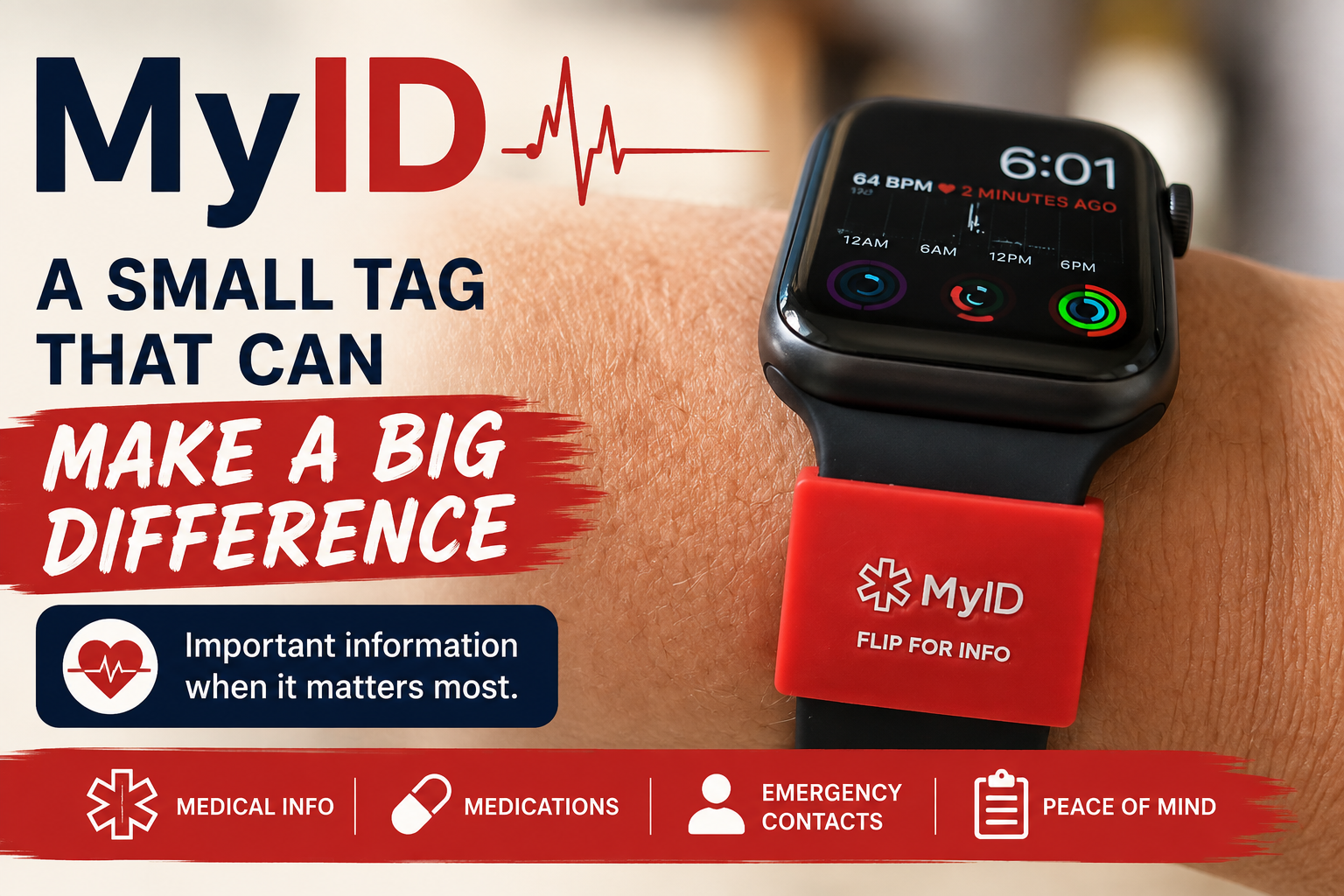
    The version I chose is a small sleeve that slides directly onto my watch band.

    It’s unobtrusive. There’s nothing dangling from my wrist, nothing around my neck, and I don’t have another item I have to remember to put on every morning.

    If I’m wearing my watch, I’m wearing my medical ID.

    For me, that was exactly what I wanted.

    A Small Tag With a Lot of Information

    The MyID sleeve has the recognizable medical ID symbol on the outside.

    On the back is a QR code that can be scanned to access the emergency medical profile I created.

    That profile can contain the information I choose to provide, including things such as:

    • Medical conditions
    • Medications
    • Allergies
    • Personal information
    • Emergency contacts
    • Other important health information

    I like this approach because I’m not trying to cram my entire medical history onto a tiny metal bracelet.

    The tag is simply the doorway to the information.

    The Star of Life Matters

    One thing I especially like about MyID is that it isn’t just a random QR code sitting on my watch band.

    The sleeve displays the Star of Life, the familiar medical identification symbol.

    According to MyID, EMTs are trained to look for this universal medical ID symbol during an emergency assessment. When they see it on a MyID product, it alerts them that medical information may be available through the QR code.

    That was important to me.

    Having all of my information stored in a profile doesn’t do much good if no one knows it’s there.

    The symbol identifies the sleeve as a medical ID, and the QR code provides access to the information I’ve chosen to make available.

    If I can’t speak for myself, the hope is that my MyID can help speak for me.

    Setting It Up Was Easy

    Setting up my profile only took me a few minutes.

    I entered the medical information I wanted available and added my emergency contacts.

    And there’s something about this system that I particularly like:

    If something changes, I don’t need to buy another medical ID.

    I can update the information in my online profile.

    New medication?

    Update it.

    Medication discontinued?

    Update it.

    New diagnosis or important change in my medical history?

    Update it.

    That’s a big advantage over a traditional engraved medical bracelet where the information printed on the bracelet can eventually become outdated.

    Of course, there’s a responsibility that comes with that convenience.

    The information is only as accurate as I make it.

    If something changes and I don’t update my profile, that’s on me.

    There Are More Options Than the One I Chose

    The watch sleeve happened to be the best choice for me, but that isn’t the only style available.

    MyID offers different types of wearable and attachable medical IDs, including bracelets, silicone bands, decorative styles, tags, wristlets, stickers, IDs, and sleeves like the one I use.

    That’s important because not everyone wants to wear the same thing.

    Someone might prefer a traditional bracelet.

    Someone else might want something attached to an item they carry.

    I wanted something on my watch.

    The important part isn’t which style you choose.

    It’s having important information available when you might not be able to provide it yourself.

    Privacy vs. Safety

    This was probably the biggest hurdle for me.

    I spent a lot of time after becoming chronically ill not wanting the world to know that anything was wrong with me.

    I understand that feeling.

    But I’ve also realized that there’s a difference between keeping my health information private from the general public and making sure critical information is available during an emergency.

    I don’t need every person I meet to know my medical history.

    But if I’m lying unconscious somewhere, I absolutely want the people trying to save my life to have as much useful information as possible.

    That changed the way I looked at wearing a medical ID.

    It stopped feeling like a sign announcing that I was sick.

    It became another tool I use to protect myself.

    Interested in MyID?

    The MyID watch sleeve shown in this article is the one I personally use every day. I like that it fits directly on my watch band, stays out of the way, and gives me a way to make important medical and emergency-contact information available if I’m ever unable to provide it myself. If you’d like to take a look at MyID and the options available, you can view it here on Amazon. There are different styles available, so you can choose the type of medical ID that works best for you.

    ❤️ Greg’s Take

    Hopefully, my MyID is something I’ll wear for years and never actually need in an emergency.

    That’s the best possible outcome.

    But I also wear a seat belt every time I get into a car hoping I’ll never need that either.

    For me, this is similar.

    I already wear my watch every day. Sliding a small medical ID onto the band doesn’t inconvenience me, and after a while I barely notice that it’s there.

    But if the day ever comes when I’m unable to speak for myself, that little red sleeve could help point emergency personnel toward information I’ve decided they should know.

    I’d rather have it and never need it than need it once and not have it.

    Suggested Internal Links

    You Are Your Best Advocate


    Product Note

    This article reflects my personal experience with MyID and why I chose to use it. Features, services, product styles, and access methods can change over time, so I recommend checking MyID’s current product information directly before purchasing or relying on any specific feature.

  • But You Don’t Look Sick

    But You Don’t Look Sick

    ”But you don’t look sick”

    I understand why people say it. From the outside, I may appear okay. I can still drive, carry on a conversation, laugh, and have days when I seem like my old self. What people cannot see is how much effort those ordinary things can require—or how physically and emotionally exhausted I may be underneath the surface.

    I live with persistent atrial fibrillation, heart failure, and left bundle branch block. I also have severe arthritis in my hips. Together, these conditions have changed what my body can do and how much energy I have available each day.

    Walking even a short distance can wear me out. The pain in my hips is part of it, but my heart also does not tolerate exertion the way it once did. A rollator or walker can provide support, but using one still requires energy and stamina. Some days, I simply do not have enough of either.

    There are good days, and I try to celebrate them. Lately, though, the difficult days have outnumbered the good ones. That can be hard for other people to understand because chronic illness does not always change the way someone looks.

    People Remember Who You Used to Be

    Friends and family remember the person I was before all of this—the person who could go almost anywhere, work on things around the house, walk through a store, and handle everyday problems without having to calculate the physical cost first.

    I remember that person too. I miss him.

    I want to be able to walk through a grocery store without wondering whether I will make it back to the car. I want to go to Home Depot, find a part, come home, and fix a toilet without turning it into a major undertaking. Those used to be ordinary errands. Now the walking, standing, hip pain, and fatigue can make them impossible.

    My appearance may not have changed dramatically, but the way my body operates has.

    That difference can be difficult for friends, family members, and even strangers to recognize. They see what I look like today and compare it with what they remember me being able to do. They cannot feel my heart working, the weakness in my body, the pain in my hips, or the exhaustion that can arrive without warning.

    No one else can fully know what living inside my body feels like.

    Learning Different Ways to Live

    I have had to find ways around some of these limitations. I order many household items from Amazon. We order groceries through Walmart, and I use curbside pickup so I do not have to walk through the entire store.

    I can still drive, which gives me some independence. The real difficulty usually begins when I have to get out of the car and walk, stand, lift something, or remain active for very long.

    These changes may look like conveniences from the outside, but for me they are adaptations. They allow me to keep participating in life while respecting what my body can currently handle.

    Adapting does not mean I am lazy, and it does not mean I have given up. It means I am learning how to live within limits I never expected to have.

    The Recovery I Expected

    When I learned that I needed my aortic valve replaced, I believed the process would be straightforward: have the procedure, take some time to recover, and eventually return to being myself.

    That is not how things unfolded.

    The valve replacement addressed an important problem, but it did not erase every other condition or return my body to the way it once was. Life still had more challenges waiting for me. I continue to live with heart failure, atrial fibrillation, LBBB, arthritis, fatigue, and uncertainty.

    That realization has been difficult. Recovery is not always a straight line, and a successful procedure does not necessarily mean everything goes back to normal.

    What Comes Next?

    That is a question I ask myself often.

    I do not know exactly what life has in store for me. I know my artificial valve requires lifelong monitoring, and I know my health may continue to change. Some days I wonder whether this is the best I am going to feel. Other days I still hope there are adjustments that could help.

    I am working with my doctors to see whether different medications, treatments, or other changes might improve my symptoms and quality of life. There are no guarantees, but I am not finished looking for answers.

    For now, I take things one day at a time. I adjust. I rest when I need to. I appreciate the good days when they arrive, and I try not to let the difficult ones convince me that there will never be another good one.

    I am not sharing this because I want pity. I am sharing it because appearances rarely tell the entire story.

    Someone can look fine and still be fighting exhaustion, pain, fear, grief, and a body that no longer works the way it once did. If someone tells you they are struggling, believe them—even if they do not look sick.