Tag: Arthritis

  • Daily Journal #17: Good Numbers Don’t Always Mean a Good Day

    Daily Journal #17: Good Numbers Don’t Always Mean a Good Day

    Another rough night of sleep.

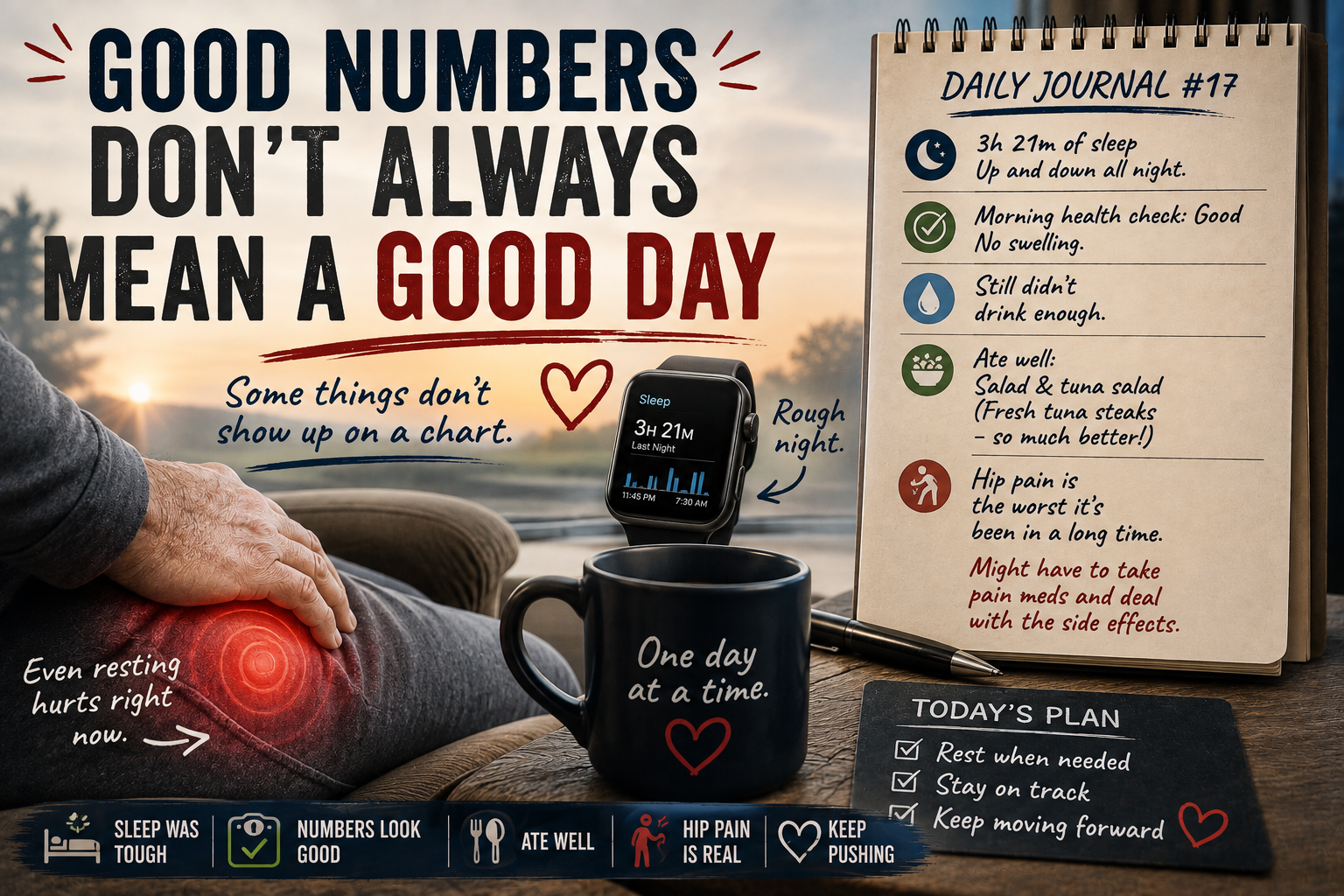
    I was up and down most of the night, and according to my Apple Watch, I managed a whopping 3 hours and 21 minutes of sleep.

    That’s not much.

    I’ll probably end up taking a nap sometime today, which unfortunately feeds into the problem. I sleep during the day because I didn’t sleep at night. Then I’m not tired when nighttime comes around.

    Before I know it, I’ve got my days and nights completely screwed up.

    It sucks.

    I’m still trying to figure out how to break that cycle.

    At Least the Morning Numbers Look Good

    The good news is that my morning health checks continue to look good.

    No swelling this morning.

    Nothing showing me that I’m heading back toward the fluid retention I was dealing with earlier.

    That’s reassuring.

    I’m still not drinking as much as I probably should, though.

    After watching my weight climb and my feet swell recently, I’ve definitely become more hesitant about fluids. I’ve talked about that over the last few days, and apparently my brain hasn’t gotten the memo yet that things have stabilized.

    That’s something I need to continue working on.

    At Least I’m Eating

    I did better with food yesterday.

    I had a salad along with some tuna salad.

    We’ve actually started doing something different with the tuna that has turned out really well.

    Instead of buying canned tuna, we’ve been cooking fresh tuna steaks and using those to make tuna salad.

    What a difference.

    It tastes so much better than canned tuna, and depending on what you’re comparing it with, it can also help me avoid some of the sodium that comes with canned and packaged products.

    This might eventually deserve its own recipe on the site.

    One more thing for the list.

    The Hip Is Another Story

    Unfortunately, while the morning numbers are behaving themselves, my hip definitely isn’t.

    This is probably the most pain I’ve been in for quite a while.

    Usually I can find some position where it settles down a little.

    Right now, even sitting still hurts.

    Sleeping has become difficult too, which certainly isn’t helping my already screwed-up sleep schedule.

    The recliner is still the place where I can get the most comfortable, but even that isn’t particularly comfortable right now.

    And mentally, I hate spending most of my day parked in a recliner.

    I want to get up.

    I want to do things.

    I want to work on the website.

    I want to cook.

    I want to move around the house.

    Instead, my hip keeps reminding me that it gets a vote too.

    Apparently, lately it has veto power.

    The Pain-Medication Trade-Off

    I haven’t taken my pain medication in a while.

    There’s a reason for that.

    Constipation.

    That’s one of the side effects I’ve dealt with, and it’s unpleasant enough that I’ve been trying to avoid the medication whenever possible.

    Usually I can tough it out.

    Right now, I’m getting to the point where I may have to reconsider that.

    There’s only so much pain you can tolerate before the benefit of getting some relief starts outweighing the downside.

    If I do need the medication, then I’ll have to deal with the constipation issue separately.

    Another trade-off.

    Seems like chronic illness comes with a lot of those.

    Fix one problem. Create another problem. Manage both. Repeat.

    ❤️ Greg’s Take

    If you only looked at my morning health checks today, you’d probably say:

    Great day.

    No swelling.

    Numbers look good.

    Fluid retention seems to be under control.

    But those numbers don’t show that I slept 3 hours and 21 minutes.

    They don’t show how much my hip hurts.

    They don’t show that sitting still hurts right now.

    And they don’t show how frustrating it is spending so much time in a recliner because it’s one of the few places where I can get even somewhat comfortable.

    That’s something I’ve learned through all of this.

    Good numbers don’t always mean a good day.

    I’m happy with the numbers.

    Believe me, I want them to stay exactly where they are.

    But today?

    I’m tired.

    My hip hurts like hell.

    And there’s a pretty good chance a nap is in my future.

    Hopefully tomorrow is better.


    Medical Disclaimer

    This journal describes my personal experience living with chronic health conditions, pain and prescribed medications. It is not medical advice. Medication decisions, fluid intake and treatment for pain or other symptoms should be discussed with your own healthcare team. Never start, stop or change a prescribed medication based on my experience.

  • Living With Hip Arthritis: From a Limp to a Walker

    Living With Hip Arthritis: From a Limp to a Walker

    Arthritis has been part of my life for years.

    Like a lot of chronic problems, it didn’t happen all at once. There wasn’t one morning when I woke up and suddenly couldn’t walk.

    It was gradual.

    A little more pain.

    A little more difficulty walking.

    A limp.

    Then a cane.

    And eventually, a walker.

    I have arthritis in both hips, but my right hip is by far the worst.

    The simplest way my doctors have described the right one is:

    Bone on bone.

    There’s essentially no longer the cushioning there that a healthy hip joint should have. With osteoarthritis, the cartilage in the joint progressively wears away, and in severe cases that can eventually result in bone rubbing against bone. 

    I can tell you from experience:

    It hurts exactly as pleasant as it sounds.

    It Didn’t Start With a Walker

    That’s probably the part of this story that’s easiest to forget.

    I didn’t go from walking normally to using a walker overnight.

    For a long time, I just dealt with the pain.

    Then I started limping.

    You compensate.

    You change how you walk.

    You figure out which movements hurt and which ones don’t.

    Without really thinking about it, your entire way of moving starts changing.

    Eventually, the limp wasn’t enough.

    I moved to a cane.

    The cane helped for a while, but as the arthritis continued progressing, there came a point where I needed more support.

    Now I use a walker or rollator.

    Looking backward, I can almost chart the progression of my arthritis by what I needed to get around:

    Walking → Limping → Cane → Walker

    That’s not a progression I ever expected to make.

    What Does “Bone on Bone” Actually Mean?

    The hip is a ball-and-socket joint.

    Normally, cartilage covers the surfaces of the bones and allows the joint to move smoothly.

    With osteoarthritis, that cartilage deteriorates over time. As it becomes increasingly damaged, movement can become painful and stiff. When the cartilage is severely worn away, bone can essentially rub against bone. 

    That’s where my right hip has ended up.

    My left hip has arthritis too.

    It isn’t good.

    It’s just that compared with the right one, the left hip sometimes seems like the good hip.

    That’s a pretty low bar.

    I’ve Tried to Avoid Getting Here

    It isn’t as though my first response to hip pain was:

    “Okay, let’s replace the thing.”

    I’ve tried different approaches over the years hoping to control the pain and keep functioning.

    One of them was radiofrequency nerve ablation.

    The idea was to target nerves involved in transmitting the pain signals.

    I tried it.

    It didn’t provide the lasting relief I was hoping for.

    I also tried stem cell injections.

    Again, I was hoping it might provide some relief and allow me to keep going without surgery.

    It didn’t work for me either.

    That’s an important distinction.

    I’m not saying those treatments will or won’t work for somebody else. I’m only describing my experience.

    For me, neither one changed where this was eventually heading.

    Arthritis Changes More Than Your Hip

    Pain is the obvious part.

    But one thing I don’t think people appreciate until they’ve experienced severe arthritis is how much it changes everyday life.

    Walking through a grocery store becomes difficult.

    Walking through a large store can become impossible.

    Standing for too long hurts.

    Sitting in the wrong chair hurts.

    Getting comfortable at night can be difficult.

    Sometimes even finding a position where the hip isn’t screaming at me becomes a challenge.

    Then there’s something else.

    You start planning your life around distance.

    Where am I parking?

    How far is the entrance?

    How much walking is involved once I get inside?

    Is there somewhere to sit?

    Can I use my walker?

    Do I have enough energy to get back to the car?

    Those weren’t questions I used to ask.

    Now they’re part of leaving the house.

    The Walker Helps — But It Also Creates Another Problem

    The walker gives me stability.

    I need it.

    But there’s an interesting complication in my situation.

    I also have heart failure.

    Using a walker isn’t effortless.

    I’m supporting myself with my arms. I’m pushing the walker. I’m walking while moving another piece of equipment along with me.

    That requires effort.

    And when exertion is already difficult, that additional work matters.

    So I have two problems working against each other.

    My hip says:

    You need the walker.

    My heart says:

    Why are you making me work harder?

    It’s a perfect example of something I’ve written about before:

    Chronic illnesses don’t exist in separate little boxes.

    What helps one problem can make another problem more difficult to manage.

    “Just Walk More” Isn’t Always That Simple

    Walking is good for you.

    I understand that.

    I want to move.

    I want to exercise.

    I want to rebuild my stamina.

    But there’s a big difference between knowing that exercise is beneficial and having a body capable of doing it.

    Walking hurts because of my hip.

    Using the walker requires additional effort.

    Exertion can leave me exhausted.

    Sometimes I have to stop and recover after walking a relatively short distance. Especially recently with the nearly passing out episodes.

    That doesn’t mean I’ve given up on moving.

    It means I’ve had to adjust what movement looks like for me.

    And that’s something I wish more people understood about chronic illness.

    Sometimes doing your best doesn’t look very impressive from the outside.

    Losing Mobility Changes Your Independence

    This may be the hardest part.

    I’ve always been someone who would just do things myself.

    Need something from the store?

    Go get it.

    Something breaks?

    Go to Home Depot, get the part and fix it.

    Walk around a grocery store?

    I wouldn’t have even considered that an activity.

    Now I have to think about all of those things differently.

    Fortunately, I’ve found ways around some of it.

    I can order things online.

    I can use grocery pickup.

    I can drive.

    I can use my walker when I need to go somewhere.

    I’m still doing things.

    I’m just doing them differently.

    And learning to accept that has probably been as difficult as dealing with the physical pain.

    There Is Hopefully an End to This Part of the Story

    My right hip has reached the point where the next step is a total hip replacement.

    That sounds like a major event.

    And it is.

    But at this point, I’m looking forward to it.

    That’s probably a strange thing to say about having a joint surgically replaced.

    But after years of progressively worsening pain, limping, using a cane and eventually needing a walker, the possibility of being able to walk with less pain sounds pretty damn good.

    Hip replacement is a recognized option when severe hip osteoarthritis causes significant pain and loss of function despite other treatment approaches. 

    I’m realistic about it.

    I’m not expecting to wake up after surgery and run a marathon.

    Actually, let’s be honest.

    I wasn’t running a marathon before the arthritis either.

    But I’d love to walk through a grocery store again.

    I’d love to walk into Home Depot and get the part I need.

    I’d love to take a walk without calculating how far I can make it before I need to stop.

    Those sound like little things.

    They’re not little things when you lose them.

    ❤️ Greg’s Take

    One of the strange things about chronic illness is that you don’t always notice how much you’ve lost while you’re losing it.

    You adapt.

    First you limp.

    Then you grab a cane.

    Then the cane isn’t enough, so you get a walker.

    You order your groceries instead of walking through the store.

    You order the part online instead of going to Home Depot.

    You find another way.

    And eventually that new way becomes normal.

    My arthritis didn’t take away my mobility in one dramatic moment.

    It took it a little bit at a time.

    That’s probably what bothers me most when I look back at it.

    But I’m still adapting.

    I’m still moving.

    And hopefully, I’m getting closer to the point where I can start taking some of that mobility back.

    I’ve tried treatments that didn’t work.

    I’ve lived with the pain.

    I’ve progressed from walking normally to a limp, a cane and finally a walker.

    Now I’m getting ready for the next step.

    A new hip.

    I’ve already had the heart plumbing replaced.

    Apparently now we’re moving on to the suspension.

    At this rate, I’m eventually going to be mostly aftermarket parts.

  • Daily Journal #11: A Good Meal, Better Numbers, and… Windex?

    Daily Journal #11: A Good Meal, Better Numbers, and… Windex?

    My morning health checks were good today, which honestly surprised me a little.

    I ate more than I normally do yesterday.

    But dinner was really good.

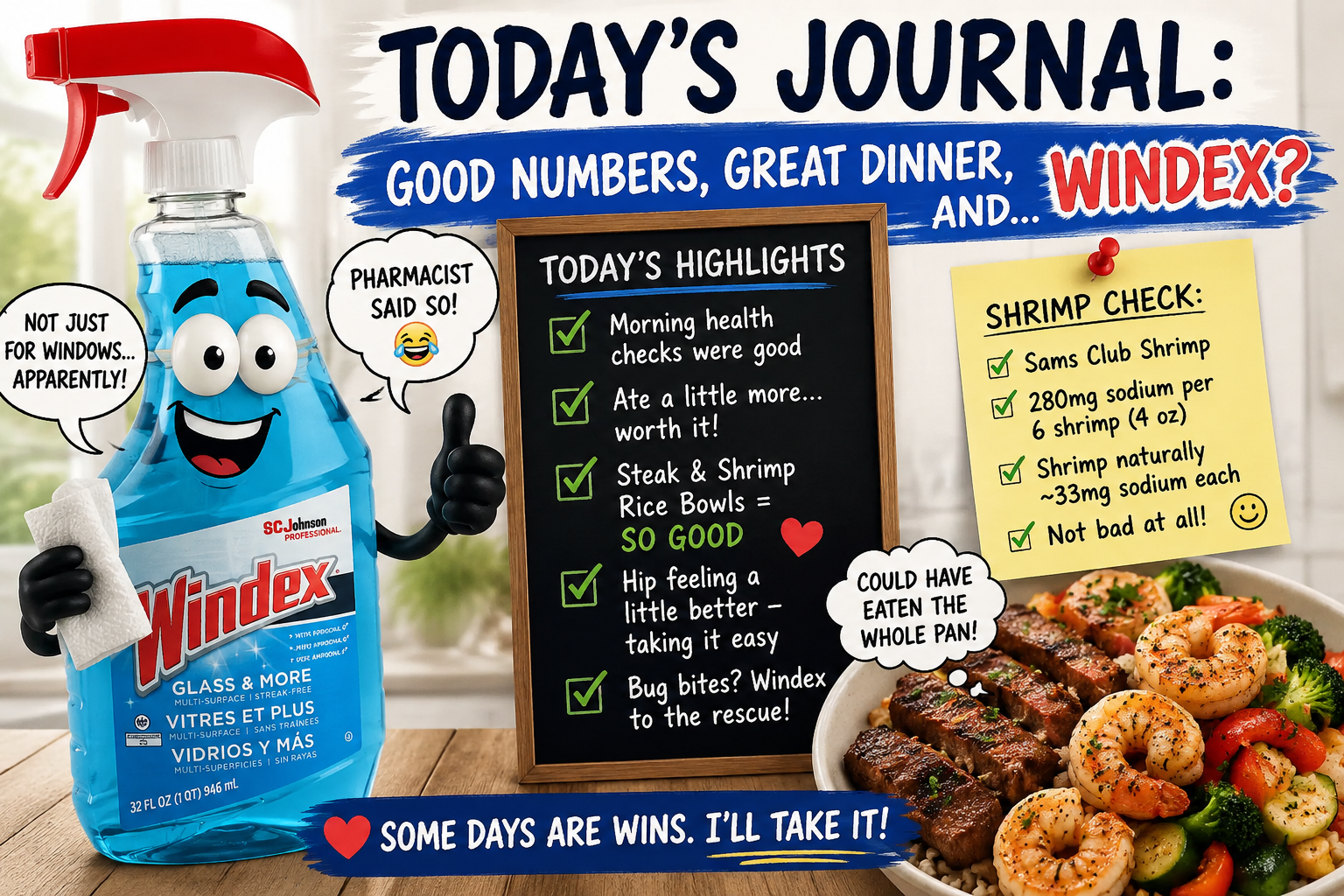
    We made one of my favorite meals: steak and shrimp rice bowls. I probably could have eaten the entire pan if I had let myself.

    I’ll be posting my version of the recipe soon because it’s another meal we’ve been able to adapt to fit my low-sodium lifestyle.

    The steak, seasoning, rice, and vegetables are all pretty easy for me to control.

    The shrimp is where I have to pay attention.

    Not All Shrimp Is the Same

    One thing I’ve learned since watching sodium so closely is that shrimp can be tricky.

    Shrimp naturally contains sodium, but some frozen shrimp can have additional sodium from the way it is processed or packaged. That means I’ve learned to check the nutrition label instead of assuming one bag of shrimp is the same as another.

    This time, I bought shrimp from Sam’s Club.

    The label showed 280 mg of sodium per 4-ounce serving, which was about six shrimp.

    Shrimp already contains naturally occurring sodium, so not all of that 280 mg is necessarily coming from processing. That’s another reason I’ve learned that the nutrition label matters more to me than trying to estimate exactly where every milligram came from.

    It’s something I’ll talk more about when I post the steak and shrimp rice bowl recipe.

    And yes, I promise I’ll try not to eat the whole pan next time.

    The Hip Is a Little Better

    My leg and hip are feeling a little better today.

    They’re certainly not back to normal, but I’ll take any improvement I can get.

    After the last few days of pretty intense pain, I’m going to make today another take-it-easy day and hopefully let things continue to settle down.

    Sometimes knowing when not to push myself is just as important as getting up and moving.

    And Then There’s the Windex…

    The bug bites are also feeling much better.

    And this is where today’s journal gets a little strange.

    We stopped at CVS and asked the pharmacist what I could do about the itching.

    The suggestion?

    Put some Windex on a paper towel and dab it on the bites.

    Yep.

    Windex.

    My first thought was pretty much:

    “You’ve got to be kidding me.”

    I honestly wondered whether everyone behind the pharmacy counter was laughing their butts off after we walked away.

    But I tried it.

    And I’ll be damned…

    It helped.

    I’m certainly not turning He’s Knocking on Your Door into a Windex medical-advice website—and I’m not recommending anyone else try it—but I have to admit that my itching improved.

    Sometimes life with chronic illness is about tracking weight, blood pressure, sodium, medications, and symptoms.

    And apparently, sometimes it’s about leaving CVS wondering how Windex just became part of the day’s story.

    ❤️ Today’s Reflection

    Good health numbers this morning.

    A little less hip pain.

    Bug bites that finally aren’t driving me crazy.

    And a fantastic dinner last night that reminded me that eating low sodium doesn’t mean giving up good food.

    I’ll take those as wins.

    Today I’m going to take it easy, enjoy feeling a little better, and start thinking about getting that steak and shrimp rice bowl recipe onto the site.

    One day at a time.

  • Daily Journal #10: A Take It Easy Day

    The right hip pain is still pretty intense today.

    In fact, it’s bad enough that even getting comfortable has been difficult. No matter how I sit or shift, I can still feel it.

    Yesterday, I did manage to get out for a walk with my rollator. That part felt good. Any time I can get some movement in, I count it as a win.

    Unfortunately, I think the walk may have stirred up the pain in my hip.

    And because apparently that wasn’t enough, I also got eaten alive by mosquitoes or no-see-ums.

    The itching has been absolutely miserable.

    So today I’m dealing with two things at once: a hip that doesn’t want to cooperate and bug bites that won’t stop itching.

    Still, I’m glad I got the walk in.

    That matters.

    My right hip is bone-on-bone, and I’m scheduled for a total right hip replacement. The left hip has problems too, but the right one is definitely the bigger issue.

    Knowing there may be a solution ahead gives me something to look forward to.

    A few more months and, hopefully, this level of pain won’t be part of my everyday life anymore.

    For today, though, the plan is simple.

    Take it easy.

    Get comfortable when I can.

    Let the hip settle down.

    And try not to scratch myself to death from the bug bites.

    Not every day has to be productive.

    Sometimes the smartest thing you can do is listen to your body and give it a chance to recover.

  • You Are Your Best Advocate

    You Are Your Best Advocate

    You Are Your Best Advocate

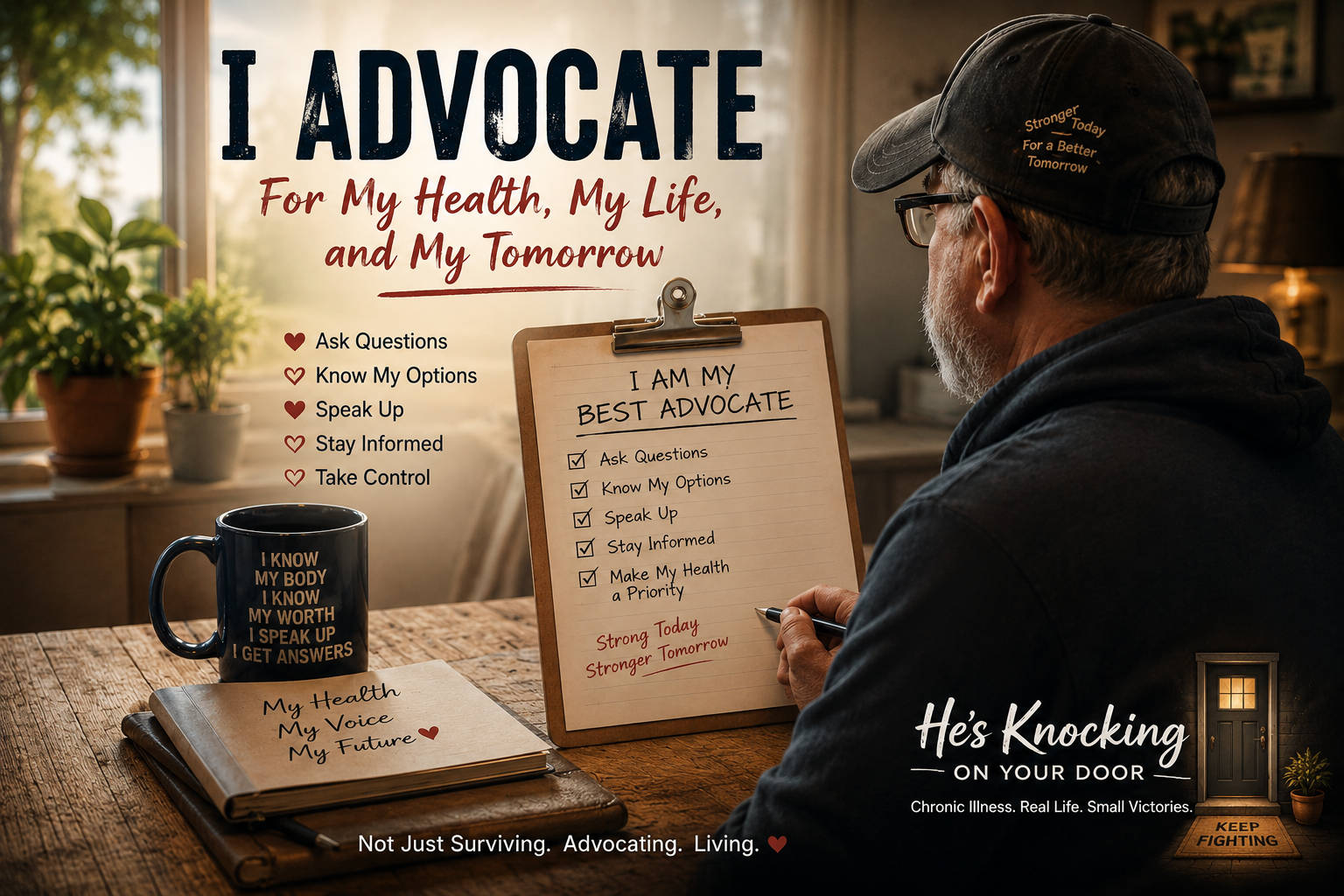
    One thing I’ve learned through this journey is that no one is going to advocate for my health more than I will.

    Living with chronic illnesses means I don’t just have one doctor. I have a cardiologist, nephrologist, primary care physician, specialists, nurses, technicians, pharmacists, therapists, and the occasional emergency room physician. Every one of them is an important part of my healthcare team.

    But they’re exactly that—a team.

    Each of them sees only a piece of the puzzle.

    They may have access to my medical records, but they don’t live in my body. They don’t know how I felt when I walked across the grocery store yesterday. They don’t know that I woke up at 12:30 this morning and never got back to sleep. They don’t know the subtle changes I’ve noticed over the past week unless I tell them.

    That’s why I’ve learned to speak up.

    When I was first diagnosed with congestive heart failure (CHF), atrial fibrillation (AFib), chronic kidney disease (CKD), diabetes, and arthritis, the medical terminology felt like learning a foreign language. I assumed the doctors would simply tell me what to do and everything would work out.

    It doesn’t work that way.

    Healthcare is often a partnership, and partnerships only work when both sides participate.

    I’ve spent countless hours learning about my conditions. I read. I ask questions. I research. Before appointments, I often use ChatGPT to help me understand medical terms, learn about upcoming tests, organize my thoughts, and build a list of questions I want to ask. It doesn’t replace my doctors or medical advice, but it helps me have more informed conversations with them.

    I’ve found that understanding why something is being recommended is just as important as knowing what is being recommended.

    One experience really drove this lesson home.

    During a recent trip to the emergency room, the staff was preparing to start intravenous fluids. That’s a routine treatment for many patients, but because I have congestive heart failure and carefully monitor my fluid intake, I stopped them and explained my situation.

    They listened.

    They reviewed my history.

    The plan changed.

    No one was upset. In fact, it became a reminder that even excellent healthcare professionals are caring for many patients, each with unique medical histories. They simply can’t know every detail unless we tell them.

    That’s why our voice matters.

    Advocating for yourself doesn’t mean arguing with your doctor or pretending you know more than they do. It doesn’t mean refusing treatment because you read something on the internet.

    It means asking questions.

    It means saying, “Can you help me understand why we’re doing this?”

    It means telling them when something doesn’t feel right.

    It means making sure they know about every condition, every medication, every symptom, and every concern.

    I’ve also learned there is a fine line to walk.

    Some medical professionals welcome questions. Others may seem rushed or uncomfortable when patients ask too many. I’ve experienced both. My goal has never been to challenge someone’s expertise or prove them wrong. My goal is much simpler than that.

    I want to understand the decisions being made about my body.

    Because at the end of the day, I live with the consequences—not my doctor.

    If you are living with one chronic illness—or several—don’t be afraid to become a student of your own health. Learn the terminology. Keep good records. Ask respectful questions. Speak up when something doesn’t seem right.

    One habit that has helped me tremendously is keeping notes on my iPhone. Whenever I think of a question, notice a new symptom, experience a side effect, or want to remember something for my next appointment, I open the Notes app and write it down.

    I’ve learned that I never trust my memory anymore. If I don’t write it down, there’s a good chance I’ll forget it when I’m sitting in the exam room. That’s not because I’m getting older—it’s because living with multiple chronic illnesses means there are simply too many things to keep straight in my head.

    By the time I see my doctor, I have an organized list instead of trying to remember everything from memory.

    The same notes are invaluable when a doctor’s office calls unexpectedly. Instead of scrambling to remember what I wanted to ask, I already have my questions, symptoms, medications, and concerns right in front of me. It helps me stay focused and makes sure I don’t forget something important once the conversation starts.

    I’ve found that walking into an appointment prepared not only helps me, but it helps my doctors too. Our conversations become more productive because we’re discussing facts instead of trying to remember details from weeks ago.

    Bring someone with you if it helps, especially if you’re facing an important diagnosis or a difficult decision. Another set of ears can catch details you might miss and help you remember what was discussed after the appointment is over.

    Being your own advocate isn’t about distrusting doctors or challenging every recommendation. It’s about partnership. The best care happens when knowledgeable medical professionals and informed patients work together toward the same goal.

    Your doctors bring years of education and experience.

    You bring the one thing no one else can.

    You live this life every single day.

    That makes your voice one of the most important ones in the room.

    If there’s one thing I hope you take away from my story, it’s this:

    No one will ever care more about your health than you do.

    So ask the question.

    Take the note.

    Speak up.

    Because your voice matters.

  • But You Don’t Look Sick

    But You Don’t Look Sick

    ”But you don’t look sick”

    I understand why people say it. From the outside, I may appear okay. I can still drive, carry on a conversation, laugh, and have days when I seem like my old self. What people cannot see is how much effort those ordinary things can require—or how physically and emotionally exhausted I may be underneath the surface.

    I live with persistent atrial fibrillation, heart failure, and left bundle branch block. I also have severe arthritis in my hips. Together, these conditions have changed what my body can do and how much energy I have available each day.

    Walking even a short distance can wear me out. The pain in my hips is part of it, but my heart also does not tolerate exertion the way it once did. A rollator or walker can provide support, but using one still requires energy and stamina. Some days, I simply do not have enough of either.

    There are good days, and I try to celebrate them. Lately, though, the difficult days have outnumbered the good ones. That can be hard for other people to understand because chronic illness does not always change the way someone looks.

    People Remember Who You Used to Be

    Friends and family remember the person I was before all of this—the person who could go almost anywhere, work on things around the house, walk through a store, and handle everyday problems without having to calculate the physical cost first.

    I remember that person too. I miss him.

    I want to be able to walk through a grocery store without wondering whether I will make it back to the car. I want to go to Home Depot, find a part, come home, and fix a toilet without turning it into a major undertaking. Those used to be ordinary errands. Now the walking, standing, hip pain, and fatigue can make them impossible.

    My appearance may not have changed dramatically, but the way my body operates has.

    That difference can be difficult for friends, family members, and even strangers to recognize. They see what I look like today and compare it with what they remember me being able to do. They cannot feel my heart working, the weakness in my body, the pain in my hips, or the exhaustion that can arrive without warning.

    No one else can fully know what living inside my body feels like.

    Learning Different Ways to Live

    I have had to find ways around some of these limitations. I order many household items from Amazon. We order groceries through Walmart, and I use curbside pickup so I do not have to walk through the entire store.

    I can still drive, which gives me some independence. The real difficulty usually begins when I have to get out of the car and walk, stand, lift something, or remain active for very long.

    These changes may look like conveniences from the outside, but for me they are adaptations. They allow me to keep participating in life while respecting what my body can currently handle.

    Adapting does not mean I am lazy, and it does not mean I have given up. It means I am learning how to live within limits I never expected to have.

    The Recovery I Expected

    When I learned that I needed my aortic valve replaced, I believed the process would be straightforward: have the procedure, take some time to recover, and eventually return to being myself.

    That is not how things unfolded.

    The valve replacement addressed an important problem, but it did not erase every other condition or return my body to the way it once was. Life still had more challenges waiting for me. I continue to live with heart failure, atrial fibrillation, LBBB, arthritis, fatigue, and uncertainty.

    That realization has been difficult. Recovery is not always a straight line, and a successful procedure does not necessarily mean everything goes back to normal.

    What Comes Next?

    That is a question I ask myself often.

    I do not know exactly what life has in store for me. I know my artificial valve requires lifelong monitoring, and I know my health may continue to change. Some days I wonder whether this is the best I am going to feel. Other days I still hope there are adjustments that could help.

    I am working with my doctors to see whether different medications, treatments, or other changes might improve my symptoms and quality of life. There are no guarantees, but I am not finished looking for answers.

    For now, I take things one day at a time. I adjust. I rest when I need to. I appreciate the good days when they arrive, and I try not to let the difficult ones convince me that there will never be another good one.

    I am not sharing this because I want pity. I am sharing it because appearances rarely tell the entire story.

    Someone can look fine and still be fighting exhaustion, pain, fear, grief, and a body that no longer works the way it once did. If someone tells you they are struggling, believe them—even if they do not look sick.