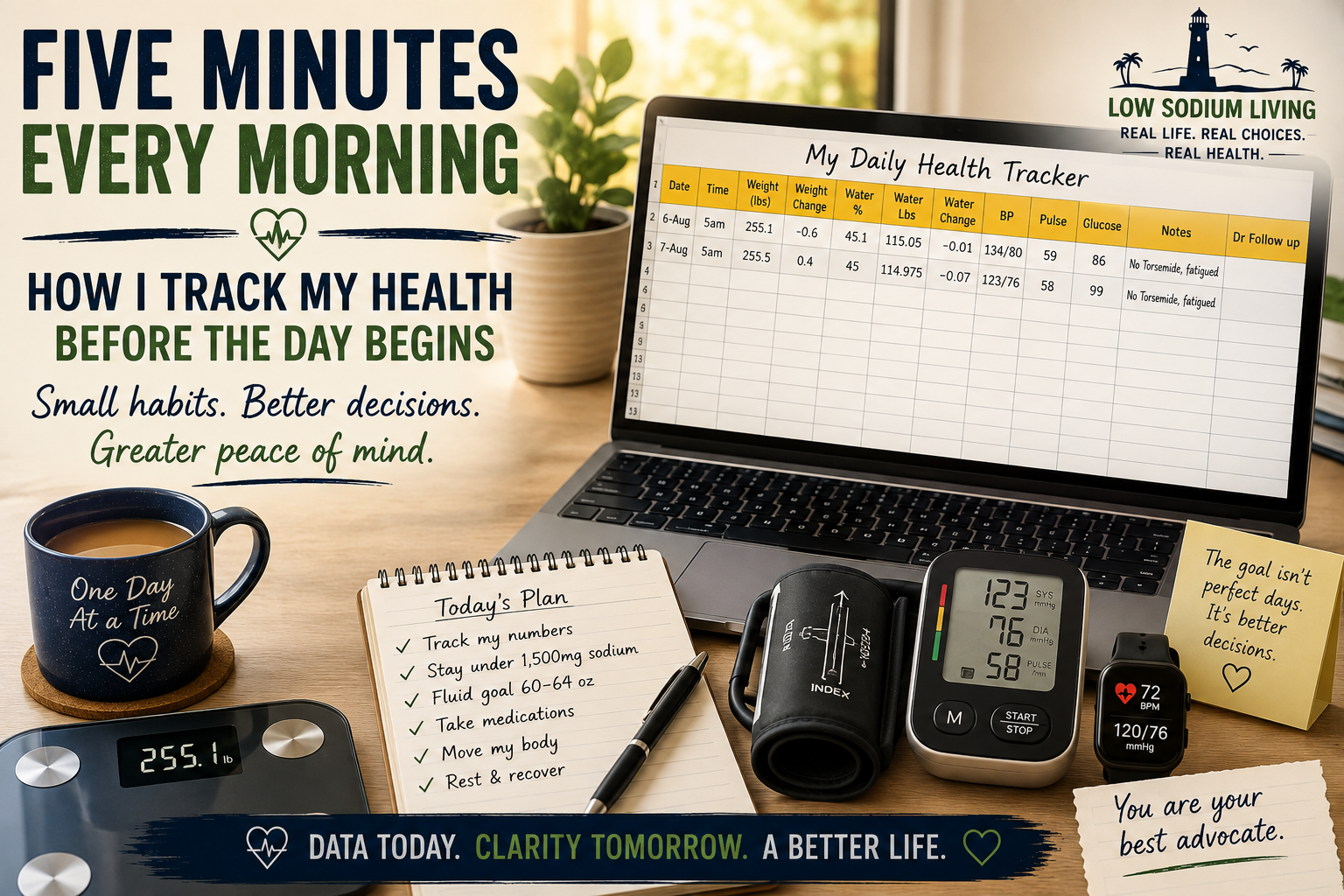
The Five Minutes Every Morning That Help Me Stay Ahead of My CHF
Living with congestive heart failure has taught me something important.
Your body is constantly giving you information.
The question is whether you’re paying attention.
Every morning, before I drink my morning water or begin my day, I spend about five minutes checking in with my body.
To some people, it probably looks like I’m filling out a simple spreadsheet.
To me, it’s much more than that.
It’s an early warning system.
Over time, I’ve learned that it’s much easier to recognize a problem before it becomes serious than it is to recover after the problem has already happened.
That’s why I track my health every single morning.
Not because my doctors told me to.
Because it helps me understand my own body.
One of the most important lessons I’ve learned while living with chronic illness is this:
Nobody will ever know your body as well as you do.
The more information I collect, the better conversations I have with my doctors, and the more confident I feel when something doesn’t seem right.
Download My Daily Health Tracker
If you’d like to use the same spreadsheet I use every morning, I’ve made an example version available for you to download.
📥 Download the Daily Health Tracker (Excel)
Feel free to customize it for your own health conditions. What I track may not be exactly what you need, but hopefully it gives you a good starting point for building your own daily routine.
What I Track Every Morning
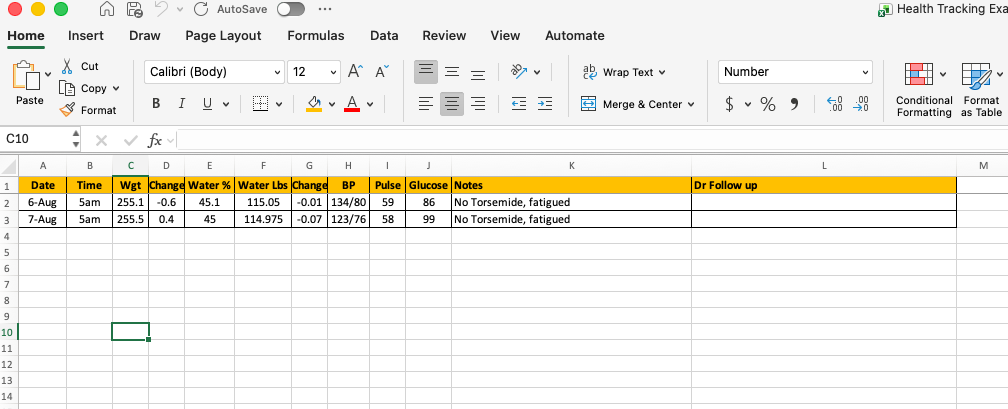
Below is a screenshot of the actual spreadsheet I use every day.
It isn’t complicated.
In fact, that’s intentional.
The easier something is to use, the more likely you’ll continue using it.
Each column serves a purpose, and together they give me a quick snapshot of how my body is doing each morning.
📅 Date
The first column simply records the date.
It sounds obvious, but dates become incredibly important when you’re looking for trends over several days, weeks, or even months.
Sometimes a doctor will ask,
“When did this start?”
Instead of guessing, I simply look back at my spreadsheet.
🕒 Time
I try to record my information at approximately the same time every morning.
For me, that’s usually around 5:00 AM, after using the restroom but before eating breakfast.
Keeping everything consistent makes it easier to compare one day to the next.
⚖️ Weight
Weight is probably the most important number I track.
For someone living with congestive heart failure, sudden weight gain often isn’t body fat.
It’s fluid.
That’s why I weigh myself every morning under the same conditions. After using the washroom and wearing the same type of clothes.
A sudden increase can be one of the earliest signs that my body is retaining fluid.
📈 Daily Weight Change
The next column calculates the difference between today’s weight and yesterday’s.
I’m watching for one thing in particular.
Have I gained 2–3 pounds overnight or about 5 pounds in a week?
Those numbers can be an early warning sign of fluid retention and may indicate that it’s time to contact my healthcare provider.
Instead of trying to remember yesterday’s weight, Excel does the math for me automatically.
💧 Water Percentage
My scale also estimates my body water percentage.
While I know this isn’t a perfect medical measurement, I still find it useful.
The spreadsheet uses that percentage to estimate approximately how many pounds of my body weight are water.
Is it exact?
No.
But it’s another piece of information I can use.
💧 Water Weight Change
This is another calculated field.
It compares today’s estimated water weight to yesterday’s.
Again, I don’t make medical decisions based on this number alone.
Instead, I use it as another indicator alongside my weight, blood pressure, and how I’m feeling that day.
Sometimes several small clues together tell a much bigger story.
❤️ Blood Pressure
Every morning I record my blood pressure.
If I’m feeling unusually tired, dizzy, or lightheaded, this number often helps explain why.
Looking back over weeks or months also helps me recognize trends that a single reading might not reveal.
❤️ Pulse
Since I live with persistent atrial fibrillation, my pulse is another number I pay close attention to.
Knowing what’s normal for me makes it easier to recognize when something feels different.
🍬 Blood Glucose
Because I also have diabetes, I record my morning glucose reading.
Like everything else in this spreadsheet, I’m more interested in trends than any single day’s number.
Consistently improving numbers are much more meaningful than one good morning.
📝 Notes
This might actually be the most valuable column in the entire spreadsheet.
Numbers only tell part of the story.
The notes tell the rest.
This is where I write things like:
- Poor night’s sleep
- Feeling unusually tired
- Increased hip pain
- Didn’t take Torsemide today
- Swelling in my ankles
- Shortness of breath
- Walked farther than usual
Months later, these notes often explain why certain numbers changed.
They’ve become incredibly valuable when preparing for doctor appointments.
👨⚕️ Doctor Follow-Up
The last column is one I added for myself.
Whenever one of my doctors changes a medication or gives me a new instruction, I write it down.
For example:
- Stop taking Torsemide until next appointment.
- Reduce blood pressure medication.
- Repeat blood work in two weeks.
- Schedule MRI.
When you’re seeing multiple specialists, it’s easy to forget exactly when something changed.
Writing it down removes the guesswork.
Why I Spend Five Minutes Every Morning
Some people may look at this spreadsheet and think it seems like a lot of work.
Honestly…
It isn’t.
It takes me about five minutes every morning.
Those five minutes give me peace of mind for the rest of the day.
More importantly, they help me become an active participant in my own healthcare instead of simply reacting when something goes wrong.
One of the biggest lessons I’ve learned is that trends are much more important than individual numbers.
One slightly elevated blood pressure reading usually isn’t a big deal.
Five straight days of gradual weight gain?
That gets my attention.
Having this information also makes my doctor appointments much more productive.
Instead of trying to remember how I’ve been feeling over the past month, I can look back at actual data.
It makes our conversations more meaningful and helps my healthcare team see the bigger picture.
Could This Help You?
I’m not suggesting everyone should track the exact same information I do.
Your health conditions may be completely different from mine.
But I do believe that anyone living with a chronic illness can benefit from keeping some type of health journal.
Whether it’s on paper…
In Excel…
Or through an app…
The important thing is consistency.
Your future self—and your doctors—will appreciate having the information.
Takeaways
One of the biggest things chronic illness has taught me is that good healthcare doesn’t only happen in the doctor’s office.
It happens every morning when I choose to pay attention to my own body.
This little spreadsheet has become much more than a collection of numbers.
It’s helped me recognize patterns before they became problems.
It’s helped me prepare for doctor appointments.
It’s helped me ask better questions.
And most importantly…
It’s helped me become my own best advocate.
For something that only takes about five minutes each morning…
I’d say that’s time well spent.
⚠️ A Note About Pacemakers, ICDs, and Implantable Devices
If you have a pacemaker, ICD (implantable cardioverter-defibrillator), CRT device, or other implanted cardiac device, some consumer smart scales that measure body composition use a small electrical current (bioelectrical impedance analysis, or BIA) to estimate body fat, muscle mass, and body water.
Before using these features, follow the manufacturer’s safety instructions for your specific scale and ask your cardiologist or electrophysiologist if they’re appropriate for you.
If your healthcare team recommends avoiding these measurements, you can still use this tracker by recording your weight and the other health information without using the body composition features.
Medical Disclaimer
This spreadsheet is intended as a personal tracking tool only. It should never replace the advice of your healthcare providers or be used to make medication changes without their guidance.
The information in this article reflects my personal experience living with chronic illnesses, including congestive heart failure, atrial fibrillation, chronic kidney disease, and diabetes. It is shared for educational purposes only and is not medical advice.
Always follow the recommendations of your own healthcare providers regarding medications, diet, fluid restrictions, and health monitoring. If you notice sudden weight gain, worsening shortness of breath, chest pain, fainting, or any other concerning symptoms, contact your healthcare provider or seek emergency medical care as appropriate.
Suggested External Links
- American Heart Association – why daily weight tracking is important for people with heart failure.
- CDC – How to Measure Blood Pressure Correctly
- National Kidney Foundation
Leave a Reply