Tag: Diabetes

  • How I Read a Nutrition Label: Serving Size Changes Everything

    How I Read a Nutrition Label: Serving Size Changes Everything

    I spend a lot more time reading nutrition labels than I ever thought I would.

    Years ago, I might have looked at calories. Maybe carbohydrates. Maybe I wouldn’t have looked at the label at all.

    Things are different now.

    When you’re trying to manage multiple health conditions, that little box on the back of a package suddenly becomes pretty important.

    For me, sodium is usually one of the first things I look at. But I also pay attention to carbohydrates, potassium and phosphorus.

    Before I look at any of those numbers, though, I’ve learned to look at something else first:

    Serving size.

    Because without knowing the serving size, almost every other number on that label can be misleading.

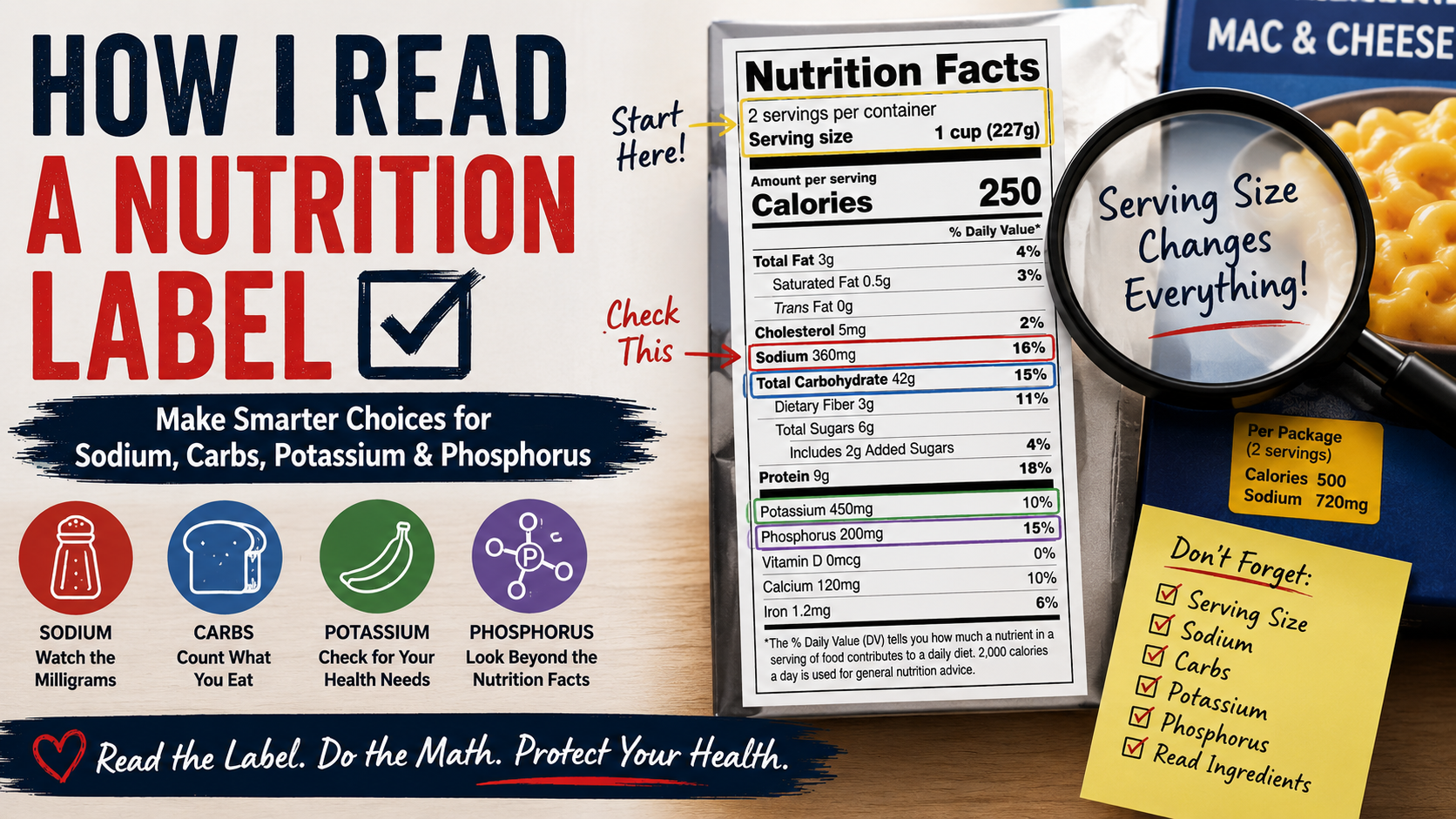
    I Always Start at the Top: Serving Size

    This is probably the biggest lesson I’ve learned from reading nutrition labels.

    The numbers on a Nutrition Facts label are based on the serving size listed at the top.

    That sounds obvious.

    It isn’t always obvious when you’re standing in the kitchen.

    A package may look like something a normal person would eat in one sitting, but the label may consider it two servings.

    If one serving contains 400 mg of sodium and I eat the entire package—and the package contains two servings—I didn’t eat 400 mg of sodium.

    I ate 800 mg.

    The same math applies to carbohydrates and the other nutrients on the label.

    That’s why my eyes go to Serving size and Servings per container before anything else.

    A “Single” Package Isn’t Necessarily a Single Serving

    This one drives me crazy.

    You pick up something that looks like it was clearly packaged for one person.

    A drink.

    A small container of macaroni and cheese.

    A snack.

    A frozen meal or another individually packaged food.

    Your brain naturally thinks:

    One package = one serving.

    Not necessarily.

    Depending on the product and labeling rules, a package can contain more than one labeled serving. Some products that could reasonably be consumed either at once or over multiple occasions may show both per-serving and per-packagenutrition information.

    So I don’t assume anymore.

    If I’m planning to eat the entire container, I want to know the nutrition information for the entire container, not just whatever serving happens to be listed on the front or back.

    Seasonings Can Really Fool You

    Seasonings are another perfect example.

    I’ll pick up a seasoning and immediately look at sodium.

    Maybe it doesn’t look terrible.

    Then I look at the serving size:

    1/4 teaspoon.

    Seriously?

    Have you ever measured 1/4 teaspoon of seasoning?

    It’s almost nothing.

    If that 1/4 teaspoon contains 150 mg of sodium but I actually shake a full teaspoon onto my food, I’ve used four servings.

    That’s 600 mg of sodium.

    Suddenly that innocent-looking seasoning isn’t so innocent.

    That’s why I don’t just ask:

    “How much sodium is in this?”

    I ask:

    “How much sodium is in the amount I’m actually going to use?”

    That’s a completely different question.

    Sodium Is Usually My Next Stop

    Once I understand the serving size, sodium is usually where I go next.

    The Nutrition Facts label lists sodium in milligrams (mg) and also provides a % Daily Value.

    For my own tracking, I tend to concentrate on the milligrams because I’m trying to understand how the food fits into my entire day.

    If something has 300 mg of sodium per serving and I know I’m going to eat two servings, I’m mentally turning that into 600 mg before deciding whether it works for me.

    I’ve learned that the number printed on the label doesn’t matter nearly as much as:

    Number on label × number of servings I actually consume.

    That’s the number I’m really eating.

    “Low Sodium” Has an Actual Meaning

    Another thing I’ve learned is that phrases on the front of a package aren’t all interchangeable.

    “Low sodium” has a defined meaning. Under FDA labeling rules, a food described as low sodium generally contains 140 mg of sodium or less per serving.

    Then there is “sodium free,” which generally means less than 5 mg per serving.

    But here’s one that I think can be confusing:

    “No salt added” does NOT necessarily mean sodium free.

    “No salt added” or “unsalted” generally means salt wasn’t added during processing. The food can still naturally contain sodium, or sodium can potentially come from other ingredients.

    So even when I see NO SALT ADDED printed across the front of a package, I turn it around.

    I still read the Nutrition Facts label.

    Then I Check the Carbohydrates

    Sodium isn’t the only thing I have to think about.

    I also pay close attention to Total Carbohydrate.

    Again, serving size matters.

    If something contains 25 grams of carbohydrates per serving but I eat two servings, I’m eating 50 grams of carbohydrates.

    It’s another reason something being “low sodium” doesn’t automatically make it an unlimited food.

    A product can be excellent from a sodium standpoint and still contain far more carbohydrates than I want in the portion I’m planning to eat.

    That’s why I try not to judge a food by a single number.

    Potassium Is Another Number I Watch

    Potassium is another nutrient I pay attention to.

    This one can get a little trickier because individual potassium needs can vary considerably, particularly when kidney function, medications and other medical conditions enter the picture.

    So I’m not going to give anyone a potassium target.

    That’s something that should be determined with their healthcare team based on their individual circumstances and lab results.

    For me, the important lesson is simply that I look.

    A product that works beautifully in one area might not work as well in another.

    What About Phosphorus?

    Phosphorus can be even trickier.

    It may appear on the Nutrition Facts label, but phosphorus isn’t one of the nutrients that is required to be listed on every Nutrition Facts panel.

    So sometimes I have to go beyond the numbers and look at the ingredient list.

    For people who have been told to monitor phosphorus, ingredients containing “phos” can indicate added phosphorus—for example, certain phosphate additives.

    This is also a good example of why I think “reading the label” means more than reading the Nutrition Facts box.

    Sometimes the ingredient list matters too.

    I Don’t Trust the Front of the Package

    I’ve learned to treat the front of a package as advertising.

    Low sodium!

    Reduced sodium!

    No salt added!

    Heart healthy!

    Those statements may provide useful information, and regulated nutrient claims have specific definitions, but they don’t tell me everything I need to know about whether that food works for me.

    I turn the package around.

    The back is where I make my decision.

    And I always start with the serving size.

    My Quick Label Check

    I’ve gotten into a pretty simple routine:

    1. Serving size — How much food are these numbers actually describing?
    2. Servings per container — Am I realistically going to eat one serving or the whole thing?
    3. Sodium — How many milligrams will be in the portion I’m actually eating?
    4. Total carbohydrates — Again, based on my actual portion.
    5. Potassium — Something I watch based on my own medical needs.
    6. Phosphorus/ingredients — If phosphorus matters, I look beyond the Nutrition Facts panel and check the ingredient list too.
    7. Do the math — If I’m eating two servings, I count two servings of everything.

    That last step is probably the most important.

    The Label Isn’t Wrong — But I Can Read It Wrong

    That’s really the lesson I’ve learned.

    A package may clearly tell me that something has 200 mg of sodium.

    The problem comes when I stop reading before noticing:

    Serving size: 1/2 package.

    If I eat the entire package, that’s 400 mg.

    The same thing happens with carbohydrates.

    And seasonings are probably one of my favorite examples because 1/4 teaspoon can make the sodium number look relatively small when I might actually use several times that amount.

    The label gave me the information.

    I just have to read all of it.

    ❤️ Greg’s Take

    Reading nutrition labels has become second nature to me.

    I’m sure there are people who can walk through a grocery store, throw something into their cart and never turn the package around.

    I can’t do that anymore.

    But I’ve also learned that simply checking sodium isn’t enough.

    I need to know the serving size.

    I need to know how many servings I’m actually going to eat.

    Then I can look at sodium, carbohydrates, potassium and, when appropriate, phosphorus and the ingredient list.

    And I’ve learned never to assume that because something looks like an individual package, the nutrition label treats the entire thing as one serving.

    Read the serving size first.

    Then read everything else.

    Because 200 mg of sodium per serving sounds pretty good until you discover you just ate three servings.

    And that tiny 1/4 teaspoon serving of seasoning?

    Yeah.

    I’m pretty sure nobody has ever looked at my dinner and accused me of under-seasoning it.

    Medical Disclaimer: I am not a doctor or medical professional. This article describes my personal experience how I look at and use nutritional value to monitor my chronic illness. Everyone’s medical situation is different, and my experience should not be used to diagnose or treat a medical condition or determine what someone needs. Always discuss nutrition, symptoms, test results and treatment decisions with your doctor or other qualified healthcare professional. If you experience symptoms that may represent a medical emergency, seek emergency medical care rather than relying upon information on this website.


  • Low Sodium Doesn’t Mean Unlimited

    Low Sodium Doesn’t Mean Unlimited

    One of the biggest lessons I’ve learned is that “low sodium” doesn’t automatically mean “eat as much as you want.”

    Sometimes solving one dietary problem creates another thing you still have to pay attention to.

    That has been especially true for me because I’m not managing just one chronic illness.

    I’m trying to balance congestive heart failure, chronic kidney disease, and diabetes at the same time.

    And some days, honestly, it feels like the rules contradict each other.

    Low Sodium Is Only One Piece of the Puzzle

    Because of my heart failure, sodium is something I pay very close attention to. Too much sodium can contribute to fluid retention, which is one reason people with heart failure may be advised to limit sodium and, in some cases, fluids. The exact limits should come from your healthcare team. 

    But sodium isn’t the only number that matters to me.

    Carbohydrates are another big one because I also have diabetes.

    Lately, my carbohydrate intake has actually been very well controlled.

    Unfortunately, part of the reason is something I’m not particularly proud of:

    I’m sometimes afraid to eat or drink too much.

    I know that sounds messed up.

    But after being hospitalized multiple times, the fear is real.

    Why I’m So Determined to Stay Out of the Hospital

    Hospital stays are particularly difficult for me because of my mobility problems.

    My right hip is bone-on-bone, and I use a walker. That makes me a fall risk.

    When I’m hospitalized, that usually means bed or chair alarms. If I need to get up, I’m supposed to call for assistance.

    That sounds reasonable until you’re receiving IV diuretics.

    When those medications start working and you need to use the bathroom, sometimes you need to go now.

    Waiting for someone to arrive, turn off the alarm, and help you up can be frustrating and uncomfortable.

    Yes, I could simply get up anyway, but in my experience that tends to make the stay even more unpleasant.

    So when I say I’m motivated to avoid another hospitalization, I mean it.

    That fear has definitely influenced the way I eat and drink.

    The strange side effect is that my diabetes numbers have been better because I’m controlling my portions and carbohydrates so carefully.

    That doesn’t mean fear is a good dietary strategy.

    It means I still have work to do finding a healthier balance.

    CHF, CKD and Diabetes Don’t Always Play Nicely Together

    This is where things get complicated.

    With chronic kidney disease, nutrition may involve paying attention to sodium, potassium, phosphorus, protein and sometimes fluids depending on kidney function and lab results. The National Kidney Foundation stresses that these needs vary from person to person and should be individualized. 

    Then heart failure enters the picture.

    My heart-failure plan includes careful sodium and fluid management.

    Then diabetes adds another layer.

    Carbohydrates matter because they affect blood glucose, and portion size matters even when the food itself seems “healthy.” The American Diabetes Association specifically emphasizes being mindful of carbohydrate intake and portioning carbohydrate foods appropriately. 

    That means I can’t simply look at something and ask:

    “Is it low sodium?”

    I also have to ask:

    How many carbohydrates are in it?

    How much potassium?

    How much phosphorus?

    How much fluid?

    How large is the serving?

    And how does it fit with everything else I’m eating that day?

    The Rice Example

    Rice is a perfect example.

    Plain rice is naturally very low in sodium, which makes it attractive for a low-sodium diet.

    But rice is also a carbohydrate food.

    So if I sit down with a giant bowl of rice because it’s “low sodium,” I may solve one problem while creating another for my blood sugar.

    That’s why portion control matters so much to me.

    I can still eat rice.

    I just have to respect what it is.

    Low sodium does not mean unlimited.

    There Probably Isn’t a Magical Food

    I think this is where people can get trapped.

    You find something that has almost no sodium and think:

    Finally! Something I can eat without worrying about it.

    But then you look at the rest of the nutrition label.

    Maybe it’s loaded with carbohydrates.

    Maybe it’s high in potassium.

    Maybe phosphorus becomes an issue for someone with kidney disease.

    Maybe the serving size is much smaller than you thought.

    There usually isn’t one magical food that checks every box for every medical condition.

    And even when something fits your diet beautifully, eating unlimited amounts of it probably isn’t the answer.

    I’m Still Learning

    I want to be clear about something.

    I have not mastered this.

    Not even close.

    I’m still learning how to balance all of these conditions without becoming afraid of food.

    I joke that I’m scared to eat or drink anything.

    The uncomfortable truth is that sometimes the joke isn’t very far from reality.

    That’s something I need to get better at.

    Yes, being more careful has contributed to my weight loss, and I’m happy about that.

    But the goal shouldn’t be to lose weight because I’m frightened to eat.

    The goal is to learn how to eat enough of the right foods, in the right portions, while staying within the limits my healthcare team has given me.

    That’s a much healthier goal.

    Moderation Has Become the Real Lesson

    If there is one thing I’ve learned, it’s this:

    Every food has to be looked at as part of the bigger picture.

    Something can be low sodium and still require portion control.

    Something can be good for diabetes but not ideal for someone who needs to watch potassium.

    Something can fit a kidney-friendly plan but not fit your particular fluid restriction.

    Nutrition becomes much more complicated when several chronic illnesses overlap.

    That’s why I’m trying to stop thinking in terms of:

    Good food. Bad food.

    And start thinking in terms of:

    How does this fit into my overall day?

    Because for me, that’s really what Low Sodium Living has become.

    Not eliminating everything.

    Not eating unlimited amounts of the “safe” foods.

    Just trying to find balance.

    And accepting that I’m still learning how to do it.

    ❤️ Greg’s Take

    Living with multiple chronic illnesses sometimes feels like trying to solve a puzzle where the pieces keep changing.

    CHF tells me to watch sodium and fluids.

    Diabetes tells me to watch carbohydrates.

    CKD means I may also need to pay attention to things like potassium and phosphorus depending on my labs and what my doctors recommend. 

    It can be exhausting.

    But I’m starting to understand that the answer probably isn’t finding the perfect food.

    It’s finding the right balance.

    Low sodium doesn’t mean unlimited.

    Neither does low carb.

    Neither does low potassium.

    Everything still has to fit into the bigger picture.

    And for now, that’s a skill I’m still learning.

    Medical Disclaimer: I am not a doctor or medical professional. The information on this page reflects my own personal experience living with chronic illness and managing my diet and health. What works for me may not be appropriate for someone else. Always talk with your doctor, dietitian, or other qualified healthcare professional before making changes to your diet, medications, fluid intake, or treatment plan.

    This website is intended to share my journey, not to replace professional medical advice.

  • Why We Finally Bought a Rice Cooker

    Why We Finally Bought a Rice Cooker

    Sometimes the best helpful finds aren’t complicated.

    They’re just things that make everyday life a little easier.

    We eat quite a bit of rice in our house. Since I’ve been following a low-sodium diet, rice has become an easy base for a lot of the meals we make at home.

    Plain rice is naturally very low in sodium as long as you’re not adding salt, salty broth, or other high-sodium ingredients while cooking it.

    There’s just one problem.

    You still have to cook it.

    Making rice on the stove certainly isn’t difficult, but you have to watch it, get the water-to-rice ratio right, make sure it doesn’t overcook, and hopefully end up with rice that’s neither crunchy nor mushy.

    Eventually we decided there had to be an easier way.

    So we bought a rice cooker.

    And I’m glad we did.

    Set It and Forget It

    The biggest reason we bought a rice cooker was convenience.

    Put in the rice and water, turn it on, and let the machine take care of the rest.

    There’s no standing over the stove or wondering whether I should turn the heat down.

    Set it and forget it.

    Once the rice is finished, our cooker automatically switches to a keep-warm mode. That means we don’t have to perfectly coordinate the rice with everything else we’re cooking for dinner.

    That may seem like a small thing, but when you’re preparing several things at once, having one less pot to worry about is pretty nice.

    The Rice Comes Out Right

    This might be my favorite part.

    The rice comes out consistently good.

    I’ve made plenty of rice on the stove that was still a little hard when dinner was ready. I’ve also gone the other direction and cooked it too long.

    With the rice cooker, there’s much less guesswork.

    Put everything in, start it, and when it’s finished, we have rice ready for dinner.

    Brown Rice, White Rice and Carbohydrates

    We make both white and brown rice.

    I’ve been using brown rice quite a bit because it provides more fiber than white rice. But that doesn’t mean we’ve eliminated white rice. We still enjoy both depending on what we’re making.

    For me, the bigger consideration is portion size.

    Rice may fit nicely into my low-sodium diet, but it still contains a significant amount of carbohydrates. Because I also have diabetes, I have to pay attention to how much rice I put on my plate.

    That’s an important distinction I’ve learned along the way:

    Low sodium doesn’t automatically mean something is unlimited.

    A food can work very well for one part of my diet while still requiring some thought because of another health condition.

    So I enjoy my rice.

    I just don’t fill half my plate with it.

    Great for the Meals We Make at Home

    Rice has become the base for quite a few meals around here.

    The steak and shrimp rice bowls I recently mentioned in my Daily Journal are a perfect example. We can control the seasoning on the steak, choose our vegetables, pay attention to the sodium in the shrimp, and serve everything over a measured portion of rice.

    I’ll be sharing my version of that recipe on the site soon.

    That’s the kind of cooking I’ve been trying to embrace.

    Instead of focusing entirely on foods I can’t have anymore, I’m finding meals we enjoy and figuring out how to make them work for me.

    The rice cooker simply makes that easier.

    It Doesn’t Take Over the Kitchen

    Another thing I like about rice cookers is that you don’t need a giant appliance.

    They come in several different capacities, so you can choose one based on how much rice you normally make.

    We went with a medium-sized model, which gives us enough capacity without taking up a ridiculous amount of counter or cabinet space.

    If kitchen storage is limited, that’s worth considering.

    Cleanup Takes Almost No Time

    Convenience doesn’t mean much to me if an appliance takes forever to clean.

    Fortunately, ours doesn’t.

    The cooking pot has a nonstick interior, so cleanup is extremely easy. Once we’re finished, it takes very little time to clean the pot and have it ready for the next meal.

    Simple to use.

    Simple to clean.

    And consistently good rice.

    That’s pretty much what I wanted.

    ❤️ Greg’s Take

    Do you absolutely need a rice cooker?

    Of course not.

    You can make perfectly good rice on the stove.

    But that’s not really why I bought one.

    I bought it because it makes life easier.

    Living with chronic illness has made me appreciate things that save a little time and effort. If an appliance can take one job off my plate while we’re making dinner, that’s valuable to me.

    I can put the rice on, walk away, and concentrate on preparing everything else—or just sit down until I need to do something again.

    When dinner is ready, the rice is ready.

    And it’s cooked right.

    Sometimes a Helpful Find doesn’t have to change your life.

    Sometimes it just has to make one little part of it easier.

    The Rice Cooker I Use

    If you’d like to see the rice cooker we purchased, you can find it here:

    See the rice cooker I use on Amazon

    There are different sizes available, so I’d choose the capacity that makes sense for the amount of rice you normally prepare rather than automatically buying the largest one.

    Affiliate Disclosure: This post contains an affiliate link. If you purchase something through my link, I may earn a small commission at no additional cost to you. I only share products that I personally use or believe may be helpful.

    Health Disclaimer: I’m sharing my personal experience and how rice fits into my own eating plan. This is not medical or nutritional advice. Rice is a carbohydrate-containing food and can affect blood glucose. If you have diabetes or another condition requiring dietary management, work with your healthcare provider or dietitian to determine the types and portions of foods that are appropriate for you. Always check nutrition labels and ingredients, particularly on seasoned or prepared rice products.

  • My Health Tracker

    My Health Tracker

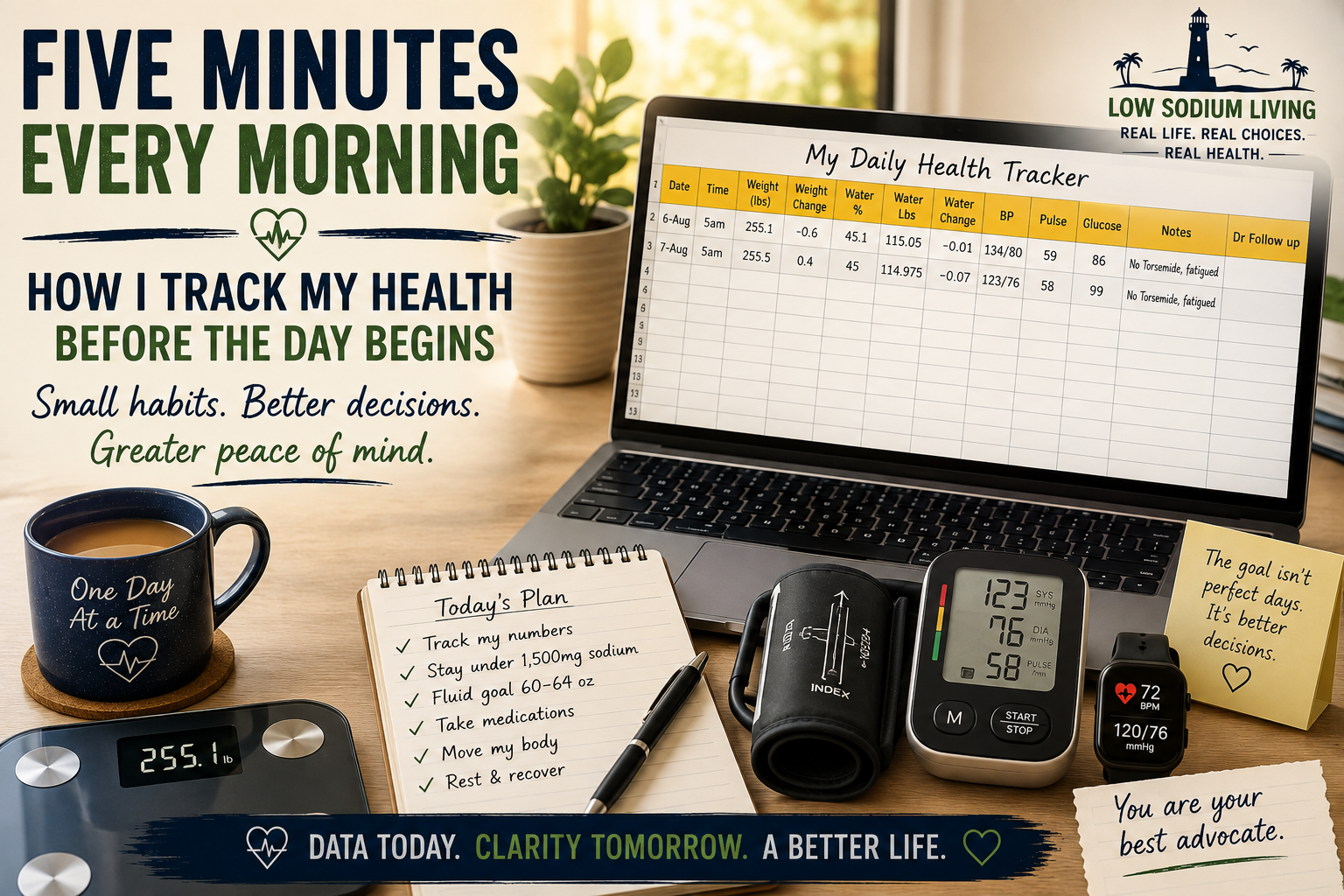
    The Five Minutes Every Morning That Help Me Stay Ahead of My CHF

    Living with congestive heart failure has taught me something important.

    Your body is constantly giving you information.

    The question is whether you’re paying attention.

    Every morning, before I drink my morning water or begin my day, I spend about five minutes checking in with my body.

    To some people, it probably looks like I’m filling out a simple spreadsheet.

    To me, it’s much more than that.

    It’s an early warning system.

    Over time, I’ve learned that it’s much easier to recognize a problem before it becomes serious than it is to recover after the problem has already happened.

    That’s why I track my health every single morning.

    Not because my doctors told me to.

    Because it helps me understand my own body.

    One of the most important lessons I’ve learned while living with chronic illness is this:

    Nobody will ever know your body as well as you do.

    The more information I collect, the better conversations I have with my doctors, and the more confident I feel when something doesn’t seem right.


    Download My Daily Health Tracker

    If you’d like to use the same spreadsheet I use every morning, I’ve made an example version available for you to download.

    📥 Download the Daily Health Tracker (Excel)

    Feel free to customize it for your own health conditions. What I track may not be exactly what you need, but hopefully it gives you a good starting point for building your own daily routine.


    What I Track Every Morning

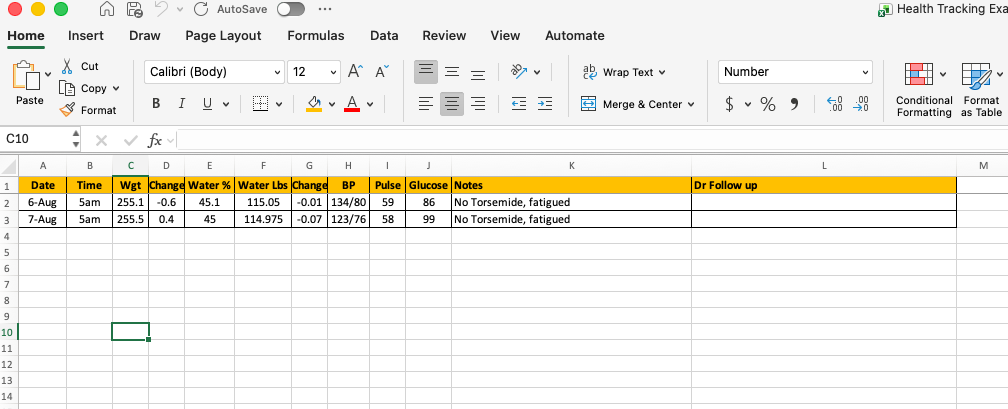
    Below is a screenshot of the actual spreadsheet I use every day.

    Screenshot of the example of the health tracking Excel Sheet that I use

    It isn’t complicated.

    In fact, that’s intentional.

    The easier something is to use, the more likely you’ll continue using it.

    Each column serves a purpose, and together they give me a quick snapshot of how my body is doing each morning.


    📅 Date

    The first column simply records the date.

    It sounds obvious, but dates become incredibly important when you’re looking for trends over several days, weeks, or even months.

    Sometimes a doctor will ask,

    “When did this start?”

    Instead of guessing, I simply look back at my spreadsheet.


    🕒 Time

    I try to record my information at approximately the same time every morning.

    For me, that’s usually around 5:00 AM, after using the restroom but before eating breakfast.

    Keeping everything consistent makes it easier to compare one day to the next.


    ⚖️ Weight

    Weight is probably the most important number I track.

    For someone living with congestive heart failure, sudden weight gain often isn’t body fat.

    It’s fluid.

    That’s why I weigh myself every morning under the same conditions. After using the washroom and wearing the same type of clothes.

    A sudden increase can be one of the earliest signs that my body is retaining fluid.


    📈 Daily Weight Change

    The next column calculates the difference between today’s weight and yesterday’s.

    I’m watching for one thing in particular.

    Have I gained 2–3 pounds overnight or about 5 pounds in a week?

    Those numbers can be an early warning sign of fluid retention and may indicate that it’s time to contact my healthcare provider.

    Instead of trying to remember yesterday’s weight, Excel does the math for me automatically.


    💧 Water Percentage

    My scale also estimates my body water percentage.

    While I know this isn’t a perfect medical measurement, I still find it useful.

    The spreadsheet uses that percentage to estimate approximately how many pounds of my body weight are water.

    Is it exact?

    No.

    But it’s another piece of information I can use.

    If you have a pacemaker, ICD or an implantable device, please see the warning at the bottom of the page on BIA scales.


    💧 Water Weight Change

    This is another calculated field.

    It compares today’s estimated water weight to yesterday’s.

    Again, I don’t make medical decisions based on this number alone.

    Instead, I use it as another indicator alongside my weight, blood pressure, and how I’m feeling that day.

    Sometimes several small clues together tell a much bigger story.


    ❤️ Blood Pressure

    Every morning I record my blood pressure.

    If I’m feeling unusually tired, dizzy, or lightheaded, this number often helps explain why.

    Looking back over weeks or months also helps me recognize trends that a single reading might not reveal.


    ❤️ Pulse

    Since I live with persistent atrial fibrillation, my pulse is another number I pay close attention to.

    Knowing what’s normal for me makes it easier to recognize when something feels different.


    🍬 Blood Glucose

    Because I also have diabetes, I record my morning glucose reading.

    Like everything else in this spreadsheet, I’m more interested in trends than any single day’s number.

    Consistently improving numbers are much more meaningful than one good morning.


    📝 Notes

    This might actually be the most valuable column in the entire spreadsheet.

    Numbers only tell part of the story.

    The notes tell the rest.

    This is where I write things like:

    • Poor night’s sleep
    • Feeling unusually tired
    • Increased hip pain
    • Didn’t take Torsemide today
    • Swelling in my ankles
    • Shortness of breath
    • Walked farther than usual

    Months later, these notes often explain why certain numbers changed.

    They’ve become incredibly valuable when preparing for doctor appointments.


    👨‍⚕️ Doctor Follow-Up

    The last column is one I added for myself.

    Whenever one of my doctors changes a medication or gives me a new instruction, I write it down.

    For example:

    • Stop taking Torsemide until next appointment.
    • Reduce blood pressure medication.
    • Repeat blood work in two weeks.
    • Schedule MRI.

    When you’re seeing multiple specialists, it’s easy to forget exactly when something changed.

    Writing it down removes the guesswork.


    Why I Spend Five Minutes Every Morning

    Some people may look at this spreadsheet and think it seems like a lot of work.

    Honestly…

    It isn’t.

    It takes me about five minutes every morning.

    Those five minutes give me peace of mind for the rest of the day.

    More importantly, they help me become an active participant in my own healthcare instead of simply reacting when something goes wrong.

    One of the biggest lessons I’ve learned is that trends are much more important than individual numbers.

    One slightly elevated blood pressure reading usually isn’t a big deal.

    Five straight days of gradual weight gain?

    That gets my attention.

    Having this information also makes my doctor appointments much more productive.

    Instead of trying to remember how I’ve been feeling over the past month, I can look back at actual data.

    It makes our conversations more meaningful and helps my healthcare team see the bigger picture.


    Could This Help You?

    I’m not suggesting everyone should track the exact same information I do.

    Your health conditions may be completely different from mine.

    But I do believe that anyone living with a chronic illness can benefit from keeping some type of health journal.

    Whether it’s on paper…

    In Excel…

    Or through an app…

    The important thing is consistency.

    Your future self—and your doctors—will appreciate having the information.


    Takeaways

    One of the biggest things chronic illness has taught me is that good healthcare doesn’t only happen in the doctor’s office.

    It happens every morning when I choose to pay attention to my own body.

    This little spreadsheet has become much more than a collection of numbers.

    It’s helped me recognize patterns before they became problems.

    It’s helped me prepare for doctor appointments.

    It’s helped me ask better questions.

    And most importantly…

    It’s helped me become my own best advocate.

    For something that only takes about five minutes each morning…

    I’d say that’s time well spent.

    ⚠️ A Note About Pacemakers, ICDs, and Implantable Devices

    If you have a pacemaker, ICD (implantable cardioverter-defibrillator), CRT device, or other implanted cardiac device, some consumer smart scales that measure body composition use a small electrical current (bioelectrical impedance analysis, or BIA) to estimate body fat, muscle mass, and body water.

    Before using these features, follow the manufacturer’s safety instructions for your specific scale and ask your cardiologist or electrophysiologist if they’re appropriate for you.

    If your healthcare team recommends avoiding these measurements, you can still use this tracker by recording your weight and the other health information without using the body composition features.

    Medical Disclaimer

    This spreadsheet is intended as a personal tracking tool only. It should never replace the advice of your healthcare providers or be used to make medication changes without their guidance.

    The information in this article reflects my personal experience living with chronic illnesses, including congestive heart failure, atrial fibrillation, chronic kidney disease, and diabetes. It is shared for educational purposes only and is not medical advice.

    Always follow the recommendations of your own healthcare providers regarding medications, diet, fluid restrictions, and health monitoring. If you notice sudden weight gain, worsening shortness of breath, chest pain, fainting, or any other concerning symptoms, contact your healthcare provider or seek emergency medical care as appropriate.

    Suggested External Links

  • You Are Your Best Advocate

    You Are Your Best Advocate

    You Are Your Best Advocate

    One thing I’ve learned through this journey is that no one is going to advocate for my health more than I will.

    Living with chronic illnesses means I don’t just have one doctor. I have a cardiologist, nephrologist, primary care physician, specialists, nurses, technicians, pharmacists, therapists, and the occasional emergency room physician. Every one of them is an important part of my healthcare team.

    But they’re exactly that—a team.

    Each of them sees only a piece of the puzzle.

    They may have access to my medical records, but they don’t live in my body. They don’t know how I felt when I walked across the grocery store yesterday. They don’t know that I woke up at 12:30 this morning and never got back to sleep. They don’t know the subtle changes I’ve noticed over the past week unless I tell them.

    That’s why I’ve learned to speak up.

    When I was first diagnosed with congestive heart failure (CHF), atrial fibrillation (AFib), chronic kidney disease (CKD), diabetes, and arthritis, the medical terminology felt like learning a foreign language. I assumed the doctors would simply tell me what to do and everything would work out.

    It doesn’t work that way.

    Healthcare is often a partnership, and partnerships only work when both sides participate.

    I’ve spent countless hours learning about my conditions. I read. I ask questions. I research. Before appointments, I often use ChatGPT to help me understand medical terms, learn about upcoming tests, organize my thoughts, and build a list of questions I want to ask. It doesn’t replace my doctors or medical advice, but it helps me have more informed conversations with them.

    I’ve found that understanding why something is being recommended is just as important as knowing what is being recommended.

    One experience really drove this lesson home.

    During a recent trip to the emergency room, the staff was preparing to start intravenous fluids. That’s a routine treatment for many patients, but because I have congestive heart failure and carefully monitor my fluid intake, I stopped them and explained my situation.

    They listened.

    They reviewed my history.

    The plan changed.

    No one was upset. In fact, it became a reminder that even excellent healthcare professionals are caring for many patients, each with unique medical histories. They simply can’t know every detail unless we tell them.

    That’s why our voice matters.

    Advocating for yourself doesn’t mean arguing with your doctor or pretending you know more than they do. It doesn’t mean refusing treatment because you read something on the internet.

    It means asking questions.

    It means saying, “Can you help me understand why we’re doing this?”

    It means telling them when something doesn’t feel right.

    It means making sure they know about every condition, every medication, every symptom, and every concern.

    I’ve also learned there is a fine line to walk.

    Some medical professionals welcome questions. Others may seem rushed or uncomfortable when patients ask too many. I’ve experienced both. My goal has never been to challenge someone’s expertise or prove them wrong. My goal is much simpler than that.

    I want to understand the decisions being made about my body.

    Because at the end of the day, I live with the consequences—not my doctor.

    If you are living with one chronic illness—or several—don’t be afraid to become a student of your own health. Learn the terminology. Keep good records. Ask respectful questions. Speak up when something doesn’t seem right.

    One habit that has helped me tremendously is keeping notes on my iPhone. Whenever I think of a question, notice a new symptom, experience a side effect, or want to remember something for my next appointment, I open the Notes app and write it down.

    I’ve learned that I never trust my memory anymore. If I don’t write it down, there’s a good chance I’ll forget it when I’m sitting in the exam room. That’s not because I’m getting older—it’s because living with multiple chronic illnesses means there are simply too many things to keep straight in my head.

    By the time I see my doctor, I have an organized list instead of trying to remember everything from memory.

    The same notes are invaluable when a doctor’s office calls unexpectedly. Instead of scrambling to remember what I wanted to ask, I already have my questions, symptoms, medications, and concerns right in front of me. It helps me stay focused and makes sure I don’t forget something important once the conversation starts.

    I’ve found that walking into an appointment prepared not only helps me, but it helps my doctors too. Our conversations become more productive because we’re discussing facts instead of trying to remember details from weeks ago.

    Bring someone with you if it helps, especially if you’re facing an important diagnosis or a difficult decision. Another set of ears can catch details you might miss and help you remember what was discussed after the appointment is over.

    Being your own advocate isn’t about distrusting doctors or challenging every recommendation. It’s about partnership. The best care happens when knowledgeable medical professionals and informed patients work together toward the same goal.

    Your doctors bring years of education and experience.

    You bring the one thing no one else can.

    You live this life every single day.

    That makes your voice one of the most important ones in the room.

    If there’s one thing I hope you take away from my story, it’s this:

    No one will ever care more about your health than you do.

    So ask the question.

    Take the note.

    Speak up.

    Because your voice matters.