That was actually reassuring because yesterday I had to drink 32 ounces — a full quart — of water before my MRI.
With the way I normally monitor my fluid intake, that is a lot of water to drink in a short period of time.
So I was curious what the scale and my body-water reading would look like this morning.
Thankfully, there was no sign that I was retaining that extra fluid.
Everything looked good.
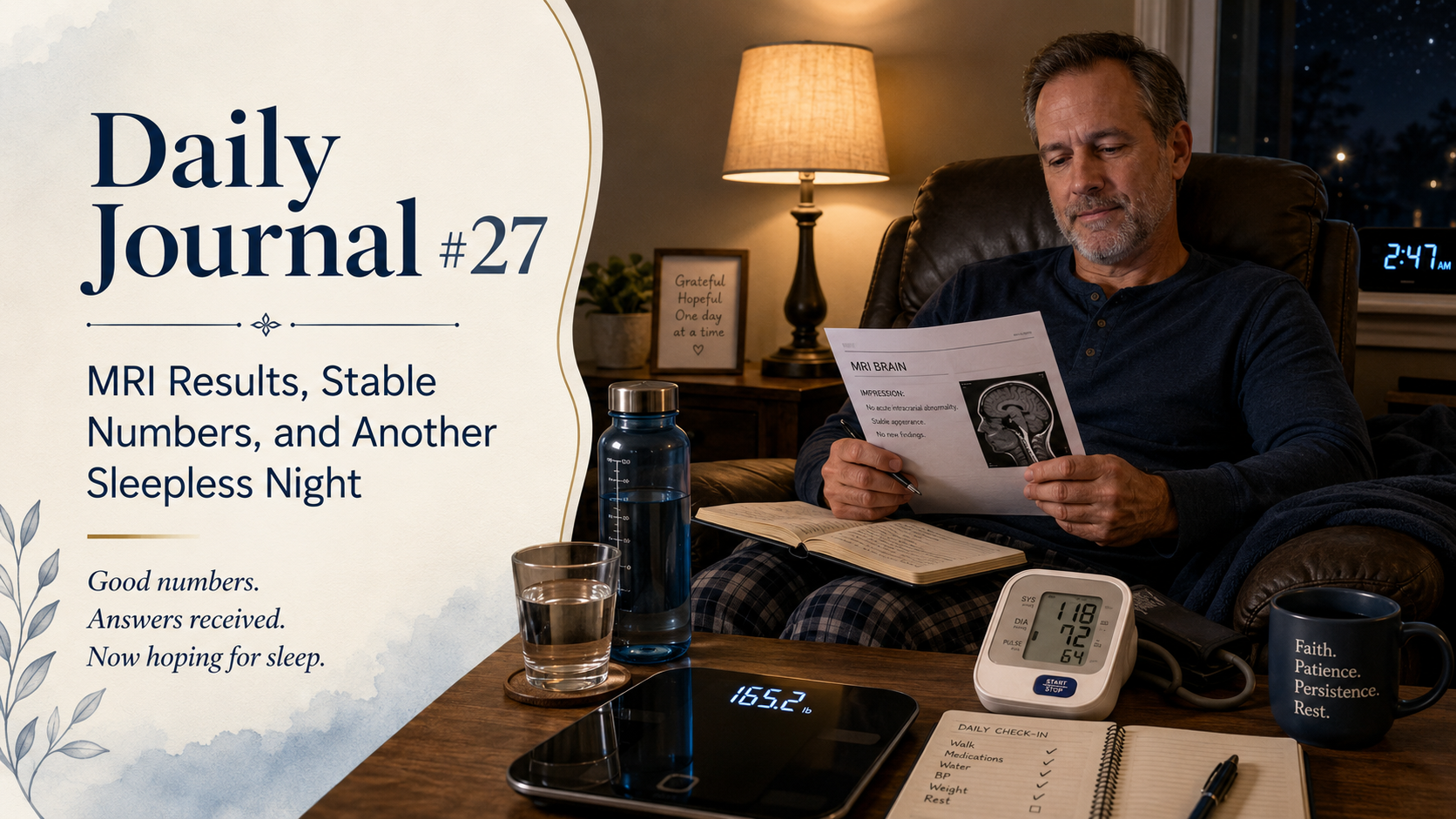
The MRI Results Are In
I also received the results from yesterday’s kidney MRI.
And thankfully, there really wasn’t anything unexpected.
We already knew that my right kidney is not functioning efficiently, and the MRI confirmed that picture.
There were also a couple of cysts noted on the left kidney, but the important part is that the left kidney is filtering well.
From what I understand from the results and my previous conversations with my nephrologist, there wasn’t anything there that suddenly changed the picture or gave me a new reason to panic.
That is a huge relief.
I’ve spent a lot of time worrying about this over the last few months.
The acute kidney injury.
The ultrasound.
The nephrology appointments.
The blood work.
Then waiting for the MRI.
Your mind can create a lot of terrible possibilities when you are waiting for answers.
Now I finally have the more detailed imaging.
Nothing unexpected.
I’ll take that.
Hopefully this means we can start putting this entire AKI episode behind me.
Unfortunately, Sleep Is Another Story
The kidneys may have given me some good news today.
Sleep did not.
I basically didn’t sleep at all last night.
Again.
The insomnia is getting really old.
There is tired, and then there is the kind of tired you get after lying awake most of the night knowing that you desperately need sleep.
Today I am beat.
Not much energy.
Not much motivation.
My brain feels tired.
My body feels tired.
Everything feels tired.
So tonight I’m not going to fight it.
I’m planning on going to bed early and hoping my body finally decides to cooperate.
A Good Day to Take the Win
Today wasn’t particularly exciting.
But considering what I’ve been worrying about lately, boring is actually pretty good.
My health numbers were good.
My weight stayed stable even after all the water I had to drink for the MRI.
The MRI didn’t reveal some new surprise.
My left kidney is still doing its job.
The biggest problem today is that I’m exhausted.
I can live with that for a day.
Hopefully tonight I finally get some sleep.
Medical Disclaimer
This journal reflects my personal health experience and my understanding of medical testing performed as part of the treatment plan developed by my healthcare providers. Nothing in this article should be considered medical advice, diagnosis, or an interpretation of anyone else’s kidney imaging or laboratory results. Kidney cysts, reduced kidney function, acute kidney injury, changes in fluid balance, and sleep problems can have many different causes and should be evaluated in the context of an individual’s complete medical history. Always discuss imaging results, kidney function, symptoms, medications, fluid recommendations, and treatment decisions with your own qualified healthcare professionals.
And my body-water reading was basically unchanged.
So overall, another good start to the day.
Then came the part I had been waiting for.
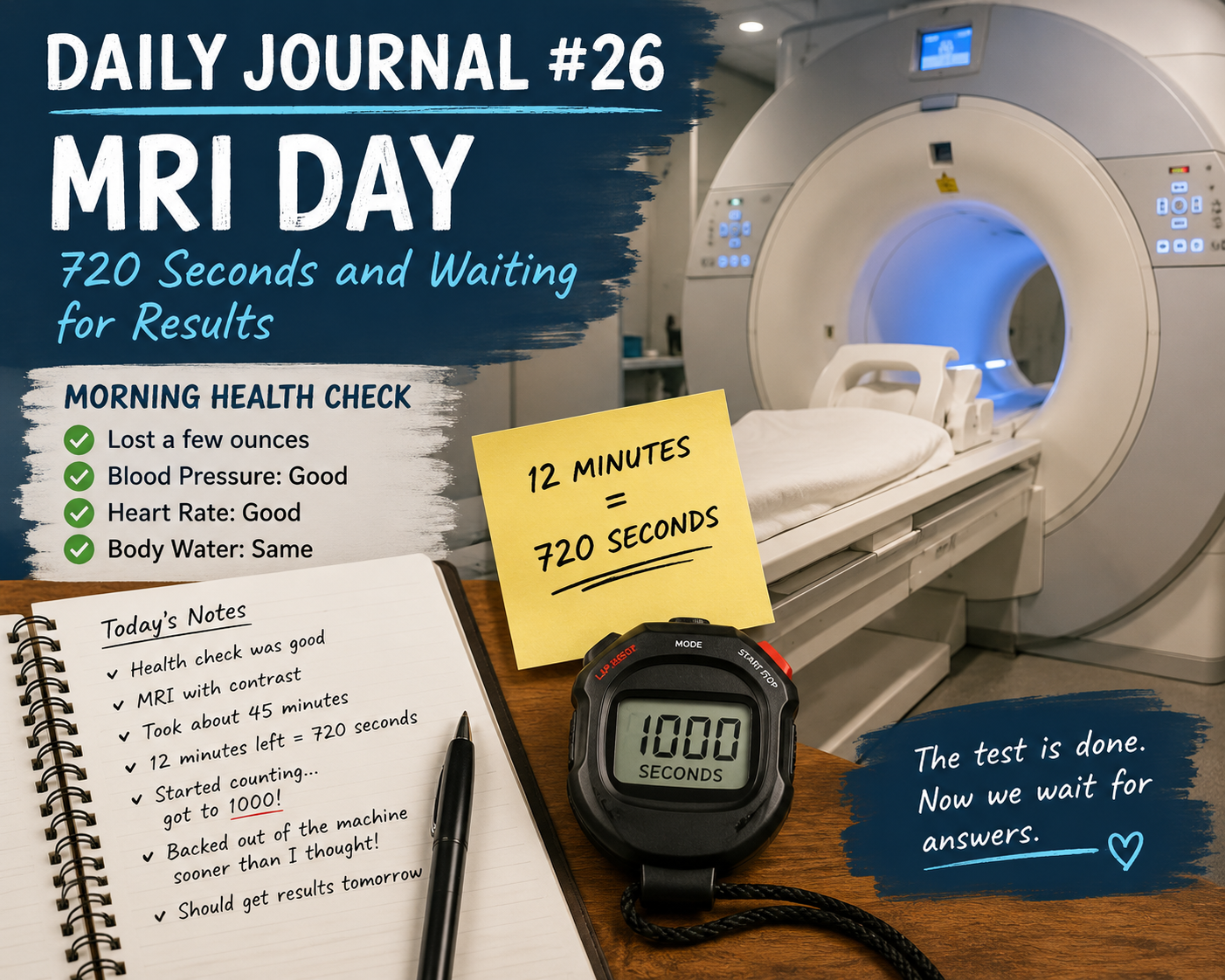
MRI Day
I had the kidney MRI today.
I had forgotten just how loud those machines are.
And how confined they feel.
Even when you know exactly what is happening, lying inside that tube for an extended period of time is still a strange experience.
The entire MRI took about 45 minutes.
This one was done with contrast.
At one point, after they gave me the contrast, the technologist told me I had about 12 minutes left.
Okay.
Twelve minutes.
My brain immediately did the math.
720 seconds.
So I started counting.
One.
Two.
Three.
Four.
Eventually I got to 1,000.
At that point I remember thinking:
I think she lied to me.
Apparently my internal clock is not nearly as accurate as I thought.
Not long after that, they started moving me back out of the machine.
So maybe she didn’t lie after all.
A Very Different MRI Experience
Something else surprised me today.
The last time I had an MRI, I barely fit inside the machine.
There wasn’t much room at all.
Today?
I still wasn’t exactly swimming around in there, but there was noticeably more space.
That was one of those little reminders of how much my body has changed.
When you lose weight gradually, sometimes you don’t really notice the difference from one day to the next.
Then something happens that gives you a comparison to the old version of yourself.
For me today, it was fitting inside an MRI machine with room to spare.
I’ll take it.
Now We Wait
The MRI is done.
That is the important part.
Now no more anticipating it.
No more wondering what it is going to be like.
No more mentally building it up.
Now I just wait for the results.
I should hopefully have them tomorrow.
After all of the kidney questions over the last few months, the ultrasound, the nephrology appointments, the blood work, and now the MRI, I’m hoping this gives us the detailed answer we’ve been waiting for.
For tonight, though, there isn’t much else I can do.
The test is finished.
The numbers this morning were good.
And tomorrow should hopefully bring some answers.
Medical Disclaimer
This journal reflects my personal health experience and the testing plan developed specifically for me by my healthcare providers. Nothing in this article should be considered medical advice, diagnosis, or a recommendation regarding MRI testing, contrast agents, kidney disease, fluid intake, medications, or treatment. MRI procedures and the use of contrast can vary depending on a person’s medical history and the purpose of the examination. Always follow the instructions provided by your own healthcare team and radiology department, and discuss any concerns about imaging or contrast with qualified healthcare professionals.
One of the biggest lessons I’ve learned is that “low sodium” doesn’t automatically mean “eat as much as you want.”
Sometimes solving one dietary problem creates another thing you still have to pay attention to.
That has been especially true for me because I’m not managing just one chronic illness.
I’m trying to balance congestive heart failure, chronic kidney disease, and diabetes at the same time.
And some days, honestly, it feels like the rules contradict each other.
Low Sodium Is Only One Piece of the Puzzle
Because of my heart failure, sodium is something I pay very close attention to. Too much sodium can contribute to fluid retention, which is one reason people with heart failure may be advised to limit sodium and, in some cases, fluids. The exact limits should come from your healthcare team.
But sodium isn’t the only number that matters to me.
Carbohydrates are another big one because I also have diabetes.
Lately, my carbohydrate intake has actually been very well controlled.
Unfortunately, part of the reason is something I’m not particularly proud of:
I’m sometimes afraid to eat or drink too much.
I know that sounds messed up.
But after being hospitalized multiple times, the fear is real.
Why I’m So Determined to Stay Out of the Hospital
Hospital stays are particularly difficult for me because of my mobility problems.
My right hip is bone-on-bone, and I use a walker. That makes me a fall risk.
When I’m hospitalized, that usually means bed or chair alarms. If I need to get up, I’m supposed to call for assistance.
That sounds reasonable until you’re receiving IV diuretics.
When those medications start working and you need to use the bathroom, sometimes you need to go now.
Waiting for someone to arrive, turn off the alarm, and help you up can be frustrating and uncomfortable.
Yes, I could simply get up anyway, but in my experience that tends to make the stay even more unpleasant.
So when I say I’m motivated to avoid another hospitalization, I mean it.
That fear has definitely influenced the way I eat and drink.
The strange side effect is that my diabetes numbers have been better because I’m controlling my portions and carbohydrates so carefully.
That doesn’t mean fear is a good dietary strategy.
It means I still have work to do finding a healthier balance.
CHF, CKD and Diabetes Don’t Always Play Nicely Together
This is where things get complicated.
With chronic kidney disease, nutrition may involve paying attention to sodium, potassium, phosphorus, protein and sometimes fluids depending on kidney function and lab results. The National Kidney Foundation stresses that these needs vary from person to person and should be individualized.
Then heart failure enters the picture.
My heart-failure plan includes careful sodium and fluid management.
Then diabetes adds another layer.
Carbohydrates matter because they affect blood glucose, and portion size matters even when the food itself seems “healthy.” The American Diabetes Association specifically emphasizes being mindful of carbohydrate intake and portioning carbohydrate foods appropriately.
That means I can’t simply look at something and ask:
“Is it low sodium?”
I also have to ask:
How many carbohydrates are in it?
How much potassium?
How much phosphorus?
How much fluid?
How large is the serving?
And how does it fit with everything else I’m eating that day?
The Rice Example
Rice is a perfect example.
Plain rice is naturally very low in sodium, which makes it attractive for a low-sodium diet.
But I’m starting to understand that the answer probably isn’t finding the perfect food.
It’s finding the right balance.
Low sodium doesn’t mean unlimited.
Neither does low carb.
Neither does low potassium.
Everything still has to fit into the bigger picture.
And for now, that’s a skill I’m still learning.
Medical Disclaimer: I am not a doctor or medical professional. The information on this page reflects my own personal experience living with chronic illness and managing my diet and health. What works for me may not be appropriate for someone else. Always talk with your doctor, dietitian, or other qualified healthcare professional before making changes to your diet, medications, fluid intake, or treatment plan.
This website is intended to share my journey, not to replace professional medical advice.
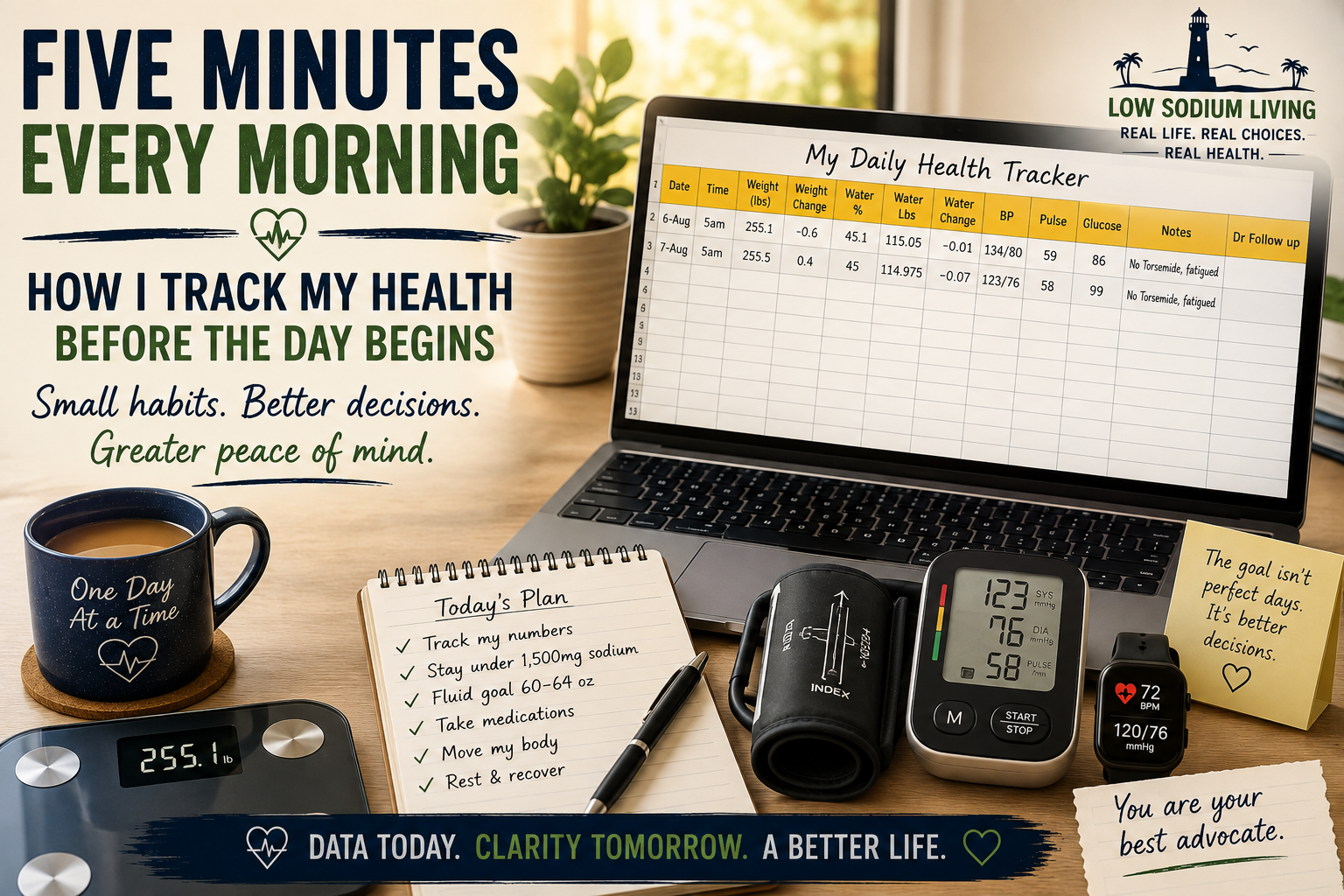
The Five Minutes Every Morning That Help Me Stay Ahead of My CHF
Living with congestive heart failure has taught me something important.
Your body is constantly giving you information.
The question is whether you’re paying attention.
Every morning, before I drink my morning water or begin my day, I spend about five minutes checking in with my body.
To some people, it probably looks like I’m filling out a simple spreadsheet.
To me, it’s much more than that.
It’s an early warning system.
Over time, I’ve learned that it’s much easier to recognize a problem before it becomes serious than it is to recover after the problem has already happened.
That’s why I track my health every single morning.
Not because my doctors told me to.
Because it helps me understand my own body.
One of the most important lessons I’ve learned while living with chronic illness is this:
Nobody will ever know your body as well as you do.
The more information I collect, the better conversations I have with my doctors, and the more confident I feel when something doesn’t seem right.
Download My Daily Health Tracker
If you’d like to use the same spreadsheet I use every morning, I’ve made an example version available for you to download.
Feel free to customize it for your own health conditions. What I track may not be exactly what you need, but hopefully it gives you a good starting point for building your own daily routine.
What I Track Every Morning
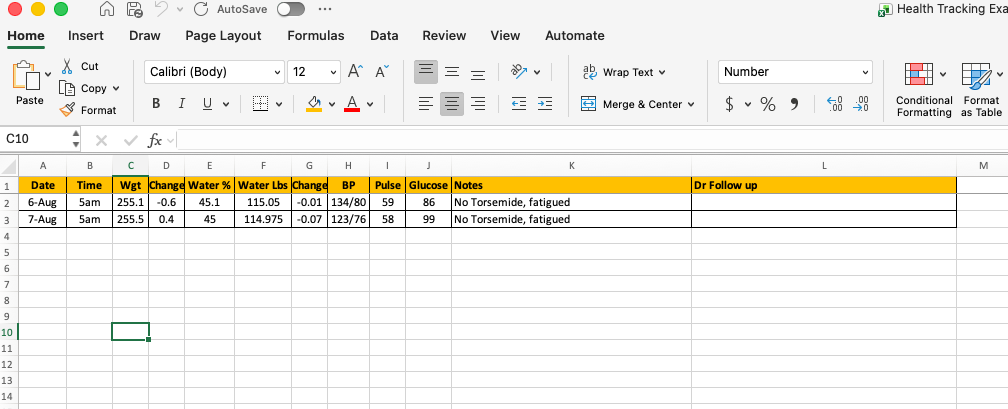
Below is a screenshot of the actual spreadsheet I use every day.
It isn’t complicated.
In fact, that’s intentional.
The easier something is to use, the more likely you’ll continue using it.
Each column serves a purpose, and together they give me a quick snapshot of how my body is doing each morning.
📅 Date
The first column simply records the date.
It sounds obvious, but dates become incredibly important when you’re looking for trends over several days, weeks, or even months.
Sometimes a doctor will ask,
“When did this start?”
Instead of guessing, I simply look back at my spreadsheet.
🕒 Time
I try to record my information at approximately the same time every morning.
For me, that’s usually around 5:00 AM, after using the restroom but before eating breakfast.
Keeping everything consistent makes it easier to compare one day to the next.
⚖️ Weight
Weight is probably the most important number I track.
For someone living with congestive heart failure, sudden weight gain often isn’t body fat.
It’s fluid.
That’s why I weigh myself every morning under the same conditions. After using the washroom and wearing the same type of clothes.
A sudden increase can be one of the earliest signs that my body is retaining fluid.
📈 Daily Weight Change
The next column calculates the difference between today’s weight and yesterday’s.
I’m watching for one thing in particular.
Have I gained 2–3 pounds overnight or about 5 pounds in a week?
Those numbers can be an early warning sign of fluid retention and may indicate that it’s time to contact my healthcare provider.
Instead of trying to remember yesterday’s weight, Excel does the math for me automatically.
💧 Water Percentage
My scale also estimates my body water percentage.
While I know this isn’t a perfect medical measurement, I still find it useful.
The spreadsheet uses that percentage to estimate approximately how many pounds of my body weight are water.
For something that only takes about five minutes each morning…
I’d say that’s time well spent.
⚠️ A Note About Pacemakers, ICDs, and Implantable Devices
If you have a pacemaker, ICD (implantable cardioverter-defibrillator), CRT device, or other implanted cardiac device, some consumer smart scales that measure body composition use a small electrical current (bioelectrical impedance analysis, or BIA) to estimate body fat, muscle mass, and body water.
Before using these features, follow the manufacturer’s safety instructions for your specific scale and ask your cardiologist or electrophysiologist if they’re appropriate for you.
If your healthcare team recommends avoiding these measurements, you can still use this tracker by recording your weight and the other health information without using the body composition features.
Medical Disclaimer
This spreadsheet is intended as a personal tracking tool only. It should never replace the advice of your healthcare providers or be used to make medication changes without their guidance.
The information in this article reflects my personal experience living with chronic illnesses, including congestive heart failure, atrial fibrillation, chronic kidney disease, and diabetes. It is shared for educational purposes only and is not medical advice.
Always follow the recommendations of your own healthcare providers regarding medications, diet, fluid restrictions, and health monitoring. If you notice sudden weight gain, worsening shortness of breath, chest pain, fainting, or any other concerning symptoms, contact your healthcare provider or seek emergency medical care as appropriate.
Finding a Balance Between Protecting Your Health and Living Your Life
One of the biggest changes I wasn’t prepared for after being diagnosed with congestive heart failure wasn’t taking medication or weighing myself every morning.
It was eating out.
For most people, going to a restaurant is just another meal.
For me, it became a decision.
Is this restaurant going to have something I can safely eat?
How much sodium is hidden in the food?
Will this one meal cause me to retain fluid for the next two days?
Those questions have changed the way I look at restaurants forever.
The hardest part isn’t actually the food.
It’s what restaurants represent.
Restaurants are where families celebrate birthdays.
They’re where friends catch up over lunch.
They’re where couples enjoy date nights.
Sharing a meal is one of the ways we stay connected to one another, and when chronic illness forces you to think twice about every menu, it can feel like you’re slowly becoming disconnected from that part of life.
I’ve experienced that feeling more than once.
There have been times when I’ve simply decided it was easier to stay home than spend the entire meal worrying about sodium.
While that protects my heart, it also means saying no to moments with family and friends.
That isn’t an easy trade-off.
Some of My Favorite Foods Are Now Memories
One of the reasons my wife and I moved to Southwest Florida was the seafood.
We couldn’t wait to enjoy fresh fish, shrimp, and all of the wonderful waterfront restaurants this area has to offer.
One of my favorite meals was blackened fish or blackened shrimp.
Today, those meals are mostly memories.
The seasonings that give blackened seafood its incredible flavor also bring a tremendous amount of sodium. While there may be exceptions, I’ve learned that it’s usually not a risk worth taking.
Another favorite of mine has always been clam chowder.
I honestly can’t remember the last time I had a bowl.
Restaurant soups are often loaded with sodium, and clam chowder is probably one of those foods I’ll simply never enjoy again.
Those may seem like small sacrifices to some people.
But they’re reminders that chronic illness changes more than your health.
It changes traditions.
It changes favorite meals.
It changes experiences you once took for granted.
Preparation Starts Before I Leave Home
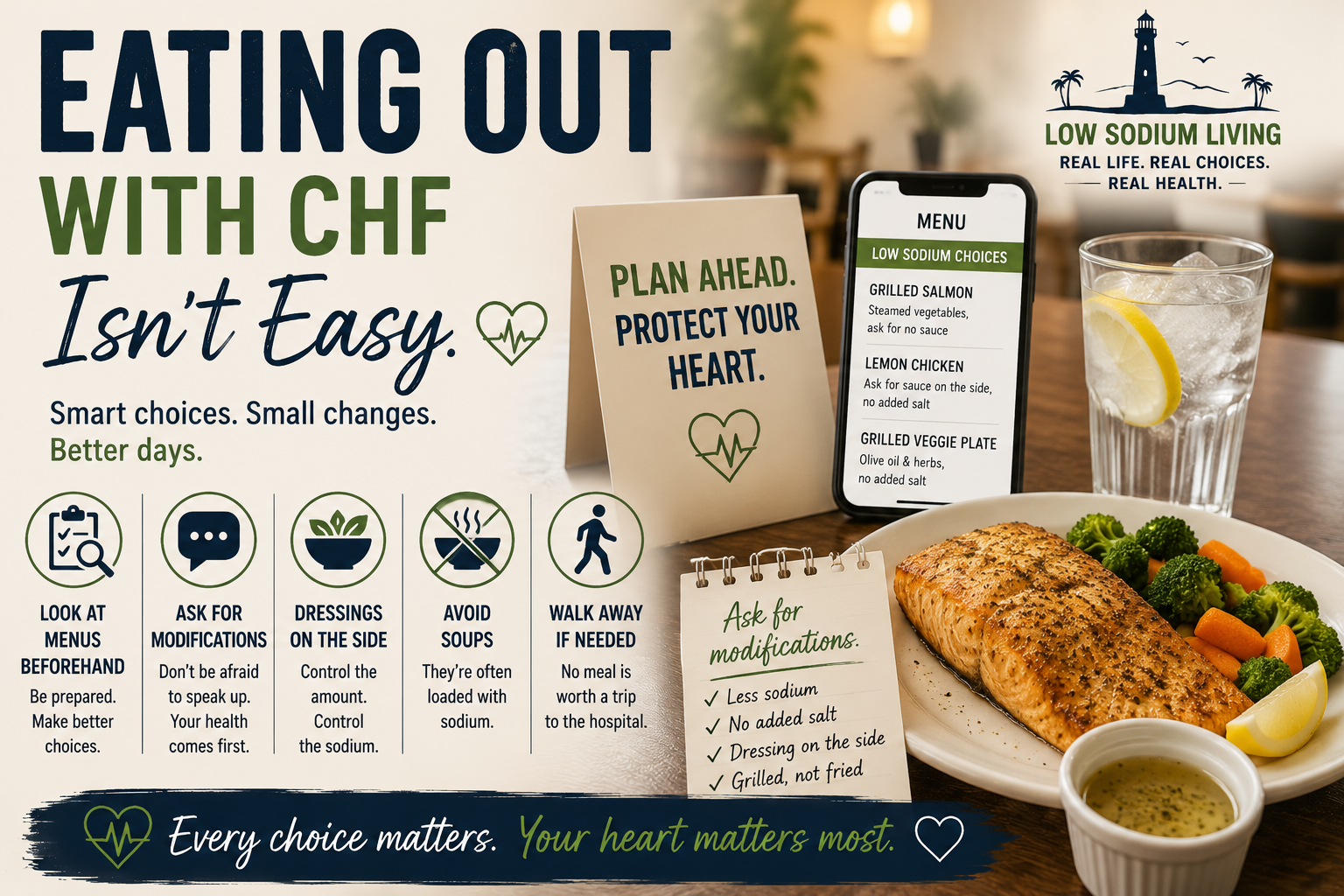
One of the best habits I’ve developed is looking at the restaurant’s menu before I ever get in the car.
Many restaurants now publish their menus online, and some even provide nutrition information. That gives me the opportunity to look for grilled foods, fresh vegetables, simple salads, or meals that can be modified before I ever sit down.
Walking into a restaurant with a plan removes a lot of the stress.
Sometimes I already know exactly what I’m going to order before I walk through the front door.
Don’t Be Afraid to Ask Questions
I’ve learned that it’s okay to ask.
Can the chicken be grilled without seasoning?
Can the vegetables be prepared without added salt?
Can the sauce be served on the side?
Most servers genuinely want to help if they understand why you’re asking.
You’re not being difficult.
You’re simply trying to take care of your health.
Dressing on the Side
Salads seem like the obvious healthy choice.
Unfortunately, many bottled dressings contain surprising amounts of sodium.
I’ll often order my dressing on the side so I can control how much I use.
I’ll admit something else.
There have even been times when I’ve quietly brought my own homemade low-sodium dressing with me.
Some restaurants don’t allow outside food because they can’t guarantee its safety or accept responsibility if someone becomes ill. I completely understand and respect their position.
When I can’t bring my own dressing, I’ll often ask for olive oil and lemon wedges instead.
It’s a simple solution that still lets me enjoy the salad.
Soup Is Usually Off My List
This one still bothers me.
I love soup.
Unfortunately, soup is one of the biggest hidden sources of sodium in many restaurants.
Even a small bowl can contain more sodium than I’d like to eat in an entire day.
As much as I enjoy it, soup has become something I almost always skip.
It’s Not Just the Sodium
One thing people often don’t realize is that my challenge isn’t only sodium.
It’s fluids too.
Because of my heart failure, I’m limited to about 1.5 liters of fluid each day.
That means every drink counts.
Water.
Coffee.
Tea.
Soft drinks.
Even healthy beverages.
They’re all part of the same daily limit.
Then there’s alcohol.
For many people, meeting friends for a drink is just another way to socialize.
For me, alcohol is no longer part of the equation.
When friends gather around a table with drinks in hand, it reminds me that chronic illness changes more than what you eat.
Sometimes it changes how you participate in life’s social moments.
I’ll be honest…
That’s something I still haven’t learned how to manage very well.
Sometimes the Best Decision Is to Walk Away
This has probably been the hardest lesson.
There have been times when I looked over a menu and realized there simply wasn’t a good option.
Instead of convincing myself that “one meal won’t matter,” I’ve learned it’s okay to leave and find another restaurant.
Years ago, I probably wouldn’t have done that.
Today, I remind myself that protecting my health is more important than protecting my pride.
I’m Still Learning
If I’m being completely honest…
I haven’t figured this out yet.
Eating out with CHF remains one of the biggest challenges in my life.
I still miss the freedom of ordering whatever sounds good.
I miss seafood dinners without worrying about sodium.
I miss a bowl of clam chowder on a cool afternoon.
I miss walking into a restaurant without studying the menu before I leave home.
But I’m learning that living with chronic illness isn’t about finding perfect solutions.
It’s about making the best decisions you can with the information you have.
Most days that means eating at home.
Some days it means asking a dozen questions before ordering.
And sometimes…
It means deciding that spending time with the people you love is worth the extra effort it takes to find a meal you can enjoy safely.
I still believe there has to be a compromise.
A way to protect my health without completely giving up one of the most important ways people connect with each other.
I haven’t found that balance yet.
But I’m still looking.
Screen capture this and carry it with you when you go out
🍽️ My Restaurant Checklist
✔️ Read the menu online first.
✔️ Look for grilled or baked options.
✔️ Ask for sauces and dressings on the side.
✔️ Skip soups and heavily seasoned foods.
✔️ Watch both sodium and fluids.
✔️ Don’t be afraid to ask questions.
✔️ If there isn’t a good option, choose another restaurant.
One thing I’ve learned through this journey is that no one is going to advocate for my health more than I will.
Living with chronic illnesses means I don’t just have one doctor. I have a cardiologist, nephrologist, primary care physician, specialists, nurses, technicians, pharmacists, therapists, and the occasional emergency room physician. Every one of them is an important part of my healthcare team.
But they’re exactly that—a team.
Each of them sees only a piece of the puzzle.
They may have access to my medical records, but they don’t live in my body. They don’t know how I felt when I walked across the grocery store yesterday. They don’t know that I woke up at 12:30 this morning and never got back to sleep. They don’t know the subtle changes I’ve noticed over the past week unless I tell them.
That’s why I’ve learned to speak up.
When I was first diagnosed with congestive heart failure (CHF), atrial fibrillation (AFib), chronic kidney disease (CKD), diabetes, and arthritis, the medical terminology felt like learning a foreign language. I assumed the doctors would simply tell me what to do and everything would work out.
It doesn’t work that way.
Healthcare is often a partnership, and partnerships only work when both sides participate.
I’ve spent countless hours learning about my conditions. I read. I ask questions. I research. Before appointments, I often use ChatGPT to help me understand medical terms, learn about upcoming tests, organize my thoughts, and build a list of questions I want to ask. It doesn’t replace my doctors or medical advice, but it helps me have more informed conversations with them.
I’ve found that understanding why something is being recommended is just as important as knowing what is being recommended.
One experience really drove this lesson home.
During a recent trip to the emergency room, the staff was preparing to start intravenous fluids. That’s a routine treatment for many patients, but because I have congestive heart failure and carefully monitor my fluid intake, I stopped them and explained my situation.
They listened.
They reviewed my history.
The plan changed.
No one was upset. In fact, it became a reminder that even excellent healthcare professionals are caring for many patients, each with unique medical histories. They simply can’t know every detail unless we tell them.
That’s why our voice matters.
Advocating for yourself doesn’t mean arguing with your doctor or pretending you know more than they do. It doesn’t mean refusing treatment because you read something on the internet.
It means asking questions.
It means saying, “Can you help me understand why we’re doing this?”
It means telling them when something doesn’t feel right.
It means making sure they know about every condition, every medication, every symptom, and every concern.
I’ve also learned there is a fine line to walk.
Some medical professionals welcome questions. Others may seem rushed or uncomfortable when patients ask too many. I’ve experienced both. My goal has never been to challenge someone’s expertise or prove them wrong. My goal is much simpler than that.
I want to understand the decisions being made about my body.
Because at the end of the day, I live with the consequences—not my doctor.
If you are living with one chronic illness—or several—don’t be afraid to become a student of your own health. Learn the terminology. Keep good records. Ask respectful questions. Speak up when something doesn’t seem right.
One habit that has helped me tremendously is keeping notes on my iPhone. Whenever I think of a question, notice a new symptom, experience a side effect, or want to remember something for my next appointment, I open the Notes app and write it down.
I’ve learned that I never trust my memory anymore. If I don’t write it down, there’s a good chance I’ll forget it when I’m sitting in the exam room. That’s not because I’m getting older—it’s because living with multiple chronic illnesses means there are simply too many things to keep straight in my head.
By the time I see my doctor, I have an organized list instead of trying to remember everything from memory.
The same notes are invaluable when a doctor’s office calls unexpectedly. Instead of scrambling to remember what I wanted to ask, I already have my questions, symptoms, medications, and concerns right in front of me. It helps me stay focused and makes sure I don’t forget something important once the conversation starts.
I’ve found that walking into an appointment prepared not only helps me, but it helps my doctors too. Our conversations become more productive because we’re discussing facts instead of trying to remember details from weeks ago.
Bring someone with you if it helps, especially if you’re facing an important diagnosis or a difficult decision. Another set of ears can catch details you might miss and help you remember what was discussed after the appointment is over.
Being your own advocate isn’t about distrusting doctors or challenging every recommendation. It’s about partnership. The best care happens when knowledgeable medical professionals and informed patients work together toward the same goal.
Your doctors bring years of education and experience.
You bring the one thing no one else can.
You live this life every single day.
That makes your voice one of the most important ones in the room.
If there’s one thing I hope you take away from my story, it’s this:
No one will ever care more about your health than you do.
My weigh-in and morning numbers were good today. Then I received the results of my kidney ultrasound.
Both kidneys measured smaller than they did on my previous ultrasound. I understand that measurements can vary depending on how the ultrasound is performed, but it still worries me. I already knew my right kidney wasn’t functioning properly, and the report now describes my left kidney as having a nodular contour.
My doctor has ordered an MRI to take a closer look. I’m worried about what it might show, but for now, all I can do is take this one step at a time.