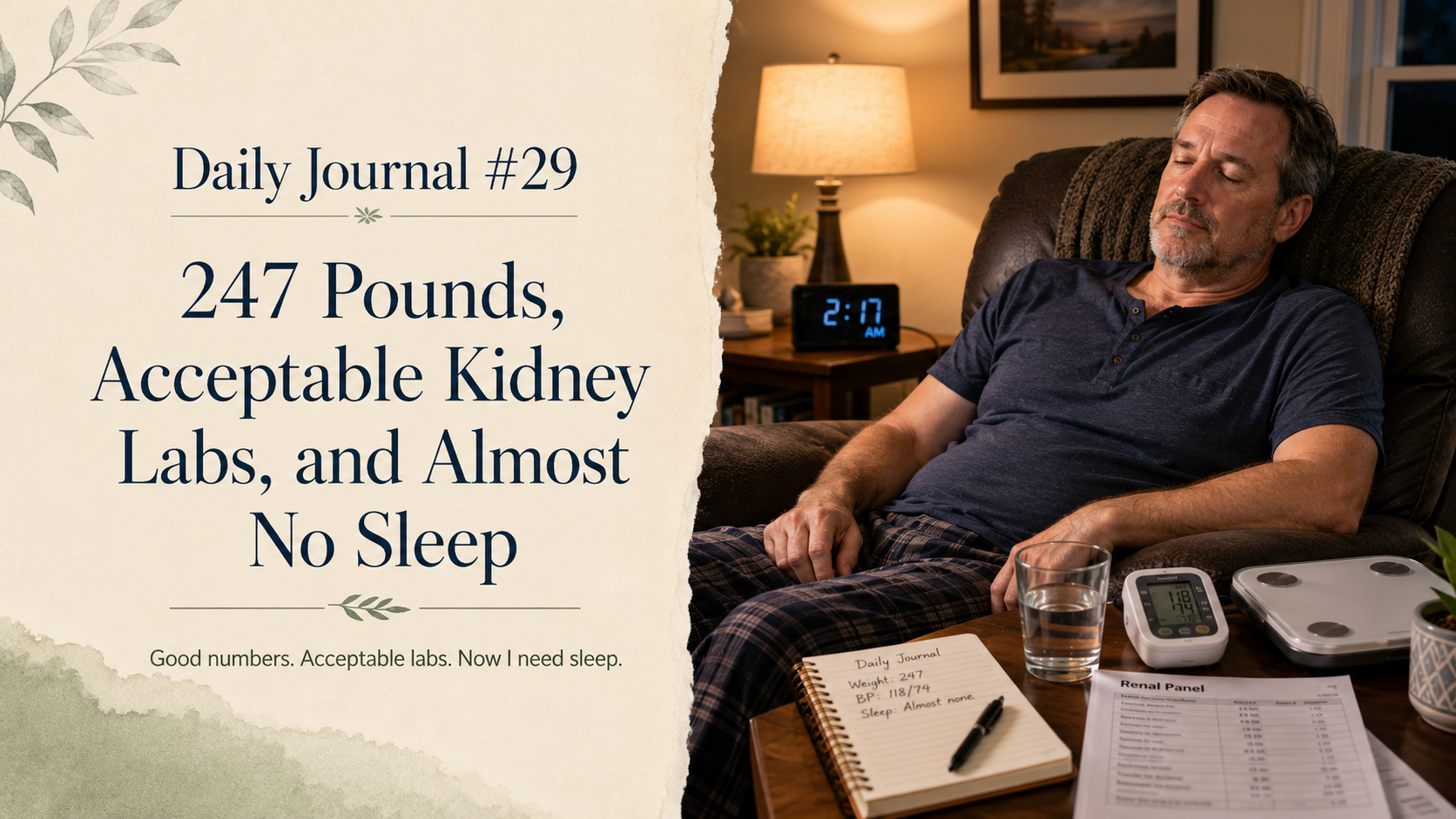
I’m down another half pound or so, which puts me at 247 pounds.
My blood pressure was good.
My pulse was good.
My body-water reading was good.
So from the health-check side of things, everything looked pretty encouraging.
The Renal Blood Work Came Back
I also got the results from the renal blood work.
The numbers were acceptable.
Nothing jumped out that required some drastic change or immediate action, which is exactly what I was hoping for.
After everything that has happened with the AKI, the ultrasound, the MRI, nephrology appointments, and repeated blood work, it is nice to finally have a stretch where the kidney news is basically:
Nothing dramatic. Keep going.
I can live with that.
Sleep Is Still a Disaster
Unfortunately, the sleep situation is another story.
I barely slept again last night.
According to my Apple Watch, I got about an hour and a half of sleep.
I know a watch is not a sleep lab, but I really don’t need technology to tell me I barely slept.
I can feel it.
I am completely beat today.
My body is tired.
My brain is tired.
Everything just feels slow.
The insomnia has been going on long enough now that it is becoming one of the most frustrating parts of my day-to-day life.
You can have good numbers on the scale.
Good blood pressure.
Good pulse.
Good kidney results.
And still feel like absolute garbage because you didn’t sleep.
Calling It an Early Night
So today’s plan is pretty simple.
Get through dinner.
Then go to bed.
Early.
No trying to push through the evening.
No pretending I’m not exhausted.
I’m hoping my body finally gets the message and lets me sleep tonight.
Today’s numbers were good.
The renal labs were acceptable.
I’m down to 247 pounds.
Those are all wins.
Now I just need one more.
Sleep.
Medical Disclaimer
This journal reflects my personal health experience and the monitoring and treatment plan developed specifically for me by my healthcare providers. Nothing in this article should be considered medical advice, diagnosis, or a recommendation regarding kidney function, weight loss, sleep, medications, or treatment. Consumer wearable devices can provide useful estimates of sleep and other health metrics, but they are not a substitute for professional medical evaluation. Persistent or severe sleep problems, significant fatigue, or changes in kidney function should be discussed with qualified healthcare professionals.
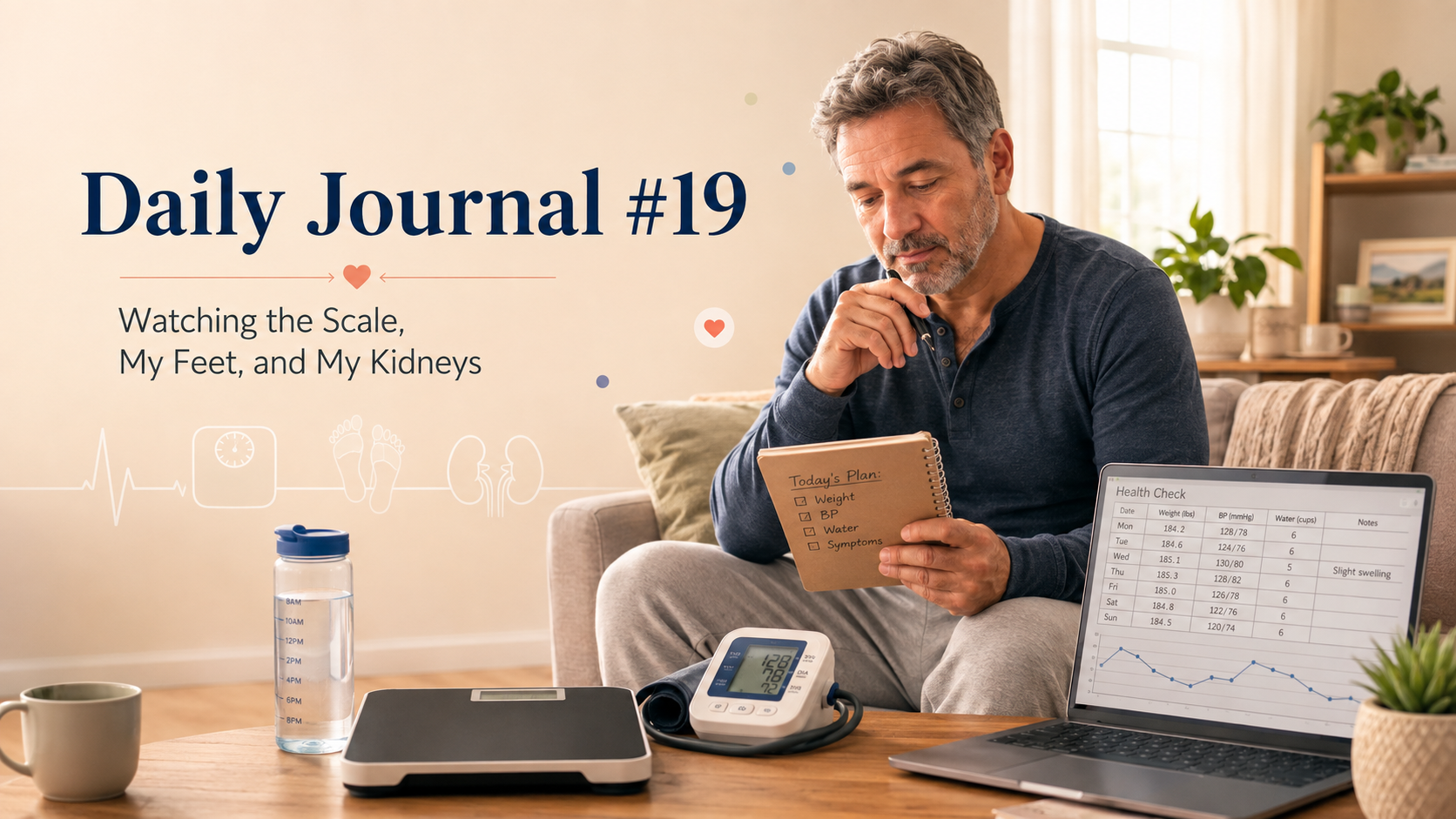
My morning health check was about as good as it has been the last couple of days, but one thing caught my attention.
I gained a pound since yesterday.
Normally, a one-pound change by itself probably wouldn’t alarm me too much. What concerned me was that I really didn’t eat much yesterday. I had a salad for dinner. It wasn’t a small salad, but it certainly wasn’t anything that should have caused me to gain a pound overnight.
Then I started looking at everything else.
My feet were slightly swollen.
My blood pressure was up.
My body-water calculation was also higher.
Put all of that together,
and I started wondering if I was retaining fluid again.
So I took a Torsemide this morning.
I only take my diuretic on an as-needed basis now. That was a decision made with my medical team, not something I decided to do on my own.
I manage my sodium and fluid intake very tightly because my goal is to avoid needing diuretics whenever possible. My doctors have actually seen the Excel spreadsheet I use to track everything. I don’t miss days. I document changes, symptoms, weight, blood pressure and medication adjustments made by my medical team.
That level of tracking became especially important after what happened a few months ago.
When Too Much Diuretic Became a Problem
A few months ago, I ended up in the hospital after becoming over-diuresed.
Basically, my body had gotten too low on fluid while I was still taking my diuretics as prescribed.
That contributed to an acute kidney injury, or AKI.
My kidney function dropped significantly. An eGFR above 60 is generally considered a better range, and mine had fallen into the low 30s.
That episode is part of the reason I later had a kidney ultrasound and why I now have an MRI scheduled.
After several appointments with my nephrologist, and after my doctors saw just how closely I was monitoring everything, my diuretic plan was changed to as-needed use.
That gives me a little more flexibility, but it also means I have to pay close attention to what my body is telling me.
And lately, I am.
Why This Morning Has Me Concerned
This is now the second time in about a week that I’ve noticed signs that make me wonder if I’m holding onto more fluid than I should.
What makes it frustrating is that I can’t immediately point to something obvious.
I didn’t have shrimp in my salad.
It was basically vegetables, other than the dressing.
So my next step is to retrace everything I ate and drank yesterday and see if something contained more sodium than I realized.
Sometimes that’s all you can do.
Go back.
Look at the numbers.
Then at what you ate.
Also at what you drank.
And try to find the missing piece.
Blood Work Today
I also have a blood draw today.
A few hours after that, I’ll have a new set of numbers to look at.
And I’ll admit it: I’m having a lot of anxiety about it.
After watching my kidney function drop before, it’s hard not to worry about what those lab results are going to show.
I’m praying everything looks good.
If it doesn’t, then there may be more changes ahead.
Either way, I’ll know more soon.
And when I do, I’ll let you know.
Medical Disclaimer
This journal reflects my personal experience living with heart failure, kidney disease, and the treatment plan developed specifically for me by my healthcare team. Nothing in this article should be taken as medical advice or as a recommendation to start, stop, skip, increase, decrease, or otherwise change any medication, including diuretics. Diuretics can affect fluid balance, blood pressure, electrolytes, and kidney function, and improper use can be dangerous. Any changes to your medications, fluid intake, sodium limits, or treatment plan should be made only in consultation with your own qualified healthcare professionals. If you experience new or worsening swelling, rapid weight changes, shortness of breath, chest pain, severe dizziness, fainting, or other concerning symptoms, seek appropriate medical care promptly.
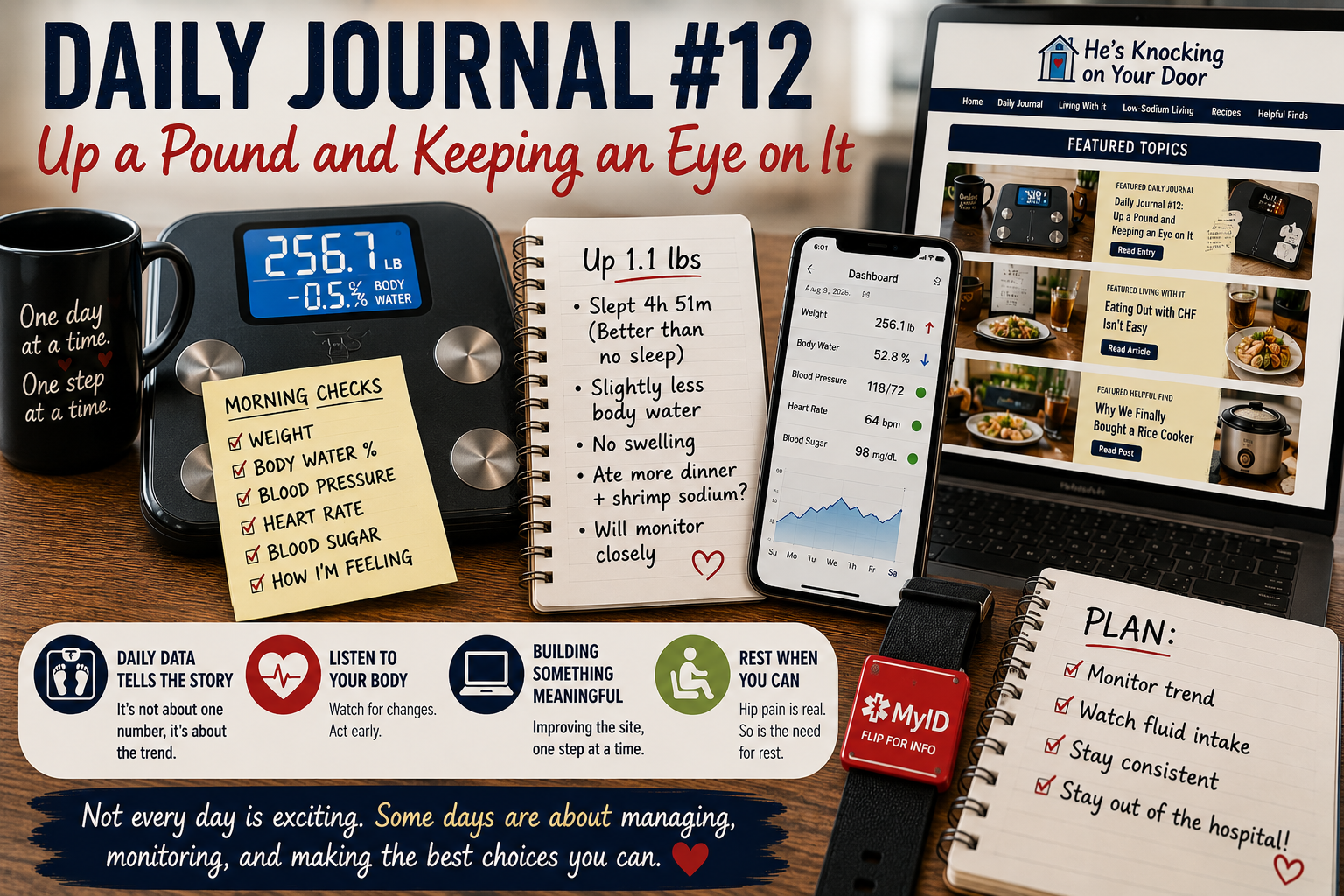
I woke up around 2:30 this morning. I’m still having trouble sleeping, but according to my Apple Watch, I managed 4 hours and 51 minutes.
Is that great? No.
But it’s better than no sleep, so I’ll take that win.
Something Different on the Scale
While doing my morning health checks, I noticed that my weight was up 1.1 pounds from yesterday.
That’s a little unusual for me, so naturally I started trying to figure out why.
My BIA scale actually showed my body-water percentage was about half a percent lower than yesterday. I’m also not noticing any swelling in my feet or legs.
Then I started going through the other possibilities.
The shirt I was wearing this morning was made from a heavier material than the one I wore yesterday. Could that account for some of the difference? Sure. But I seriously doubt my shirt weighs an extra pound.
I’m not constipated, so that probably isn’t contributing much either.
Then there’s dinner.
A couple of nights ago, we made those steak and shrimp rice bowls I mentioned in my last journal entry. They were so good that I ate more than I normally do. The shrimp we used also had some added sodium from processing.
Could the extra food, sodium and possibly a little fluid retention be contributing to what I’m seeing on the scale?
Maybe.
The truth is, I don’t know yet.
And that’s where I’ve learned not to overreact to a single number.
Watch the Trend
A 1.1-pound increase by itself isn’t setting off alarm bells for me. It’s simply something I’m going to pay attention to.
That’s one of the reasons I track this information every morning. One number gives me a snapshot. Several days of numbers give me a trend.
I’ll keep watching my weight, body-water reading, blood pressure and how I’m feeling over the next few days.
If the weight keeps climbing or I notice other changes, that’s information I can act on and share with my doctors.
For now, I’m monitoring it.
The last thing I want is another trip to the hospital.
Some Changes Around the Website
I also spent some time working on He’s Knocking on Your Door yesterday.
I’ve added featured content to the front page, so now you can see highlights from the Daily Journal, Living With It articles, and Helpful Finds without having to click around the site looking for something new.
I also decided to start adding featured images to these Daily Journal entries.
They were getting a little boring without something visual. Besides, some of the images are giving me an opportunity to have a little fun with what’s happening that day.
Yesterday’s Windex image might be difficult to top.
Otherwise, a Pretty Boring Day
Other than that, there isn’t a whole lot to report.
My hip still hurts—a lot.
One of the frustrating parts is simply trying to find a comfortable position. Sitting in a regular chair for any length of time can be difficult, which limits how much time I can spend working at a computer.
I can accomplish quite a bit from my phone or iPad, but there’s only so much I want to type or design on a smaller screen.
So today may be another relatively quiet day.
A little website work.
Keep an eye on the scale.
Deal with the hip.
And hopefully get a little more sleep tonight.
Not every day needs to be exciting. Sometimes a boring day is perfectly fine.
The Five Minutes Every Morning That Help Me Stay Ahead of My CHF
Living with congestive heart failure has taught me something important.
Your body is constantly giving you information.
The question is whether you’re paying attention.
Every morning, before I drink my morning water or begin my day, I spend about five minutes checking in with my body.
To some people, it probably looks like I’m filling out a simple spreadsheet.
To me, it’s much more than that.
It’s an early warning system.
Over time, I’ve learned that it’s much easier to recognize a problem before it becomes serious than it is to recover after the problem has already happened.
That’s why I track my health every single morning.
Not because my doctors told me to.
Because it helps me understand my own body.
One of the most important lessons I’ve learned while living with chronic illness is this:
Nobody will ever know your body as well as you do.
The more information I collect, the better conversations I have with my doctors, and the more confident I feel when something doesn’t seem right.
Download My Daily Health Tracker
If you’d like to use the same spreadsheet I use every morning, I’ve made an example version available for you to download.
Feel free to customize it for your own health conditions. What I track may not be exactly what you need, but hopefully it gives you a good starting point for building your own daily routine.
What I Track Every Morning
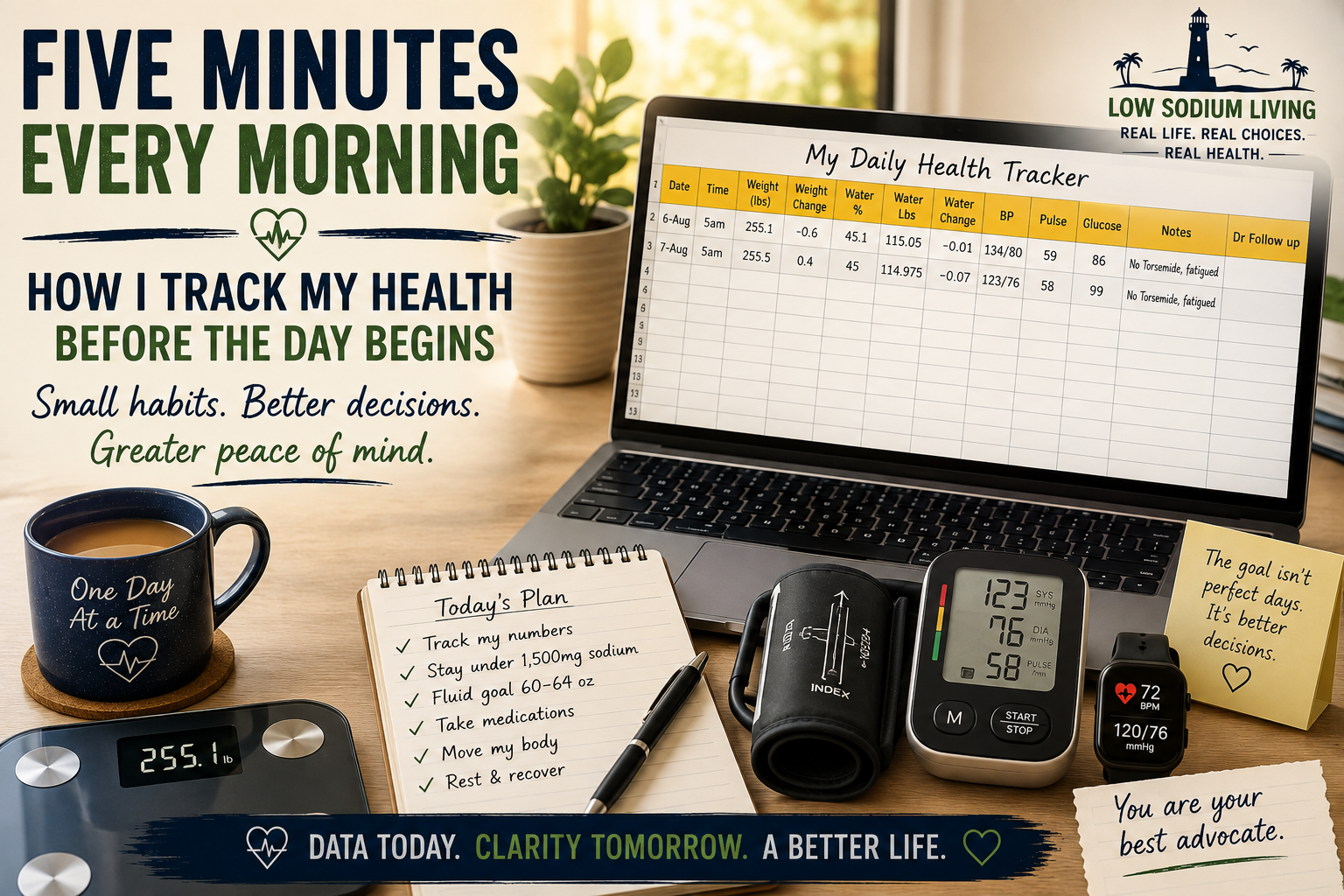
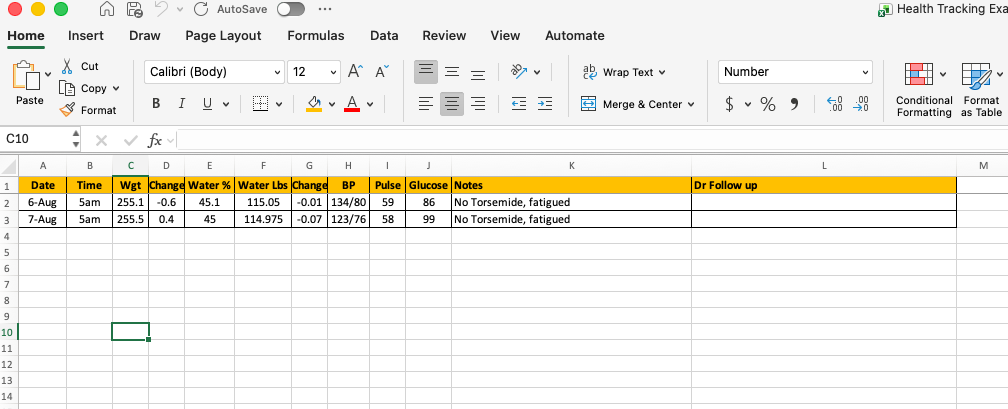
Below is a screenshot of the actual spreadsheet I use every day.
It isn’t complicated.
In fact, that’s intentional.
The easier something is to use, the more likely you’ll continue using it.
Each column serves a purpose, and together they give me a quick snapshot of how my body is doing each morning.
📅 Date
The first column simply records the date.
It sounds obvious, but dates become incredibly important when you’re looking for trends over several days, weeks, or even months.
Sometimes a doctor will ask,
“When did this start?”
Instead of guessing, I simply look back at my spreadsheet.
🕒 Time
I try to record my information at approximately the same time every morning.
For me, that’s usually around 5:00 AM, after using the restroom but before eating breakfast.
Keeping everything consistent makes it easier to compare one day to the next.
⚖️ Weight
Weight is probably the most important number I track.
For someone living with congestive heart failure, sudden weight gain often isn’t body fat.
It’s fluid.
That’s why I weigh myself every morning under the same conditions. After using the washroom and wearing the same type of clothes.
A sudden increase can be one of the earliest signs that my body is retaining fluid.
📈 Daily Weight Change
The next column calculates the difference between today’s weight and yesterday’s.
I’m watching for one thing in particular.
Have I gained 2–3 pounds overnight or about 5 pounds in a week?
Those numbers can be an early warning sign of fluid retention and may indicate that it’s time to contact my healthcare provider.
Instead of trying to remember yesterday’s weight, Excel does the math for me automatically.
💧 Water Percentage
My scale also estimates my body water percentage.
While I know this isn’t a perfect medical measurement, I still find it useful.
The spreadsheet uses that percentage to estimate approximately how many pounds of my body weight are water.
For something that only takes about five minutes each morning…
I’d say that’s time well spent.
⚠️ A Note About Pacemakers, ICDs, and Implantable Devices
If you have a pacemaker, ICD (implantable cardioverter-defibrillator), CRT device, or other implanted cardiac device, some consumer smart scales that measure body composition use a small electrical current (bioelectrical impedance analysis, or BIA) to estimate body fat, muscle mass, and body water.
Before using these features, follow the manufacturer’s safety instructions for your specific scale and ask your cardiologist or electrophysiologist if they’re appropriate for you.
If your healthcare team recommends avoiding these measurements, you can still use this tracker by recording your weight and the other health information without using the body composition features.
Medical Disclaimer
This spreadsheet is intended as a personal tracking tool only. It should never replace the advice of your healthcare providers or be used to make medication changes without their guidance.
The information in this article reflects my personal experience living with chronic illnesses, including congestive heart failure, atrial fibrillation, chronic kidney disease, and diabetes. It is shared for educational purposes only and is not medical advice.
Always follow the recommendations of your own healthcare providers regarding medications, diet, fluid restrictions, and health monitoring. If you notice sudden weight gain, worsening shortness of breath, chest pain, fainting, or any other concerning symptoms, contact your healthcare provider or seek emergency medical care as appropriate.
Living with heart failure and kidney disease means that every morning begins with a small collection of measurements. The process can be tedious, but it has become an important part of understanding what my body is doing and recognizing changes before they become larger problems.
This is the routine developed for me with guidance from my medical team. It is not medical advice or a monitoring plan for everyone. Your doctors should determine which measurements and warning signs matter for you.
Starting with a Consistent Weigh-In
My routine begins after I use the bathroom and before I eat or drink anything. I try to wear approximately the same amount of clothing each time and always use the same scale in the same location.
These details may sound overly particular, but consistency makes it easier to tell whether a change on the scale is likely real or simply caused by different clothing, food, fluids, or the time of day.
The American Heart Association recommends weighing yourself each morning after urinating, before breakfast, without shoes, and while wearing the same type of clothing.
I record my weight and compare it with both the previous day and the preceding week. The general warning levels I watch for are:
A gain of approximately 2–3 pounds in one day
A gain of 5 pounds or more in one week
Any different threshold my medical team has instructed me to follow
A sudden increase does not automatically prove that I am retaining fluid, but it is a reason to look more closely at my other numbers and symptoms. The American Heart Association explains that rapid weight gain can be an early sign of fluid retention in people with heart failure.
Tracking Body-Water Percentage
My scale also estimates my body-water percentage. I convert that percentage into pounds using this formula:
Body weight × body-water percentage = estimated pounds of body water
For example, if someone weighs 200 pounds and the scale reports 50% body water:
200 × 0.50 = 100 pounds of estimated body water
I do not treat this number as a precise measurement or as proof that I am retaining fluid. Consumer body-composition scales can be affected by hydration, food, skin contact, time of day, and other factors. I use it as another trend to compare with my previous readings.
If my weight and estimated body water rise together—especially if I also notice swelling, shortness of breath, or other changes—that gives me more information to discuss with my medical team.
An Important Scale-Safety Warning
Body-composition scales use bioelectrical impedance analysis, or BIA. They send a very small electrical signal through the body to estimate measurements such as body fat, muscle mass, and body water.
People with pacemakers or certain other implanted electronic medical devices should not use impedance-based features unless the device manufacturer and their medical team have confirmed that it is safe. Some compatible scales provide a weight-only or pacemaker-safety mode that disables these features.
I have a loop recorder and an artificial heart valve rather than a pacemaker. Even so, I checked with my cardiologist before using this type of scale. Anyone with an implanted medical device should check the instructions for the exact scale and speak with a qualified medical professional before using its body-composition functions. Withings explains how BIA and its weight-only safety mode work here.
Blood Pressure and Heart Rate
Next, I record my blood pressure and heart rate.
For me, a higher-than-usual blood pressure reading can be one clue that my heart is working harder or that something has changed. A lower-than-usual reading—especially when accompanied by dizziness, weakness, or lightheadedness—can raise questions about dehydration, medication effects, or whether too much fluid has been removed.
A single reading does not tell the complete story. I look at the measurement alongside my weight, symptoms, medication use, and recent trends. I do not change my diuretics or other medications based only on my spreadsheet unless my medical team has given me specific instructions to do so.
Glucose
I also record my glucose. Tracking it alongside my other measurements gives me a more complete daily picture and helps me notice patterns that might otherwise be missed.
Blood glucose can be affected by food, medication, illness, stress, activity, and sleep, so the context surrounding the number matters. As with my other readings, I follow the targets and reporting instructions given to me by my health care team.
Recording Everything in One Place
I currently track all these measurements in an Excel workbook:
Weight
Daily and weekly weight changes
Body-water percentage
Estimated pounds of body water
Blood pressure
Heart rate
Glucose
Symptoms and other notes
Google Sheets would work well for the same purpose. The most important part is keeping the information organized and easy to review over time.
My cardiologist and nephrologist review these records regularly. Having the information collected in one place makes it easier for them to see patterns and understand what has been happening between appointments.
What I Want to Build Next
My next goal is to create a dashboard within the spreadsheet. I would like it to use green, yellow, and red indicators:
Green: Measurements are within my usual range
Yellow: I am approaching a threshold and should pay closer attention
Red: A measurement has reached a limit established by my medical team and may require action
The thresholds will need to be personalized. A number that is normal for one person may not be normal for someone else, particularly when heart disease, kidney disease, diabetes, and medications are involved.
Eventually, I would like to turn this system into an app that makes daily tracking easier. When I finish the spreadsheet dashboard—and if I develop the app—I will share what I learn.
Tedious, but Worth Doing
I will be honest: completing this routine every morning can feel repetitive. There are days when I would rather step off the scale, forget the numbers, and get on with my morning.
However, these measurements give me a clearer picture of my health. One isolated number may not mean very much, but changes across several days can reveal a trend worth paying attention to.
This is what I personally do to monitor my health each day. It does not replace professional medical care, and I follow the thresholds and instructions established by my cardiologist and nephrologist. Anyone who wants to begin a similar routine should first ask their medical team what to measure, how often to measure it, and which changes should prompt a phone call or urgent care.
How Can I Have Heart Failure If My Heart Is Pumping Normally?
That was one of my first questions after learning that I had heart failure with preserved ejection fraction, commonly called HFpEF.
My echocardiogram showed that my ejection fraction was in the normal range. If my heart was still pumping normally, how could I possibly have heart failure?
The answer is that ejection fraction tells only part of the story. HFpEF is not primarily a problem with how forcefully the heart squeezes. It is a problem with how well the heart relaxes and fills between beats.
It is also important to distinguish a normal ejection fraction from a normal heartbeat. A person can have a preserved ejection fraction while also having an abnormal rhythm, valve disease, conduction problems, or other cardiac conditions, like me.
What Does “Preserved Ejection Fraction” Mean?
Ejection fraction measures the percentage of blood that the left ventricle pumps out with each contraction. In HFpEF, that percentage is generally 50% or higher.
However, a normal percentage does not necessarily mean that the heart is moving a normal total amount of blood.
Imagine a flexible balloon that expands easily and fills completely. Now imagine a thick, stiff balloon that can hold only a smaller amount. Both balloons might empty the same percentage of their contents, but the stiff balloon starts with less inside it.
Something similar can happen with HFpEF. The heart may eject a normal percentage of the blood inside the ventricle, but because the ventricle cannot relax and fill properly, the total amount of blood pumped may still be insufficient—especially during physical activity.
The National Heart, Lung, and Blood Institute describes HFpEF as a condition in which the left side of the heart becomes too stiff to relax fully between beats. That stiffness prevents it from filling with enough blood to meet the body’s needs efficiently.
What Is a “Stiff Heart”?
The heart works in two main phases:
During systole, the heart contracts and pushes blood forward.
During diastole, the heart relaxes so its chambers can refill.
With HFpEF, the squeezing phase may remain relatively strong, but the relaxation phase is impaired. The left ventricle does not expand as easily as it should. More pressure is therefore required to push blood into it.
This is why HFpEF was once commonly called diastolic heart failure.
The problem may become more noticeable during exercise or other activity. The body needs more oxygen-rich blood, the heart rate increases, and the ventricle has less time to fill. A stiff heart may not be able to increase its output enough to meet that demand.
This can contribute to symptoms such as mine:
Fatigue
Shortness of breath
Reduced exercise tolerance
Lightheadedness
Swelling
Rapid weight gain
Difficulty breathing while lying flat
How Does Pressure Build Up?
When the left ventricle cannot fill easily, pressure begins to rise inside it. That increased pressure can travel backward into the left atrium and then into the blood vessels in the lungs.
As pressure rises in those vessels, fluid can move out of the bloodstream and into surrounding tissue. In the lungs, this congestion can cause shortness of breath, coughing, reduced oxygen levels, and difficulty breathing while lying down.
Congestion can also affect the right side of the heart and the veins returning blood from the rest of the body. Fluid may then collect in several places, including:
Feet and ankles
Lower legs
Abdomen
Lungs
Tissues around internal organs
Some people first notice tighter shoes, sock marks, swollen ankles, abdominal fullness, or an unexplained increase in weight. Others experience worsening shortness of breath before obvious swelling appears.
How Is Excess Fluid Removed at Home?
For many people with heart failure, fluid management begins at home. The exact plan should be developed with a cardiologist or other healthcare professional and may include:
Limiting sodium, mine is around 1200mg a day
Following a prescribed fluid limit, mine is 1.5 liters a day
Taking an oral diuretic, sometimes called a water pill
Monitoring weight, blood pressure, symptoms, and swelling daily
Contacting the healthcare team when warning signs appear
Diuretics help the kidneys remove extra sodium and water through urination. This can reduce congestion and make it easier for the heart to work. It also make you having to use the washroom much more frequently.
A person should not begin taking extra diuretic medication or change the dose unless their clinician has provided specific instructions for doing so. Too much diuretic can cause dehydration, low blood pressure, electrolyte abnormalities, or worsening kidney function. I’ve been in the hospital for this.
What Happens If Home Treatment Does Not Work?
If oral medication is not removing enough fluid—or symptoms are becoming severe—hospital treatment may be necessary.
In the hospital, clinicians can give diuretics intravenously. IV medication enters the bloodstream directly and may work more quickly and reliably than oral medication.
The healthcare team may also:
Measure urine output
Monitor daily weight
Check kidney function
Check sodium, potassium, and other electrolytes
Monitor blood pressure and oxygen levels
Adjust heart failure medications
Treat the condition that triggered the worsening congestion
In uncommon, severe cases where medications are not effective, a specialized filtration procedure may be considered to remove excess fluid. Most episodes, however, are treated with carefully monitored IV diuretics.
Why Daily Monitoring Matters
Fluid can accumulate before it becomes obvious in the feet or ankles. For that reason, daily weight is one of the most useful early-warning tools for someone living with heart failure.
Weight should generally be checked:
Every morning
After using the bathroom
Before eating or drinking
On the same scale
In similar clothing
The American Heart Association advises contacting the healthcare team about a sudden gain of approximately 2–3 pounds in one day or 5 pounds in one week, because it may indicate fluid retention. These are general guidelines; each person should follow the limits established by their own healthcare team. These are the thresholds I have also established with my doctors.
Blood pressure should also be recorded regularly, but there is no single blood-pressure threshold that applies to everyone with HFpEF. Both high and low blood pressure can create problems. The appropriate range depends on medications, kidney function, symptoms, and other medical conditions.
A useful daily record can include:
Weight
Blood pressure
Heart rate
Swelling in the feet or legs
Shortness of breath
Ability to lie flat comfortably
Fatigue or lightheadedness
Diuretic use
Sodium and fluid intake, when directed
The trend often matters more than a single number. A gradual weight increase, falling blood pressure accompanied by dizziness, or steadily worsening breathing deserves attention even when no individual reading appears extreme. I track these daily in an Excel spreadsheet. I will make a post and explain how and what I track.
A Normal Ejection Fraction Does Not Mean a Normal Heart
HFpEF can be confusing because the heart may still appear to squeeze normally on an echocardiogram. But the heart must do more than squeeze—it must also relax, fill, and respond when the body requires additional blood flow.
A stiff ventricle cannot perform those jobs efficiently. Pressure rises, blood backs up, fluid accumulates, and symptoms develop. That is genuine heart failure, even when the ejection fraction remains preserved.
Living with HFpEF means learning to notice small changes before they become emergencies. Daily monitoring, medication, sodium awareness, and communication with the healthcare team all play important roles in keeping fluid and symptoms under control.
This article is based on personal experience and general educational information. It is not medical advice. Medication doses, fluid limits, sodium goals, and warning thresholds should be established with a qualified healthcare professional.
A reliable blood pressure monitor is an essential part of my daily routine. Every morning, I check my blood pressure along with my weight and other health measurements. These readings help me notice changes and provide useful information to share with my doctors.
Because I live with heart failure and other chronic health conditions, I pay close attention to possible signs of fluid retention. Blood pressure alone cannot determine whether fluid is building up, but I use it as one part of the overall picture—along with changes in my weight, swelling, symptoms, and the care plan provided by my medical team.
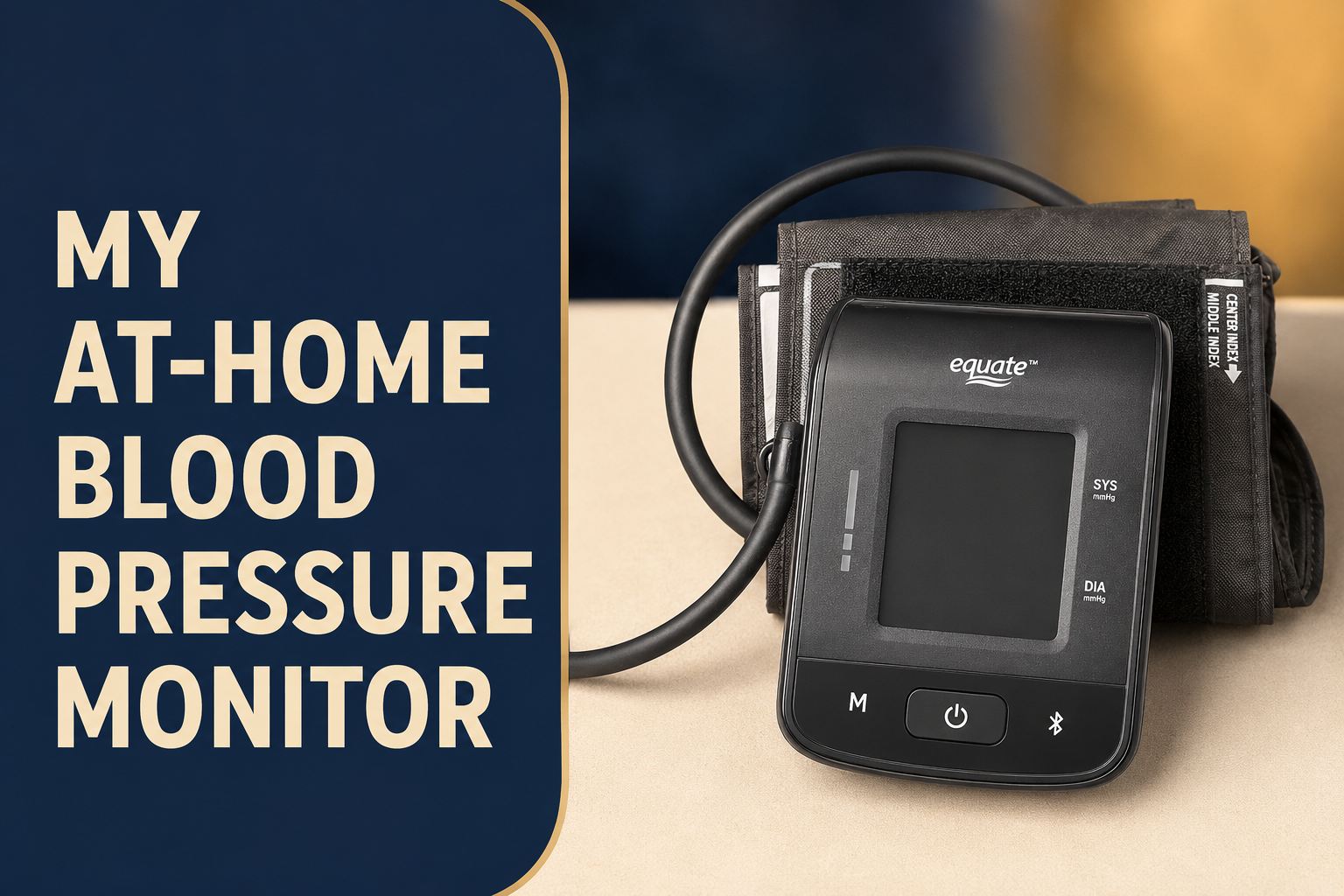
The monitor I use is the Equate 8000 Series Premium Upper Arm Blood Pressure Monitor. I purchased it at Walmart and have found it dependable and easy to incorporate into my morning routine.
What I Like About It
One of its most useful features is Bluetooth connectivity. My readings can be synchronized with Apple Health, which helps keep my health information together and makes it easier to review changes over time.
The monitor supports two users, so two people can maintain separate reading histories on the same device. It also alerts me when it detects a potentially irregular heartbeat during a measurement. Since I live with persistent atrial fibrillation, I do not use that notification to diagnose anything, but it is still useful information to notice and discuss with my healthcare team when necessary.
It offers two different measurement modes:
A standard mode that takes one blood pressure reading
A multi-reading mode that takes three readings and calculates an average
I especially like the three-reading option because blood pressure can vary from one measurement to the next. Having the monitor calculate an average gives me a more consistent number without requiring me to record and calculate three separate readings myself.
The monitor is also extremely quiet while operating. That makes it convenient to use early in the morning without disturbing anyone else.
It runs on four AA batteries, so it does not need to remain plugged into an outlet.
What I Don’t Like
My only significant complaint is its size. It is larger than some blood pressure monitors, so it is not the most convenient choice for travel or for someone with limited storage space. For regular use at home, however, the size has not prevented it from becoming a valuable part of my routine.
My Overall Opinion
This monitor has worked well for my needs. I like its Bluetooth syncing, support for two users, quiet operation, irregular-heartbeat detection, and the option to average three readings.
It is not the smallest monitor available, but for daily home use, I have found it convenient and dependable. Most importantly, it helps me consistently track information that I can review over time and share with my healthcare providers.
This is my personal experience with a product I purchased and use. It is not medical advice, and a home blood pressure monitor is not a substitute for evaluation or treatment by a qualified healthcare professional.