Tag: Low Sodium Diet

  • Helpful Find: Why I Bought a Bread Machine for Low-Sodium Living

    Helpful Find: Why I Bought a Bread Machine for Low-Sodium Living

    Bread was one of those foods I never gave much thought to before I had to start watching my sodium.

    It’s bread. How much sodium could possibly be in it?

    Apparently, quite a bit.

    Once I started reading nutrition labels, I realized that bread could add a surprising amount of sodium to a meal—especially when you’re eating two slices for a sandwich or adding a bun to something that already contains sodium.

    I didn’t want to give up bread completely.

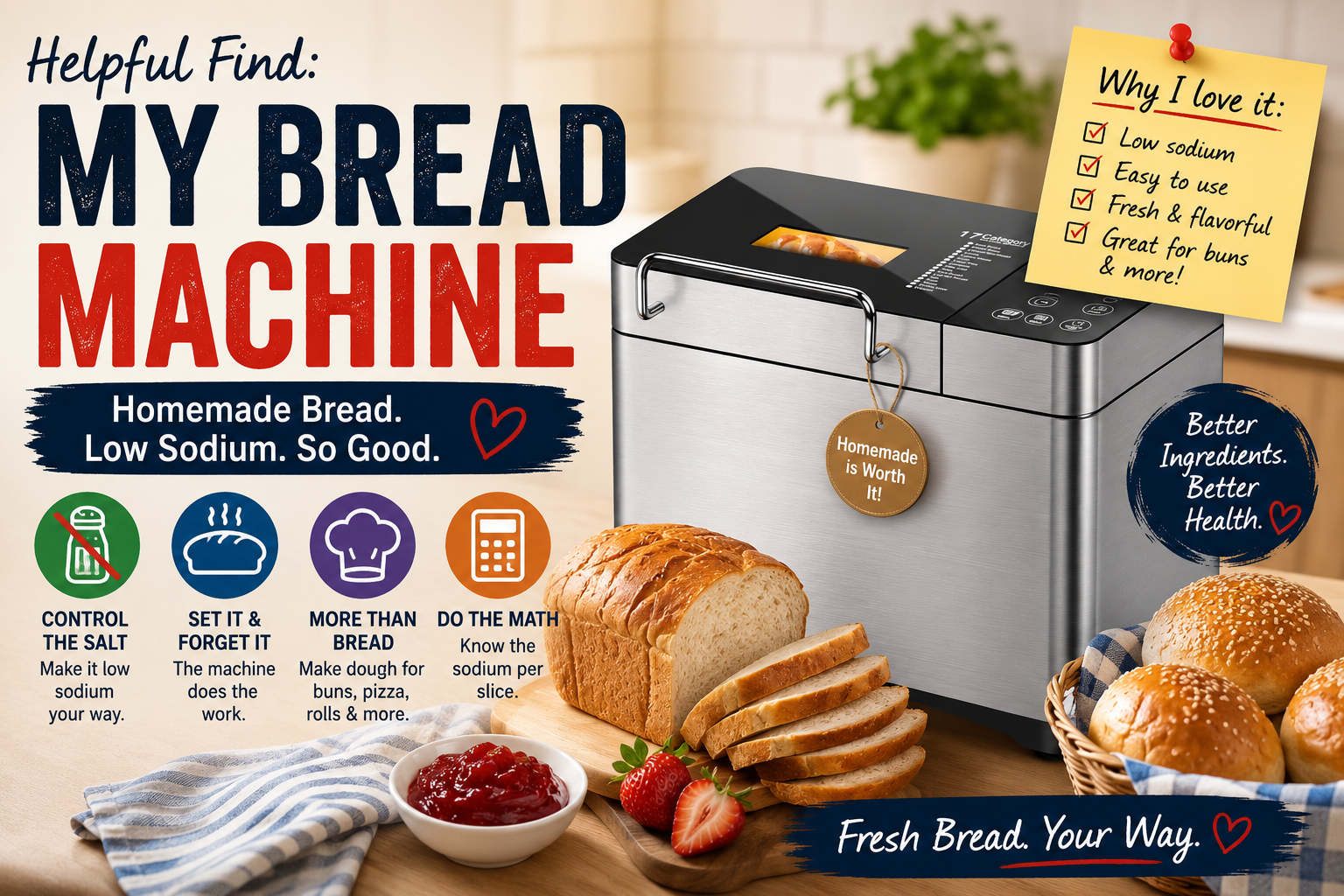
    So we bought a bread machine.

    And it has turned out to be one of the most useful appliances we’ve purchased since I started living a low-sodium lifestyle.

    Why Make Bread at Home?

    The biggest advantage is pretty obvious:

    I control what goes into it.

    Flour. Water. Yeast. A few other ingredients depending on the recipe.

    And most importantly, I control the salt.

    There are plenty of salt-free and low-sodium bread recipes available online. I’ve made bread with no added salt at all, but I’ve also experimented with regular bread recipes and simply reduced the amount of salt.

    If a recipe calls for a teaspoon of salt, for example, I might try half a teaspoon or even a quarter teaspoon.

    That’s one of the things I like about making it myself.

    It doesn’t always have to be all or nothing.

    I can experiment and find a balance between flavor, texture and the amount of sodium I’m comfortable with.

    I Can Actually Calculate the Sodium Per Slice

    Another thing I really like about homemade bread is knowing exactly what’s in it.

    If I’m making the loaf myself, I know how much sodium went into every ingredient.

    That means I can add up the sodium in the entire recipe and divide it by the number of slices I get from the loaf.

    For example, if all the ingredients in my loaf contained 600 mg of sodium and I cut the finished loaf into 12 slices:

    600 ÷ 12 = approximately 50 mg of sodium per slice.

    I’m not relying on a guess.

    I know what I put into it.

    Of course, you have to remember that your calculation is only as accurate as your ingredients and portion sizes, but it gives me a pretty good way to track what I’m eating.

    It Really Is Set It and Forget It

    I think some people hear “homemade bread” and imagine spending half the day kneading dough on the kitchen counter.

    That’s not what I’m doing.

    The bread machine does most of the work.

    I put the ingredients into the machine, select the program and let it go.

    It mixes.

    It kneads.

    It allows the dough to rise.

    And if I’m making a regular loaf, it bakes it too.

    A few hours later, I’ve got fresh bread.

    That’s my kind of cooking.

    It Does More Than Make Loaves of Bread

    This might actually be my favorite part.

    I don’t always let the bread machine bake the bread.

    Most machines have a dough cycle, and that opens up a whole different world.

    I’ve even made homemade hamburger buns.

    I let the bread machine mix, knead and raise the dough. When it’s finished, I take the dough out, divide it, shape the hamburger buns and put them on a baking sheet.

    Then I bake them in the regular oven.

    They turn out great.

    And personally, I think they’re much more flavorful than the store-bought buns I used to eat.

    You can use the same idea for things like dinner rolls, pizza dough and other breads.

    I’ve also made focaccia using my bread machine, which is another recipe I’ve shared on the site.

    That’s one reason I don’t think of this as an appliance that only makes rectangular loaves of bread.

    For me, it’s really a dough-making machine too.

    There Are Some Downsides

    As much as I like it, a bread machine isn’t perfect.

    It’s Not Small

    This is a legitimate consideration.

    A bread machine is a fairly large countertop appliance.

    If you have a small kitchen or limited storage, you’ll need to figure out where you’re going to put it.

    It’s not something you’re going to tuck into a tiny drawer when you’re finished.

    For us, the amount we use it makes the storage space worthwhile.

    Homemade Bread Doesn’t Last as Long

    This is another thing I’ve learned.

    Homemade bread generally doesn’t have the shelf life of the commercial bread you buy at the grocery store.

    Salt plays several roles in bread making, and reducing it can affect the finished bread. Homemade bread also doesn’t typically contain the preservatives and other ingredients used to extend the shelf life of many commercially produced breads.

    So I don’t expect my homemade bread to sit around for weeks.

    Honestly, that’s usually not much of a problem.

    Fresh homemade bread has a funny way of disappearing.

    You can also slice and freeze bread you aren’t going to use right away.

    Is It Worth It?

    For me?

    Absolutely.

    When I first started eating low sodium, there were so many things that suddenly felt like they were being taken away.

    Bread was one of them.

    Buying a bread machine gave some of that back.

    Now I can make a loaf with little or no added salt.

    I can experiment with recipes.

    I can make hamburger buns.

    I can make focaccia.

    I can make pizza dough.

    And I know exactly how much salt I put into it.

    There are some inconveniences.

    The machine takes up space.

    Homemade bread doesn’t last as long.

    And yes, making bread requires a little more effort than grabbing a loaf off the grocery-store shelf.

    But I’ll take those trade-offs.

    ❤️ Greg’s Take

    One of the things I’m slowly learning about low-sodium living is that sometimes the answer isn’t finding a perfect replacement at the grocery store.

    Sometimes the answer is:

    Make it yourself.

    That’s what happened with bread.

    Instead of walking through the bread aisle reading label after label and getting frustrated by the sodium, I can make my own and decide exactly how much salt goes into it.

    Sometimes that’s none.

    Sometimes I take a regular recipe and cut the salt in half.

    Sometimes I cut it even further.

    I’m still experimenting.

    But the important thing is that bread is back on the menu.

    And when you’re living with a diet that can sometimes feel like an endless list of things you can’t have, getting something back feels pretty damn good.


    The Bread Machine I Use

    The bread machine I’m talking about in this article is the one I personally purchased and use at home.

    See the Bread Machine I Use on Amazon

    I use it for regular loaves as well as making dough for things like hamburger buns and focaccia.

    Affiliate Disclosure: This post contains an Amazon affiliate link. As an Amazon Associate, I may earn from qualifying purchases made through this link at no additional cost to you. I personally use the bread machine featured in this article. I purchased it with my own money and am not affiliated with KBS. I’m sharing it because it has been useful in my own low-sodium cooking, not because it will be the right choice for everyone. My opinions and experiences are my own.
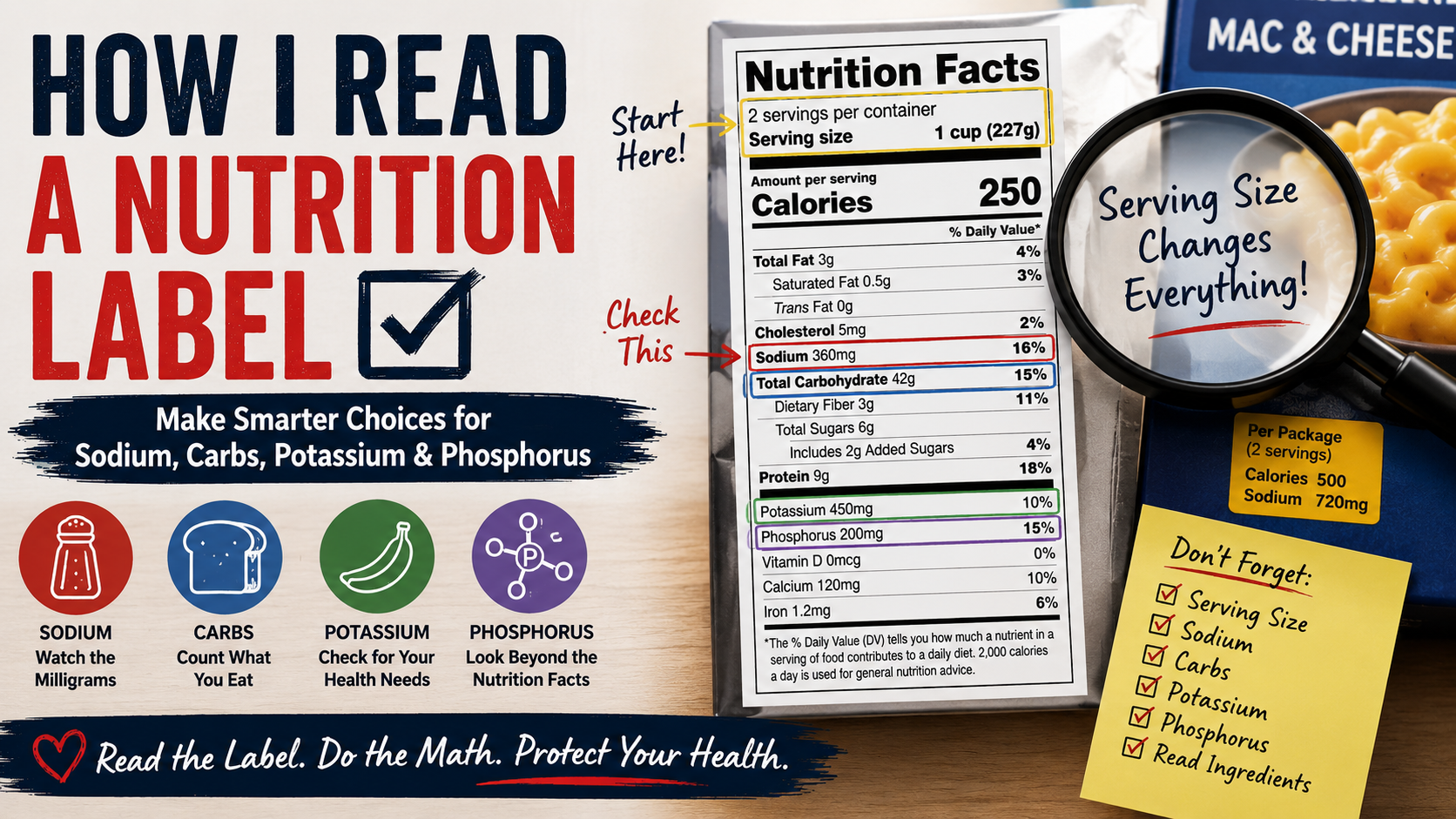
  • How I Read a Nutrition Label: Serving Size Changes Everything

    How I Read a Nutrition Label: Serving Size Changes Everything

    I spend a lot more time reading nutrition labels than I ever thought I would.

    Years ago, I might have looked at calories. Maybe carbohydrates. Maybe I wouldn’t have looked at the label at all.

    Things are different now.

    When you’re trying to manage multiple health conditions, that little box on the back of a package suddenly becomes pretty important.

    For me, sodium is usually one of the first things I look at. But I also pay attention to carbohydrates, potassium and phosphorus.

    Before I look at any of those numbers, though, I’ve learned to look at something else first:

    Serving size.

    Because without knowing the serving size, almost every other number on that label can be misleading.

    I Always Start at the Top: Serving Size

    This is probably the biggest lesson I’ve learned from reading nutrition labels.

    The numbers on a Nutrition Facts label are based on the serving size listed at the top.

    That sounds obvious.

    It isn’t always obvious when you’re standing in the kitchen.

    A package may look like something a normal person would eat in one sitting, but the label may consider it two servings.

    If one serving contains 400 mg of sodium and I eat the entire package—and the package contains two servings—I didn’t eat 400 mg of sodium.

    I ate 800 mg.

    The same math applies to carbohydrates and the other nutrients on the label.

    That’s why my eyes go to Serving size and Servings per container before anything else.

    A “Single” Package Isn’t Necessarily a Single Serving

    This one drives me crazy.

    You pick up something that looks like it was clearly packaged for one person.

    A drink.

    A small container of macaroni and cheese.

    A snack.

    A frozen meal or another individually packaged food.

    Your brain naturally thinks:

    One package = one serving.

    Not necessarily.

    Depending on the product and labeling rules, a package can contain more than one labeled serving. Some products that could reasonably be consumed either at once or over multiple occasions may show both per-serving and per-packagenutrition information.

    So I don’t assume anymore.

    If I’m planning to eat the entire container, I want to know the nutrition information for the entire container, not just whatever serving happens to be listed on the front or back.

    Seasonings Can Really Fool You

    Seasonings are another perfect example.

    I’ll pick up a seasoning and immediately look at sodium.

    Maybe it doesn’t look terrible.

    Then I look at the serving size:

    1/4 teaspoon.

    Seriously?

    Have you ever measured 1/4 teaspoon of seasoning?

    It’s almost nothing.

    If that 1/4 teaspoon contains 150 mg of sodium but I actually shake a full teaspoon onto my food, I’ve used four servings.

    That’s 600 mg of sodium.

    Suddenly that innocent-looking seasoning isn’t so innocent.

    That’s why I don’t just ask:

    “How much sodium is in this?”

    I ask:

    “How much sodium is in the amount I’m actually going to use?”

    That’s a completely different question.

    Sodium Is Usually My Next Stop

    Once I understand the serving size, sodium is usually where I go next.

    The Nutrition Facts label lists sodium in milligrams (mg) and also provides a % Daily Value.

    For my own tracking, I tend to concentrate on the milligrams because I’m trying to understand how the food fits into my entire day.

    If something has 300 mg of sodium per serving and I know I’m going to eat two servings, I’m mentally turning that into 600 mg before deciding whether it works for me.

    I’ve learned that the number printed on the label doesn’t matter nearly as much as:

    Number on label × number of servings I actually consume.

    That’s the number I’m really eating.

    “Low Sodium” Has an Actual Meaning

    Another thing I’ve learned is that phrases on the front of a package aren’t all interchangeable.

    “Low sodium” has a defined meaning. Under FDA labeling rules, a food described as low sodium generally contains 140 mg of sodium or less per serving.

    Then there is “sodium free,” which generally means less than 5 mg per serving.

    But here’s one that I think can be confusing:

    “No salt added” does NOT necessarily mean sodium free.

    “No salt added” or “unsalted” generally means salt wasn’t added during processing. The food can still naturally contain sodium, or sodium can potentially come from other ingredients.

    So even when I see NO SALT ADDED printed across the front of a package, I turn it around.

    I still read the Nutrition Facts label.

    Then I Check the Carbohydrates

    Sodium isn’t the only thing I have to think about.

    I also pay close attention to Total Carbohydrate.

    Again, serving size matters.

    If something contains 25 grams of carbohydrates per serving but I eat two servings, I’m eating 50 grams of carbohydrates.

    It’s another reason something being “low sodium” doesn’t automatically make it an unlimited food.

    A product can be excellent from a sodium standpoint and still contain far more carbohydrates than I want in the portion I’m planning to eat.

    That’s why I try not to judge a food by a single number.

    Potassium Is Another Number I Watch

    Potassium is another nutrient I pay attention to.

    This one can get a little trickier because individual potassium needs can vary considerably, particularly when kidney function, medications and other medical conditions enter the picture.

    So I’m not going to give anyone a potassium target.

    That’s something that should be determined with their healthcare team based on their individual circumstances and lab results.

    For me, the important lesson is simply that I look.

    A product that works beautifully in one area might not work as well in another.

    What About Phosphorus?

    Phosphorus can be even trickier.

    It may appear on the Nutrition Facts label, but phosphorus isn’t one of the nutrients that is required to be listed on every Nutrition Facts panel.

    So sometimes I have to go beyond the numbers and look at the ingredient list.

    For people who have been told to monitor phosphorus, ingredients containing “phos” can indicate added phosphorus—for example, certain phosphate additives.

    This is also a good example of why I think “reading the label” means more than reading the Nutrition Facts box.

    Sometimes the ingredient list matters too.

    I Don’t Trust the Front of the Package

    I’ve learned to treat the front of a package as advertising.

    Low sodium!

    Reduced sodium!

    No salt added!

    Heart healthy!

    Those statements may provide useful information, and regulated nutrient claims have specific definitions, but they don’t tell me everything I need to know about whether that food works for me.

    I turn the package around.

    The back is where I make my decision.

    And I always start with the serving size.

    My Quick Label Check

    I’ve gotten into a pretty simple routine:

    1. Serving size — How much food are these numbers actually describing?
    2. Servings per container — Am I realistically going to eat one serving or the whole thing?
    3. Sodium — How many milligrams will be in the portion I’m actually eating?
    4. Total carbohydrates — Again, based on my actual portion.
    5. Potassium — Something I watch based on my own medical needs.
    6. Phosphorus/ingredients — If phosphorus matters, I look beyond the Nutrition Facts panel and check the ingredient list too.
    7. Do the math — If I’m eating two servings, I count two servings of everything.

    That last step is probably the most important.

    The Label Isn’t Wrong — But I Can Read It Wrong

    That’s really the lesson I’ve learned.

    A package may clearly tell me that something has 200 mg of sodium.

    The problem comes when I stop reading before noticing:

    Serving size: 1/2 package.

    If I eat the entire package, that’s 400 mg.

    The same thing happens with carbohydrates.

    And seasonings are probably one of my favorite examples because 1/4 teaspoon can make the sodium number look relatively small when I might actually use several times that amount.

    The label gave me the information.

    I just have to read all of it.

    ❤️ Greg’s Take

    Reading nutrition labels has become second nature to me.

    I’m sure there are people who can walk through a grocery store, throw something into their cart and never turn the package around.

    I can’t do that anymore.

    But I’ve also learned that simply checking sodium isn’t enough.

    I need to know the serving size.

    I need to know how many servings I’m actually going to eat.

    Then I can look at sodium, carbohydrates, potassium and, when appropriate, phosphorus and the ingredient list.

    And I’ve learned never to assume that because something looks like an individual package, the nutrition label treats the entire thing as one serving.

    Read the serving size first.

    Then read everything else.

    Because 200 mg of sodium per serving sounds pretty good until you discover you just ate three servings.

    And that tiny 1/4 teaspoon serving of seasoning?

    Yeah.

    I’m pretty sure nobody has ever looked at my dinner and accused me of under-seasoning it.

    Medical Disclaimer: I am not a doctor or medical professional. This article describes my personal experience how I look at and use nutritional value to monitor my chronic illness. Everyone’s medical situation is different, and my experience should not be used to diagnose or treat a medical condition or determine what someone needs. Always discuss nutrition, symptoms, test results and treatment decisions with your doctor or other qualified healthcare professional. If you experience symptoms that may represent a medical emergency, seek emergency medical care rather than relying upon information on this website.

  • Low Sodium Doesn’t Mean Unlimited

    Low Sodium Doesn’t Mean Unlimited

    One of the biggest lessons I’ve learned is that “low sodium” doesn’t automatically mean “eat as much as you want.”

    Sometimes solving one dietary problem creates another thing you still have to pay attention to.

    That has been especially true for me because I’m not managing just one chronic illness.

    I’m trying to balance congestive heart failure, chronic kidney disease, and diabetes at the same time.

    And some days, honestly, it feels like the rules contradict each other.

    Low Sodium Is Only One Piece of the Puzzle

    Because of my heart failure, sodium is something I pay very close attention to. Too much sodium can contribute to fluid retention, which is one reason people with heart failure may be advised to limit sodium and, in some cases, fluids. The exact limits should come from your healthcare team. 

    But sodium isn’t the only number that matters to me.

    Carbohydrates are another big one because I also have diabetes.

    Lately, my carbohydrate intake has actually been very well controlled.

    Unfortunately, part of the reason is something I’m not particularly proud of:

    I’m sometimes afraid to eat or drink too much.

    I know that sounds messed up.

    But after being hospitalized multiple times, the fear is real.

    Why I’m So Determined to Stay Out of the Hospital

    Hospital stays are particularly difficult for me because of my mobility problems.

    My right hip is bone-on-bone, and I use a walker. That makes me a fall risk.

    When I’m hospitalized, that usually means bed or chair alarms. If I need to get up, I’m supposed to call for assistance.

    That sounds reasonable until you’re receiving IV diuretics.

    When those medications start working and you need to use the bathroom, sometimes you need to go now.

    Waiting for someone to arrive, turn off the alarm, and help you up can be frustrating and uncomfortable.

    Yes, I could simply get up anyway, but in my experience that tends to make the stay even more unpleasant.

    So when I say I’m motivated to avoid another hospitalization, I mean it.

    That fear has definitely influenced the way I eat and drink.

    The strange side effect is that my diabetes numbers have been better because I’m controlling my portions and carbohydrates so carefully.

    That doesn’t mean fear is a good dietary strategy.

    It means I still have work to do finding a healthier balance.

    CHF, CKD and Diabetes Don’t Always Play Nicely Together

    This is where things get complicated.

    With chronic kidney disease, nutrition may involve paying attention to sodium, potassium, phosphorus, protein and sometimes fluids depending on kidney function and lab results. The National Kidney Foundation stresses that these needs vary from person to person and should be individualized. 

    Then heart failure enters the picture.

    My heart-failure plan includes careful sodium and fluid management.

    Then diabetes adds another layer.

    Carbohydrates matter because they affect blood glucose, and portion size matters even when the food itself seems “healthy.” The American Diabetes Association specifically emphasizes being mindful of carbohydrate intake and portioning carbohydrate foods appropriately. 

    That means I can’t simply look at something and ask:

    “Is it low sodium?”

    I also have to ask:

    How many carbohydrates are in it?

    How much potassium?

    How much phosphorus?

    How much fluid?

    How large is the serving?

    And how does it fit with everything else I’m eating that day?

    The Rice Example

    Rice is a perfect example.

    Plain rice is naturally very low in sodium, which makes it attractive for a low-sodium diet.

    But rice is also a carbohydrate food.

    So if I sit down with a giant bowl of rice because it’s “low sodium,” I may solve one problem while creating another for my blood sugar.

    That’s why portion control matters so much to me.

    I can still eat rice.

    I just have to respect what it is.

    Low sodium does not mean unlimited.

    There Probably Isn’t a Magical Food

    I think this is where people can get trapped.

    You find something that has almost no sodium and think:

    Finally! Something I can eat without worrying about it.

    But then you look at the rest of the nutrition label.

    Maybe it’s loaded with carbohydrates.

    Maybe it’s high in potassium.

    Maybe phosphorus becomes an issue for someone with kidney disease.

    Maybe the serving size is much smaller than you thought.

    There usually isn’t one magical food that checks every box for every medical condition.

    And even when something fits your diet beautifully, eating unlimited amounts of it probably isn’t the answer.

    I’m Still Learning

    I want to be clear about something.

    I have not mastered this.

    Not even close.

    I’m still learning how to balance all of these conditions without becoming afraid of food.

    I joke that I’m scared to eat or drink anything.

    The uncomfortable truth is that sometimes the joke isn’t very far from reality.

    That’s something I need to get better at.

    Yes, being more careful has contributed to my weight loss, and I’m happy about that.

    But the goal shouldn’t be to lose weight because I’m frightened to eat.

    The goal is to learn how to eat enough of the right foods, in the right portions, while staying within the limits my healthcare team has given me.

    That’s a much healthier goal.

    Moderation Has Become the Real Lesson

    If there is one thing I’ve learned, it’s this:

    Every food has to be looked at as part of the bigger picture.

    Something can be low sodium and still require portion control.

    Something can be good for diabetes but not ideal for someone who needs to watch potassium.

    Something can fit a kidney-friendly plan but not fit your particular fluid restriction.

    Nutrition becomes much more complicated when several chronic illnesses overlap.

    That’s why I’m trying to stop thinking in terms of:

    Good food. Bad food.

    And start thinking in terms of:

    How does this fit into my overall day?

    Because for me, that’s really what Low Sodium Living has become.

    Not eliminating everything.

    Not eating unlimited amounts of the “safe” foods.

    Just trying to find balance.

    And accepting that I’m still learning how to do it.

    ❤️ Greg’s Take

    Living with multiple chronic illnesses sometimes feels like trying to solve a puzzle where the pieces keep changing.

    CHF tells me to watch sodium and fluids.

    Diabetes tells me to watch carbohydrates.

    CKD means I may also need to pay attention to things like potassium and phosphorus depending on my labs and what my doctors recommend. 

    It can be exhausting.

    But I’m starting to understand that the answer probably isn’t finding the perfect food.

    It’s finding the right balance.

    Low sodium doesn’t mean unlimited.

    Neither does low carb.

    Neither does low potassium.

    Everything still has to fit into the bigger picture.

    And for now, that’s a skill I’m still learning.

    Medical Disclaimer: I am not a doctor or medical professional. The information on this page reflects my own personal experience living with chronic illness and managing my diet and health. What works for me may not be appropriate for someone else. Always talk with your doctor, dietitian, or other qualified healthcare professional before making changes to your diet, medications, fluid intake, or treatment plan.

    This website is intended to share my journey, not to replace professional medical advice.

  • Why We Finally Bought a Rice Cooker

    Why We Finally Bought a Rice Cooker

    Sometimes the best helpful finds aren’t complicated.

    They’re just things that make everyday life a little easier.

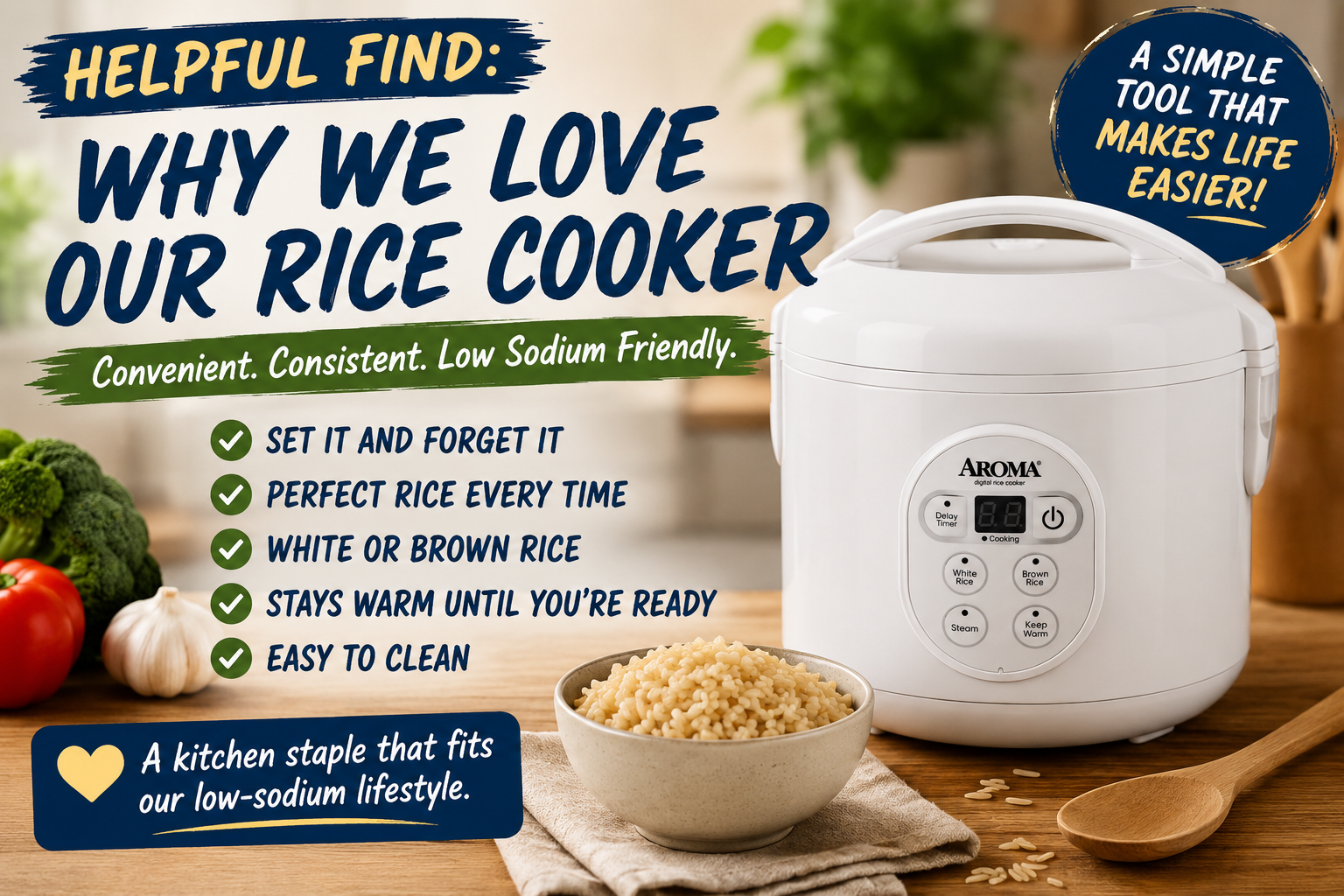
    We eat quite a bit of rice in our house. Since I’ve been following a low-sodium diet, rice has become an easy base for a lot of the meals we make at home.

    Plain rice is naturally very low in sodium as long as you’re not adding salt, salty broth, or other high-sodium ingredients while cooking it.

    There’s just one problem.

    You still have to cook it.

    Making rice on the stove certainly isn’t difficult, but you have to watch it, get the water-to-rice ratio right, make sure it doesn’t overcook, and hopefully end up with rice that’s neither crunchy nor mushy.

    Eventually we decided there had to be an easier way.

    So we bought a rice cooker.

    And I’m glad we did.

    Set It and Forget It

    The biggest reason we bought a rice cooker was convenience.

    Put in the rice and water, turn it on, and let the machine take care of the rest.

    There’s no standing over the stove or wondering whether I should turn the heat down.

    Set it and forget it.

    Once the rice is finished, our cooker automatically switches to a keep-warm mode. That means we don’t have to perfectly coordinate the rice with everything else we’re cooking for dinner.

    That may seem like a small thing, but when you’re preparing several things at once, having one less pot to worry about is pretty nice.

    The Rice Comes Out Right

    This might be my favorite part.

    The rice comes out consistently good.

    I’ve made plenty of rice on the stove that was still a little hard when dinner was ready. I’ve also gone the other direction and cooked it too long.

    With the rice cooker, there’s much less guesswork.

    Put everything in, start it, and when it’s finished, we have rice ready for dinner.

    Brown Rice, White Rice and Carbohydrates

    We make both white and brown rice.

    I’ve been using brown rice quite a bit because it provides more fiber than white rice. But that doesn’t mean we’ve eliminated white rice. We still enjoy both depending on what we’re making.

    For me, the bigger consideration is portion size.

    Rice may fit nicely into my low-sodium diet, but it still contains a significant amount of carbohydrates. Because I also have diabetes, I have to pay attention to how much rice I put on my plate.

    That’s an important distinction I’ve learned along the way:

    Low sodium doesn’t automatically mean something is unlimited.

    A food can work very well for one part of my diet while still requiring some thought because of another health condition.

    So I enjoy my rice.

    I just don’t fill half my plate with it.

    Great for the Meals We Make at Home

    Rice has become the base for quite a few meals around here.

    The steak and shrimp rice bowls I recently mentioned in my Daily Journal are a perfect example. We can control the seasoning on the steak, choose our vegetables, pay attention to the sodium in the shrimp, and serve everything over a measured portion of rice.

    I’ll be sharing my version of that recipe on the site soon.

    That’s the kind of cooking I’ve been trying to embrace.

    Instead of focusing entirely on foods I can’t have anymore, I’m finding meals we enjoy and figuring out how to make them work for me.

    The rice cooker simply makes that easier.

    It Doesn’t Take Over the Kitchen

    Another thing I like about rice cookers is that you don’t need a giant appliance.

    They come in several different capacities, so you can choose one based on how much rice you normally make.

    We went with a medium-sized model, which gives us enough capacity without taking up a ridiculous amount of counter or cabinet space.

    If kitchen storage is limited, that’s worth considering.

    Cleanup Takes Almost No Time

    Convenience doesn’t mean much to me if an appliance takes forever to clean.

    Fortunately, ours doesn’t.

    The cooking pot has a nonstick interior, so cleanup is extremely easy. Once we’re finished, it takes very little time to clean the pot and have it ready for the next meal.

    Simple to use.

    Simple to clean.

    And consistently good rice.

    That’s pretty much what I wanted.

    ❤️ Greg’s Take

    Do you absolutely need a rice cooker?

    Of course not.

    You can make perfectly good rice on the stove.

    But that’s not really why I bought one.

    I bought it because it makes life easier.

    Living with chronic illness has made me appreciate things that save a little time and effort. If an appliance can take one job off my plate while we’re making dinner, that’s valuable to me.

    I can put the rice on, walk away, and concentrate on preparing everything else—or just sit down until I need to do something again.

    When dinner is ready, the rice is ready.

    And it’s cooked right.

    Sometimes a Helpful Find doesn’t have to change your life.

    Sometimes it just has to make one little part of it easier.

    The Rice Cooker I Use

    If you’d like to see the rice cooker we purchased, you can find it here:

    See the rice cooker I use on Amazon

    There are different sizes available, so I’d choose the capacity that makes sense for the amount of rice you normally prepare rather than automatically buying the largest one.

    Affiliate Disclosure: This post contains an affiliate link. If you purchase something through my link, I may earn a small commission at no additional cost to you. I only share products that I personally use or believe may be helpful.

    Health Disclaimer: I’m sharing my personal experience and how rice fits into my own eating plan. This is not medical or nutritional advice. Rice is a carbohydrate-containing food and can affect blood glucose. If you have diabetes or another condition requiring dietary management, work with your healthcare provider or dietitian to determine the types and portions of foods that are appropriate for you. Always check nutrition labels and ingredients, particularly on seasoned or prepared rice products.

  • Daily Journal #11: A Good Meal, Better Numbers, and… Windex?

    Daily Journal #11: A Good Meal, Better Numbers, and… Windex?

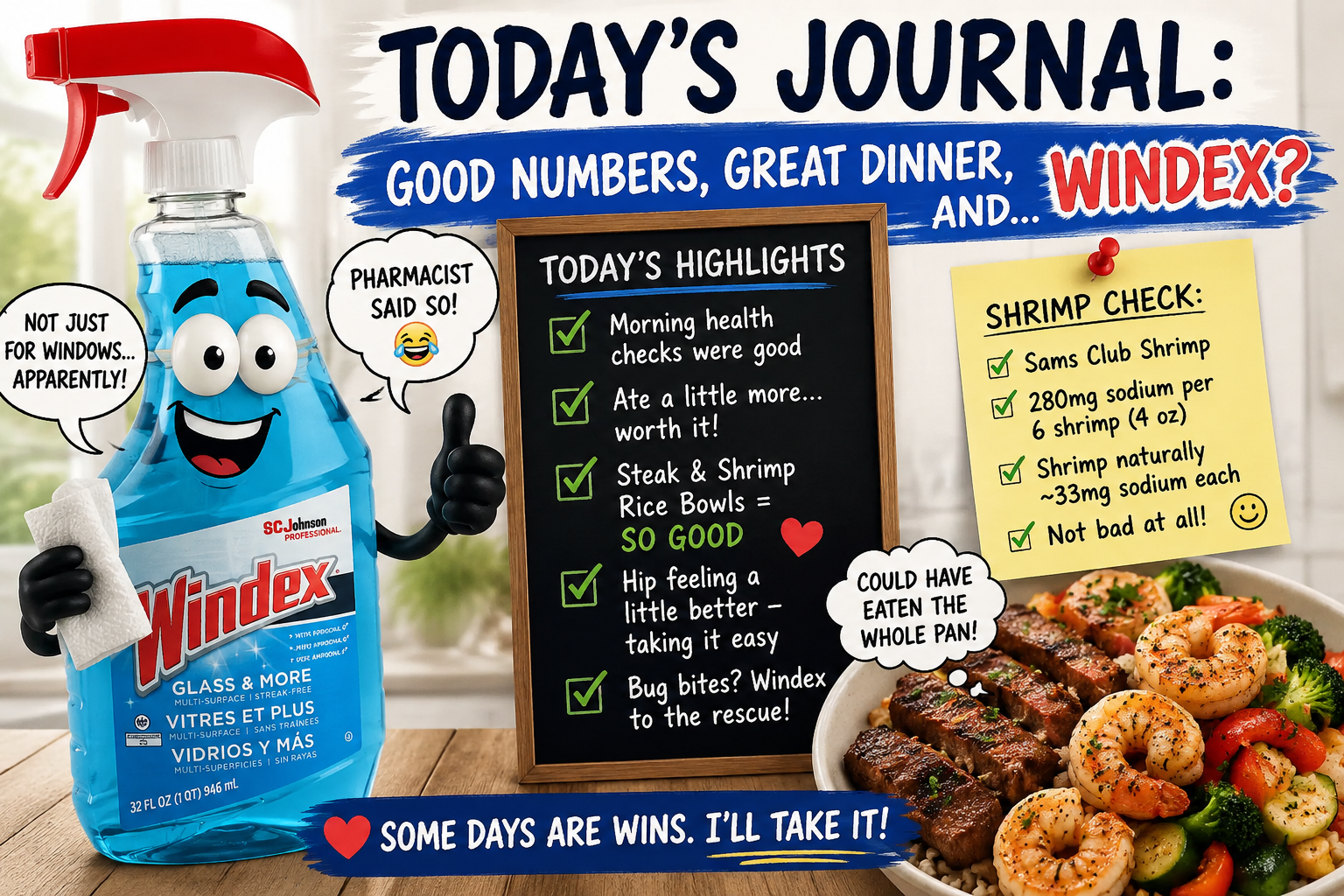
    My morning health checks were good today, which honestly surprised me a little.

    I ate more than I normally do yesterday.

    But dinner was really good.

    We made one of my favorite meals: steak and shrimp rice bowls. I probably could have eaten the entire pan if I had let myself.

    I’ll be posting my version of the recipe soon because it’s another meal we’ve been able to adapt to fit my low-sodium lifestyle.

    The steak, seasoning, rice, and vegetables are all pretty easy for me to control.

    The shrimp is where I have to pay attention.

    Not All Shrimp Is the Same

    One thing I’ve learned since watching sodium so closely is that shrimp can be tricky.

    Shrimp naturally contains sodium, but some frozen shrimp can have additional sodium from the way it is processed or packaged. That means I’ve learned to check the nutrition label instead of assuming one bag of shrimp is the same as another.

    This time, I bought shrimp from Sam’s Club.

    The label showed 280 mg of sodium per 4-ounce serving, which was about six shrimp.

    Shrimp already contains naturally occurring sodium, so not all of that 280 mg is necessarily coming from processing. That’s another reason I’ve learned that the nutrition label matters more to me than trying to estimate exactly where every milligram came from.

    It’s something I’ll talk more about when I post the steak and shrimp rice bowl recipe.

    And yes, I promise I’ll try not to eat the whole pan next time.

    The Hip Is a Little Better

    My leg and hip are feeling a little better today.

    They’re certainly not back to normal, but I’ll take any improvement I can get.

    After the last few days of pretty intense pain, I’m going to make today another take-it-easy day and hopefully let things continue to settle down.

    Sometimes knowing when not to push myself is just as important as getting up and moving.

    And Then There’s the Windex…

    The bug bites are also feeling much better.

    And this is where today’s journal gets a little strange.

    We stopped at CVS and asked the pharmacist what I could do about the itching.

    The suggestion?

    Put some Windex on a paper towel and dab it on the bites.

    Yep.

    Windex.

    My first thought was pretty much:

    “You’ve got to be kidding me.”

    I honestly wondered whether everyone behind the pharmacy counter was laughing their butts off after we walked away.

    But I tried it.

    And I’ll be damned…

    It helped.

    I’m certainly not turning He’s Knocking on Your Door into a Windex medical-advice website—and I’m not recommending anyone else try it—but I have to admit that my itching improved.

    Sometimes life with chronic illness is about tracking weight, blood pressure, sodium, medications, and symptoms.

    And apparently, sometimes it’s about leaving CVS wondering how Windex just became part of the day’s story.

    ❤️ Today’s Reflection

    Good health numbers this morning.

    A little less hip pain.

    Bug bites that finally aren’t driving me crazy.

    And a fantastic dinner last night that reminded me that eating low sodium doesn’t mean giving up good food.

    I’ll take those as wins.

    Today I’m going to take it easy, enjoy feeling a little better, and start thinking about getting that steak and shrimp rice bowl recipe onto the site.

    One day at a time.

  • Blackened Mahi Mahi: Bringing One of My Favorite Foods Back

    Blackened Mahi Mahi: Bringing One of My Favorite Foods Back

    Sometimes a recipe is about more than what’s for dinner.

    For me, blackened mahi mahi is tied to a much bigger part of my story.

    After my stroke in 2020, my doctors gave me a long list of lifestyle changes to consider. Some were fairly simple, like switching to an electric razor because I was taking blood thinners and needed to reduce the chance of cutting myself.

    Others involved bigger changes—eating healthier, exercising, losing weight, and being more careful about injuries and falls.

    At the time, I was probably in the worst physical shape of my life. I was driving an hour and a half each way to and from work, spending far too much time sitting, and not taking particularly good care of myself.

    To make matters worse, my stroke recovery happened during a Midwestern winter.

    Because I was taking a blood thinner, my doctors were understandably concerned about what could happen if I slipped on the ice and hit my head. One suggestion was that I wear a bicycle helmet when I went outside.

    At first, I thought they meant during the early part of my recovery.

    Nope.

    They meant going forward.

    I understood the reasoning. A fall and head injury while taking a blood thinner can be serious.

    But I also knew myself.

    I wasn’t going to spend every Midwestern winter walking around outside wearing a bicycle helmet.

    Something had to change.

    Trading Midwest Winters for Southwest Florida

    After I recovered enough from the stroke, my wife and I made a major life decision.

    We were moving to Southwest Florida.

    It was a place we had vacationed and loved, and we decided it was where we wanted to live.

    There were plenty of reasons for the move, but I’ll admit that food was one of them.

    We love seafood.

    Fresh fish. Shrimp. Outdoor restaurants. Sitting near the water and enjoying a meal in the Florida sunshine.

    And one of our absolute favorites has always been blackened fish and blackened shrimp.

    Unfortunately, my health journey wasn’t finished with me yet.

    Several years after the stroke, congestive heart failure entered the picture, and eventually I found myself living on a very restrictive low-sodium diet.

    Suddenly, those blackened seafood dinners I loved became a thing of the past.

    Blackened Didn’t Have to Mean Gone

    Restaurant blackening seasoning is something I generally avoid now because I don’t have enough control over how the food is seasoned or how much sodium is in it.

    For a while, I thought blackened fish might simply become another food I’d have to give up.

    Then I started looking at the problem differently.

    Maybe I didn’t have to give up blackened fish. Maybe I just needed to change how I made it.

    That’s exactly what we did.

    I found a Blackened Mahi Mahi recipe from Valerie Brunmeier at Valerie’s Kitchen that we really enjoy. Her recipe uses mahi mahi cooked quickly in a hot skillet with butter and olive oil, then finished with fresh lemon juice. 

    Original Blackened Mahi Mahi Recipe at Valerie’s Kitchen

    But there’s one important change I make.

    My Low-Sodium Modification

    Valerie’s original recipe calls for a homemade Cajun seasoning mixture that includes salt. 

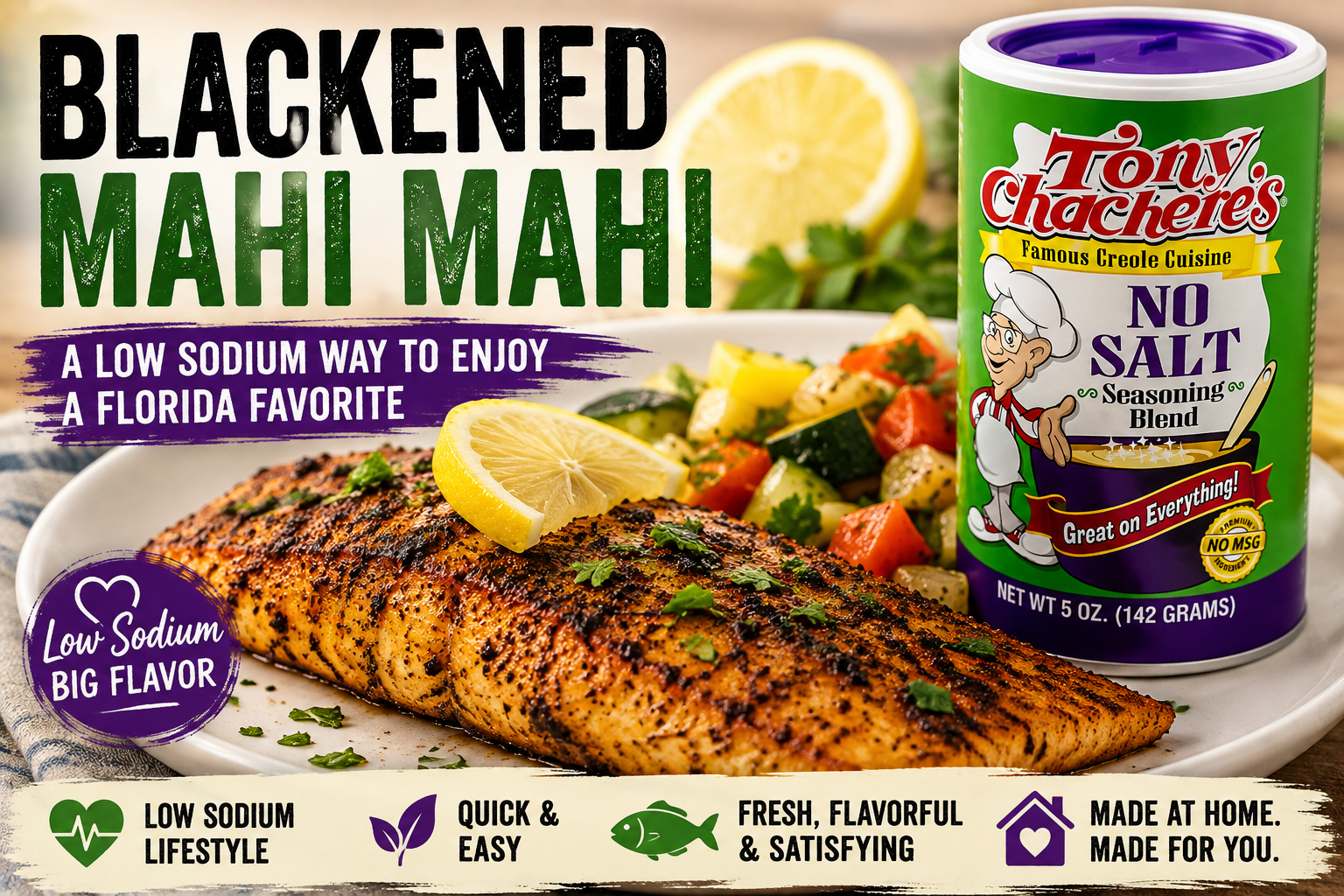
    Instead of making that seasoning mixture, I substitute Tony Chachere’s No Salt Seasoning Blend.

    That’s it.

    I still follow the basic cooking method from the original recipe, but replacing the blackening seasoning allows me to better control the sodium in the meal.

    I’ve already written about the seasoning and why it’s become one of my Helpful Finds:

    Tony Chachere’s No Salt Seasoning – My Helpful Find

    The original mahi mahi recipe is incredibly quick, too. Valerie lists about 10 minutes of preparation and 8 minutes of cooking time. The fish is seasoned, cooked in a hot skillet until golden and cooked through, and finished with fresh lemon. 

    It’s exactly the kind of meal I like: simple, fast and full of flavor.

    The Sodium Difference Matters to Me

    Here’s where making the meal at home really becomes important.

    The original recipe’s published nutrition information estimates 540 mg of sodium per serving, although Valerie notes that the nutrition calculation is only an estimate and actual values depend on the ingredients used. 

    By eliminating the salt-containing seasoning mixture and using my no-salt seasoning instead, I can remove a significant source of added sodium from the recipe.

    That doesn’t necessarily make the finished dish completely sodium-free—the fish, butter and other ingredients can contain naturally occurring or added sodium depending on what you buy—but it gives me much more control over the final meal.

    And control has become incredibly important to me.

    At a restaurant, I don’t know exactly what’s going onto that piece of fish.

    At home, I do.

    This Is What Low-Sodium Living Means to Me

    I’ve talked before about how frustrating a low-sodium diet can be.

    There are foods I simply don’t eat anymore.

    There are restaurants I don’t visit anymore.

    There are things I miss.

    But I’m also learning that before I put something permanently on the can’t-have-it-anymore list, it’s worth asking one question:

    Can I make it differently?

    That’s what happened with bread. Store-bought bread was difficult to fit into my sodium goals, so we bought a bread machine and started making our own.

    It’s what happened with spaghetti sauce.

    And now it’s what we’ve done with blackened seafood.

    I’m not pretending my version is identical to sitting at a waterfront restaurant in Southwest Florida and ordering a heavily seasoned piece of blackened mahi mahi.

    But I can sit at home, enjoy a piece of fish with the flavors I love, and know exactly what went into it.

    I’ll take that trade.

    ❤️ Greg’s Take

    My health has changed tremendously since that stroke in 2020.

    So has the way I live.

    And definitely the way I eat.

    But one thing I’m trying very hard not to do is look at every dietary restriction as another thing being taken away from me.

    Sometimes there’s another way.

    This blackened mahi mahi is a perfect example.

    I didn’t have to give up one of my favorite Florida meals. I just had to learn how to make it differently.

    And when you’re living with chronic illness, getting one of those little pieces of normal life back can mean an awful lot.


    Recipe Credit

    The original Blackened Mahi Mahi recipe was created by Valerie Brunmeier of Valerie’s Kitchen. I’m sharing my personal experience and the low-sodium substitution I use when making it at home. Please visit Valerie’s site for the complete ingredient list, measurements, and cooking instructions. 

    Get the Original Blackened Mahi Mahi Recipe

    Disclaimer: This article reflects my personal experience with low-sodium cooking and the modifications I make to recipes while living with chronic illness. It is not medical or nutritional advice. Sodium needs can vary from person to person, so always check ingredient labels and follow the guidance of your own doctor, dietitian, or healthcare team. Product ingredients and nutrition information can also change over time.

  • Bringing Blackened Fish Back to My Low Sodium Diet

    Bringing Blackened Fish Back to My Low Sodium Diet

    Affiliate Disclosure: This post contains an affiliate link. If you make a purchase through the link, I may earn a small commission at no additional cost to you. I only share products that I personally use or believe may be helpful. of the things I’ve missed most since switching to a low sodium lifestyle is blackened seafood.

    I’ve mentioned before that one of the reasons we moved to Southwest Florida was the seafood. I love blackened fish and shrimp, but traditional blackening seasonings can contain more sodium than I’m comfortable with.

    So, like a lot of things since being diagnosed with CHF, I started looking for another way.

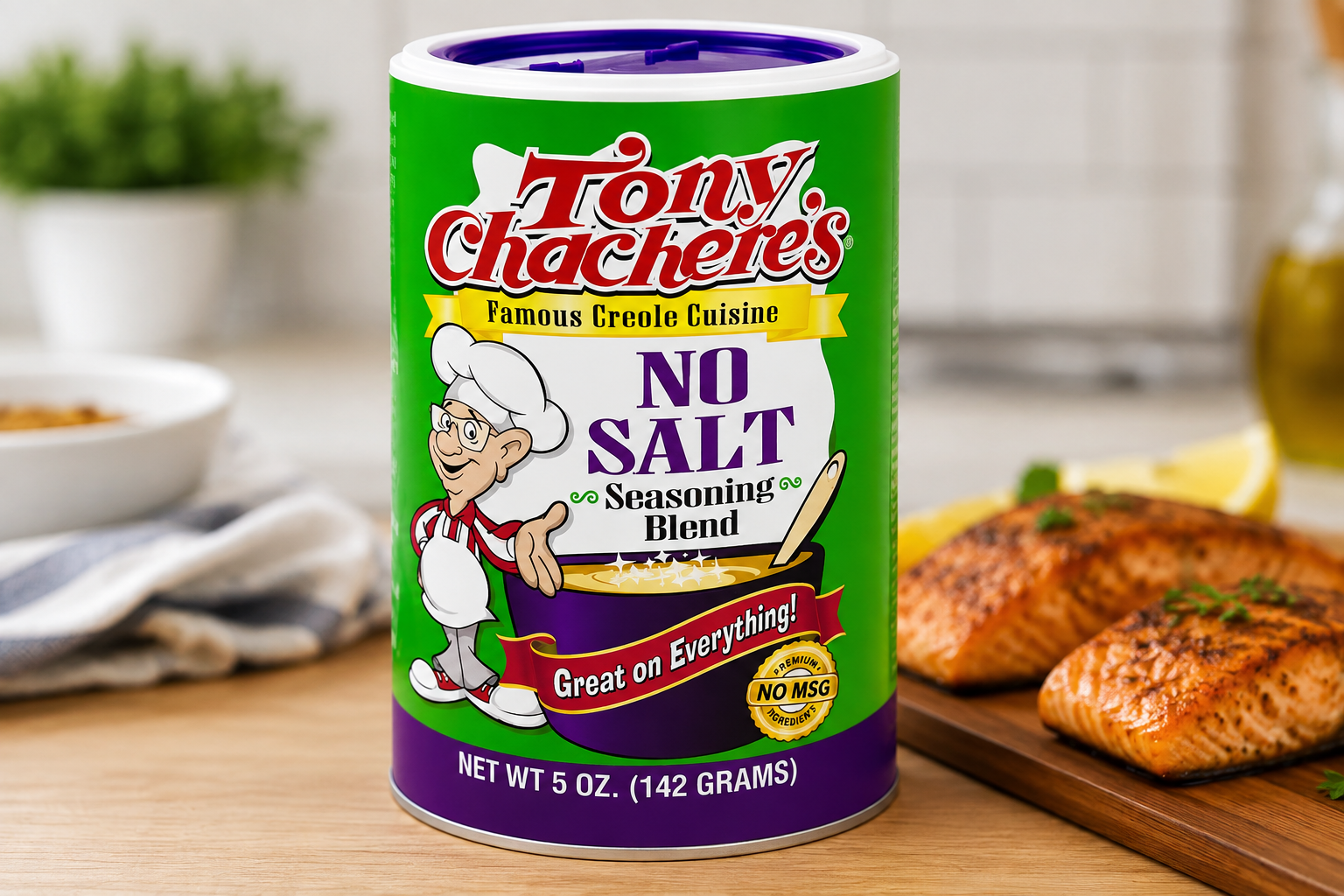
    That’s when I found Tony Chachere’s No Salt Seasoning.

    I’ve been using it at home as an alternative to traditional blackening seasoning, particularly on fish and shrimp. 

    And I’ve been really happy with it.

    Getting the Flavor Back

    One of the biggest lessons I’ve learned about low sodium cooking is that removing salt doesn’t have to mean removing flavor.

    You just have to find other ways to get there.

    When I cook fish or shrimp, I use this seasoning much like I would have used a traditional blackening seasoning in the past. It gives me that Cajun-style flavor I’m looking for without having to rely on the seasoning blends I used before.

    Is it exactly the same as ordering a heavily seasoned piece of blackened grouper at a waterfront restaurant?

    Probably not.

    But I can make it at home, control what goes into the meal, and enjoy something I thought I might have to give up.

    That’s a pretty good trade in my book.

    This Is What Low Sodium Living Has Become for Me

    This seasoning is a perfect example of why I created the Low Sodium Living section of this website.

    I’m not interested in spending the rest of my life eating bland chicken and steamed vegetables.

    I want food that I actually look forward to eating.

    Sometimes that means making spaghetti sauce from scratch.

    Sometimes it means buying a bread machine so I can enjoy bread again.

    And sometimes it’s as simple as finding a seasoning that lets me put fish and shrimp back on the menu.

    The goal isn’t to recreate my old diet.

    It’s finding new ways to enjoy the foods I love while making choices that work better for my health.

    Where I Use It

    Fish and shrimp are where I use this seasoning the most, but I’m going to start sharing some of the recipes where I’ve substituted it for traditional blackening seasoning.

    As I add those recipes to the site, I’ll link them here so this page becomes a place you can come back to for ideas.

    Would I recommend it?

    Absolutely.

    It’s exactly the kind of product I want to feature under Helpful Finds: something I actually use in my own kitchen that has made living with a low sodium diet a little easier.

    Living with CHF has taken some foods off my menu.

    But every once in a while, I find something that lets me put one back on.

    That’s a helpful find worth sharing.

    Where to Find It

    I purchased mine online. You can see the seasoning I use here:

    Tony Chachere’s No Salt Seasoning on Amazon

    Disclosure: If this is an affiliate link, I may earn a small commission if you make a purchase through it, at no additional cost to you.

  • Eating Out with CHF Isn’t Easy

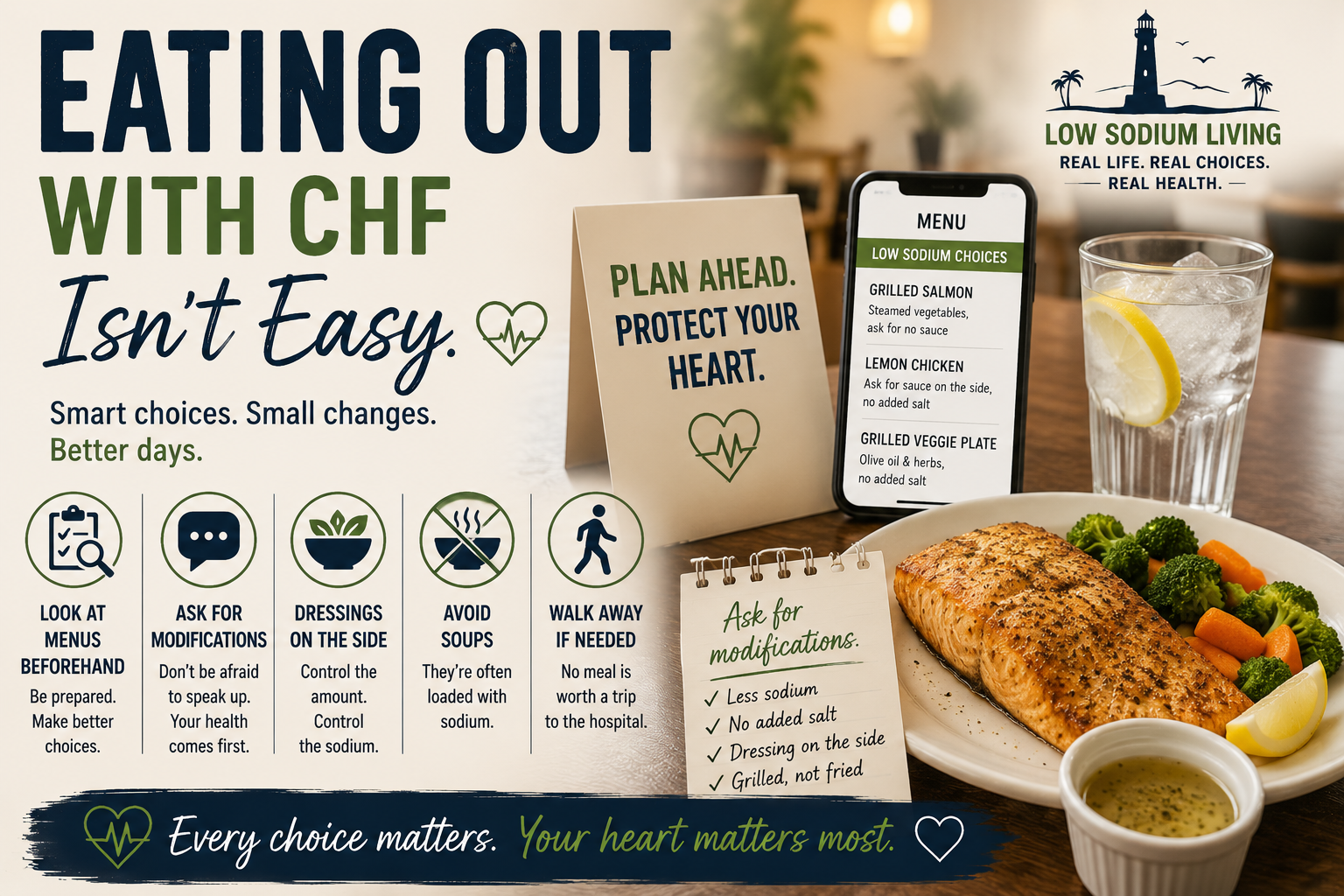
    Eating Out with CHF Isn’t Easy

    Finding a Balance Between Protecting Your Health and Living Your Life

    One of the biggest changes I wasn’t prepared for after being diagnosed with congestive heart failure wasn’t taking medication or weighing myself every morning.

    It was eating out.

    For most people, going to a restaurant is just another meal.

    For me, it became a decision.

    Is this restaurant going to have something I can safely eat?

    How much sodium is hidden in the food?

    Will this one meal cause me to retain fluid for the next two days?

    Those questions have changed the way I look at restaurants forever.

    The hardest part isn’t actually the food.

    It’s what restaurants represent.

    Restaurants are where families celebrate birthdays.

    They’re where friends catch up over lunch.

    They’re where couples enjoy date nights.

    Sharing a meal is one of the ways we stay connected to one another, and when chronic illness forces you to think twice about every menu, it can feel like you’re slowly becoming disconnected from that part of life.

    I’ve experienced that feeling more than once.

    There have been times when I’ve simply decided it was easier to stay home than spend the entire meal worrying about sodium.

    While that protects my heart, it also means saying no to moments with family and friends.

    That isn’t an easy trade-off.

    Some of My Favorite Foods Are Now Memories

    One of the reasons my wife and I moved to Southwest Florida was the seafood.

    We couldn’t wait to enjoy fresh fish, shrimp, and all of the wonderful waterfront restaurants this area has to offer.

    One of my favorite meals was blackened fish or blackened shrimp.

    Today, those meals are mostly memories.

    The seasonings that give blackened seafood its incredible flavor also bring a tremendous amount of sodium. While there may be exceptions, I’ve learned that it’s usually not a risk worth taking.

    Another favorite of mine has always been clam chowder.

    I honestly can’t remember the last time I had a bowl.

    Restaurant soups are often loaded with sodium, and clam chowder is probably one of those foods I’ll simply never enjoy again.

    Those may seem like small sacrifices to some people.

    But they’re reminders that chronic illness changes more than your health.

    It changes traditions.

    It changes favorite meals.

    It changes experiences you once took for granted.

    Preparation Starts Before I Leave Home

    One of the best habits I’ve developed is looking at the restaurant’s menu before I ever get in the car.

    Many restaurants now publish their menus online, and some even provide nutrition information. That gives me the opportunity to look for grilled foods, fresh vegetables, simple salads, or meals that can be modified before I ever sit down.

    Walking into a restaurant with a plan removes a lot of the stress.

    Sometimes I already know exactly what I’m going to order before I walk through the front door.

    Don’t Be Afraid to Ask Questions

    I’ve learned that it’s okay to ask.

    Can the chicken be grilled without seasoning?

    Can the vegetables be prepared without added salt?

    Can the sauce be served on the side?

    Most servers genuinely want to help if they understand why you’re asking.

    You’re not being difficult.

    You’re simply trying to take care of your health.

    Dressing on the Side

    Salads seem like the obvious healthy choice.

    Unfortunately, many bottled dressings contain surprising amounts of sodium.

    I’ll often order my dressing on the side so I can control how much I use.

    I’ll admit something else.

    There have even been times when I’ve quietly brought my own homemade low-sodium dressing with me.

    Some restaurants don’t allow outside food because they can’t guarantee its safety or accept responsibility if someone becomes ill. I completely understand and respect their position.

    When I can’t bring my own dressing, I’ll often ask for olive oil and lemon wedges instead.

    It’s a simple solution that still lets me enjoy the salad.

    Soup Is Usually Off My List

    This one still bothers me.

    I love soup.

    Unfortunately, soup is one of the biggest hidden sources of sodium in many restaurants.

    Even a small bowl can contain more sodium than I’d like to eat in an entire day.

    As much as I enjoy it, soup has become something I almost always skip.

    It’s Not Just the Sodium

    One thing people often don’t realize is that my challenge isn’t only sodium.

    It’s fluids too.

    Because of my heart failure, I’m limited to about 1.5 liters of fluid each day.

    That means every drink counts.

    Water.

    Coffee.

    Tea.

    Soft drinks.

    Even healthy beverages.

    They’re all part of the same daily limit.

    Then there’s alcohol.

    For many people, meeting friends for a drink is just another way to socialize.

    For me, alcohol is no longer part of the equation.

    When friends gather around a table with drinks in hand, it reminds me that chronic illness changes more than what you eat.

    Sometimes it changes how you participate in life’s social moments.

    I’ll be honest…

    That’s something I still haven’t learned how to manage very well.

    Sometimes the Best Decision Is to Walk Away

    This has probably been the hardest lesson.

    There have been times when I looked over a menu and realized there simply wasn’t a good option.

    Instead of convincing myself that “one meal won’t matter,” I’ve learned it’s okay to leave and find another restaurant.

    Years ago, I probably wouldn’t have done that.

    Today, I remind myself that protecting my health is more important than protecting my pride.

    I’m Still Learning

    If I’m being completely honest…

    I haven’t figured this out yet.

    Eating out with CHF remains one of the biggest challenges in my life.

    I still miss the freedom of ordering whatever sounds good.

    I miss seafood dinners without worrying about sodium.

    I miss a bowl of clam chowder on a cool afternoon.

    I miss walking into a restaurant without studying the menu before I leave home.

    But I’m learning that living with chronic illness isn’t about finding perfect solutions.

    It’s about making the best decisions you can with the information you have.

    Most days that means eating at home.

    Some days it means asking a dozen questions before ordering.

    And sometimes…

    It means deciding that spending time with the people you love is worth the extra effort it takes to find a meal you can enjoy safely.

    I still believe there has to be a compromise.

    A way to protect my health without completely giving up one of the most important ways people connect with each other.

    I haven’t found that balance yet.

    But I’m still looking.

    Screen capture this and carry it with you when you go out

    🍽️ My Restaurant Checklist

    ✔️ Read the menu online first.

    ✔️ Look for grilled or baked options.

    ✔️ Ask for sauces and dressings on the side.

    ✔️ Skip soups and heavily seasoned foods.

    ✔️ Watch both sodium and fluids.

    ✔️ Don’t be afraid to ask questions.

    ✔️ If there isn’t a good option, choose another restaurant.

  • Homemade Low Sodium Focaccia

    Homemade Low Sodium Focaccia

    Greg’s Kitchen Rating ⭐

    ⭐⭐⭐⭐⭐ Taste

    ⭐⭐⭐☆☆ Difficulty

    ⭐⭐⭐⭐⭐ Would I Make It Again?

    ⭐⭐⭐⭐⭐ Family Approved

    ⭐⭐⭐⭐⭐ Freezer Friendly

    ⭐⭐⭐⭐⭐ Worth Buying a Bread Machine?

    This recipe completely changed how I think about bread. I honestly believed fresh bread was something I’d have to give up after being diagnosed with CHF. Buying a bread machine turned out to be one of the best investments we’ve made for our kitchen—and our health.

    Sometimes You Don’t Have to Give Up the Foods You Love

    One of the hardest things about switching to a low sodium lifestyle wasn’t giving up potato chips or fast food.

    It was bread.

    Bread has always been a part of our meals. Toast with breakfast. A sandwich for lunch. Fresh bread alongside pasta or soup. I never really thought much about it until I started reading nutrition labels after being diagnosed with congestive heart failure.

    That’s when I realized something surprising.

    Even ordinary sandwich bread can contain a significant amount of sodium in just a couple of slices. When you’re trying to stay within a daily sodium limit, those numbers add up quickly. 

    I wasn’t ready to give up bread.

    Instead, my wife and I decided to find another solution.

    We bought a bread machine.

    At first, I wasn’t sure if it would be worth it. Neither of us had much experience baking bread, and I honestly wondered if homemade bread could taste as good as what we were buying at the grocery store.

    It didn’t take long to find out.

    Not only did it taste better, but I finally had something I hadn’t had in a long time—control.

    I knew exactly what was going into every loaf.

    I could leave out the added salt.

    I could choose the ingredients.

    And for the first time since changing my diet, bread was back on the menu.

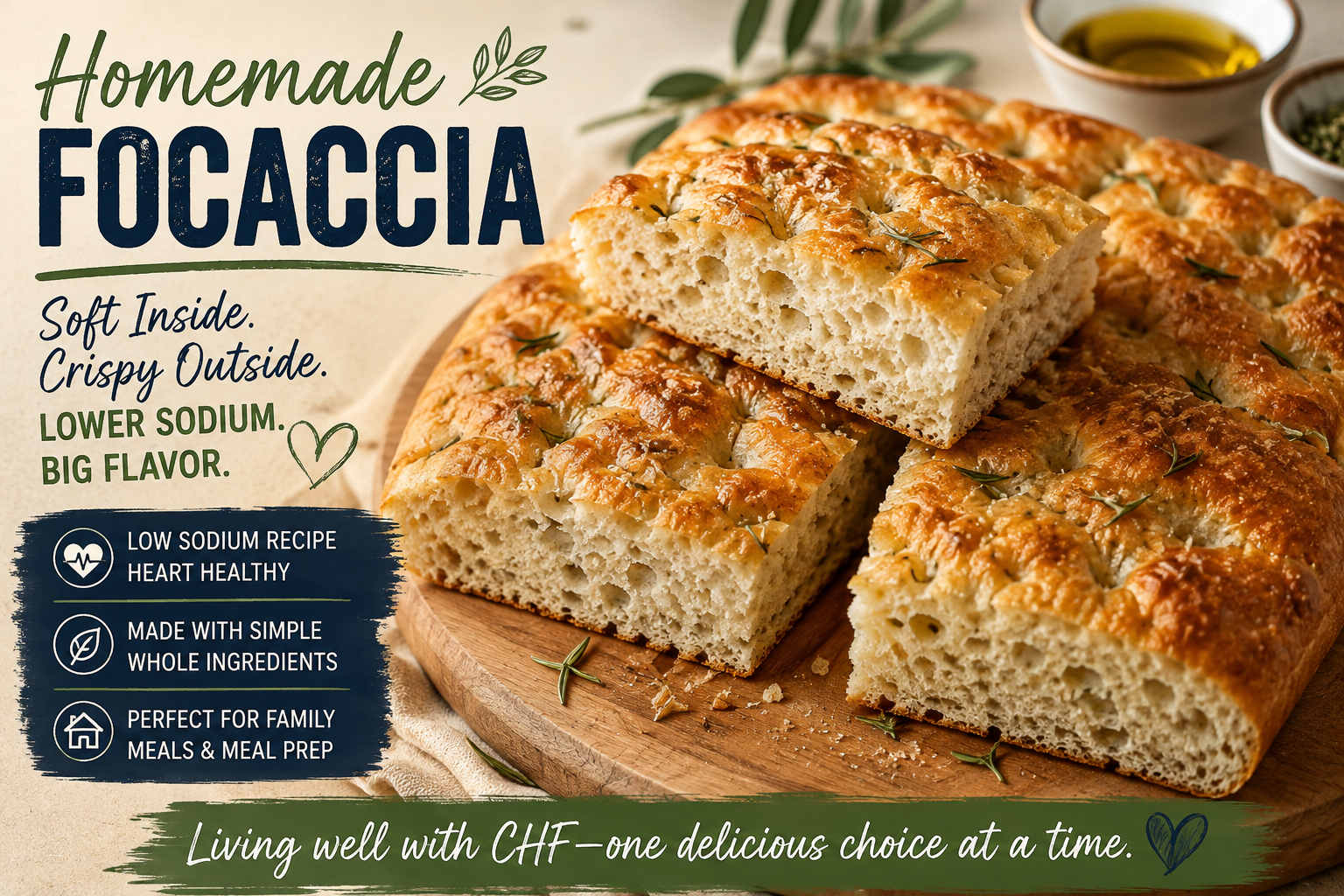
    One of the first recipes we tried was a No-Salt Focaccia recipe from Paula Rhodes at Salad in a Jar. What caught my attention was that the bread machine does all of the hard work—mixing, kneading, and the first rise—while the focaccia is finished in the oven to create a crisp crust and a soft, airy interior. 

    The recipe uses simple ingredients like bread flour, olive oil, honey, Italian seasoning, and yeast to build flavor naturally instead of relying on salt. The result is a focaccia that’s light, flavorful, and incredibly versatile. We’ve enjoyed it as a side with pasta, dipped in olive oil and herbs, and even sliced for sandwiches. 

    One thing I’ve learned throughout this journey is that living with chronic illness doesn’t always mean giving things up.

    Sometimes it simply means learning a different way to make them.

    Buying a bread machine wasn’t really about making bread.

    It was about taking back something I thought I had lost.

    Every loaf reminds me that a low sodium lifestyle doesn’t have to be about deprivation. With a little creativity—and sometimes a new kitchen gadget—you can still enjoy many of the foods you love.


    ❤️ Greg’s Tip

    If you’re thinking about buying a bread machine, don’t look at it as another appliance taking up space on your counter.

    Think of it as an investment in your health.

    For me, it opened the door to fresh, homemade bread with ingredients I could control. That peace of mind has been worth every penny.


    Recipe Credit

    This focaccia recipe was created by Paula Rhodes of Salad in a Jar. I’ve shared my experience because it has become one of my favorite homemade bread recipes for a low sodium lifestyle. If you’d like the complete recipe and detailed step-by-step instructions, you can find it here:

    No-Salt Focaccia (Bread Machine Dough + Oven Bake) by Paula Rhodes. 

    Chronic illness may change how I eat, but it doesn’t get to decide what I enjoy.

  • The Hidden Sodium Trap

    The Hidden Sodium Trap

    10 Foods That Shocked Me the Most

    When I was diagnosed with congestive heart failure (CHF), I thought I knew what my biggest challenge would be.

    The salt shaker.

    I figured if I stopped adding salt to my food, I’d be well on my way to a healthier lifestyle.

    I couldn’t have been more wrong.

    The real problem wasn’t the salt I was adding.

    It was the sodium that had already been added before I ever bought the food.

    That realization completely changed the way I shop, cook, and eat.

    Today, I spend more time reading nutrition labels than I ever imagined possible. At first it felt overwhelming. Every trip to the grocery store became an investigation. I’d pick up one product after another, flip it over, and immediately look for one thing:

    How much sodium is in this?

    What I discovered surprised me.

    Some of the biggest sources of sodium weren’t the foods I expected. They were foods that most of us buy every week without giving them a second thought.

    Here are ten foods that completely changed the way I grocery shop.


    1. Bread

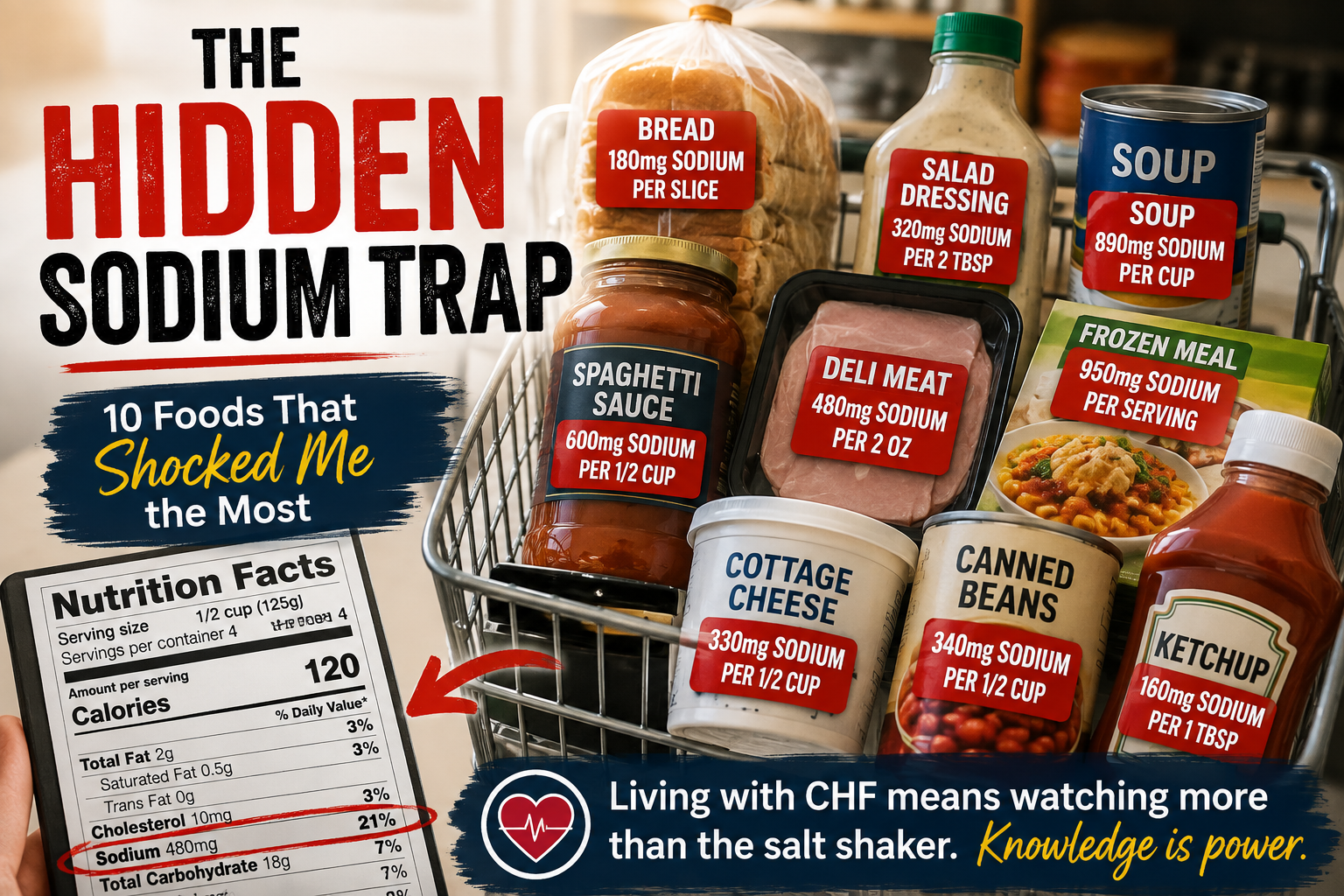
    Many sandwich breads contain well over 150–200 mg of sodium per slice. That means a simple sandwich can provide several hundred milligrams of sodium before you even add the meat, cheese, or condiments.

    Bread was probably my biggest surprise. I never imagined something that didn’t even taste salty could contain so much sodium. After comparing label after label, I finally decided to buy a bread machine. Instead of giving up bread altogether, I learned to make my own. Now I know exactly what goes into every loaf, I can control the sodium, and I get to enjoy fresh bread again.

    If you don’t make your own, make sure you read labels and look for lower-sodium options whenever possible.


    2. Salad Dressing

    Salads are supposed to be healthy.

    Unfortunately, many bottled dressings aren’t.

    A couple of tablespoons can contain more sodium than the salad itself.

    These days I often make my own dressings at home. Not only are they lower in sodium, but I actually enjoy the flavor more because I can control the ingredients.


    3. Jarred Spaghetti Sauce

    This one hurt.

    Spaghetti has always been one of my favorite comfort foods.

    Some jarred sauces contain several hundred milligrams of sodium in just a half-cup serving.

    Instead of giving up spaghetti, I learned to make my own sauce using no-salt-added tomatoes and fresh herbs.

    Check out my article here on LOSO Spaghetti Sauce

    Problem solved.


    4. Canned Soup

    This one probably won’t surprise many people.

    Some soups contain nearly an entire day’s worth of sodium in one bowl.

    If I buy soup today, it’s almost always a low-sodium or no-salt-added version—or better yet, homemade.


    5. Deli Meats

    Ham.

    Turkey.

    Roast beef.

    Chicken.

    I thought I was making healthy sandwich choices.

    Then I learned these meats are often preserved with large amounts of sodium.

    Today I prefer freshly cooked chicken or turkey whenever possible.


    6. Cottage Cheese

    This one really caught me off guard.

    Cottage cheese seems like the perfect healthy snack.

    Unfortunately, many brands are surprisingly high in sodium.

    Fortunately, more companies are beginning to offer lower-sodium versions if you’re willing to look for them.

    The one I found that is low in sodium is by Friendship at Publix


    7. Frozen Meals

    Convenience often comes with a price.

    Many frozen dinners are loaded with sodium because it’s used for preservation and flavor.

    That’s one of the reasons I cook extra portions whenever I can.

    My freezer has become my own “frozen food aisle”—except I know exactly what’s in every meal.


    8. Canned Vegetables

    This one is easy to fix.

    Instead of regular canned vegetables, I buy no-salt-added versions whenever they’re available.

    Sometimes frozen vegetables are an even better choice.


    9. Condiments

    Ketchup.

    Mustard.

    Barbecue sauce.

    Soy sauce.

    Teriyaki sauce.

    You don’t use much at one time, but the sodium adds up quickly.

    I’ve learned that sometimes a squeeze of lemon juice, fresh herbs, or homemade sauces add just as much flavor without the extra sodium.

    Or check out the link to our homemade stir-fry sauce


    10. Restaurant Meals

    This has probably been the hardest adjustment for me.

    Restaurants aren’t trying to make unhealthy food.

    They’re trying to make food that tastes great.

    Unfortunately, that often means using generous amounts of salt.

    Before I go out to eat, I almost always look at the menu online. If nutrition information is available, I read it before I ever walk through the door.

    Planning ahead helps me make better choices.


    What I Learned

    Looking back, I realized something important.

    The biggest source of sodium in my diet wasn’t the salt shaker sitting on my kitchen table.

    It was the food I was buying at the grocery store without ever reading the labels.

    Once I understood that, everything changed.

    Today I still enjoy sandwiches.

    I still eat spaghetti.

    I still have salads.

    I simply prepare them differently.

    Living with CHF hasn’t meant giving up the foods I love.

    It has meant learning how to make better choices.

    And honestly…

    I’m healthier because of it.


    ❤️ Greg’s Tip

    Don’t start by changing your entire pantry.

    Instead, the next time you’re grocery shopping, pick one product you buy regularly and compare three different brands.

    You might be amazed at how much the sodium content varies.

    Small changes, repeated over time, become healthier habits.

    Keep an eye out for a new article where I will compare 3 of the same products and pick the best option


    My Challenge to You

    The next time you’re in the grocery store, don’t look at the front of the package first.

    Turn it over.

    Read the Nutrition Facts label.

    Take a close look at the sodium.

    It may completely change what goes into your shopping cart.