Bread was one of those foods I never gave much thought to before I had to start watching my sodium.
It’s bread. How much sodium could possibly be in it?
Apparently, quite a bit.
Once I started reading nutrition labels, I realized that bread could add a surprising amount of sodium to a meal—especially when you’re eating two slices for a sandwich or adding a bun to something that already contains sodium.
I didn’t want to give up bread completely.
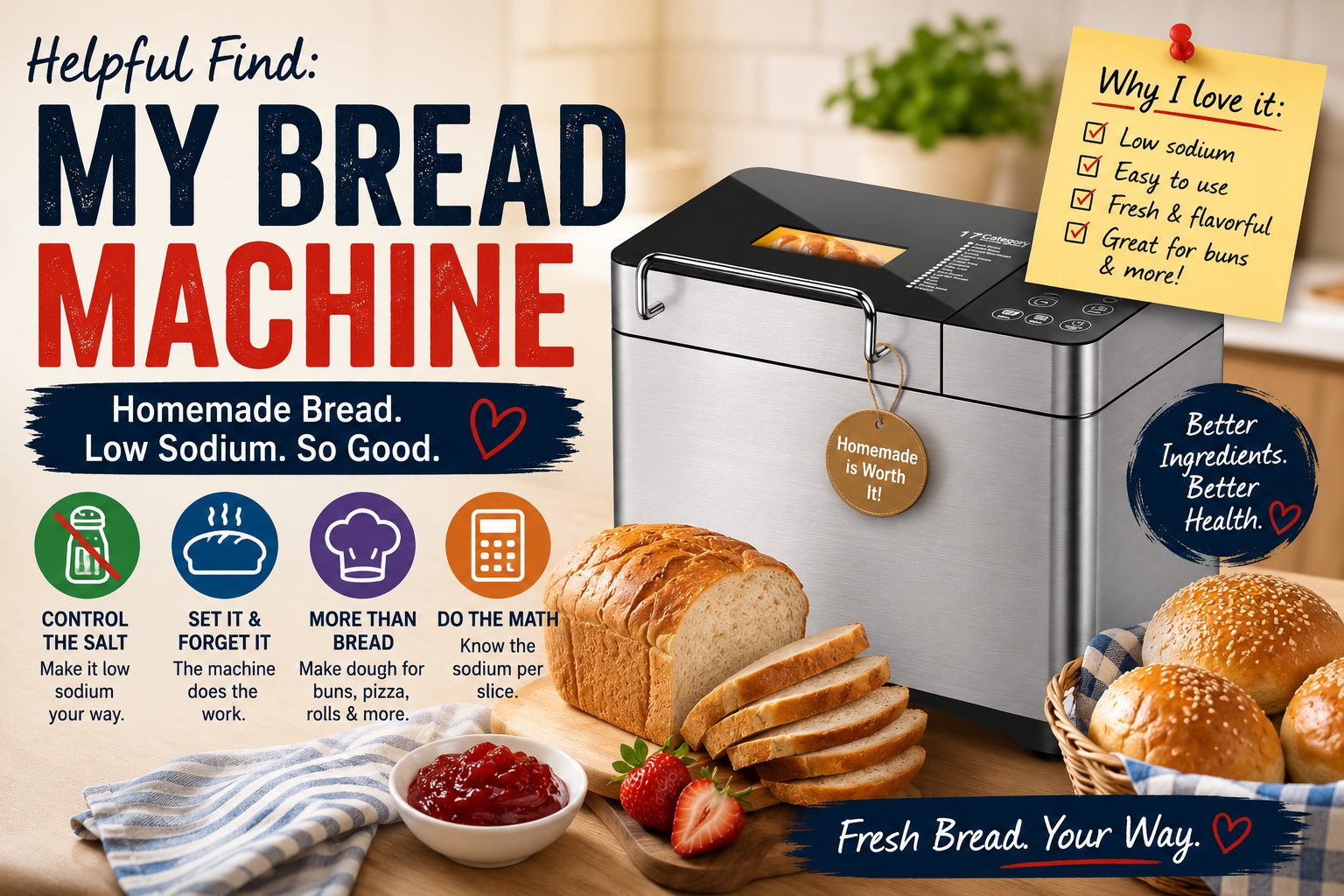
So we bought a bread machine.
And it has turned out to be one of the most useful appliances we’ve purchased since I started living a low-sodium lifestyle.
Why Make Bread at Home?
The biggest advantage is pretty obvious:
I control what goes into it.
Flour. Water. Yeast. A few other ingredients depending on the recipe.
And most importantly, I control the salt.
There are plenty of salt-free and low-sodium bread recipes available online. I’ve made bread with no added salt at all, but I’ve also experimented with regular bread recipes and simply reduced the amount of salt.
If a recipe calls for a teaspoon of salt, for example, I might try half a teaspoon or even a quarter teaspoon.
That’s one of the things I like about making it myself.
It doesn’t always have to be all or nothing.
I can experiment and find a balance between flavor, texture and the amount of sodium I’m comfortable with.
I Can Actually Calculate the Sodium Per Slice
Another thing I really like about homemade bread is knowing exactly what’s in it.
If I’m making the loaf myself, I know how much sodium went into every ingredient.
That means I can add up the sodium in the entire recipe and divide it by the number of slices I get from the loaf.
For example, if all the ingredients in my loaf contained 600 mg of sodium and I cut the finished loaf into 12 slices:
600 ÷ 12 = approximately 50 mg of sodium per slice.
I’m not relying on a guess.
I know what I put into it.
Of course, you have to remember that your calculation is only as accurate as your ingredients and portion sizes, but it gives me a pretty good way to track what I’m eating.
It Really Is Set It and Forget It
I think some people hear “homemade bread” and imagine spending half the day kneading dough on the kitchen counter.
That’s not what I’m doing.
The bread machine does most of the work.
I put the ingredients into the machine, select the program and let it go.
It mixes.
It kneads.
It allows the dough to rise.
And if I’m making a regular loaf, it bakes it too.
A few hours later, I’ve got fresh bread.
That’s my kind of cooking.
It Does More Than Make Loaves of Bread
This might actually be my favorite part.
I don’t always let the bread machine bake the bread.
Most machines have a dough cycle, and that opens up a whole different world.
I’ve even made homemade hamburger buns.
I let the bread machine mix, knead and raise the dough. When it’s finished, I take the dough out, divide it, shape the hamburger buns and put them on a baking sheet.
Then I bake them in the regular oven.
They turn out great.
And personally, I think they’re much more flavorful than the store-bought buns I used to eat.
You can use the same idea for things like dinner rolls, pizza dough and other breads.
I’ve also made focaccia using my bread machine, which is another recipe I’ve shared on the site.
That’s one reason I don’t think of this as an appliance that only makes rectangular loaves of bread.
For me, it’s really a dough-making machine too.
There Are Some Downsides
As much as I like it, a bread machine isn’t perfect.
It’s Not Small
This is a legitimate consideration.
A bread machine is a fairly large countertop appliance.
If you have a small kitchen or limited storage, you’ll need to figure out where you’re going to put it.
It’s not something you’re going to tuck into a tiny drawer when you’re finished.
For us, the amount we use it makes the storage space worthwhile.
Homemade Bread Doesn’t Last as Long
This is another thing I’ve learned.
Homemade bread generally doesn’t have the shelf life of the commercial bread you buy at the grocery store.
Salt plays several roles in bread making, and reducing it can affect the finished bread. Homemade bread also doesn’t typically contain the preservatives and other ingredients used to extend the shelf life of many commercially produced breads.
So I don’t expect my homemade bread to sit around for weeks.
Honestly, that’s usually not much of a problem.
Fresh homemade bread has a funny way of disappearing.
You can also slice and freeze bread you aren’t going to use right away.
Is It Worth It?
For me?
Absolutely.
When I first started eating low sodium, there were so many things that suddenly felt like they were being taken away.
Bread was one of them.
Buying a bread machine gave some of that back.
Now I can make a loaf with little or no added salt.
I can experiment with recipes.
I can make hamburger buns.
I can make focaccia.
I can make pizza dough.
And I know exactly how much salt I put into it.
There are some inconveniences.
The machine takes up space.
Homemade bread doesn’t last as long.
And yes, making bread requires a little more effort than grabbing a loaf off the grocery-store shelf.
But I’ll take those trade-offs.
❤️ Greg’s Take
One of the things I’m slowly learning about low-sodium living is that sometimes the answer isn’t finding a perfect replacement at the grocery store.
Sometimes the answer is:
Make it yourself.
That’s what happened with bread.
Instead of walking through the bread aisle reading label after label and getting frustrated by the sodium, I can make my own and decide exactly how much salt goes into it.
Sometimes that’s none.
Sometimes I take a regular recipe and cut the salt in half.
Sometimes I cut it even further.
I’m still experimenting.
But the important thing is that bread is back on the menu.
And when you’re living with a diet that can sometimes feel like an endless list of things you can’t have, getting something back feels pretty damn good.
The Bread Machine I Use
The bread machine I’m talking about in this article is the one I personally purchased and use at home.
See the Bread Machine I Use on Amazon
I use it for regular loaves as well as making dough for things like hamburger buns and focaccia.
Affiliate Disclosure: This post contains an Amazon affiliate link. As an Amazon Associate, I may earn from qualifying purchases made through this link at no additional cost to you. I personally use the bread machine featured in this article. I purchased it with my own money and am not affiliated with KBS. I’m sharing it because it has been useful in my own low-sodium cooking, not because it will be the right choice for everyone. My opinions and experiences are my own.
Leave a Reply