Tag: Low Sodium Diet

  • Helpful Find: Sodium-Free Ranch Mix That Makes a Great Low-Sodium Ranch That Actually Tastes Like Ranch

    Helpful Find: Sodium-Free Ranch Mix That Makes a Great Low-Sodium Ranch That Actually Tastes Like Ranch

    One of the foods I miss on a low-sodium diet is ranch dressing.

    Not because ranch is some gourmet food.

    It’s ranch.

    But it goes on everything.

    Salads.

    Vegetables.

    Chicken.

    Wraps.

    Potatoes.

    And unfortunately, most bottled ranch dressing can contain a decent amount of sodium before you even put it on anything.

    So I started looking for something I could make myself.

    That is when I found MySALT Restaurant-Style Ranch Dressing & Dip Mix.

    The thing that got my attention was simple:

    The dry mix itself contains zero sodium per serving.

    That gives me something I really like with low-sodium cooking — control.

    I can decide what goes into the finished dressing instead of starting with a bottle that already contains a bunch of sodium. The manufacturer specifically says the mix is sodium-free as packaged and can be combined with buttermilk and mayonnaise to make ranch dressing. 

    MySALT Sodium-Free Ranch Mix on Amazon

    Important: The Finished Ranch Is Not Sodium-Free

    This is worth making very clear.

    The seasoning packet is sodium-free.

    The ranch dressing I make from it is not.

    Why?

    Because I add mayonnaise and buttermilk, and both contain naturally occurring or added sodium depending on the brand.

    That means the final sodium content depends almost entirely on the ingredients you choose.

    This is one of those situations where reading labels still matters.

    If one brand of mayonnaise has considerably less sodium than another, use the lower-sodium one.

    Same with the buttermilk.

    The seasoning mix gives you a zero-sodium starting point, but it does not magically remove the sodium from everything you mix with it.

    How I Make My Low-Sodium Ranch Dressing

    This is about as simple as a recipe gets.

    Ingredients

    • 1 packet MySALT Sodium-Free Ranch Dressing & Dip Mix
    • 1 cup mayonnaise
    • 1 cup buttermilk

    Directions

    Add the mayonnaise and buttermilk to a bowl.

    Pour in the ranch seasoning.

    Whisk everything together until completely combined.

    Refrigerate it before serving so the flavors have time to come together.

    That’s it.

    You now have about 2 cups of homemade ranch dressing.

    The manufacturer also says the seasoning can be used to make a dip with sour cream, so there are a few different ways to use it beyond salad dressing. 

    Why I Like Making Ranch This Way

    The biggest advantage is that I know where the sodium is coming from.

    The mix?

    Zero.

    Then I can look at my mayonnaise label.

    Look at my buttermilk label.

    Do the math.

    That is much easier for me than buying a bottled dressing where I have no control over how much salt was added.

    And it actually tastes like ranch.

    That last part is important.

    I have tried enough low-sodium replacements that taste like somebody removed everything enjoyable from the food.

    I’m not interested in eating something just because the label says it is healthy.

    It still has to taste good.

    This does.

    You Can Adjust the Consistency Too

    Another benefit of making it yourself is that you can control how thick it is.

    If you want a thicker ranch for dipping vegetables, use a little less buttermilk.

    If you want it thinner for salads, add a little more.

    Just remember that changing the amount of buttermilk also changes the sodium content of the finished dressing.

    Again, read the label.

    Don’t Forget Portion Size

    There is another trap with ranch.

    You make something considerably lower in sodium and suddenly think:

    Great. I can use as much as I want.

    Not exactly.

    Mayonnaise and buttermilk still contribute sodium, calories, and fat.

    And ranch is really easy to pour.

    A little becomes a lot very quickly.

    So even though this gives me much more control than bottled ranch, I still pay attention to how much I use.

    Low sodium does not mean unlimited.

    More Than Salad Dressing

    The manufacturer also suggests using the dry ranch mix as a seasoning on foods such as meats and potatoes. 

    That opens up a lot of possibilities.

    You could try it on:

    • Chicken
    • Potatoes
    • Vegetables
    • Burgers
    • Sandwiches
    • Wraps

    Because the seasoning itself starts with zero sodium, you can add ranch flavor without automatically adding the salt found in many traditional ranch seasoning packets.

    That is probably where I’ll experiment with it next.

    Helpful Find Verdict

    For me, this one is definitely a Helpful Find.

    It solves a real problem.

    I wanted ranch.

    I didn’t want all the sodium that often comes with ranch.

    This gives me a sodium-free seasoning base and lets me control the rest of the recipe myself.

    Is the finished dressing sodium-free?

    No.

    But it doesn’t need to be.

    The goal for me isn’t always zero sodium.

    The goal is knowing what I’m eating and being able to make choices that fit the plan my medical team gave me.

    And this makes that a lot easier.

    Affiliate Disclosure

    This article contains an affiliate link. If you purchase something through the link, I may receive a small commission at no additional cost to you. I only share products that I personally use or think may be helpful.

    Medical & Nutrition Disclaimer

    This article reflects my personal experience managing sodium intake and chronic health conditions. It is provided for informational purposes only and is not medical or nutritional advice. Sodium needs vary depending on medical conditions, medications, kidney function, blood pressure, and individual treatment plans. Always read nutrition labels, calculate values based on the products you actually use, and follow the dietary guidance provided by your own qualified healthcare professionals.
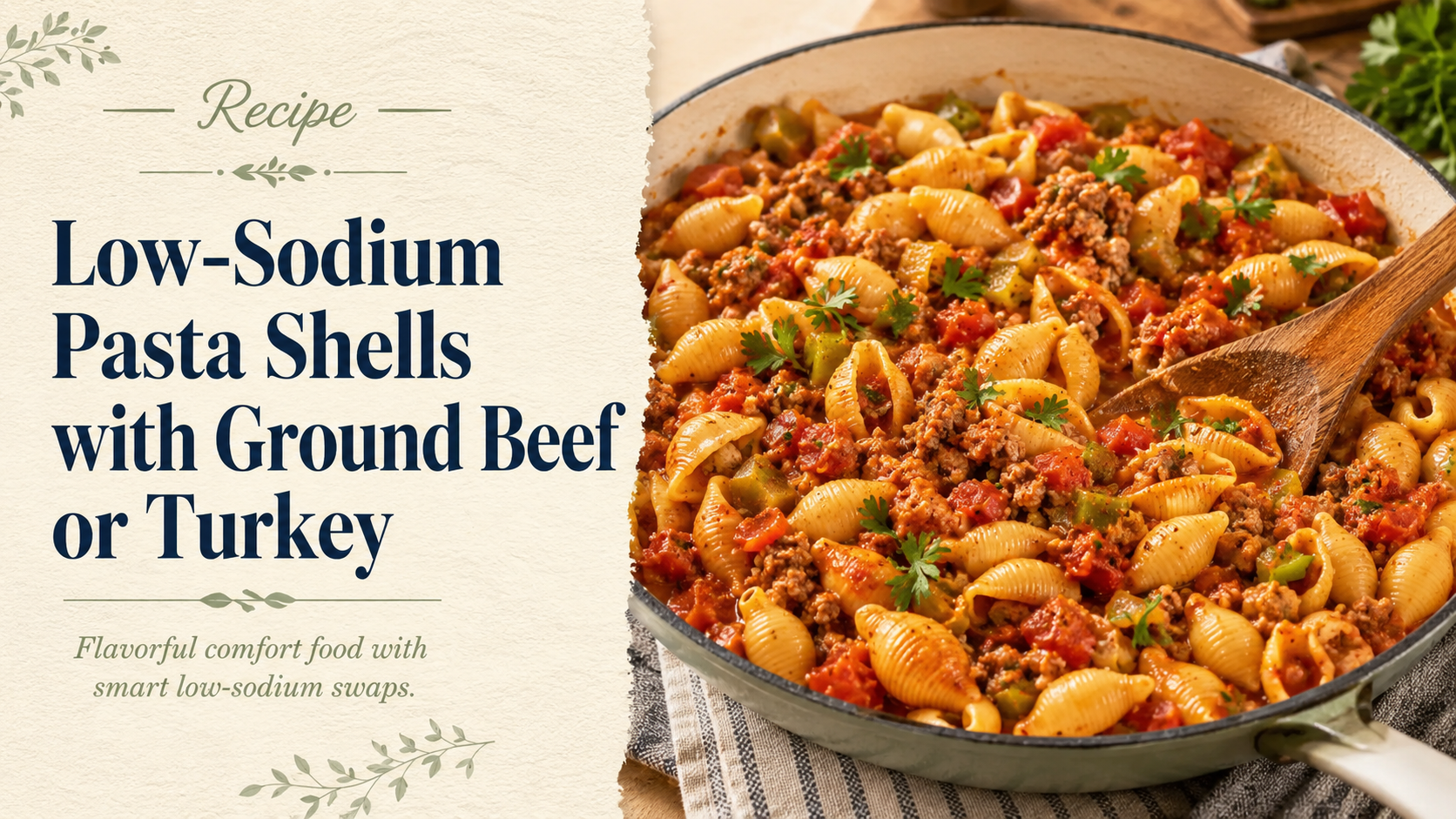
  • Low-Sodium Pasta Shells with Ground Beef or Turkey

    Low-Sodium Pasta Shells with Ground Beef or Turkey

    Some recipes are almost perfect for us right out of the gate.

    Others need a little work.

    This one definitely needed some work.

    The original recipe is Pasta Shells with Ground Beef from Sweet Pea’s Kitchen. It is a hearty skillet meal made with pasta shells, ground beef, Sazón, chicken broth, tomato broth, serrano peppers, onion, Rotel, and a few other seasonings. The original recipe lists about 841 mg of sodium per serving, so obviously I wasn’t making it exactly as written. 

    But the basic idea was really good.

    So we changed the high-sodium ingredients and made it fit the way we eat.

    And honestly, it works really well.

    We have made this with both ground beef and ground turkey, and both versions are good.

    Start With the Protein

    The original recipe uses 1½ pounds of ground beef. 

    We have made it that way, but we have also substituted ground turkey.

    Ground turkey gives you a lighter version and still works really well with all of the spices and tomato flavor in the dish.

    So use whichever fits your diet and what you have on hand.

    If I’m using ground beef, I drain the excess fat after cooking it.

    If I’m using turkey, there is usually much less to drain.

    The First Big Change: No-Salt Sazón

    The original recipe uses Sazón seasoning in more than one place.

    That can be a problem because many packaged Sazón blends contain a lot of sodium.

    So instead, I use my own Homemade No-Salt Sazón Seasoning.

    It has coriander, garlic powder, cumin, oregano, annatto or turmeric, and black pepper, with no added salt. It gives the dish the flavor and color I want without adding a bunch of sodium. 

    You can find my recipe here:

    Homemade No-Salt Sazón Seasoning

    That one substitution makes a big difference.

    Replace the Granulated Chicken Broth

    The original recipe calls for 2 tablespoons of granulated chicken broth. 

    That is another place where sodium can pile up fast.

    Instead, I use Swanson Unsalted Chicken Broth.

    Swanson Unsalted Chicken Broth at Walmart

    Since the original recipe also uses water, I simply replace part of that liquid with unsalted broth.

    You still get the chicken flavor, but without using concentrated granulated broth loaded with salt.

    Replace the Tomato Broth Too

    The original recipe also calls for 4 tablespoons of granulated tomato broth. 

    Again, I don’t use it.

    Instead, I use an unsalted condensed tomato soup as part of the tomato base.

    Condensed Unsalted Tomato Soup at Walmart

    That gives the dish a nice tomato flavor and helps create the sauce without needing a high-sodium tomato bouillon product.

    You may need to adjust the liquid slightly depending on how thick you want the finished dish.

    That’s one of those things I do by eye.

    If it looks too dry while the pasta is cooking, add a little more unsalted broth or water.

    Use No-Salt-Added Rotel

    This is another easy one.

    Instead of regular Rotel, we use RO*TEL Original No Salt Added Diced Tomatoes and Green Chilies.

    RO*TEL No Salt Added Tomatoes and Green Chilies at Walmart

    Same idea.

    Same basic flavor.

    Much better fit for the way I need to eat.

    These are exactly the kinds of substitutions I like because you really aren’t changing the character of the meal.

    You are just removing sodium that doesn’t need to be there.

    Our Low-Sodium Version

    Ingredients

    • 1½ pounds ground beef or ground turkey
    • 2 cups small pasta shells
    • ¼ cup olive oil
    • About 4 cups total liquid, using a combination of water and unsalted chicken broth
    • 1 can unsalted condensed tomato soup
    • 3 serrano peppers, diced
    • ½ onion, chopped
    • 1 can no-salt-added RO*TEL diced tomatoes and green chilies
    • Chopped parsley
    • Garlic powder, to taste
    • Onion powder, to taste
    • Black pepper, to taste
    • 1 bay leaf
    • Homemade No-Salt Sazón Seasoning, to taste

    No added salt.

    How We Make It

    Brown the ground beef or ground turkey in a large, deep skillet until fully cooked.

    If you are using beef, drain the excess fat.

    Season the meat with black pepper and some of the homemade no-salt Sazón.

    In a separate skillet, lightly brown the dry pasta shells in the olive oil.

    The original recipe does this too, and I actually like the extra flavor it gives the pasta. 

    Once the shells have a little color, stir them into the cooked meat.

    Add the diced serrano peppers, chopped onion, no-salt-added Rotel, unsalted tomato soup, parsley, garlic powder, onion powder, bay leaf, and additional no-salt Sazón.

    Then add your liquid.

    I use a combination of unsalted chicken broth and water instead of the original granulated broth products.

    Stir everything together.

    Cover the skillet, reduce the heat, and simmer until the pasta shells are tender.

    Keep an eye on it while it cooks.

    If the pasta absorbs the liquid too quickly, add a little more unsalted broth or water.

    Once the shells are cooked, remove the bay leaf and serve.

    Why This One Works

    This recipe has plenty of flavor without needing much help from salt.

    You have:

    • Serrano peppers
    • Onion
    • Garlic
    • Cumin
    • Coriander
    • Oregano
    • Tomato
    • Green chilies
    • Black pepper

    There is a lot going on.

    That is one of the things I have learned about low-sodium cooking.

    If you take salt away from a bland recipe, you notice it immediately.

    If you build flavor from spices, vegetables, peppers, herbs, and good cooking techniques, you miss the salt a lot less.

    This dish is a good example of that.

    Beef or Turkey?

    We have made it both ways.

    If you want the richer flavor, use ground beef.

    If you want something a little lighter, ground turkey works really well.

    The tomato, peppers, and Sazón provide so much flavor that the turkey doesn’t feel like some sad substitute.

    Either one works.

    I’d make it based on what you like and what fits your own dietary needs.

    How Much Sodium Does This Save?

    I’m not going to give an exact sodium-per-serving number for our version because it depends too much on the brands of pasta, meat, broth, tomato soup, and canned tomatoes you use.

    But look at where the sodium is coming from in the original recipe.

    It contains packaged Sazón, granulated chicken broth, granulated tomato broth, and regular Rotel. The original recipe estimates 841 mg of sodium per serving. 

    Our version replaces those ingredients with:

    • Homemade no-salt Sazón
    • Unsalted chicken broth
    • Unsalted tomato soup
    • No-salt-added Rotel
    • No added salt

    That removes several major sodium sources before the food even hits the plate.

    As always, read your own labels because products can change.

    Another Recipe That Doesn’t Feel Like Diet Food

    That’s probably my favorite thing about this meal.

    It doesn’t taste like something we made because I’m on a sodium restriction.

    It is just dinner.

    The rest of the family can eat the same thing.

    I can eat the same thing.

    Nobody is sitting there thinking:

    This would be good if we could only put some salt in it.

    That is what I’m looking for with these recipes.

    Food I can actually enjoy without feeling like every meal is another reminder of what I can’t have.

    This one stays in the rotation.

    Recipe Credit

    This recipe was adapted from Pasta Shells with Ground Beef by Sweet Pea’s Kitchen. The original recipe and cooking method can be found here:

    Original Pasta Shells with Ground Beef Recipe – Sweet Pea’s Kitchen

    I modified the ingredients to significantly reduce sodium and to fit the way my family cooks.

    Medical & Nutrition Disclaimer

    This recipe reflects how I personally reduce sodium in meals as part of the dietary plan developed for my health needs. It is provided for informational purposes only and is not medical or nutritional advice. Sodium requirements and restrictions vary depending on medical conditions, medications, kidney function, blood pressure, and individual treatment plans. Nutrition values also vary by brand, serving size, and preparation method. Always read product labels and follow the dietary guidance provided by your own qualified healthcare professionals.

  • The Great Shrimp Sodium Surprise

    The Great Shrimp Sodium Surprise

    Over the last couple of weeks, I’ve had a few mornings where my daily health checks just didn’t look right.

    My weight was up.

    My body-water reading was up.

    My feet were a little swollen.

    And I was sitting there trying to figure out what had changed.

    I’m pretty obsessive about sodium and fluid intake at this point, so when something jumps unexpectedly, I usually start retracing what I ate the day before.

    One thing kept showing up.

    Shrimp.

    That surprised me because shrimp has always seemed like one of the safer foods.

    Plain shrimp.

    No breading.

    No heavy sauce.

    No obvious salt.

    How bad could it be?

    Apparently, pretty bad if you buy the wrong bag.

    Shrimp Isn’t Always Just Shrimp

    Fresh, untreated shrimp can actually be fairly reasonable when it comes to sodium.

    NOAA lists raw pink and white shrimp at about 148 mg of sodium per 100 grams.

    That is not sodium-free, but it is a completely different world from some processed frozen shrimp.

    Researchers have found raw retail shrimp products ranging from about 170 mg all the way up to 1,130 mg of sodium per 113-gram serving.

    Think about that for a second.

    Two bags of shrimp can look almost identical.

    Same color.

    Same size.

    Same shape.

    Same freezer case.

    But one can contain several times the sodium of the other.

    That is where this gets interesting.

    Why Would Frozen Shrimp Have So Much Sodium?

    Shrimp is highly perishable.

    Once it is caught, quality can deteriorate quickly, and freezing creates its own problems. During freezing and thawing, shrimp can lose moisture, texture, and weight.

    Food processors often use moisture-retention treatments to reduce those losses.

    One of the most common is sodium tripolyphosphate, usually abbreviated STPP.

    STPP helps shrimp retain water and maintain texture during freezing and thawing. Salt may also be included in treatment solutions.

    From the processor’s point of view, this makes sense.

    The shrimp keeps more moisture.

    It loses less weight during thawing.

    The texture holds up better.

    There is potentially more sellable weight.

    The problem for someone watching sodium is that the shrimp you thought was basically plain seafood may no longer be plain seafood.

    The Label Is Where You Have to Start

    This is why I have learned that you cannot look at a bag of shrimp and assume anything.

    Flip it over.

    Read the Nutrition Facts.

    Then read the ingredient list.

    Look for things like:

    • Sodium tripolyphosphate
    • Sodium phosphate
    • Sodium chloride
    • Salt
    • Sodium bicarbonate
    • Sodium carbonate
    • Sodium citrate
    • Wording such as “treated with” or “solution added”

    Not every processed shrimp product is extremely high in sodium, and not every additive has the same effect.

    But if sodium matters to you, the ingredient list is worth reading.

    I used to look at shrimp and think:

    Shrimp is shrimp.

    I don’t anymore.

    Then I Found Something That Really Got My Attention

    While looking into this, I came across a U.S. market survey involving 152 samples of raw and cooked peeled shrimpcollected from retail locations.

    The sodium variation was huge.

    Raw shrimp ranged from 170 to 1,130 mg per 113-gram serving.

    Cooked shrimp ranged from 100 to 612 mg per 85-gram serving.

    But that wasn’t even the part that bothered me the most.

    Only 31 percent of the samples correctly reported the sodium amount on the Nutrition Facts panel within the allowable tolerance.

    After accounting for the permitted variation, researchers found that about 53 percent of the samples underreported sodium, while roughly 15 percent reported more sodium than testing actually found.

    That one got my attention.

    If you are just casually watching sodium, a difference on a label might not seem like a huge deal.

    If you are trying to tightly control sodium because you are watching weight, swelling, fluid retention, blood pressure, or heart failure symptoms, it becomes a much bigger deal.

    You can make what you think is the right choice and still end up consuming considerably more sodium than you expected.

    And That’s Before You Even Cook It

    Here’s another thing that is easy to overlook.

    The sodium number on the package is before you cook the shrimp.

    So if the shrimp already starts out high in sodium because of processing, you can make the problem much worse depending on how you prepare it.

    Blackened shrimp is a perfect example.

    A lot of blackening seasonings contain a significant amount of salt. The same goes for many Cajun blends, seafood seasonings, garlic salt, seasoned butter, bottled marinades, sauces, and even some lemon-pepper blends.

    So you could start with shrimp that already contains several hundred milligrams of sodium per serving and then add another layer of sodium during cooking without realizing how quickly it adds up.

    That means I have to be just as careful with the seasoning as I am with the shrimp itself.

    For me, the safest approach is to start with the lowest-sodium shrimp I can find and then season it with salt-free spices and herbs.

    Paprika.

    Garlic powder.

    Onion powder.

    Cayenne.

    Black pepper.

    Oregano.

    Thyme.

    Lemon juice.

    Fresh garlic.

    You can still get plenty of flavor without dumping a bunch of sodium on top of food that may already contain more than you expected.

    That is really the bigger lesson.

    Check the sodium before you cook it — then make sure you don’t put it all back in while cooking it.

    What About Washing the Shrimp?

    The obvious question is:

    Can’t I just rinse it?

    Maybe rinsing removes some sodium from the surface.

    But I would not personally depend on that as a strategy.

    These treatments are used specifically to affect the shrimp’s ability to hold water, and some of that treatment is not just sitting loosely on the outside waiting to be washed away.

    The bigger problem is that I have no way in my kitchen to know how much sodium rinsing actually removed.

    Did I remove 5 percent?

    Twenty percent?

    Half?

    I have absolutely no idea.

    And neither does my sink.

    For me, if the package starts out much higher in sodium than I want, I would rather choose another product than try to wash my way out of it.

    Fresh Shrimp Is Still My First Choice

    When I can get genuinely fresh, untreated shrimp, that is my preference.

    Here in Florida, that is sometimes easier than it might be in other parts of the country.

    But fresh shrimp has its own limitations.

    It is highly perishable.

    It needs to be handled properly.

    And much of what is sold as “fresh” seafood may have been previously frozen, so it is still worth asking questions.

    Frozen shrimp itself is not the enemy.

    There is absolutely nothing wrong with freezing shrimp.

    The issue is what happened to the shrimp before it went into the freezer.

    That is the part I am paying much closer attention to now.

    My Shrimp Lesson

    I can’t prove that shrimp caused every fluid issue I’ve experienced recently.

    There are too many variables involved for me to make that claim.

    But I can say that it made me start looking much more closely at the shrimp I was buying.

    And once I did, I realized how dramatically sodium levels can vary between products that look almost identical.

    That is really the lesson here.

    If you are watching sodium, don’t judge seafood by what it looks like.

    Don’t assume “plain” means untreated.

    Don’t assume frozen shrimp has the same sodium content as fresh shrimp.

    And definitely don’t assume every bag sitting next to each other in the freezer case is nutritionally interchangeable.

    Turn the package over and read it.

    Then pay just as much attention to what you add once it hits the pan or grill.

    Sometimes the biggest sodium surprises are hiding in foods that don’t taste particularly salty at all.

    That was my shrimp lesson.

    Hopefully now it doesn’t have to be yours.

    Medical Disclaimer

    This article reflects my personal experience managing sodium intake and chronic health conditions. It is provided for informational purposes only and is not medical or dietary advice. Sodium needs and restrictions vary significantly depending on a person’s medical conditions, medications, kidney function, blood pressure, and treatment plan. Do not make changes to your sodium intake, fluid intake, medications, or medical treatment based on my experience or anything you read on this website. If you have heart failure, kidney disease, high blood pressure, or another condition requiring sodium restriction, discuss appropriate dietary limits and food choices with your own qualified healthcare professionals.

  • Daily Journal #19 — Watching the Scale, My Feet, and My Kidneys

    Daily Journal #19 — Watching the Scale, My Feet, and My Kidneys

    My morning health check was about as good as it has been the last couple of days, but one thing caught my attention.

    I gained a pound since yesterday.

    Normally, a one-pound change by itself probably wouldn’t alarm me too much. What concerned me was that I really didn’t eat much yesterday. I had a salad for dinner. It wasn’t a small salad, but it certainly wasn’t anything that should have caused me to gain a pound overnight.

    Then I started looking at everything else.

    My feet were slightly swollen.

    My blood pressure was up.

    My body-water calculation was also higher.

    Put all of that together,

    and I started wondering if I was retaining fluid again.

    So I took a Torsemide this morning.

    I only take my diuretic on an as-needed basis now. That was a decision made with my medical team, not something I decided to do on my own.

    I manage my sodium and fluid intake very tightly because my goal is to avoid needing diuretics whenever possible. My doctors have actually seen the Excel spreadsheet I use to track everything. I don’t miss days. I document changes, symptoms, weight, blood pressure and medication adjustments made by my medical team.

    That level of tracking became especially important after what happened a few months ago.

    When Too Much Diuretic Became a Problem

    A few months ago, I ended up in the hospital after becoming over-diuresed.

    Basically, my body had gotten too low on fluid while I was still taking my diuretics as prescribed.

    That contributed to an acute kidney injury, or AKI.

    My kidney function dropped significantly. An eGFR above 60 is generally considered a better range, and mine had fallen into the low 30s.

    That episode is part of the reason I later had a kidney ultrasound and why I now have an MRI scheduled.

    After several appointments with my nephrologist, and after my doctors saw just how closely I was monitoring everything, my diuretic plan was changed to as-needed use.

    That gives me a little more flexibility, but it also means I have to pay close attention to what my body is telling me.

    And lately, I am.

    Why This Morning Has Me Concerned

    This is now the second time in about a week that I’ve noticed signs that make me wonder if I’m holding onto more fluid than I should.

    What makes it frustrating is that I can’t immediately point to something obvious.

    I didn’t have shrimp in my salad.

    It was basically vegetables, other than the dressing.

    So my next step is to retrace everything I ate and drank yesterday and see if something contained more sodium than I realized.

    Sometimes that’s all you can do.

    Go back.

    Look at the numbers.

    Then at what you ate.

    Also at what you drank.

    And try to find the missing piece.

    Blood Work Today

    I also have a blood draw today.

    A few hours after that, I’ll have a new set of numbers to look at.

    And I’ll admit it: I’m having a lot of anxiety about it.

    After watching my kidney function drop before, it’s hard not to worry about what those lab results are going to show.

    I’m praying everything looks good.

    If it doesn’t, then there may be more changes ahead.

    Either way, I’ll know more soon.

    And when I do, I’ll let you know.

    Medical Disclaimer

    This journal reflects my personal experience living with heart failure, kidney disease, and the treatment plan developed specifically for me by my healthcare team. Nothing in this article should be taken as medical advice or as a recommendation to start, stop, skip, increase, decrease, or otherwise change any medication, including diuretics. Diuretics can affect fluid balance, blood pressure, electrolytes, and kidney function, and improper use can be dangerous. Any changes to your medications, fluid intake, sodium limits, or treatment plan should be made only in consultation with your own qualified healthcare professionals. If you experience new or worsening swelling, rapid weight changes, shortness of breath, chest pain, severe dizziness, fainting, or other concerning symptoms, seek appropriate medical care promptly.
  • Social Media and Chronic Illness: Finding Support Without Getting Lost in the Noise

    Social Media and Chronic Illness: Finding Support Without Getting Lost in the Noise

    When I was in the hospital and found out I had congestive heart failure, I knew something wasn’t right.

    I didn’t feel good. I was having chest pains. My blood pressure was high. I already knew I had aortic stenosis and was waiting to be scheduled for surgery to replace my aortic valve.

    At the time, I thought the two things went together pretty simply.

    My valve was bad. They would replace the valve. I would recover. Then I would be fine.

    Well, apparently I misunderstood part of that conversation.

    The heart failure wasn’t necessarily going away.

    I have HFpEF — heart failure with preserved ejection fraction — and it took me about three months after having my heart valve replaced to fully understand that this was something I was going to have to manage going forward.

    That realization changes things.

    The First Thing You Do Is Google It

    Fast-forward a little bit and, like most people who suddenly find themselves diagnosed with something serious, I started reading.

    And reading.

    And reading.

    You Google congestive heart failure and eventually ask the question everyone is probably afraid to ask:

    How long am I going to live?

    Then you see statistics saying things like half of people with heart failure die within five years.

    Well, shit.

    Those aren’t exactly comforting odds when you are sitting there trying to figure out what just happened to your life.

    But statistics need context. Heart failure affects a huge range of people with different types of heart failure, different ages, different health conditions and different levels of disease.

    A statistic doesn’t know me.

    So I started trying to learn specifically about HFpEF: what it is, how people manage it and what living with it actually looks like.

    There is certainly no shortage of information online.

    There are thousands of pages from hospitals, government agencies, heart foundations, pharmaceutical companies, doctors and researchers.

    Much of that information is incredibly valuable.

    But I wanted something else too.

    I wanted to hear from people living with it.

    I wanted someone to talk about chronic illness in language I understood.

    Where Are the Regular People?

    I started searching websites and blogs for personal experiences.

    What surprised me was how difficult those could be to find.

    Most of the results took me right back to hospital websites, medical organizations, pharmaceutical companies and foundations.

    There wasn’t nearly as much from the person sitting at home trying to figure out:

    What does my life look like now?

    That’s one of the reasons I eventually started He’s Knocking on My Door.

    I’m not a medical organization.

    I’m just someone living through this stuff and trying to make sense of it.

    Then I Found the Facebook Groups

    Eventually I started looking through Facebook.

    And as everyone who has spent more than five minutes on Facebook knows, there is some good stuff there and there is some absolute garbage.

    I’ve tried quite a few groups. These are some of the ones I’ve continued to follow:

    There are tons more.

    These are simply the ones I’ve tried and, for one reason or another, continued reading.

    Hearing Other People’s Stories Helps

    My experience with the illness-specific support groups has generally been positive.

    Most people genuinely seem to care.

    Everyone is there because either they or somebody they love is dealing with an illness. People understand fear, uncertainty and frustration because they have experienced some version of it themselves.

    Sometimes you just need to hear somebody say:

    I’ve been there too.

    Those groups contain thousands of stories.

    Someone talks about being exhausted.

    Someone talks about swelling.

    Someone talks about being afraid before valve surgery.

    Someone talks about adjusting to medication.

    Someone talks about having a good day after weeks of bad ones.

    I read their experiences and sometimes see pieces of my own situation in them.

    I’m not looking for a cure from Facebook.

    I’m trying to understand the journey.

    There is a difference.

    The Dangerous Part: Everybody Becomes a Doctor

    There is also a problem with medical support groups.

    People want to help.

    Sometimes they want to help a little too much.

    You mention a symptom and suddenly people are telling you which medication you should take, which medication you should stop taking, which supplement cured their problem or what your doctor should be doing.

    That’s where you need to be careful.

    Your medical team should be the people giving you medical advice.

    What works for one person may be completely inappropriate or even dangerous for somebody else.

    The person answering your Facebook post doesn’t know your medical history, medications, kidney function, blood pressure, lab results or the hundred other things your doctors may be considering.

    I didn’t join these groups looking for strangers to treat me.

    I joined because I wanted to hear how other people were living with their conditions.

    That can be incredibly valuable.

    Medical advice from strangers?

    Not so much.

    Then There Are the Food Groups

    The food groups have been a completely different experience for me.

    I’m sure the overwhelming majority of people in them are perfectly nice.

    Unfortunately, sometimes the internet trolls are considerably louder than everybody else.

    When you’re dealing with heart failure and trying to completely change how you eat, you’re already overwhelmed.

    I’m trying to find low-sodium food that doesn’t suck.

    That’s challenging enough.

    I don’t need to post something I’m eating and have somebody tell me I’m doing everything wrong because their idea of the perfect heart-healthy diet is different from mine.

    I’ve tried several food groups and eventually left many of them.

    There can be useful information buried in there, but sometimes the negativity isn’t worth digging through.

    Chronic illness already consumes enough mental energy.

    I don’t need Facebook taking the rest.

    Podcasts, TikTok and Everything Else

    I’ve also listened to some very good podcasts about chronic illness and heart disease.

    Most of the ones I’ve found are produced by doctors, hospitals or other medical professionals.

    Again, that’s valuable information.

    What seems much harder to find are podcasts from average people simply talking about what it is like to live with these conditions every day.

    I understand why.

    Creating a podcast, website or regular video content takes a lot of work.

    I’ve seen some chronic illness content on TikTok too. A lot of it seems centered around weight loss, exercise or individual pieces of someone’s health journey.

    But I still haven’t found nearly as many people simply saying:

    Here’s what happened to me. Here’s what I’m dealing with. Here’s what worked for me. Here’s what didn’t. Here’s what today was like.

    That’s part of what I’m trying to do here.

    This Website Is Part of How I Cope

    He’s Knocking on My Door started partly because I couldn’t find exactly what I was looking for.

    I wanted the patient side of the story.

    Not another definition of HFpEF.

    Not another diagram of the heart.

    Not another medical paper that requires me to look up every third word.

    I wanted to know how people live with this stuff.

    How do you deal with the fatigue?

    How do you change your diet?

    How do you handle the fear?

    How do you adjust when you can’t physically do everything you used to do?

    How do you deal with family and friends who don’t completely understand?

    How do you keep living your life when chronic illness suddenly becomes part of it?

    Writing about those things has become a coping mechanism for me.

    If somebody else happens to find something helpful in my experience along the way, even better.

    Social Media Isn’t Medicine — But It Can Still Help

    There is an incredible amount of chronic illness information on social media.

    Some of it is helpful.

    Some of it is wrong.

    Some of it is supportive.

    Some of it will scare the hell out of you.

    And some of it should probably never have been posted in the first place.

    You have to learn to separate someone sharing their experience from someone giving you medical advice.

    Those are two very different things.

    I would never recommend changing medication, treatment, diet restrictions or anything else medically significant because somebody in a Facebook group told you to.

    That’s a conversation for your medical team.

    But I absolutely believe there is value in hearing other people’s stories.

    Sometimes those stories help you understand what questions to ask.

    Sometimes they help you realize that something you’re experiencing isn’t unique to you.

    Sometimes they help set realistic expectations.

    And sometimes they simply make you feel a little less alone.

    When you’re suddenly living with a chronic illness, that can matter more than people realize.

    Use social media as a place to listen, learn and connect. Just don’t confuse the person sitting behind a keyboard with the doctor sitting across from you.

    Disclaimer: This article is based on my personal experiences and observations while living with chronic illness. The Facebook groups, websites, podcasts, and other resources mentioned are shared for informational and community-support purposes only. I am not endorsing any medical advice, treatment, product, or recommendation made by members of these groups. Always discuss symptoms, medications, treatments, diet changes, and other medical decisions with your own healthcare team. Online support can be helpful, but it should never replace professional medical care.

  • Strawberries and Blueberries: A Small Part of My Morning That Actually Works

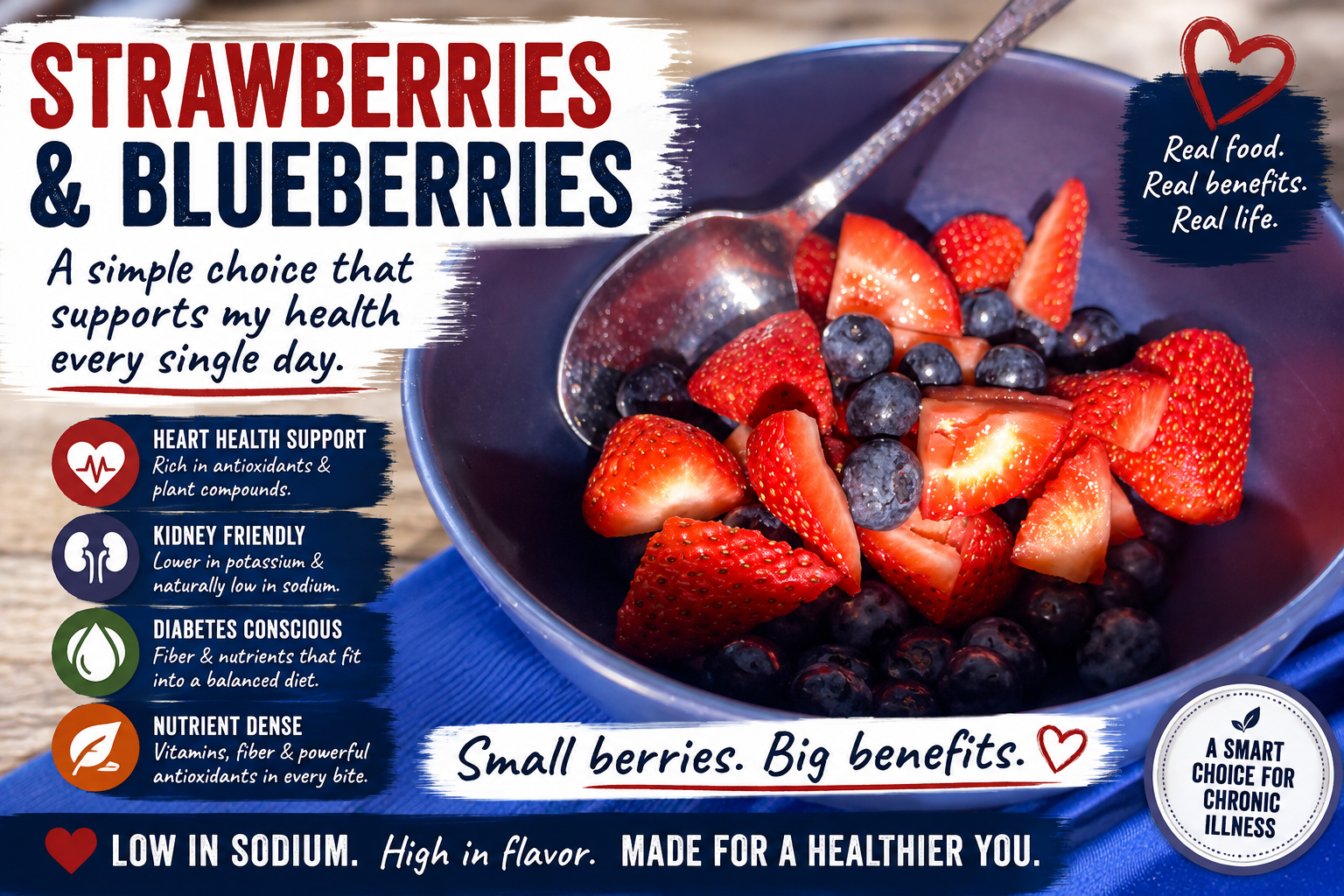
    Strawberries and Blueberries: A Small Part of My Morning That Actually Works

    When you start living with chronic illness, food gets complicated.

    Really complicated.

    Something can be low in sodium but high in potassium. Something else might be great for your heart but loaded with carbohydrates. Then there are calories, phosphorus, fluid, added sugar and about a dozen other things somebody tells you that you should be watching.

    Some days it feels like you need a chemistry degree just to make breakfast.

    That’s one reason strawberries and blueberries have become a regular part of my mornings.

    I eat them all the time, and initially I wasn’t eating them because I’d researched every possible health benefit. I ate them because I like them.

    It turns out they aren’t a bad choice for me either.

    First Things First: Berries Aren’t Medicine

    I want to get this out of the way before going any further.

    I’m not suggesting that eating a bowl of blueberries is going to cure heart failure, fix kidney disease or make diabetes disappear.

    I wish it worked that way.

    What I’m talking about is something much simpler: finding foods that fit reasonably well into the nutritional puzzle that comes with my chronic illnesses.

    For me, strawberries and blueberries check quite a few boxes.

    Almost No Sodium — That’s an Easy Win

    Obviously, sodium is a big deal around here.

    I’ve written plenty about how closely I watch it, and one of the nice things about fresh fruit is that I don’t have to start doing sodium mathematics before taking a bite.

    Fresh strawberries and blueberries are naturally extremely low in sodium.

    The National Kidney Foundation notes that strawberries are low in sodium, phosphorus and potassium while providing fiber and vitamin C.

    That’s the kind of nutritional label I like to see.

    No negotiating.

    No “I’ll just eat half.”

    No wondering how somebody managed to cram 600 milligrams of sodium into something that shouldn’t need salt in the first place.

    They’re just berries.

    They’re Pretty Kidney-Friendly Too

    Kidney disease has added another wrinkle to how I think about food.

    It’s no longer enough for me to look only at sodium. Potassium matters too.

    That’s another place where berries can fit nicely.

    According to the National Kidney Foundation, a half-cup serving of strawberries contains about 130 mg of potassium, while a half cup of blueberries contains less than 150 mg.

    Both are considered lower-potassium fruit choices.

    That doesn’t mean I can eat unlimited amounts. Portion size still matters, especially when you’re balancing multiple health issues.

    But compared with some other fruits, berries can be a pretty comfortable fit.

    Blueberries Pack a Lot Into a Little Berry

    The dark blue color of blueberries isn’t just there to make them look good on top of breakfast.

    Blueberries contain plant compounds called anthocyanins, which belong to a larger group of compounds called flavonoids.

    Researchers have been particularly interested in anthocyanins because of their potential effects on cardiovascular and metabolic health.

    Research on blueberries has suggested potential benefits involving vascular function and other cardiovascular risk factors. There’s also research examining anthocyanins and glucose metabolism.

    That doesn’t translate into “blueberries prevent heart disease” or “blueberries treat diabetes.”

    Nutrition research is rarely that simple.

    What it does tell me is that blueberries are a nutrient-rich whole food that makes sense as part of the type of diet I’m trying to follow.

    And unlike a lot of things marketed as “heart healthy,” nobody had to manufacture them in a factory and print a giant red heart on the package.

    Strawberries Deserve Some Credit Too

    Blueberries seem to get most of the superfood publicity, but strawberries aren’t exactly sitting around doing nothing.

    They’re a good source of vitamin C and fiber and contain numerous plant compounds, including anthocyanins.

    Researchers have studied strawberries for possible effects on cardiovascular risk factors and inflammation as well.

    A meta-analysis of randomized controlled trials found that strawberry interventions reduced C-reactive protein (CRP), a marker of inflammation. The overall effects on things such as blood pressure, glucose and cholesterol weren’t consistently significant, although some subgroups did show improvements.

    That’s an important distinction.

    It’s easy to turn nutrition research into headlines like:

    “EAT STRAWBERRIES AND SAVE YOUR HEART!”

    That’s not what the research says.

    What it suggests is much less exciting—but much more useful: strawberries can be part of an overall healthy dietary pattern.

    I’m perfectly happy with that.

    What About Diabetes?

    Fruit contains sugar.

    That’s something I have to remember with type 2 diabetes, regardless of how healthy the fruit might be.

    But whole berries also provide fiber, and you’re eating the intact fruit rather than drinking its sugar as juice.

    A half cup of strawberries provides roughly 2 grams of fiber, according to the National Kidney Foundation. A half cup of blueberries provides about the same.

    That fiber is one reason I’d much rather eat the actual berries than drink strawberry or blueberry juice.

    It also brings me back to something I’ve learned repeatedly while managing chronic illness:

    Healthy doesn’t mean unlimited.

    I’m still eating carbohydrates. I’m still consuming calories. The berries contain water, which technically contributes to overall fluid intake too.

    My illnesses didn’t suddenly stop keeping score because I picked something nutritious.

    Portions still matter.

    It’s Nice to Find Something I Don’t Have to Fight With

    Maybe that’s what I like most about strawberries and blueberries.

    So much of eating with chronic illness feels like giving something up.

    I miss foods I used to eat without thinking twice. Restaurant meals have become difficult. Grocery shopping involves reading labels. Recipes get modified. Sodium gets calculated.

    Sometimes I find something I want to eat and discover that one serving contains half the sodium I’d like to consume in an entire day.

    Berries aren’t like that.

    I can put some strawberries and blueberries into my morning routine and know I’m getting fruit, fiber, vitamins and beneficial plant compounds without adding a meaningful sodium load.

    They’re colorful.

    They taste good.

    They’re easy.

    And most importantly, I actually enjoy eating them.

    The Bigger Lesson I’ve Learned

    Living with chronic illness has changed my relationship with food.

    I used to think mostly about whether something tasted good.

    Now I’m thinking about sodium, carbohydrates, potassium, fluid and how a particular food fits into everything else I’m eating that day.

    It can become exhausting.

    So when I find simple whole foods that work for me, I hang onto them.

    Strawberries and blueberries aren’t miracle foods.

    They’re not treating my heart failure. They’re not repairing my kidneys. They’re not curing my diabetes.

    They’re simply two foods that fit surprisingly well into the complicated balancing act my health requires.

    And sometimes that’s enough.

    Tomorrow morning, I’ll probably eat some more.


    Sources & Further Reading

    National Kidney Foundation — Strawberries
    Information about potassium, sodium, phosphorus, fiber and other nutrients in strawberries.
    National Kidney Foundation: Strawberries

    National Kidney Foundation — Blueberries
    Nutritional information and discussion of blueberries as a lower-potassium fruit choice for people with kidney disease.
    National Kidney Foundation: Blueberries

    National Library of Medicine / PubMed — Recent Research on the Health Benefits of Blueberries and Their Anthocyanins
    Review of research involving blueberries, anthocyanins and cardiovascular and metabolic health.
    PubMed: Health Benefits of Blueberries and Their Anthocyanins

    National Library of Medicine / PubMed — Effects of Strawberry Intervention on Cardiovascular Risk Factors
    Systematic review and meta-analysis of randomized controlled trials examining strawberries and cardiovascular risk factors.
    PubMed: Strawberry Intervention and Cardiovascular Risk Factors

    Note: This article describes my personal experience living with chronic illness and the dietary choices I make. It isn’t medical advice. Dietary needs can vary significantly, particularly for people with heart failure, kidney disease or diabetes. Talk with your healthcare team or a registered dietitian about what’s appropriate for you.

  • Homemade Low-Sodium Arby’s-Style Sauce

    Homemade Low-Sodium Arby’s-Style Sauce

    There are certain condiments I really missed when I started seriously restricting sodium.

    This is one of them.

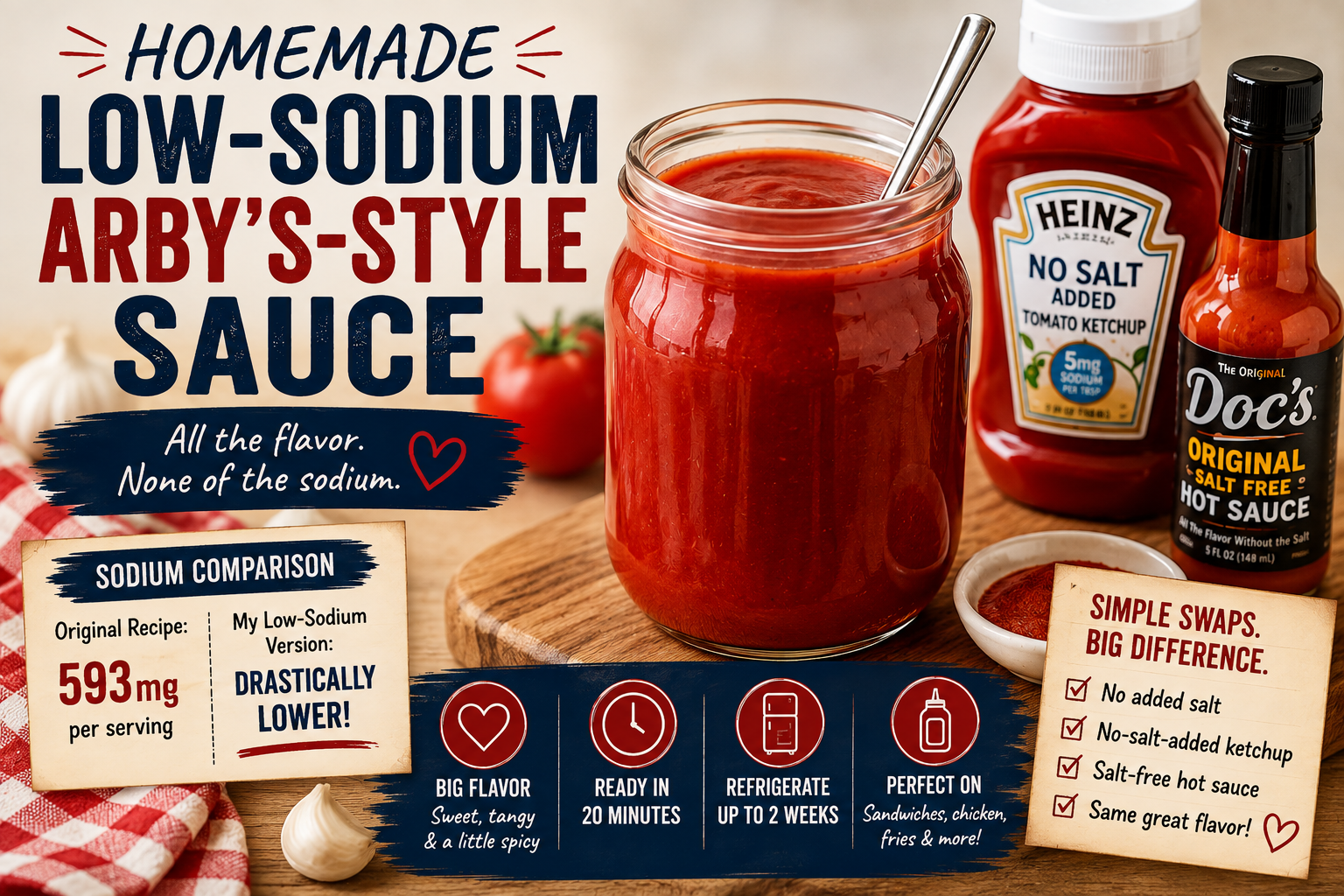
    I love Arby’s Sauce. It’s sweet, tangy, a little spicy, and it’s one of those sauces I’ll put on all kinds of food.

    The problem?

    Like so many condiments, sodium can add up quickly.

    Fortunately, I found a homemade Arby’s-style sauce recipe from WonkyWonderful and realized it would be incredibly easy to modify for the way I eat now.

    A couple of ingredient swaps, leave out the added salt, and about 20 minutes later…

    Bam. Sauce is back.

    First Thing to Go: The Salt

    This one’s easy.

    The original recipe calls for sea salt.

    I leave it out completely.

    There are already plenty of flavorful ingredients in this sauce, so I don’t think it needs it.

    That’s something I’ve discovered over and over since I started cooking with much less sodium.

    Salt isn’t always necessary just because it’s printed in the recipe.

    Sometimes you can leave it out and barely notice.

    For me, this is one of those times.

    The Big Change: No-Salt-Added Ketchup

    Ketchup is the base of the sauce, so this is where I can make a huge difference.

    Instead of regular ketchup, I use Heinz No Salt Added Ketchup.

    This stuff is kind of interesting.

    Regular Heinz ketchup contains 180 mg of sodium per serving, while the no-salt-added version has only 5 mg. That’s 96% less sodium. 

    By itself?

    I’ll be honest.

    It’s pretty bland.

    If I squirt some on a burger and expect regular ketchup, I’m probably going to be disappointed.

    But that’s not what I’m doing here.

    Once you combine it with all the other ingredients in this recipe, that bland ketchup becomes a completely different animal.

    That’s where it really works for me.

    Then I Replace the Hot Sauce

    The other substitution I make is the hot sauce.

    A lot of traditional hot sauces can bring more sodium into a recipe, so I use Doc’s Original Salt-Free Hot Sauce.

    Doc’s Original Salt-Free Hot Sauce

    Doc’s describes its original hot sauce as sodium-free, which makes it a great option for this recipe. 

    This product was actually a pretty big find for me.

    Hot sauce was another condiment I thought might disappear from my life once I started watching sodium so closely.

    Then I found this.

    Hot sauce was back.

    I’ll eventually add Doc’s Salt-Free Hot Sauce as its own Helpful Find because I’ve found plenty of uses for it besides this recipe.

    Everything Else Stays Pretty Much the Same

    After those changes, I follow the original recipe.

    That’s what I like about this one.

    I’m not trying to invent some complicated replacement sauce with 47 ingredients that takes half a day to make.

    Remove the salt.

    Swap the ketchup.

    Swap the hot sauce.

    Follow the rest of the directions.

    About 20 minutes later…

    I’ve got sauce.

    That’s my kind of recipe.

    How Much Sodium Did We Actually Remove?

    This is where things get interesting.

    The original recipe’s nutrition information lists 593 mg of sodium per serving.

    By removing the added salt and replacing two major sodium sources with extremely low- or no-sodium alternatives, we’re eliminating a substantial amount of sodium from the recipe.

    The Heinz ketchup I use has only 5 mg of sodium per serving, compared with 180 mg in regular Heinz ketchup. 

    And the Doc’s hot sauce is marketed as sodium-free. 

    So my version is dramatically lower in sodium than making it with the regular ingredients.

    But compared with where we started?

    It’s not even close.

    Don’t Read That as “Drink the Bottle”

    You knew this was coming.

    Just because we’ve taken a huge amount of sodium out of something doesn’t mean:

    Congratulations! The entire bottle is now one serving.

    No.

    We’ve talked about this.

    I still use it as a condiment.

    The difference is that now I can enjoy a flavorful sauce without having one little squirt consume a ridiculous portion of what I’m trying to manage for the day.

    That’s the goal.

    Not unlimited food.

    Better choices.

    Into the Bottle It Goes

    Once the sauce has finished cooking and cooled, I transfer it into condiment bottles and keep it in the refrigerator.

    I use bottles like these:

    Get these on Amazon

    It makes the homemade sauce just as convenient as something I’d buy at the grocery store.

    Open the refrigerator.

    Grab the bottle.

    Squirt.

    Put it back.

    The original recipe recommends keeping the sauce refrigerated and using it within about two weeks.

    That’s never really been a problem around here.

    It doesn’t last two weeks.

    Not because it goes bad.

    Because we eat it.

    What Do I Put It On?

    Probably a better question is:

    What don’t I put it on?

    It’s great anywhere you want a sweet, tangy barbecue-style sauce.

    I’ve used it with sandwiches, chicken and other meals where I would have previously reached for a bottled condiment.

    And that’s really why I like recipes like this.

    It’s not just about making “diet food.”

    I don’t want every meal to remind me that I’m eating differently because of my health.

    Sometimes I just want some freaking sauce.

    Now I can have it.

    ❤️ Greg’s Take

    This recipe represents something I’ve learned about low-sodium cooking:

    Before eliminating a food completely, see if you can fix it.

    The original recipe wasn’t going to work particularly well for the way I eat.

    So I changed three things.

    No sea salt.

    No-salt-added ketchup.

    Salt-free hot sauce.

    That’s it.

    I didn’t sacrifice all the flavor.

    I didn’t create some bizarre substitute that tastes nothing like the thing I wanted.

    I just changed the ingredients that were creating the sodium problem.

    And 20 minutes later, I have one of my favorite condiments sitting in my refrigerator again.

    That’s a win.

    Low sodium doesn’t have to mean no sauce.


    Original Recipe

    My version is adapted from the Arby’s Sauce Recipe by WonkyWonderful. You can find the original recipe and complete preparation instructions here:

    Original Arby’s Sauce Recipe – WonkyWonderful

    I modify the original recipe by omitting the added sea salt and substituting no-salt-added ketchup and salt-free hot sauce.

    Products I Use

    Heinz No Salt Added Ketchup:
    View at Amazon

    Doc’s Original Salt-Free Hot Sauce:
    View at Doc’s Salt Free

    Storage Bottles:
    View at Amazon


    Affiliate Disclosure

    This article contains an Amazon affiliate link. If you purchase something through that link, I may earn a small commission at no additional cost to you. I only share products that I personally use or believe are useful. Purchasing through my affiliate links helps support He’s Knocking on My Door and allows me to continue creating content.

    Medical Disclaimer

    This article describes how I personally modify recipes to reduce sodium in my diet. It is not medical or nutritional advice. Sodium needs and dietary restrictions vary from person to person. Always check the nutrition labels on the specific ingredients you use, since formulations can change, and follow the dietary recommendations provided by your healthcare team.

  • Low-Sodium Chicken Tacos with Pineapple Salsa

    Low-Sodium Chicken Tacos with Pineapple Salsa

    These tacos are dangerously good.

    And by dangerously good, I mean I used to have a serious problem understanding when taco night was supposed to end.

    I’ve gotten much better about portion control since then.

    The original recipe comes from Jessica Gavin’s Chicken Tacos with Pineapple Salsa, and it’s one we’ve made many times. It combines seasoned chicken with fresh pineapple salsa and warm tortillas, and the whole recipe can come together pretty quickly. 

    View the Original Chicken Tacos with Pineapple Salsa Recipe

    I’ve made a few changes over time to reduce the sodium and make the recipe a little easier for us to prepare.

    The First Thing I Do: Leave Out the Salt

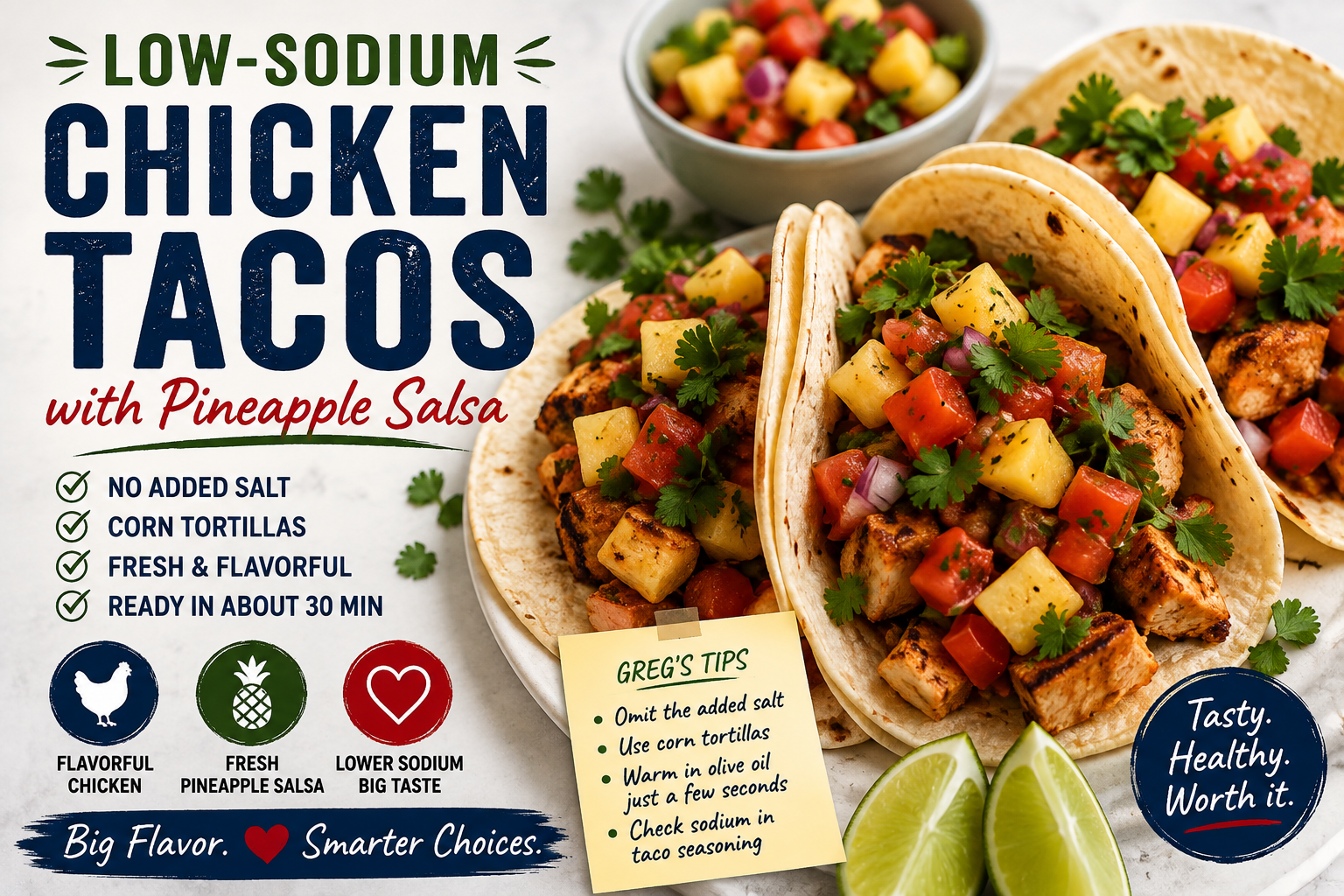
    The original chicken marinade calls for ¾ teaspoon of kosher salt along with lime, honey, cumin, chili powder, paprika, onion powder, garlic powder, black pepper, oregano and optional cayenne. 

    I simply leave the salt out.

    All of it.

    There’s already so much flavor coming from everything else that I don’t think these tacos need the added salt.

    The lime brings acidity. The cumin, chili powder and paprika bring plenty of flavor. Then there’s garlic, onion, oregano, black pepper and a little cayenne if you want some heat.

    I don’t miss the salt.

    That’s something I’ve learned since changing the way I cook. Sometimes salt is doing most of the work in a recipe.

    Other times?

    It’s just along for the ride.

    This is one of those recipes where I think it can stay home.

    My Shortcut for Preparing the Chicken

    The original recipe calls for slicing chicken breasts into thinner cutlets and pounding them to an even thickness before marinating them. This helps the chicken cook evenly. 

    When I’m in a hurry, I’ll sometimes buy chicken tenderloins instead.

    That saves me from having to slice a large chicken breast into cutlets. I put the tenderloins between plastic or inside a resealable bag and use a meat tenderizer to flatten them.

    It’s a simple shortcut that saves me some work.

    And yes, I have a meat tenderizer specifically for this.

    I use it for this recipe and anytime I need to get chicken to a relatively even thickness.

    Just remember: I’m trying to flatten the chicken.

    I’m not trying to punish it for something it did.

    Let the Marinade Do Its Thing

    Once the chicken is flattened, it goes into the marinade.

    The original recipe recommends marinating it for at least 20 minutes, with the option of preparing it farther in advance. 

    The only significant change I make to that marinade is leaving out the added salt.

    Then I cook the chicken until it reaches a safe internal temperature of 165°F, let it rest and cut it into pieces for the tacos. 

    Don’t Forget the Pineapple Salsa

    The pineapple salsa is one of the best parts.

    The original combines pineapple, tomato, red onion, jalapeño, lime and cilantro. 

    You get sweet from the pineapple, some heat from the jalapeño, acidity from the lime and freshness from everything else.

    Pile that on top of the seasoned chicken and you really don’t need salt to make these tacos interesting.

    There’s already plenty happening.

    Watch the Tortillas

    This is another place where I’ve learned to read the nutrition label.

    I use corn tortillas rather than flour tortillas.

    Some flour tortillas can contain a surprising amount of sodium depending on the brand, variety and size. I’ve personally found some around 400 mg of sodium per tortilla.

    That’s a lot when you consider that you’re probably not eating just one taco.

    So don’t assume tortillas are low in sodium simply because they don’t taste salty.

    Turn the package over and read the label.

    These are the corn tortillas I currently use:

    See the Corn Tortillas I Buy at Walmart

    I still check the nutrition information when I buy them because recipes and nutrition information can change.

    A Few Seconds in the Pan

    I like my tortillas warmed in a skillet with a little olive oil.

    They don’t need much.

    The original recipe recommends warming the tortillas for only about 10–15 seconds per side. 

    That’s about what I do.

    A few seconds on one side.

    Flip.

    A few seconds on the other.

    Done.

    Don’t walk away and start checking Facebook.

    We’re talking seconds here, not minutes.

    Then Into the Tortilla Warmer

    Once I’ve warmed the tortillas, I don’t want the first ones getting cold while I’m finishing the rest.

    That’s where another little kitchen gadget comes in handy:

    our tortilla warmer.

    I put the warmed tortillas inside, close it up and keep them there until we’re ready to assemble the tacos.

    It’s certainly not something you need to make this recipe.

    But it’s one of those inexpensive kitchen tools that makes taco night a little easier, especially when you’re preparing several tortillas at once.

    Warm chicken.

    Fresh pineapple salsa.

    Warm tortillas.

    Now we’re ready.

    Be Careful With the Taco-Seasoning Shortcut

    The original recipe also suggests using taco seasoning as an alternative when you’re short on time. 

    That’s certainly an option.

    But if you’re watching your sodium, check the package first.

    Taco seasoning is another place where sodium can sneak into a meal quickly, and the amount can vary substantially between products.

    Don’t assume.

    Read the serving size.

    Read the sodium.

    And pay attention to how much seasoning you’re actually using.

    You could also make your own salt-free taco seasoning and control exactly what goes into it.

    That’s probably another recipe I need to add to the site.

    And Then There’s Portion Control…

    Remember when I said these tacos are dangerously good?

    I wasn’t kidding.

    I used to eat a lot of them.

    I’ve gotten much better about that.

    One of the biggest lessons I’ve learned is that making something lower in sodium doesn’t magically turn it into an unlimited food.

    There are still tortillas.

    There are still carbohydrates.

    There are still calories.

    And there’s still the small problem that I could probably keep eating these until somebody physically removes the plate from the table.

    So now I pay attention to how many I’m eating.

    Low sodium doesn’t mean unlimited.

    Funny how that article keeps finding its way into my recipes.

    ❤️ Greg’s Take

    This is exactly the kind of recipe that convinced me low-sodium food doesn’t have to taste like punishment.

    I didn’t completely reinvent it.

    I didn’t replace fifteen ingredients.

    I made a few simple changes.

    Leave out the ¾ teaspoon of salt.

    Choose a lower-sodium corn tortilla.

    Pay attention to the sodium if you’re using packaged taco seasoning.

    That’s basically it.

    The chicken still has lime, cumin, chili powder, paprika, garlic, onion, oregano and cayenne.

    Then you pile fresh pineapple salsa on top.

    There’s plenty happening in that taco.

    And I’ve found a few ways to make preparing them easier too. Chicken tenderloins and my meat tenderizer save me some prep work, and the tortilla warmer keeps everything warm while I finish cooking.

    Quick, flavorful and something I actually look forward to eating.

    The only thing I haven’t found a good kitchen gadget for is self-control.

    I’m still looking for that one on Amazon.


    Recipe Credit

    This is my lower-sodium adaptation of Jessica Gavin’s Chicken Tacos with Pineapple Salsa. Her original recipe, complete ingredient measurements and preparation instructions are available on her website. 

    View the Original Recipe at Jessica Gavin

    I omit the added salt, use the corn tortillas I prefer and make a few preparation changes based on how we cook the recipe at home.


    Affiliate Disclosure

    This article contains Amazon affiliate links. If you purchase something through one of these links, I may earn a small commission at no additional cost to you. I personally use the products I’ve linked in this article and am sharing them because they’ve been useful in my own kitchen. Purchasing through my links helps support He’s Knocking on My Door and allows me to continue creating content.

    Medical Disclaimer

    This article describes how I personally modify recipes to fit the way I eat. It is not medical or nutritional advice. Individual dietary needs vary, particularly for people managing conditions that affect sodium, carbohydrates, potassium or other nutrients. Always check the nutrition labels on the specific ingredients you use and follow the dietary guidance provided by your healthcare team.

  • Daily Journal #13: The Scale Is Heading the Wrong Way

    Daily Journal #13: The Scale Is Heading the Wrong Way

    Well, my morning health checks are continuing to move in the wrong direction.

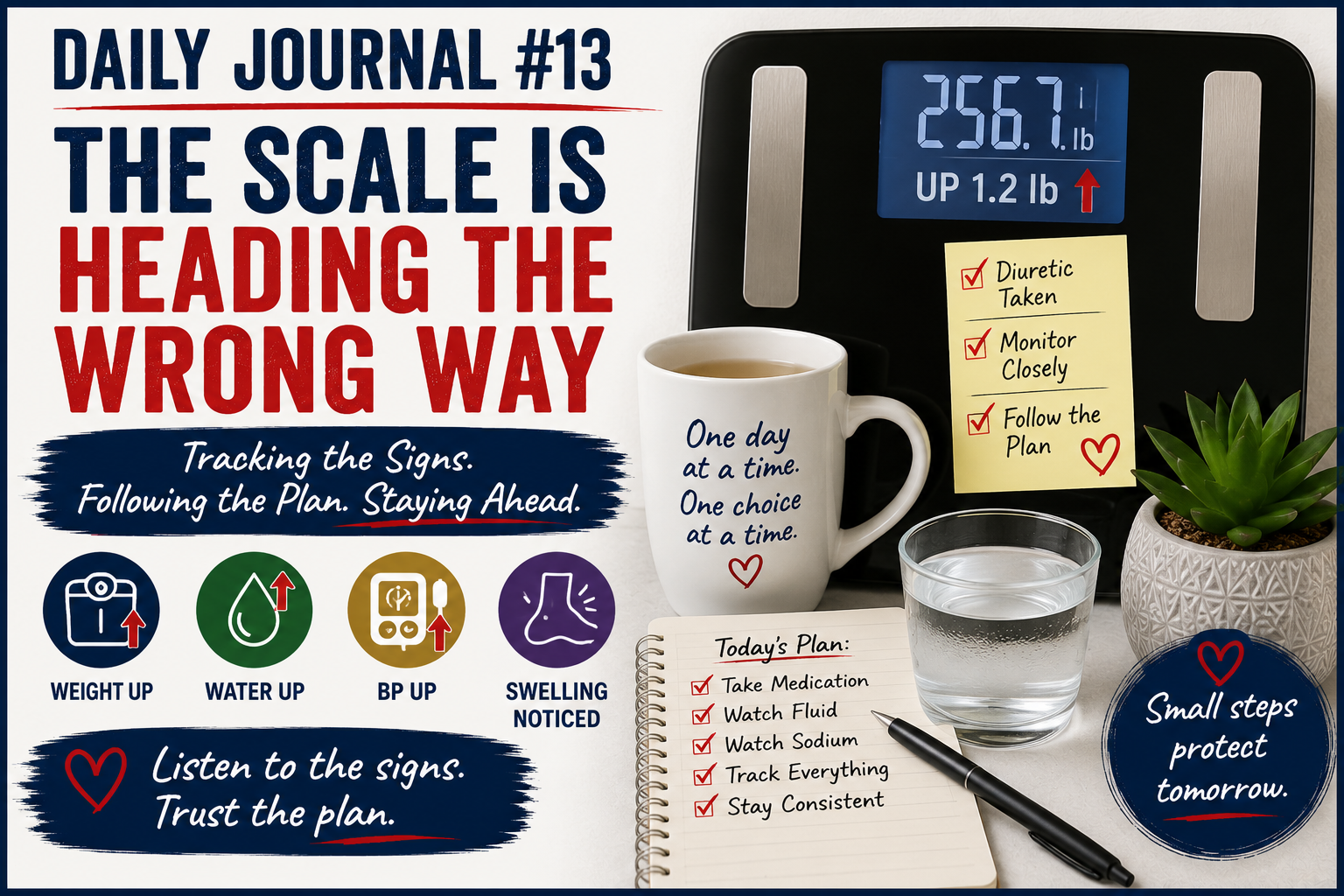
    I gained more than a pound again this morning. That’s now two days in a row with a gain of more than a pound.

    This time, there were some other signs along with it.

    My BIA scale showed an increase in body water. My blood pressure was slightly elevated, and when I looked at my feet, I could see some mild swelling.

    One number by itself might not concern me much.

    Several things pointing in the same direction get my attention.

    It looks like I’m retaining fluid.

    First Things First

    The first thing I did was follow the plan my cardiologist has given me and take my prescribed diuretic.

    Anyone who has dealt with heart failure and diuretics probably knows what that means.

    A good portion of today’s schedule will revolve around knowing exactly where the nearest bathroom is.

    Not particularly exciting, but that’s part of managing this.

    Now I watch what happens.

    Does the swelling decrease?

    Does my weight start moving back down?

    Does the extra water come off?

    Tomorrow morning’s numbers will be especially interesting.

    Now Comes the Detective Work

    The next thing I do when this happens is start retracing my steps.

    What changed?

    Did I drink too much?

    I don’t think so. I didn’t have any extra water yesterday. I did have a couple of peaches, which obviously contain water, but I don’t think that alone explains what I’m seeing.

    Then I started thinking about dinner from a couple of nights ago.

    The steak and shrimp rice bowls.

    They were one of my favorite meals, and I’ll admit it:

    I overindulged.

    The meal itself wasn’t necessarily the problem. We make it at home, so I have a pretty good idea of what’s going into the steak, rice, vegetables and seasonings.

    The question mark is the shrimp.

    Shrimp Can Be Tricky

    Shrimp naturally contains some sodium, but packaged shrimp can contain considerably more depending on how it was processed.

    Unfortunately, we already threw away the package.

    So I can’t go back and check the label.

    That’s frustrating because I’d really like to know exactly what I ate.

    Maybe we bought a different shrimp than usual. Maybe it contained more sodium from processing or packaging. Maybe the larger portion I ate was enough to push me over the edge.

    Or maybe it wasn’t the shrimp at all.

    I don’t know.

    That’s important for me to say because it’s very easy to see the scale move and immediately blame the last suspicious thing I ate.

    All I can do is look at the information I have and try to identify the most likely explanation.

    Maybe Fresh Shrimp Is the Better Answer

    One thing I’m considering going forward is buying more of our shrimp fresh from a seafood market.

    Living in Southwest Florida, we’re certainly not lacking seafood markets.

    That would give me another option when I’m trying to avoid some of the sodium that can be added during processing.

    But even then, I’ll still need to ask questions and pay attention to what I’m buying. “Fresh” doesn’t automatically tell me everything about how seafood was handled before it reached the counter.

    That’s one lesson I keep learning:

    Never assume. Ask. Read. Check.

    Sodium Doesn’t Always Give Me an Immediate Warning

    This is one of the frustrating parts of tracking everything.

    I don’t necessarily eat something salty at dinner and wake up the next morning several pounds heavier.

    Sometimes the pattern takes longer to become apparent.

    That’s why looking at trends has become more useful to me than reacting to one isolated number.

    Yesterday I was up.

    Today I’m up again.

    Now I’m also seeing increased body water on the scale and some swelling in my feet.

    That’s a trend worth paying attention to.

    I’m Watching — Not Panicking

    I’m still nowhere near the point where I think I need to head to the hospital.

    But I’m also not ignoring what’s happening.

    I’ve followed the medication plan my cardiologist gave me, and now I’ll monitor things more closely.

    That’s really what all of this daily tracking is about.

    It’s not about panicking every time the scale moves.

    It’s about noticing when several things start changing together and knowing when I need to pay closer attention.

    Hopefully, the diuretic does what it’s supposed to do today.

    Hopefully, the swelling improves.

    And hopefully tomorrow morning I step on the scale and finally see that number traveling in the other direction.

    ❤️ Greg’s Take

    This is exactly why I do morning health checks every day.

    Yesterday’s weight gain was something to watch.

    Today’s second consecutive gain, increased body water, slightly swollen feet and higher blood pressure gave me more information.

    Now I can respond according to the plan my cardiologist has already given me instead of waiting until things get significantly worse.

    I may never know whether those delicious steak and shrimp rice bowls were responsible.

    But I learned something anyway.

    Next time, don’t throw away the shrimp package until after I’ve survived the meal.

    And maybe don’t eat quite so much of it either.

    That second lesson may be the harder one.

    Medical Disclaimer: This journal reflects my personal experience living with chronic illness and how I manage my health based on guidance from my own healthcare team. It is not medical advice. Medications, including diuretics, should only be taken as prescribed by your healthcare provider. If you notice changes in your weight, swelling, blood pressure, breathing, or other symptoms, contact your healthcare provider for guidance. Seek immediate medical attention for symptoms that may be an emergency.

  • Easy Low-Sodium Yellow Rice in the Rice Cooker

    Easy Low-Sodium Yellow Rice in the Rice Cooker

    This has become one of our favorite easy side dishes.

    We originally found this Yellow Rice in a Rice Cooker recipe from I Heart Vegetables, and it’s good, simple and incredibly easy to make.

    Original Yellow Rice Recipe from I Heart Vegetables

    And when I say easy, I mean easy.

    Rinse the rice, put everything in the rice cooker, push the button and basically forget about it.

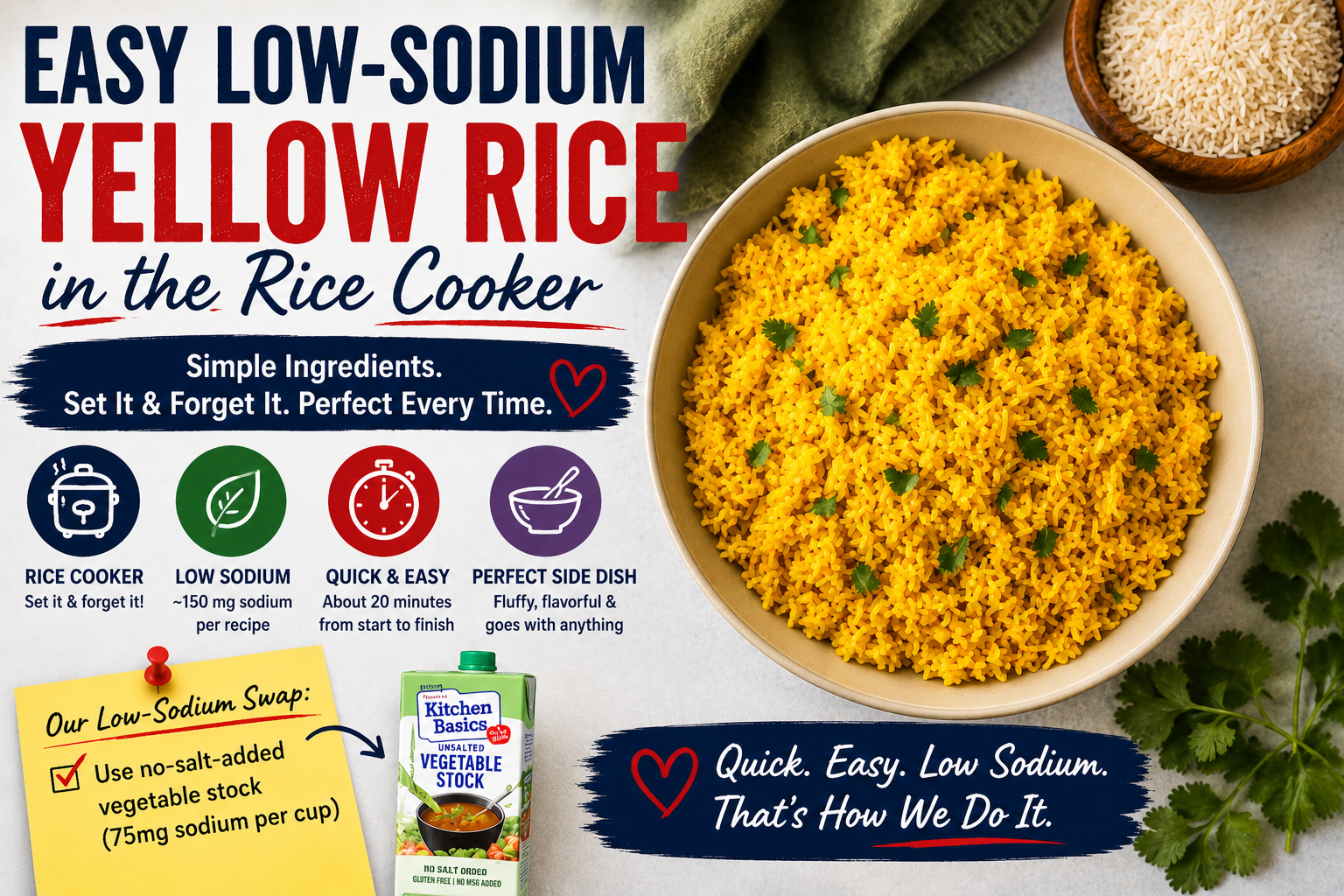
    About 20 minutes later, you have a flavorful yellow rice that works as a side dish or as the base for a meal. The original recipe lists about 5 minutes of prep and 15 minutes of cooking time. 

    How We Make It Lower in Sodium

    The original recipe uses vegetable broth and mentions Better Than Bouillon vegetable base as the author’s choice. 

    That’s where we make our biggest change.

    Instead, we use Kitchen Basics Unsalted Vegetable Stock. Walmart currently lists it as having no added salt. 

    Kitchen Basics Unsalted Vegetable Stock at Walmart

    The carton we use lists 75 mg of sodium per cup. Since the recipe requires two cups, that’s about:

    75 mg × 2 cups = 150 mg of sodium

    That’s roughly 150 mg of sodium from the stock in the entire batch of rice, not per serving.

    We also leave out the additional salt called for in the original recipe.

    Of course, the exact sodium in your finished rice depends on the specific brands and ingredients you use, so always check your own labels.

    Our Version

    For our lower-sodium version, we use:

    • 1 cup white rice
    • 2 cups no-salt-added vegetable stock
    • 1 teaspoon ground turmeric
    • 1/2 teaspoon onion powder
    • 1/2 teaspoon garlic powder
    • We omit the salt

    The ingredient proportions, other than our stock substitution and omission of added salt, come from the original I Heart Vegetables recipe. 

    I rinse the rice, put everything into the rice cooker, give it a stir and start the normal white-rice cycle.

    That’s about it.

    When it’s finished, fluff it with a fork and serve.

    Quick. Easy. And very little cleanup.

    This Is Why I Love the Rice Cooker

    This recipe is a perfect example of why we bought our rice cooker in the first place.

    There’s no standing over the stove watching a pot.

    There’s no wondering whether the rice is done.

    I put everything in, start it and move on to whatever else we’re making.

    The rice cooker handles the rest.

    And the rice comes out consistently good.

    Why We Finally Bought a Rice Cooker

    Don’t Forget About Serving Size

    Here’s where I’m going to sound like a broken record.

    Just because I reduced the sodium doesn’t mean I should sit down and eat the entire rice cooker.

    Low sodium doesn’t mean unlimited.

    Rice still contains carbohydrates, so portion size matters to me for reasons beyond sodium.

    It’s also exactly why I wrote my article about reading nutrition labels.

    You can’t look at one number on a label and decide whether something works for you. You have to consider the serving size and the amount you’re actually going to eat.

    ❤️ Greg’s Take

    This is exactly the kind of recipe I’ve been looking for since changing the way I eat.

    I don’t necessarily need to reinvent every recipe.

    Sometimes I just need to find the ingredient that’s causing me trouble and replace it with something that works better for me.

    In this case, swapping the vegetable bouillon/broth for an unsalted vegetable stock and skipping the additional salt gives us a version that fits much better into the way we’re eating now.

    And I don’t feel like I’m eating bland “diet food.”

    It’s yellow rice.

    It’s flavorful.

    It goes with a ton of different meals.

    And the rice cooker does almost all the work.

    Drop it in. Push the button. Go make the rest of dinner.

    That’s my kind of recipe.


    Recipe Credit

    This recipe is adapted from I Heart Vegetables — How to Make Yellow Rice in a Rice Cooker. I use their recipe as the starting point and modify it to reduce the sodium by using unsalted vegetable stock and omitting the added salt.

    View the Original Recipe at I Heart Vegetables

    Disclaimer: This article reflects my personal experience with low-sodium cooking and the modifications I make to recipes while living with chronic illness. It is not medical or nutritional advice. Sodium needs can vary from person to person, so always check ingredient labels and follow the guidance of your own doctor, dietitian, or healthcare team. Product ingredients and nutrition information can also change over time.