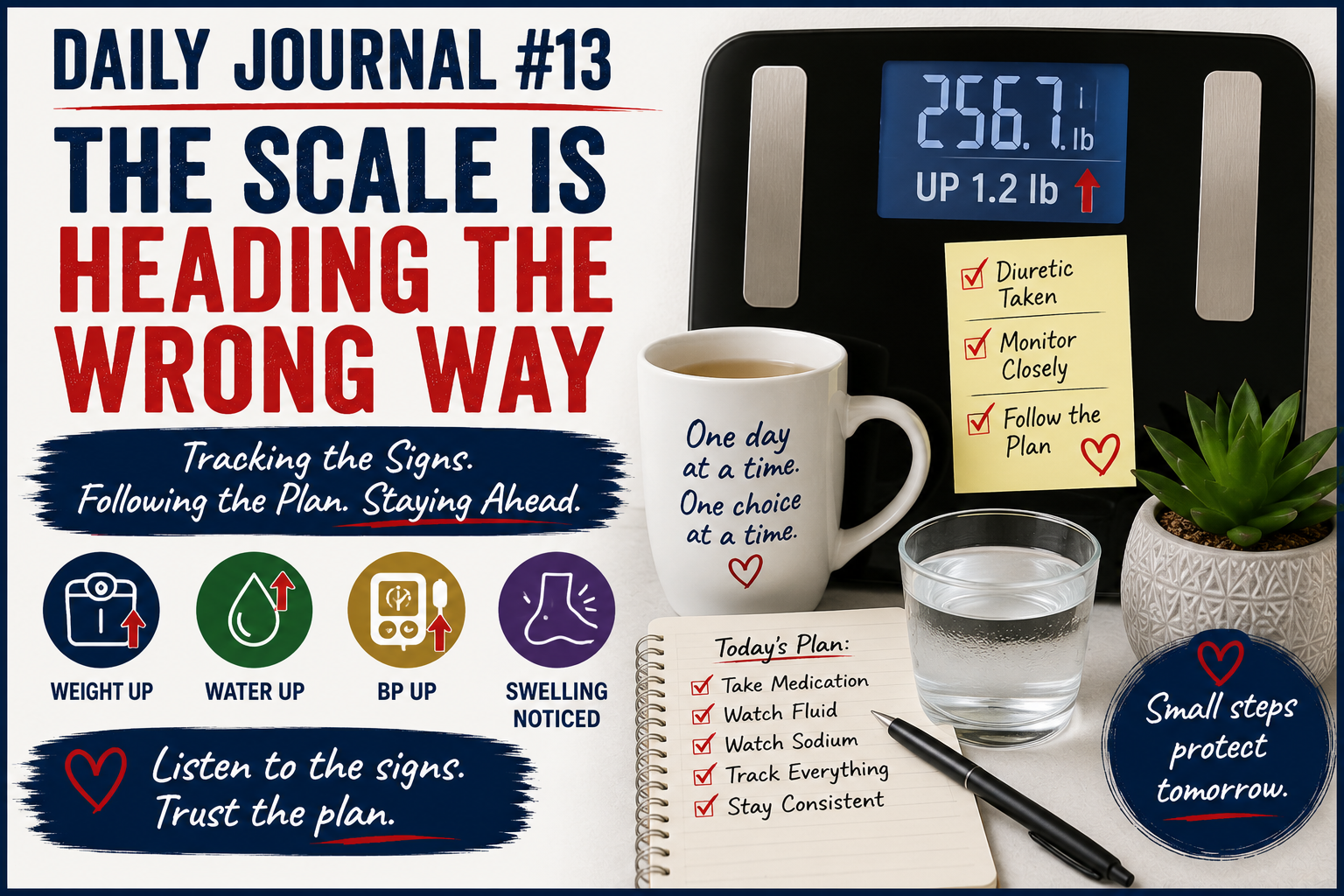
Well, my morning health checks are continuing to move in the wrong direction.
I gained more than a pound again this morning. That’s now two days in a row with a gain of more than a pound.
This time, there were some other signs along with it.
My BIA scale showed an increase in body water. My blood pressure was slightly elevated, and when I looked at my feet, I could see some mild swelling.
One number by itself might not concern me much.
Several things pointing in the same direction get my attention.
It looks like I’m retaining fluid.
First Things First
The first thing I did was follow the plan my cardiologist has given me and take my prescribed diuretic.
Anyone who has dealt with heart failure and diuretics probably knows what that means.
A good portion of today’s schedule will revolve around knowing exactly where the nearest bathroom is.
Not particularly exciting, but that’s part of managing this.
Now I watch what happens.
Does the swelling decrease?
Does my weight start moving back down?
Does the extra water come off?
Tomorrow morning’s numbers will be especially interesting.
Now Comes the Detective Work
The next thing I do when this happens is start retracing my steps.
What changed?
Did I drink too much?
I don’t think so. I didn’t have any extra water yesterday. I did have a couple of peaches, which obviously contain water, but I don’t think that alone explains what I’m seeing.
Then I started thinking about dinner from a couple of nights ago.
The steak and shrimp rice bowls.
They were one of my favorite meals, and I’ll admit it:
I overindulged.
The meal itself wasn’t necessarily the problem. We make it at home, so I have a pretty good idea of what’s going into the steak, rice, vegetables and seasonings.
The question mark is the shrimp.
Shrimp Can Be Tricky
Shrimp naturally contains some sodium, but packaged shrimp can contain considerably more depending on how it was processed.
Unfortunately, we already threw away the package.
So I can’t go back and check the label.
That’s frustrating because I’d really like to know exactly what I ate.
Maybe we bought a different shrimp than usual. Maybe it contained more sodium from processing or packaging. Maybe the larger portion I ate was enough to push me over the edge.
Or maybe it wasn’t the shrimp at all.
I don’t know.
That’s important for me to say because it’s very easy to see the scale move and immediately blame the last suspicious thing I ate.
All I can do is look at the information I have and try to identify the most likely explanation.
Maybe Fresh Shrimp Is the Better Answer
One thing I’m considering going forward is buying more of our shrimp fresh from a seafood market.
Living in Southwest Florida, we’re certainly not lacking seafood markets.
That would give me another option when I’m trying to avoid some of the sodium that can be added during processing.
But even then, I’ll still need to ask questions and pay attention to what I’m buying. “Fresh” doesn’t automatically tell me everything about how seafood was handled before it reached the counter.
That’s one lesson I keep learning:
Never assume. Ask. Read. Check.
Sodium Doesn’t Always Give Me an Immediate Warning
This is one of the frustrating parts of tracking everything.
I don’t necessarily eat something salty at dinner and wake up the next morning several pounds heavier.
Sometimes the pattern takes longer to become apparent.
That’s why looking at trends has become more useful to me than reacting to one isolated number.
Yesterday I was up.
Today I’m up again.
Now I’m also seeing increased body water on the scale and some swelling in my feet.
That’s a trend worth paying attention to.
I’m Watching — Not Panicking
I’m still nowhere near the point where I think I need to head to the hospital.
But I’m also not ignoring what’s happening.
I’ve followed the medication plan my cardiologist gave me, and now I’ll monitor things more closely.
That’s really what all of this daily tracking is about.
It’s not about panicking every time the scale moves.
It’s about noticing when several things start changing together and knowing when I need to pay closer attention.
Hopefully, the diuretic does what it’s supposed to do today.
Hopefully, the swelling improves.
And hopefully tomorrow morning I step on the scale and finally see that number traveling in the other direction.
❤️ Greg’s Take
This is exactly why I do morning health checks every day.
Yesterday’s weight gain was something to watch.
Today’s second consecutive gain, increased body water, slightly swollen feet and higher blood pressure gave me more information.
Now I can respond according to the plan my cardiologist has already given me instead of waiting until things get significantly worse.
I may never know whether those delicious steak and shrimp rice bowls were responsible.
But I learned something anyway.
Next time, don’t throw away the shrimp package until after I’ve survived the meal.
And maybe don’t eat quite so much of it either.
That second lesson may be the harder one.
Medical Disclaimer: This journal reflects my personal experience living with chronic illness and how I manage my health based on guidance from my own healthcare team. It is not medical advice. Medications, including diuretics, should only be taken as prescribed by your healthcare provider. If you notice changes in your weight, swelling, blood pressure, breathing, or other symptoms, contact your healthcare provider for guidance. Seek immediate medical attention for symptoms that may be an emergency.
Leave a Reply