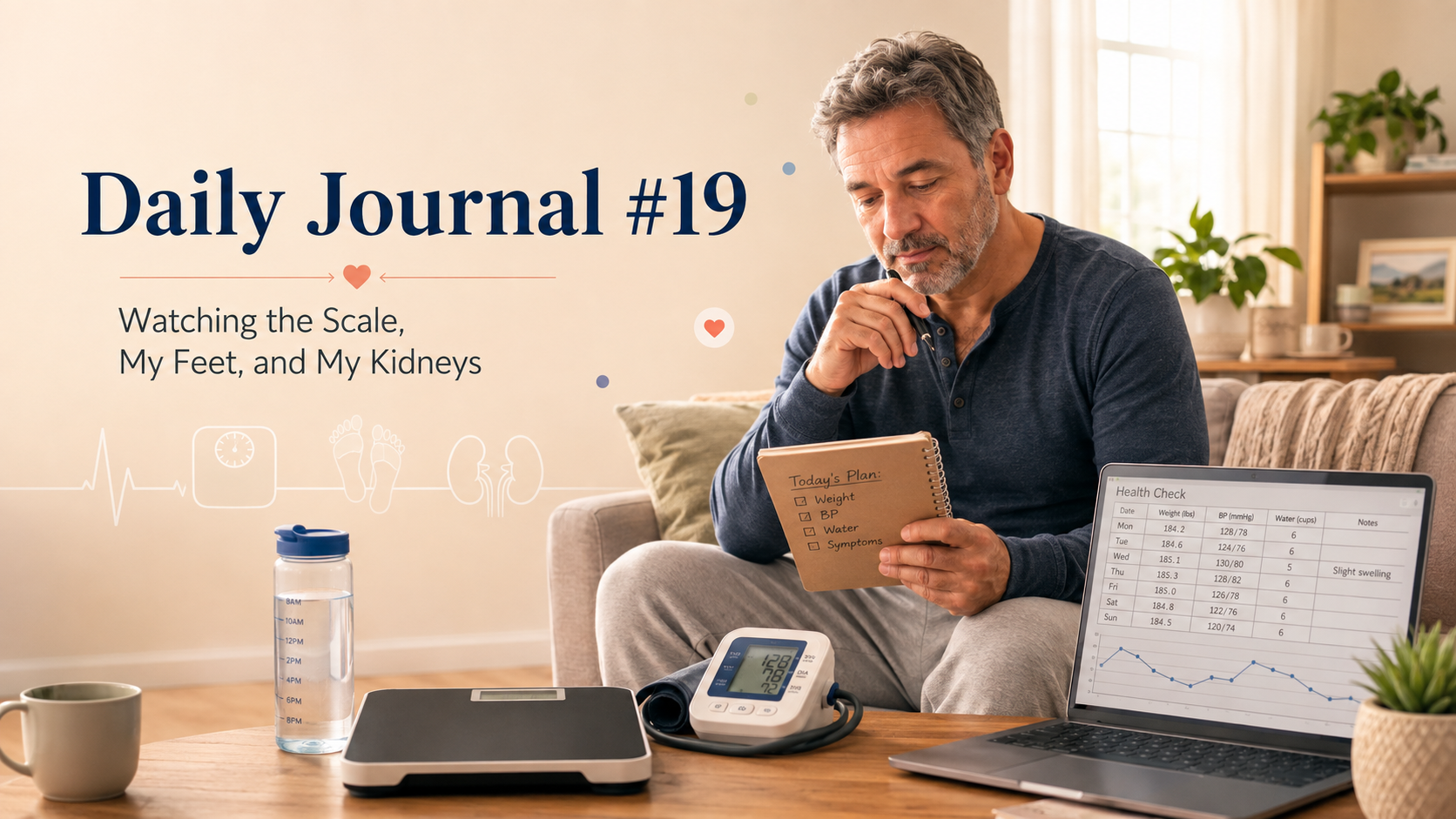
My morning health check was about as good as it has been the last couple of days, but one thing caught my attention.
I gained a pound since yesterday.
Normally, a one-pound change by itself probably wouldn’t alarm me too much. What concerned me was that I really didn’t eat much yesterday. I had a salad for dinner. It wasn’t a small salad, but it certainly wasn’t anything that should have caused me to gain a pound overnight.
Then I started looking at everything else.
My feet were slightly swollen.
My blood pressure was up.
My body-water calculation was also higher.
Put all of that together,
and I started wondering if I was retaining fluid again.
So I took a Torsemide this morning.
I only take my diuretic on an as-needed basis now. That was a decision made with my medical team, not something I decided to do on my own.
I manage my sodium and fluid intake very tightly because my goal is to avoid needing diuretics whenever possible. My doctors have actually seen the Excel spreadsheet I use to track everything. I don’t miss days. I document changes, symptoms, weight, blood pressure and medication adjustments made by my medical team.
That level of tracking became especially important after what happened a few months ago.
When Too Much Diuretic Became a Problem
A few months ago, I ended up in the hospital after becoming over-diuresed.
Basically, my body had gotten too low on fluid while I was still taking my diuretics as prescribed.
That contributed to an acute kidney injury, or AKI.
My kidney function dropped significantly. An eGFR above 60 is generally considered a better range, and mine had fallen into the low 30s.
That episode is part of the reason I later had a kidney ultrasound and why I now have an MRI scheduled.
After several appointments with my nephrologist, and after my doctors saw just how closely I was monitoring everything, my diuretic plan was changed to as-needed use.
That gives me a little more flexibility, but it also means I have to pay close attention to what my body is telling me.
And lately, I am.
Why This Morning Has Me Concerned
This is now the second time in about a week that I’ve noticed signs that make me wonder if I’m holding onto more fluid than I should.
What makes it frustrating is that I can’t immediately point to something obvious.
I didn’t have shrimp in my salad.
It was basically vegetables, other than the dressing.
So my next step is to retrace everything I ate and drank yesterday and see if something contained more sodium than I realized.
Sometimes that’s all you can do.
Go back.
Look at the numbers.
Then at what you ate.
Also at what you drank.
And try to find the missing piece.
Blood Work Today
I also have a blood draw today.
A few hours after that, I’ll have a new set of numbers to look at.
And I’ll admit it: I’m having a lot of anxiety about it.
After watching my kidney function drop before, it’s hard not to worry about what those lab results are going to show.
I’m praying everything looks good.
If it doesn’t, then there may be more changes ahead.
Either way, I’ll know more soon.
And when I do, I’ll let you know.
Medical Disclaimer
This journal reflects my personal experience living with heart failure, kidney disease, and the treatment plan developed specifically for me by my healthcare team. Nothing in this article should be taken as medical advice or as a recommendation to start, stop, skip, increase, decrease, or otherwise change any medication, including diuretics. Diuretics can affect fluid balance, blood pressure, electrolytes, and kidney function, and improper use can be dangerous. Any changes to your medications, fluid intake, sodium limits, or treatment plan should be made only in consultation with your own qualified healthcare professionals. If you experience new or worsening swelling, rapid weight changes, shortness of breath, chest pain, severe dizziness, fainting, or other concerning symptoms, seek appropriate medical care promptly.
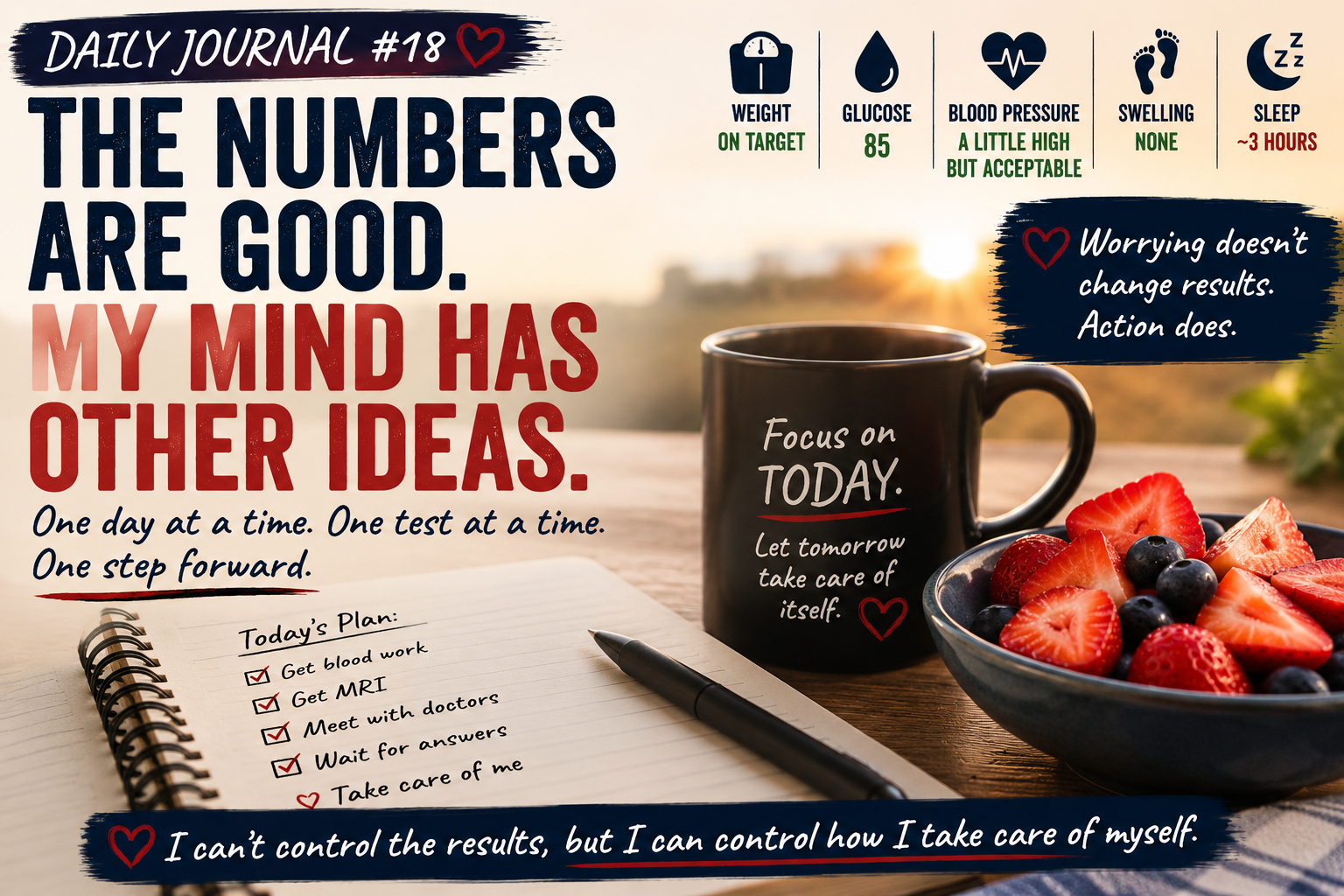
My weight was right where I wanted it. My glucose was 85. My blood pressure was a little higher than usual, but still acceptable.
Most importantly, no swelling in my feet.
After the fluid retention I was dealing with recently, I finally feel like I’m back in a place where I’m comfortable with what I’m seeing.
That’s the good news.
Unfortunately, my brain apparently didn’t get the memo.
Another Night With Almost No Sleep
I got maybe three hours of sleep last night.
Again.
My hip certainly isn’t helping. It’s still hurting quite a bit, and finding a comfortable position has been difficult.
But I don’t think the hip deserves all the blame this time.
Anxiety does.
I have blood work coming up and then an MRI of my kidneys.
And apparently my brain has decided that 2:00 in the morning is the perfect time to explore every possible outcome.
Waiting Is Sometimes the Hardest Part
I’ve already been told there are problems with my right kidney. Then the ultrasound found something that needs a closer look on the other kidney.
That’s about all I actually know right now.
But that’s not where my mind stops.
My mind immediately jumps ahead:
What if something is seriously wrong with the other kidney?
What if my kidney function gets worse?
What if someday I need dialysis?
Then I start thinking about my other chronic illnesses, my age and whether I’d ever even be a candidate for something like a kidney transplant.
Before long, I’ve gone from:
“I have an MRI scheduled.”
to:
“I’m going to end up on dialysis.”
That’s quite a leap.
And I know that.
The reality is much simpler.
I don’t have those answers yet.
I don’t know what the MRI is going to show. I don’t know what the upcoming blood work will show. And I certainly don’t know that dialysis or a transplant is anywhere in my future.
Those are fears.
They aren’t test results.
Sometimes I need to remind myself of the difference.
There’s Nothing I Can Do About It Today
This might be the hardest part for me.
I like problems I can fix.
If something breaks around the house, figure out what’s wrong and fix it.
If there’s a problem with the website, troubleshoot it.
Health doesn’t always work that way.
Right now, my job is pretty simple:
Get the blood work.
Get the MRI.
Meet with my doctors.
Wait for the actual information.
Worrying about it at three in the morning isn’t going to change what that MRI shows.
It’s just going to make me exhausted when morning arrives.
Much easier said than done.
The Heat Isn’t Helping Either
It’s still ridiculously hot here in Southwest Florida.
We’ve had what seems like one heat warning after another lately, so I’m continuing to be careful about how much I do outside.
I’ve had enough episodes of getting lightheaded and feeling like I might pass out with exertion and heat that I’m not interested in pushing my luck.
That doesn’t mean I want to sit around all day, though.
I Still Want to Move
Even with my hip hurting, I’d like to get some walking in.
The hospital gave me some exercises to work on before my hip surgery. They’re intentionally pretty mild and don’t require a huge amount of exertion.
I’d also like to walk a little when I can.
Nothing heroic.
I’m certainly not heading outside in a heat warning and trying to set a personal record.
I just don’t want to completely stop moving because my hip hurts.
There’s a balance there too.
Apparently my entire life has become one giant balancing act.
❤️ Greg’s Take
Physically, this morning started pretty well.
Weight looks good.
Glucose was 85.
Blood pressure was acceptable.
No swelling.
Those are all wins.
Mentally?
That’s a different story.
I’m tired, my hip hurts, and I’m worried about what we’re going to find with my kidneys.
I can come up with a hundred terrible possibilities if I give myself enough time.
But none of them are facts.
The facts will come from the blood work, the MRI and my doctors.
Until then, worrying myself into another sleepless night accomplishes absolutely nothing.
I know that.
Now I just need to convince my brain.
Medical Disclaimer
This daily journal documents my personal experiences living with chronic illness, anxiety about medical testing, pain and ongoing treatment. It is not medical advice. Everyone’s medical situation is different, and decisions about kidney disease, exercise, medications or other treatments should be made with your own healthcare professionals.
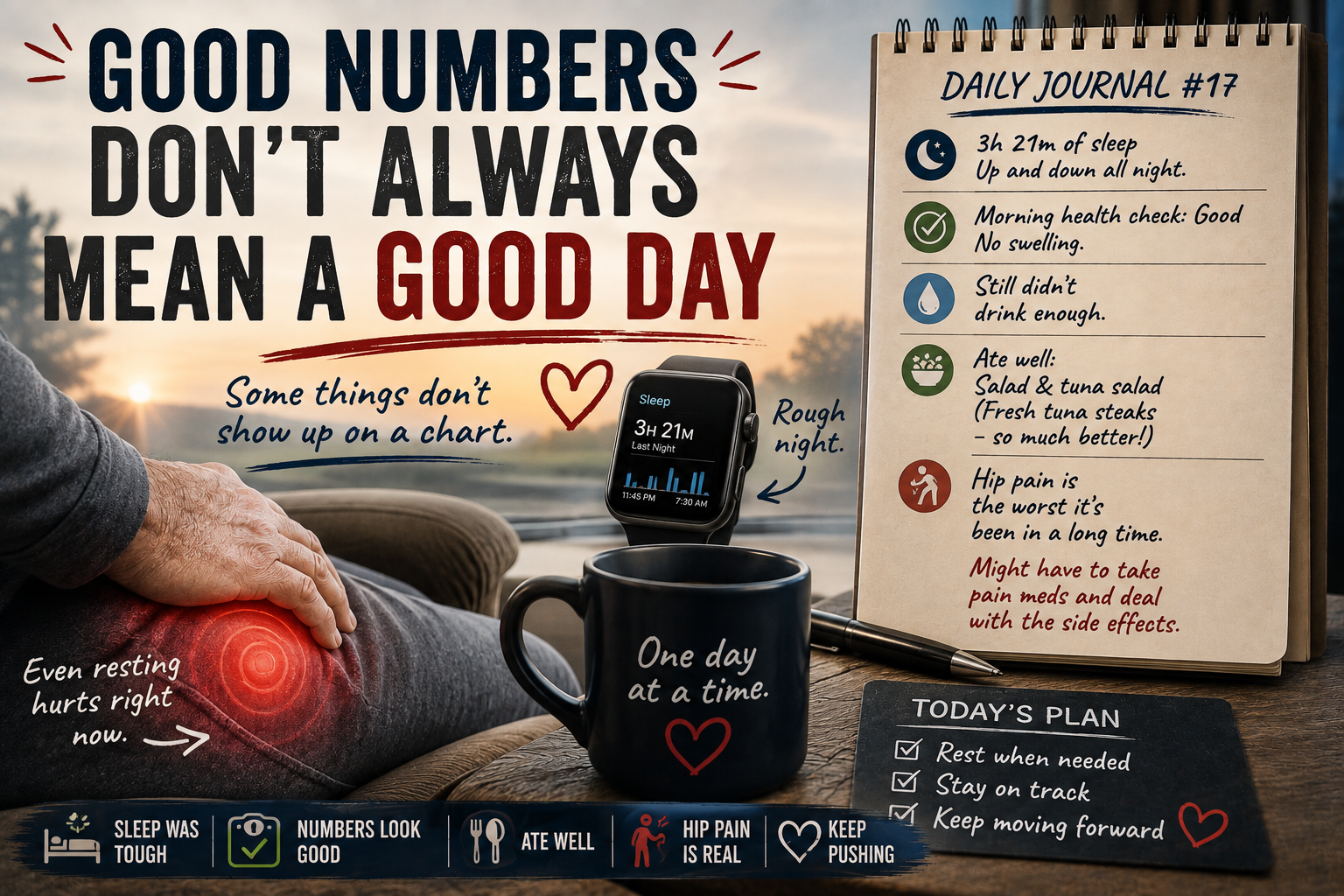
I was up and down most of the night, and according to my Apple Watch, I managed a whopping 3 hours and 21 minutes of sleep.
That’s not much.
I’ll probably end up taking a nap sometime today, which unfortunately feeds into the problem. I sleep during the day because I didn’t sleep at night. Then I’m not tired when nighttime comes around.
Before I know it, I’ve got my days and nights completely screwed up.
It sucks.
I’m still trying to figure out how to break that cycle.
Nothing showing me that I’m heading back toward the fluid retention I was dealing with earlier.
That’s reassuring.
I’m still not drinking as much as I probably should, though.
After watching my weight climb and my feet swell recently, I’ve definitely become more hesitant about fluids. I’ve talked about that over the last few days, and apparently my brain hasn’t gotten the memo yet that things have stabilized.
That’s something I need to continue working on.
At Least I’m Eating
I did better with food yesterday.
I had a salad along with some tuna salad.
We’ve actually started doing something different with the tuna that has turned out really well.
Instead of buying canned tuna, we’ve been cooking fresh tuna steaks and using those to make tuna salad.
What a difference.
It tastes so much better than canned tuna, and depending on what you’re comparing it with, it can also help me avoid some of the sodium that comes with canned and packaged products.
This might eventually deserve its own recipe on the site.
One more thing for the list.
The Hip Is Another Story
Unfortunately, while the morning numbers are behaving themselves, my hip definitely isn’t.
This is probably the most pain I’ve been in for quite a while.
Usually I can find some position where it settles down a little.
Right now, even sitting still hurts.
Sleeping has become difficult too, which certainly isn’t helping my already screwed-up sleep schedule.
The recliner is still the place where I can get the most comfortable, but even that isn’t particularly comfortable right now.
And mentally, I hate spending most of my day parked in a recliner.
I want to get up.
I want to do things.
I want to work on the website.
I want to cook.
I want to move around the house.
Instead, my hip keeps reminding me that it gets a vote too.
Apparently, lately it has veto power.
The Pain-Medication Trade-Off
I haven’t taken my pain medication in a while.
There’s a reason for that.
Constipation.
That’s one of the side effects I’ve dealt with, and it’s unpleasant enough that I’ve been trying to avoid the medication whenever possible.
Usually I can tough it out.
Right now, I’m getting to the point where I may have to reconsider that.
There’s only so much pain you can tolerate before the benefit of getting some relief starts outweighing the downside.
If I do need the medication, then I’ll have to deal with the constipation issue separately.
Another trade-off.
Seems like chronic illness comes with a lot of those.
Fix one problem. Create another problem. Manage both. Repeat.
❤️ Greg’s Take
If you only looked at my morning health checks today, you’d probably say:
Great day.
No swelling.
Numbers look good.
Fluid retention seems to be under control.
But those numbers don’t show that I slept 3 hours and 21 minutes.
They don’t show how much my hip hurts.
They don’t show that sitting still hurts right now.
And they don’t show how frustrating it is spending so much time in a recliner because it’s one of the few places where I can get even somewhat comfortable.
That’s something I’ve learned through all of this.
Good numbers don’t always mean a good day.
I’m happy with the numbers.
Believe me, I want them to stay exactly where they are.
But today?
I’m tired.
My hip hurts like hell.
And there’s a pretty good chance a nap is in my future.
Hopefully tomorrow is better.
Medical Disclaimer
This journal describes my personal experience living with chronic health conditions, pain and prescribed medications. It is not medical advice. Medication decisions, fluid intake and treatment for pain or other symptoms should be discussed with your own healthcare team. Never start, stop or change a prescribed medication based on my experience.
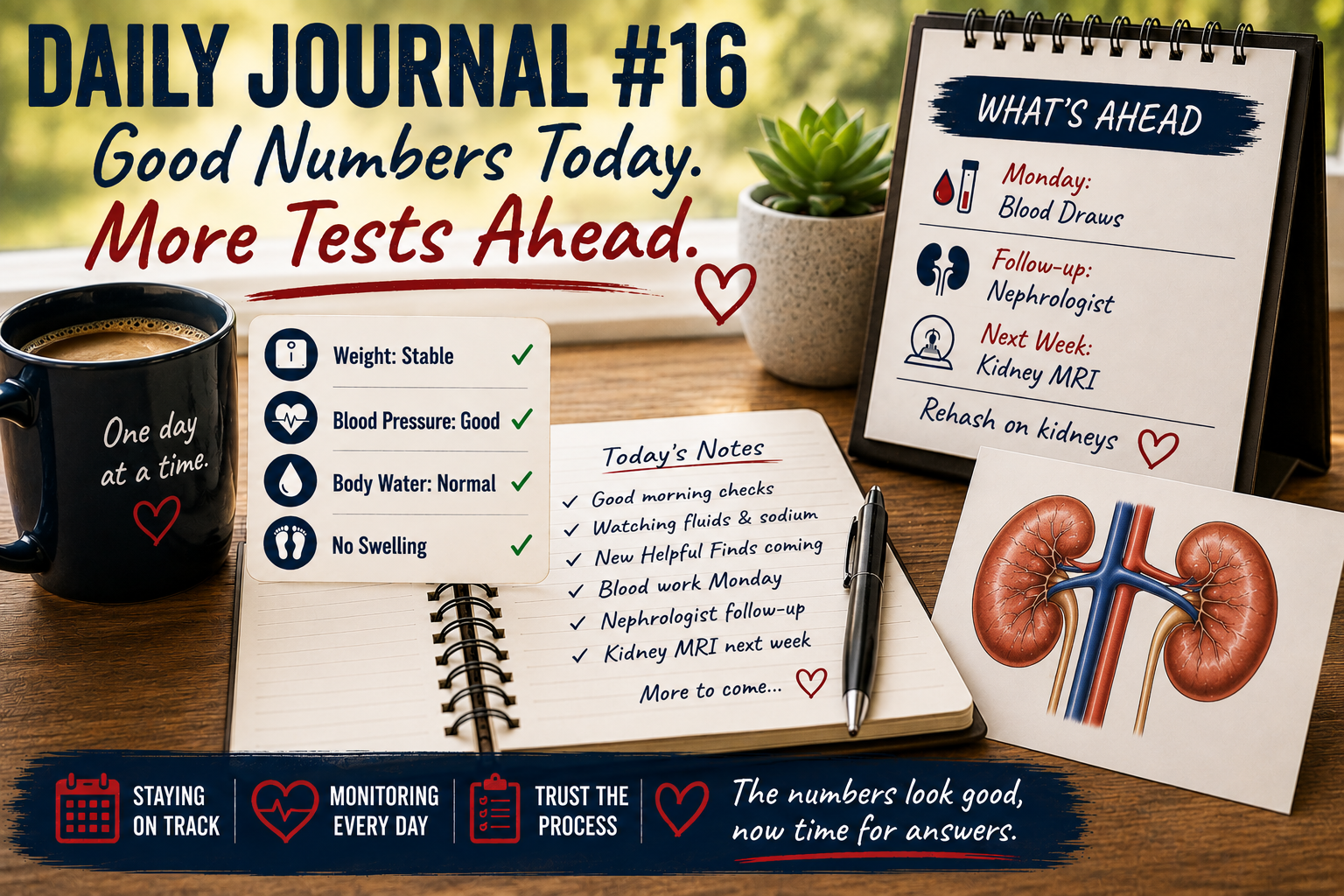
My weight is behaving. My blood pressure looks good. No new signs of fluid retention.
Basically, nothing exciting happened.
And when it comes to my morning health checks, boring is exactly what I want.
I’m Still Hesitant About Food and Water
Even though everything has settled back down, I’m still a little hesitant about eating and drinking normally after the fluid retention I had earlier this week.
Truthfully, I probably didn’t drink enough water yesterday.
That’s the balancing act I’m still trying to figure out.
I don’t want to drink too much and end up retaining fluid.
But I also can’t go too far in the opposite direction and not give my body—and especially my kidneys—what it needs.
Logically, I understand that.
Convincing my brain is another matter.
The good news is that my morning numbers continue to tell me things are moving in the right direction.
So I’ll keep monitoring.
A Few New Helpful Finds Are Coming
I also spent some time working on a few new products for the Helpful Finds section of the website.
I’ve accumulated quite a few things that have made living with all of this a little easier.
Some are health related.
Some help with cooking and eating low sodium.
Others are just things that make everyday life easier when you aren’t as mobile as you used to be.
I’ll be posting more of those soon.
Here Come the Appointments
The calendar is starting to fill up again.
Monday is blood-draw day.
And apparently everybody wants a piece of me.
I have a bunch of labs ordered, including testing from both my nephrologist and urologist. I’m sure some of those tests overlap, but either way they’re getting plenty of blood.
After that, I have a follow-up appointment with my nephrologist.
Then the following week comes the bigger one:
An MRI of my kidneys.
Trying to Figure Out What’s Going On With My Kidneys
I had an ultrasound a few weeks ago that raised some additional questions.
There are concerns about how well my right kidney is functioning, and the ultrasound also noted a cyst and described the left kidney as having a nodular contour.
I’m not going to pretend I completely understand what all of that means.
That’s what the additional testing and doctors are for.
I’ve learned enough through this whole medical adventure to know that reading a few words on a test result and immediately heading to Google isn’t always the greatest idea.
A medical report can make something sound absolutely terrifying when you don’t understand the context.
So for now, I’m trying not to get ahead of myself.
Blood work first.
Nephrologist follow-up.
MRI.
Then we’ll see what the doctors have to say when they have more information.
More to come.
❤️ Greg’s Take
Today was another good health-check day.
I’ll take it.
After the fluid-retention scare earlier this week, seeing several days of stable numbers helps.
I’m still working on trusting those numbers enough to stop being afraid of eating and drinking normally, but I suppose that’s going to take some time.
Meanwhile, we’re moving on to the next medical mystery.
My kidneys.
Blood work Monday.
Nephrologist follow-up.
Kidney MRI the following week.
I don’t know what we’re going to find.
And for once, I’m going to try something I’m historically not very good at:
Waiting until I actually have the information before worrying about it.
We’ll see how that goes.
Medical Disclaimer
This journal describes my personal experiences with chronic illness, health monitoring and medical testing. It is not medical advice. My fluid intake, diet, medications, testing and treatment decisions are based on guidance from my own healthcare team. If you’re dealing with kidney, heart or other health problems, work with your healthcare professionals to determine what’s appropriate for you.
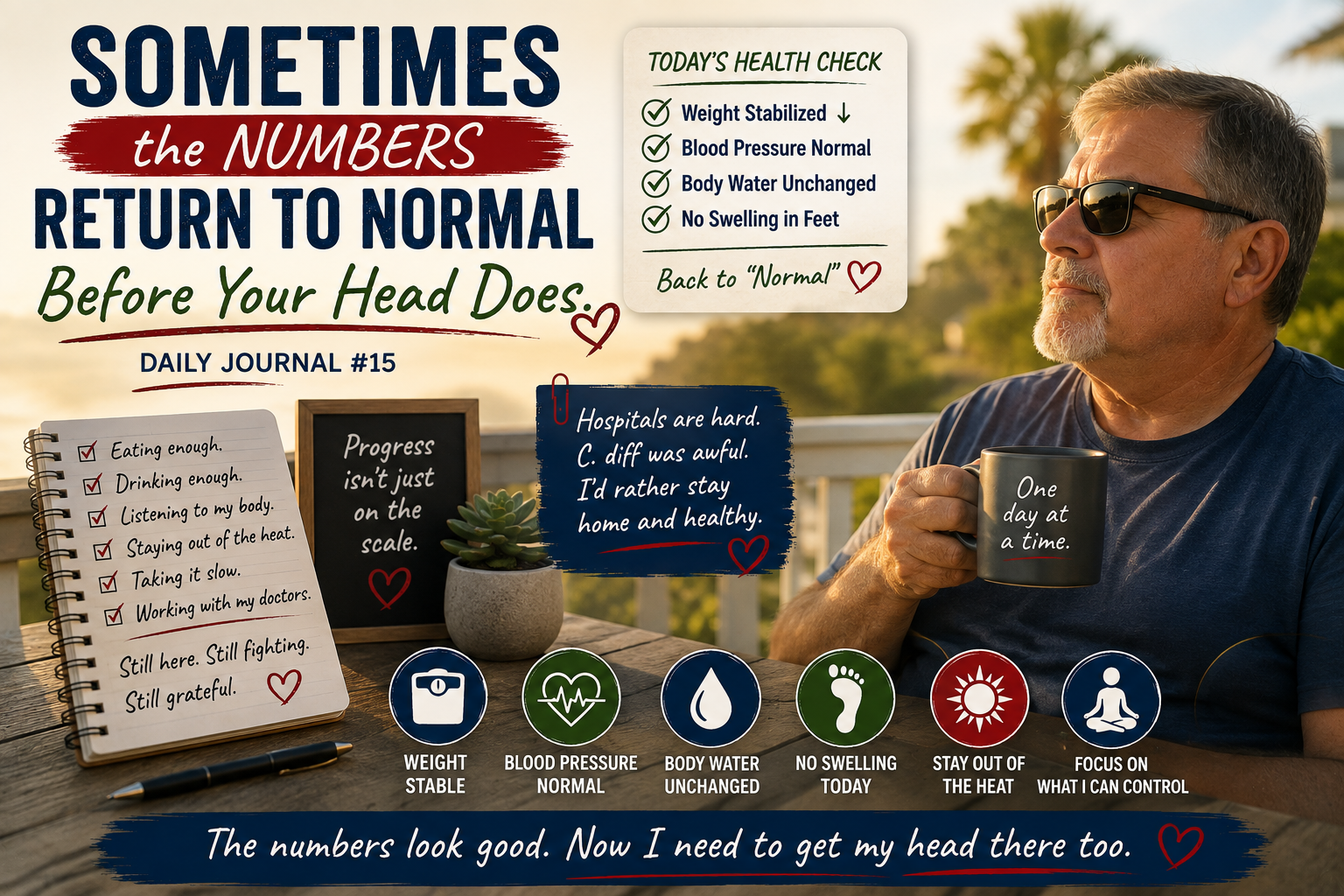
My morning health checks are continuing to trend in the right direction.
Finally.
My weight has stabilized and I’ve even lost a little more. I’m still working toward my goal of 225 pounds by April 2027, so I’ll happily take a loss when it’s the kind I’m actually trying to achieve.
My blood pressure was normal this morning.
My body-water percentage was unchanged from yesterday.
And maybe most importantly after what I’ve been watching over the last few days:
No swelling in my feet today.
Weight stable.
Blood pressure good.
Body water stable.
No swelling.
All of those signs tell me that I’m pretty much back to my version of “normal.”
Physically, that’s great news.
Mentally?
That’s a little more complicated.
Now I Have to Convince Myself It’s Okay to Eat and Drink
After watching my weight climb and seeing the swelling in my feet, I became extremely cautious about what I was eating and drinking.
Maybe too cautious.
Truth be told, I didn’t eat or drink normally yesterday.
I drank because I know my kidneys need hydration.
I ate because I know I need enough food to keep my blood sugar from dropping.
But I can’t say I was comfortable doing either one.
That’s something I’m still working on.
Logically, I understand that my body needs food and fluid.
Emotionally, there’s another voice saying:
Remember what happens when this goes wrong.
Because the thing I really want to avoid is another hospitalization.
I Really Hate Hospitals
I don’t just dislike being hospitalized.
I hate it.
It’s incredibly difficult for me to stay positive when I’m in the hospital.
Part of that is everything that comes with being sick enough to be there in the first place.
But there’s something else.
I’m kind of a germ freak.
Okay…
I’m definitely a germ freak.
I practiced social distancing before COVID made it fashionable.
When I was working, I’d walk around with Lysol wipes cleaning things.
Door knobs.
Conference tables.
Chairs.
Elevator buttons.
Handrails.
Basically, if another human being had touched it, there was a decent chance I was coming behind them with a disinfecting wipe.
A little insane?
Probably.
But I rarely got sick.
So you can probably imagine how I feel about hospitals.
They’re full of sick people.
There are germs everywhere.
There are diseases I didn’t even know existed until somebody put me in a room next to one.
That part of being hospitalized genuinely freaks me out.
And unfortunately, I have a pretty good reason for feeling that way.
Then There Was C. Diff
After one of my hospital stays, I ended up back home only to develop C. diff shortly afterward.
At that point in my life, I was barely leaving the house because of everything else going on with my health.
Where exactly I picked it up isn’t something I can prove, but the timing certainly made that hospital stay stand out in my mind.
If you’ve never experienced C. diff…
Consider yourself lucky.
It was awful.
It even threatened to interfere with the timing of my heart procedure.
At the time, there was absolutely nothing funny about it.
Now?
Well…
Enough time has passed that I can find some humor in the experience.
That might eventually become a Living With It article.
Although I’m not entirely sure the internet is ready for that one.
So Yeah, I’m Afraid of Going Back
All of that helps explain why a couple pounds of weight gain and some swelling can mess with my head.
It’s not simply:
Oh, my weight went up.
My brain immediately starts working its way down the road:
Weight gain.
Fluid retention.
Heart failure.
Diuretics.
Is it getting worse?
Do I need to call somebody?
Am I going back to the hospital?
That’s what I’m trying to get better at managing.
My morning health checks are supposed to give me information.
They’re supposed to help me make informed decisions and recognize trends.
I don’t want them to become something that makes me afraid to eat.
There’s a balance there that I haven’t completely figured out yet.
Meanwhile, Welcome to August in Southwest Florida
Life itself has been pretty boring lately.
It’s August in Southwest Florida.
Which basically means:
It’s hot.
Really hot.
And I’ve been trying to stay out of it.
I’ve had several episodes recently where I’ve become extremely lightheaded and started sweating profusely, particularly with exertion and heat.
One of them happened while I was simply cooking on the grill.
I wasn’t running a marathon.
I wasn’t doing yard work.
I was making dinner.
Suddenly, I became so lightheaded that I genuinely thought I might face-plant.
When that happens, I’m done.
I sit down.
I cool off.
And it can take about 20 minutes before I start feeling normal again.
That’s something I’m already working with my doctors to understand.
Until we have better answers, I’m not going to prove how tough I am by standing outside in the Florida heat.
The grill will survive without me.
❤️ Greg’s Take
Physically, today was a good morning.
Actually, it was probably exactly what I wanted to see.
My weight has stabilized.
My blood pressure looks good.
My body-water percentage isn’t climbing.
And the swelling in my feet is gone.
That’s a win.
Now I have to work on the other part.
Trusting my body enough to eat.
Trusting myself enough to drink what I’m supposed to drink.
And using my morning health checks as information rather than letting every change scare me into thinking I’m headed back to the hospital.
That’s easier said than done.
I’ve had enough hospital stays that avoiding another one has become a pretty powerful motivator.
Sometimes maybe too powerful.
But that’s part of living with all of this too.
Not every recovery happens on a scale.
Sometimes the numbers return to normal before your head does.
Today, my numbers look pretty good.
Now I need to work on catching up with them.
Medical Disclaimer
This daily journal describes my personal experiences managing chronic health conditions and is not medical advice. My monitoring routine, diet, fluid intake and medications are based on guidance from my own healthcare team. Everyone’s medical needs are different. If you have heart failure, kidney disease, diabetes or another chronic condition, talk with your healthcare team about appropriate fluid, nutrition, weight and symptom-monitoring goals for you.
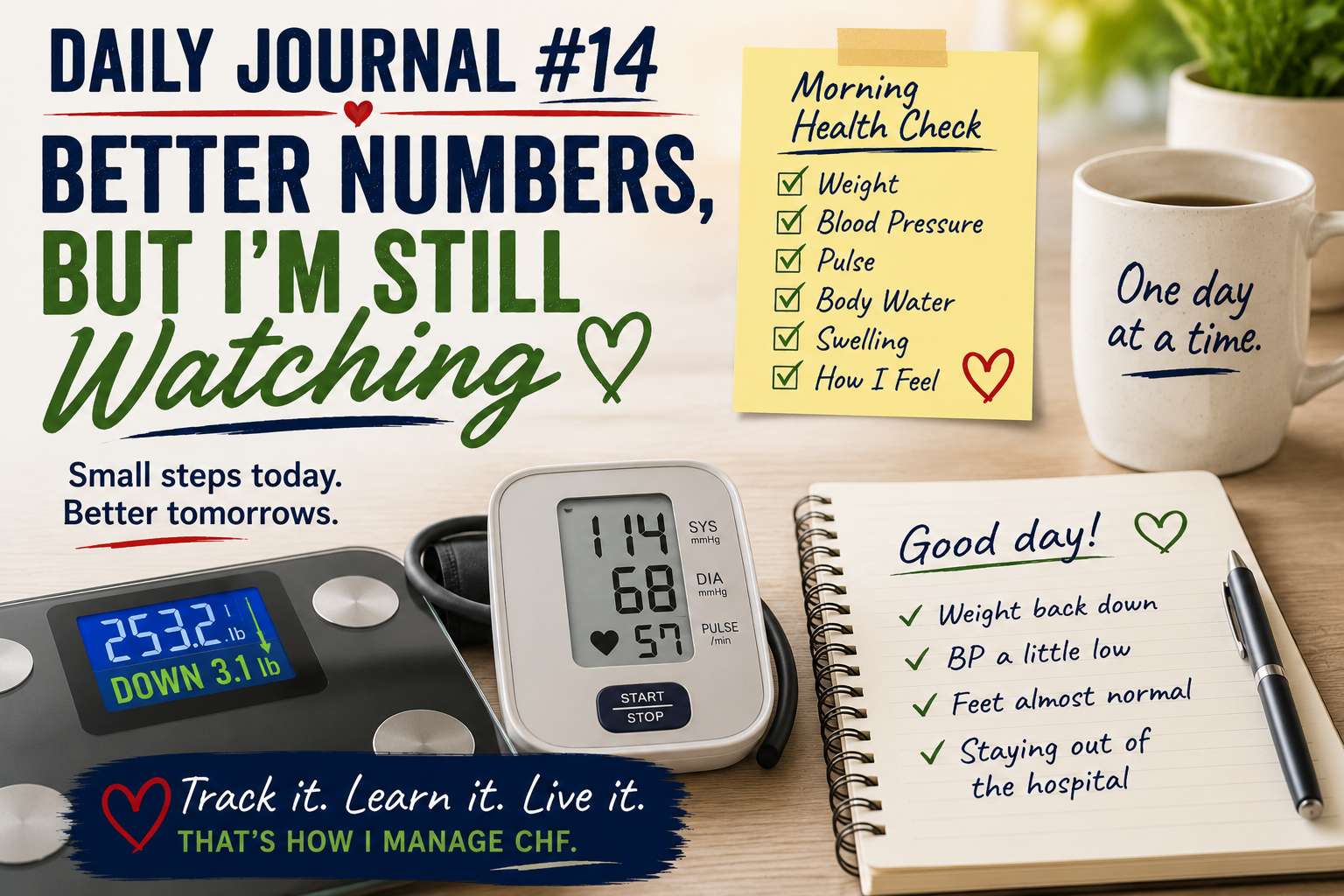
My morning health checks were much better today than they were the previous two days.
And I’m definitely happy to see that.
I dropped a little over three pounds since yesterday, bringing my weight back down to about where it should be. Considering the weight gain, increased body water and swelling I was seeing over the last couple of days, it certainly looks like I had been retaining fluid.
My blood pressure was also lower this morning at 114/68 with a pulse of 57.
That’s lower than yesterday, but not something I’m particularly concerned about based on how I’m feeling. It’s simply another number I’m going to continue watching.
My feet also look almost normal again.
I think there’s still a little swelling because they feel somewhat stiff, but there’s a noticeable improvement. Yesterday, they actually hurt.
Today is definitely a better day.
This Is Why I Do Morning Health Checks
Days like today reinforce why I’ve become so committed to doing these checks every morning.
It can seem like a hassle.
Get on the scale.
Check my blood pressure and pulse.
Look at the body-water reading from my BIA scale.
Check my feet and legs for swelling.
Pay attention to how I’m feeling.
Record everything.
Then do it all over again tomorrow.
But there’s a reason I do it.
I’m trying to catch changes early rather than waiting until I’m sick enough to end up back in the hospital.
Yesterday, several things were moving in the wrong direction at the same time.
My weight was up for the second consecutive day. My BIA scale showed increased body water. My blood pressure was a little higher, and I could see swelling in my feet.
Today, most of those things are moving back toward normal.
That’s exactly the kind of trend I’m looking for.
A Good Day Doesn’t Mean I Stop Monitoring
It would be easy to look at today’s three-pound drop and think:
Great. Problem solved.
Not quite.
My feet still appear to be slightly swollen.
And more importantly, I still don’t know exactly what caused the fluid retention in the first place.
Was it too much sodium?
Was there more sodium in the shrimp I ate than I realized?
Did the fruit I ate add enough additional fluid to make a difference?
Was it a combination of several small things?
Or is something happening with my heart that has absolutely nothing to do with anything I ate or drank?
I don’t know.
And that’s exactly why I can’t stop monitoring just because today’s numbers look better.
Sometimes There Isn’t an Obvious Answer
I think that’s one of the frustrating parts of managing a chronic illness.
I want there to be a simple cause and effect.
I did X, so Y happened.
Unfortunately, the body doesn’t always cooperate with that logic.
I can retrace everything I ate.
I can look at how much I drank.
I can check nutrition labels.
I can look at my activity.
And sometimes I still won’t have a definite answer.
What I can do is continue collecting information.
If something starts changing again tomorrow, I’ll know.
If my weight continues downward and the swelling disappears, I’ll know that too.
The individual number matters.
The trend matters even more.
The Goal Is Staying Out of the Hospital
I’ve spent enough time in hospitals.
If taking a few minutes every morning to check my weight, blood pressure, pulse, body water and swelling gives me a better chance of catching a problem early, those few minutes are absolutely worth it.
Are morning health checks sometimes annoying?
Yep.
Would I occasionally rather just grab a cup of coffee and forget about all of it?
Absolutely.
But I also know the alternative.
A few minutes checking numbers at home sounds a whole lot better than spending several days checking the ceiling from a hospital bed.
So tomorrow morning I’ll do it all again.
Even though today’s numbers were better.
Especially because today’s numbers were better.
I want to know they stay that way.
❤️ Greg’s Take
Yesterday was a little concerning.
Today was encouraging.
But neither day tells the entire story by itself.
That’s what I’m learning from tracking my health every morning.
One bad number doesn’t necessarily mean disaster.
And one good number doesn’t necessarily mean everything is fixed.
It’s the pattern I’m watching.
Today, I’m more comfortable knowing my weight has come back down, my feet look considerably better and most of the signs I was watching are moving in the right direction.
I’ll take that win.
But tomorrow morning, I’ll still step on that scale.
I’ll still check my blood pressure.
I’ll still look at my feet.
And I’ll still write everything down.
Because as much of a pain as this routine can sometimes be, I know which is worse:
Five minutes of morning health checks or another few days in the hospital.
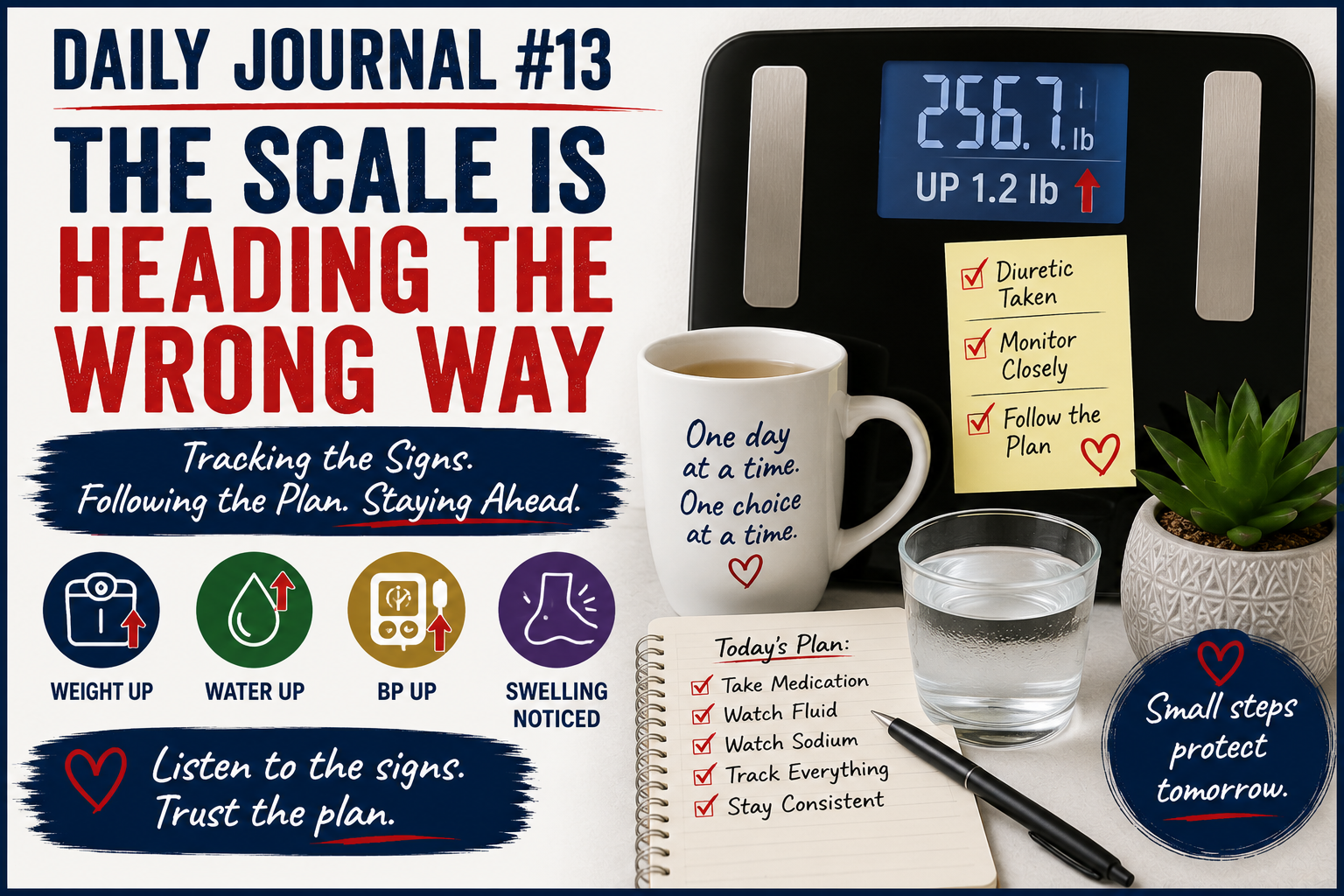
Well, my morning health checks are continuing to move in the wrong direction.
I gained more than a pound again this morning. That’s now two days in a row with a gain of more than a pound.
This time, there were some other signs along with it.
My BIA scale showed an increase in body water. My blood pressure was slightly elevated, and when I looked at my feet, I could see some mild swelling.
One number by itself might not concern me much.
Several things pointing in the same direction get my attention.
It looks like I’m retaining fluid.
First Things First
The first thing I did was follow the plan my cardiologist has given me and take my prescribed diuretic.
Anyone who has dealt with heart failure and diuretics probably knows what that means.
A good portion of today’s schedule will revolve around knowing exactly where the nearest bathroom is.
Not particularly exciting, but that’s part of managing this.
Now I watch what happens.
Does the swelling decrease?
Does my weight start moving back down?
Does the extra water come off?
Tomorrow morning’s numbers will be especially interesting.
Now Comes the Detective Work
The next thing I do when this happens is start retracing my steps.
What changed?
Did I drink too much?
I don’t think so. I didn’t have any extra water yesterday. I did have a couple of peaches, which obviously contain water, but I don’t think that alone explains what I’m seeing.
Then I started thinking about dinner from a couple of nights ago.
The steak and shrimp rice bowls.
They were one of my favorite meals, and I’ll admit it:
I overindulged.
The meal itself wasn’t necessarily the problem. We make it at home, so I have a pretty good idea of what’s going into the steak, rice, vegetables and seasonings.
The question mark is the shrimp.
Shrimp Can Be Tricky
Shrimp naturally contains some sodium, but packaged shrimp can contain considerably more depending on how it was processed.
Unfortunately, we already threw away the package.
So I can’t go back and check the label.
That’s frustrating because I’d really like to know exactly what I ate.
Maybe we bought a different shrimp than usual. Maybe it contained more sodium from processing or packaging. Maybe the larger portion I ate was enough to push me over the edge.
Or maybe it wasn’t the shrimp at all.
I don’t know.
That’s important for me to say because it’s very easy to see the scale move and immediately blame the last suspicious thing I ate.
All I can do is look at the information I have and try to identify the most likely explanation.
Maybe Fresh Shrimp Is the Better Answer
One thing I’m considering going forward is buying more of our shrimp fresh from a seafood market.
Living in Southwest Florida, we’re certainly not lacking seafood markets.
That would give me another option when I’m trying to avoid some of the sodium that can be added during processing.
But even then, I’ll still need to ask questions and pay attention to what I’m buying. “Fresh” doesn’t automatically tell me everything about how seafood was handled before it reached the counter.
That’s one lesson I keep learning:
Never assume. Ask. Read. Check.
Sodium Doesn’t Always Give Me an Immediate Warning
This is one of the frustrating parts of tracking everything.
I don’t necessarily eat something salty at dinner and wake up the next morning several pounds heavier.
Sometimes the pattern takes longer to become apparent.
That’s why looking at trends has become more useful to me than reacting to one isolated number.
Yesterday I was up.
Today I’m up again.
Now I’m also seeing increased body water on the scale and some swelling in my feet.
That’s a trend worth paying attention to.
I’m Watching — Not Panicking
I’m still nowhere near the point where I think I need to head to the hospital.
But I’m also not ignoring what’s happening.
I’ve followed the medication plan my cardiologist gave me, and now I’ll monitor things more closely.
That’s really what all of this daily tracking is about.
It’s not about panicking every time the scale moves.
It’s about noticing when several things start changing together and knowing when I need to pay closer attention.
Hopefully, the diuretic does what it’s supposed to do today.
Hopefully, the swelling improves.
And hopefully tomorrow morning I step on the scale and finally see that number traveling in the other direction.
❤️ Greg’s Take
This is exactly why I do morning health checks every day.
Yesterday’s weight gain was something to watch.
Today’s second consecutive gain, increased body water, slightly swollen feet and higher blood pressure gave me more information.
Now I can respond according to the plan my cardiologist has already given me instead of waiting until things get significantly worse.
I may never know whether those delicious steak and shrimp rice bowls were responsible.
But I learned something anyway.
Next time, don’t throw away the shrimp package until after I’ve survived the meal.
And maybe don’t eat quite so much of it either.
That second lesson may be the harder one.
Medical Disclaimer: This journal reflects my personal experience living with chronic illness and how I manage my health based on guidance from my own healthcare team. It is not medical advice. Medications, including diuretics, should only be taken as prescribed by your healthcare provider. If you notice changes in your weight, swelling, blood pressure, breathing, or other symptoms, contact your healthcare provider for guidance. Seek immediate medical attention for symptoms that may be an emergency.
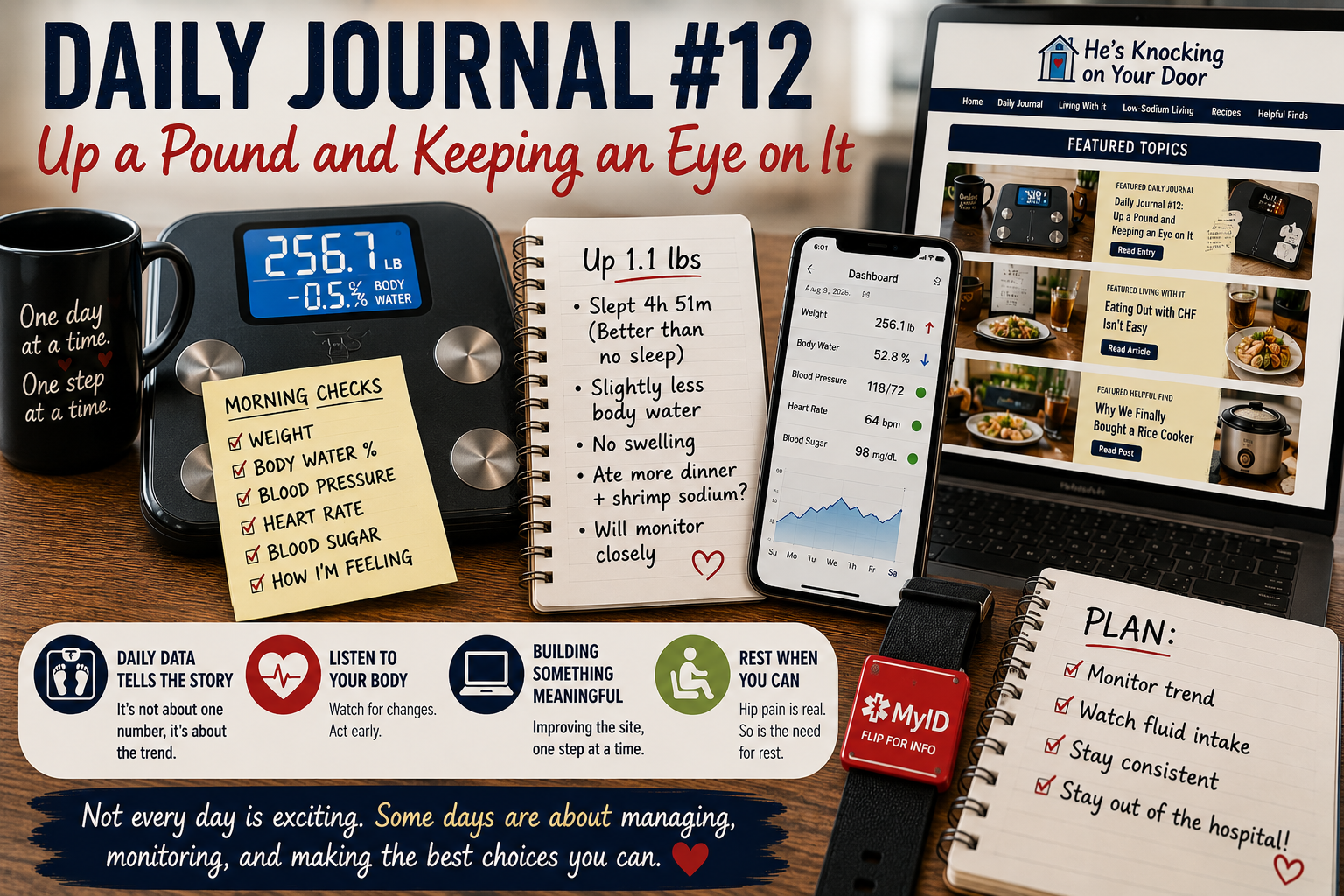
I woke up around 2:30 this morning. I’m still having trouble sleeping, but according to my Apple Watch, I managed 4 hours and 51 minutes.
Is that great? No.
But it’s better than no sleep, so I’ll take that win.
Something Different on the Scale
While doing my morning health checks, I noticed that my weight was up 1.1 pounds from yesterday.
That’s a little unusual for me, so naturally I started trying to figure out why.
My BIA scale actually showed my body-water percentage was about half a percent lower than yesterday. I’m also not noticing any swelling in my feet or legs.
Then I started going through the other possibilities.
The shirt I was wearing this morning was made from a heavier material than the one I wore yesterday. Could that account for some of the difference? Sure. But I seriously doubt my shirt weighs an extra pound.
I’m not constipated, so that probably isn’t contributing much either.
Then there’s dinner.
A couple of nights ago, we made those steak and shrimp rice bowls I mentioned in my last journal entry. They were so good that I ate more than I normally do. The shrimp we used also had some added sodium from processing.
Could the extra food, sodium and possibly a little fluid retention be contributing to what I’m seeing on the scale?
Maybe.
The truth is, I don’t know yet.
And that’s where I’ve learned not to overreact to a single number.
Watch the Trend
A 1.1-pound increase by itself isn’t setting off alarm bells for me. It’s simply something I’m going to pay attention to.
That’s one of the reasons I track this information every morning. One number gives me a snapshot. Several days of numbers give me a trend.
I’ll keep watching my weight, body-water reading, blood pressure and how I’m feeling over the next few days.
If the weight keeps climbing or I notice other changes, that’s information I can act on and share with my doctors.
For now, I’m monitoring it.
The last thing I want is another trip to the hospital.
Some Changes Around the Website
I also spent some time working on He’s Knocking on Your Door yesterday.
I’ve added featured content to the front page, so now you can see highlights from the Daily Journal, Living With It articles, and Helpful Finds without having to click around the site looking for something new.
I also decided to start adding featured images to these Daily Journal entries.
They were getting a little boring without something visual. Besides, some of the images are giving me an opportunity to have a little fun with what’s happening that day.
Yesterday’s Windex image might be difficult to top.
Otherwise, a Pretty Boring Day
Other than that, there isn’t a whole lot to report.
My hip still hurts—a lot.
One of the frustrating parts is simply trying to find a comfortable position. Sitting in a regular chair for any length of time can be difficult, which limits how much time I can spend working at a computer.
I can accomplish quite a bit from my phone or iPad, but there’s only so much I want to type or design on a smaller screen.
So today may be another relatively quiet day.
A little website work.
Keep an eye on the scale.
Deal with the hip.
And hopefully get a little more sleep tonight.
Not every day needs to be exciting. Sometimes a boring day is perfectly fine.
My morning health checks were good today, which honestly surprised me a little.
I ate more than I normally do yesterday.
But dinner was really good.
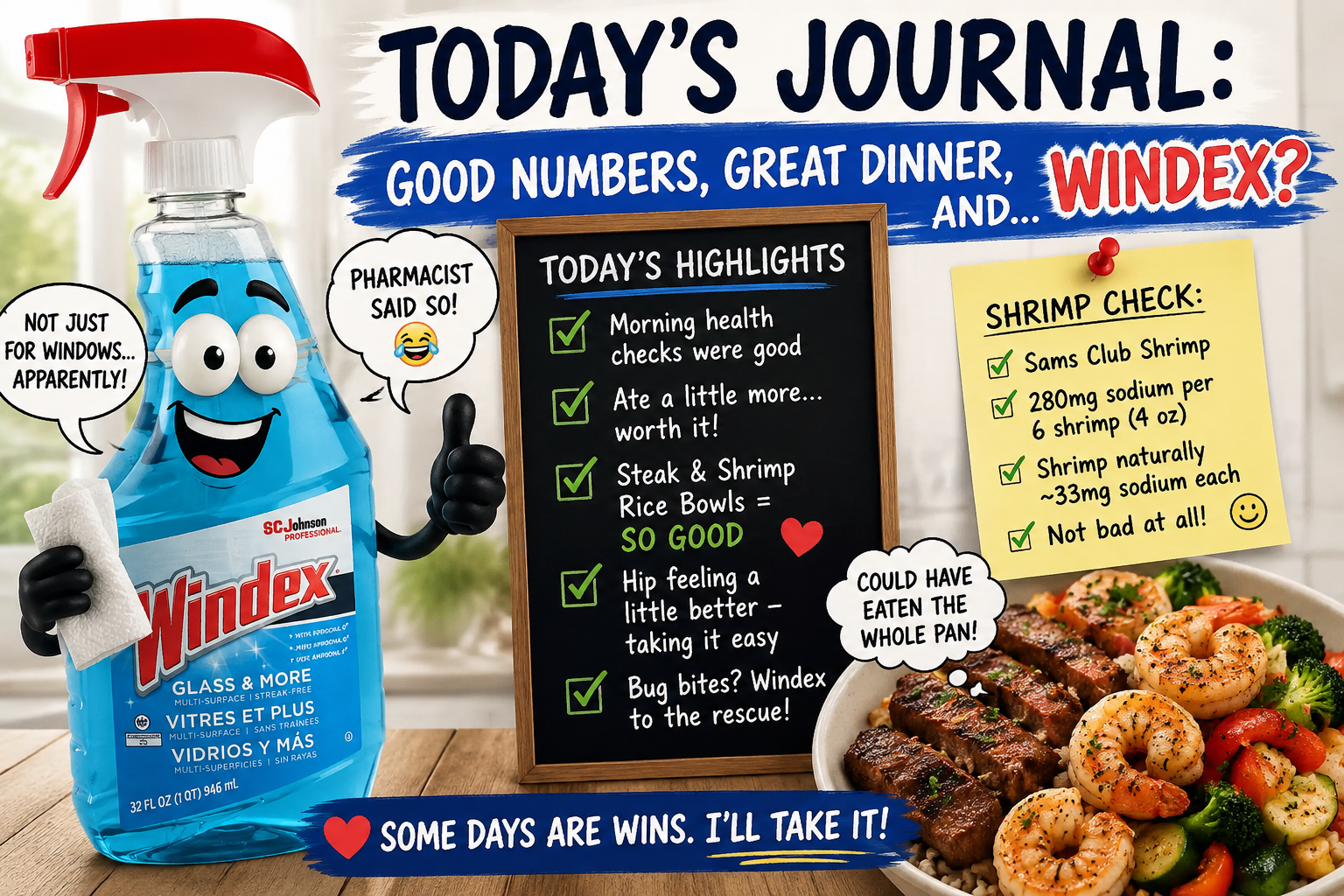
We made one of my favorite meals: steak and shrimp rice bowls. I probably could have eaten the entire pan if I had let myself.
I’ll be posting my version of the recipe soon because it’s another meal we’ve been able to adapt to fit my low-sodium lifestyle.
The steak, seasoning, rice, and vegetables are all pretty easy for me to control.
The shrimp is where I have to pay attention.
Not All Shrimp Is the Same
One thing I’ve learned since watching sodium so closely is that shrimp can be tricky.
Shrimp naturally contains sodium, but some frozen shrimp can have additional sodium from the way it is processed or packaged. That means I’ve learned to check the nutrition label instead of assuming one bag of shrimp is the same as another.
The label showed 280 mg of sodium per 4-ounce serving, which was about six shrimp.
Shrimp already contains naturally occurring sodium, so not all of that 280 mg is necessarily coming from processing. That’s another reason I’ve learned that the nutrition label matters more to me than trying to estimate exactly where every milligram came from.
It’s something I’ll talk more about when I post the steak and shrimp rice bowl recipe.
And yes, I promise I’ll try not to eat the whole pan next time.
The Hip Is a Little Better
My leg and hip are feeling a little better today.
They’re certainly not back to normal, but I’ll take any improvement I can get.
After the last few days of pretty intense pain, I’m going to make today another take-it-easy day and hopefully let things continue to settle down.
Sometimes knowing when not to push myself is just as important as getting up and moving.
And Then There’s the Windex…
The bug bites are also feeling much better.
And this is where today’s journal gets a little strange.
We stopped at CVS and asked the pharmacist what I could do about the itching.
The suggestion?
Put some Windex on a paper towel and dab it on the bites.
Yep.
Windex.
My first thought was pretty much:
“You’ve got to be kidding me.”
I honestly wondered whether everyone behind the pharmacy counter was laughing their butts off after we walked away.
But I tried it.
And I’ll be damned…
It helped.
I’m certainly not turning He’s Knocking on Your Door into a Windex medical-advice website—and I’m not recommending anyone else try it—but I have to admit that my itching improved.
Sometimes life with chronic illness is about tracking weight, blood pressure, sodium, medications, and symptoms.
And apparently, sometimes it’s about leaving CVS wondering how Windex just became part of the day’s story.
❤️ Today’s Reflection
Good health numbers this morning.
A little less hip pain.
Bug bites that finally aren’t driving me crazy.
And a fantastic dinner last night that reminded me that eating low sodium doesn’t mean giving up good food.
I’ll take those as wins.
Today I’m going to take it easy, enjoy feeling a little better, and start thinking about getting that steak and shrimp rice bowl recipe onto the site.
The Five Minutes Every Morning That Help Me Stay Ahead of My CHF
Living with congestive heart failure has taught me something important.
Your body is constantly giving you information.
The question is whether you’re paying attention.
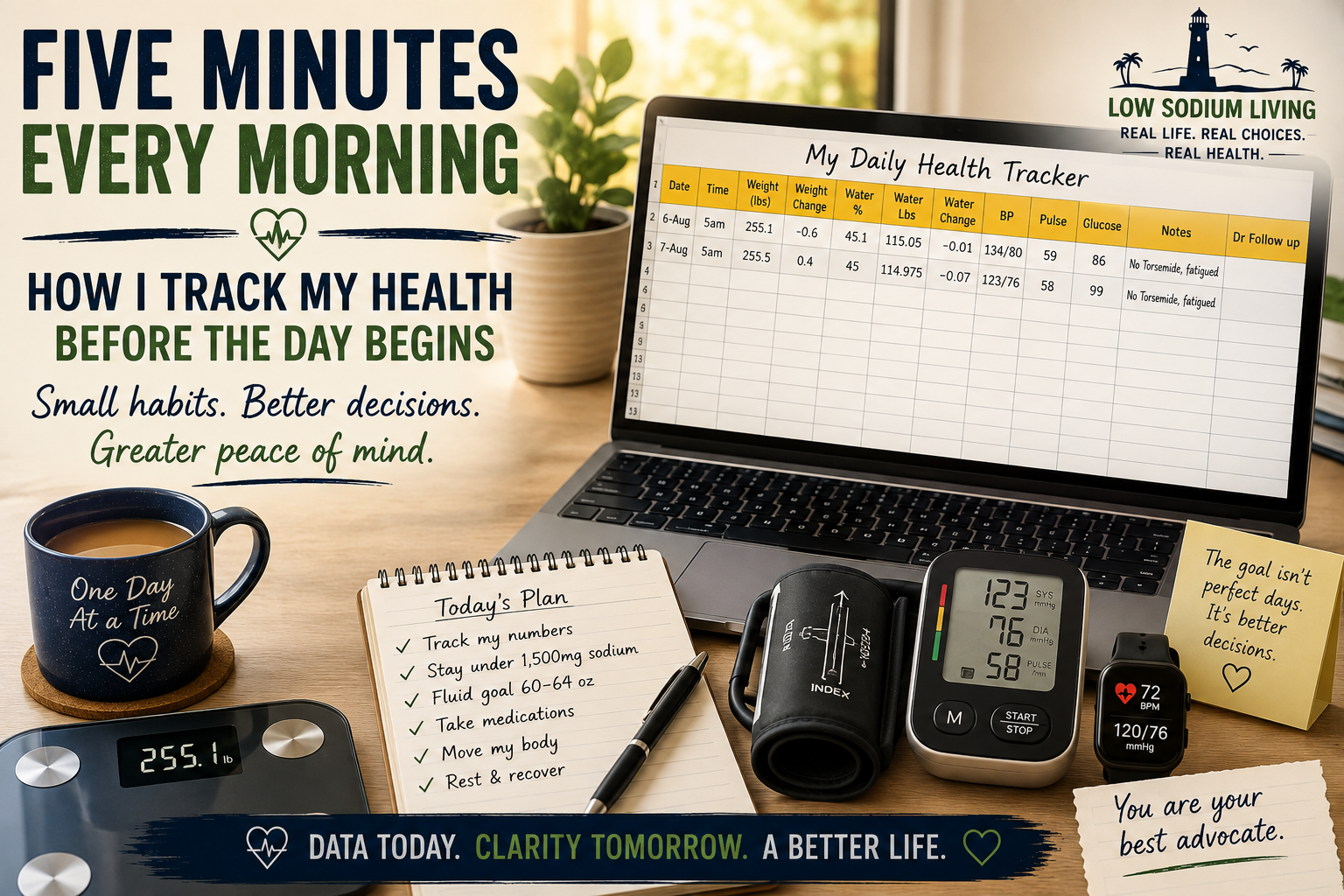
Every morning, before I drink my morning water or begin my day, I spend about five minutes checking in with my body.
To some people, it probably looks like I’m filling out a simple spreadsheet.
To me, it’s much more than that.
It’s an early warning system.
Over time, I’ve learned that it’s much easier to recognize a problem before it becomes serious than it is to recover after the problem has already happened.
That’s why I track my health every single morning.
Not because my doctors told me to.
Because it helps me understand my own body.
One of the most important lessons I’ve learned while living with chronic illness is this:
Nobody will ever know your body as well as you do.
The more information I collect, the better conversations I have with my doctors, and the more confident I feel when something doesn’t seem right.
Download My Daily Health Tracker
If you’d like to use the same spreadsheet I use every morning, I’ve made an example version available for you to download.
Feel free to customize it for your own health conditions. What I track may not be exactly what you need, but hopefully it gives you a good starting point for building your own daily routine.
What I Track Every Morning
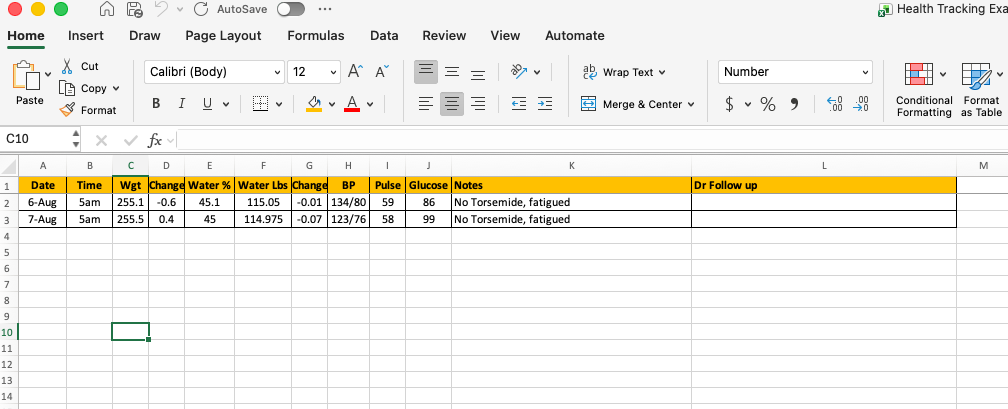
Below is a screenshot of the actual spreadsheet I use every day.
It isn’t complicated.
In fact, that’s intentional.
The easier something is to use, the more likely you’ll continue using it.
Each column serves a purpose, and together they give me a quick snapshot of how my body is doing each morning.
📅 Date
The first column simply records the date.
It sounds obvious, but dates become incredibly important when you’re looking for trends over several days, weeks, or even months.
Sometimes a doctor will ask,
“When did this start?”
Instead of guessing, I simply look back at my spreadsheet.
🕒 Time
I try to record my information at approximately the same time every morning.
For me, that’s usually around 5:00 AM, after using the restroom but before eating breakfast.
Keeping everything consistent makes it easier to compare one day to the next.
⚖️ Weight
Weight is probably the most important number I track.
For someone living with congestive heart failure, sudden weight gain often isn’t body fat.
It’s fluid.
That’s why I weigh myself every morning under the same conditions. After using the washroom and wearing the same type of clothes.
A sudden increase can be one of the earliest signs that my body is retaining fluid.
📈 Daily Weight Change
The next column calculates the difference between today’s weight and yesterday’s.
I’m watching for one thing in particular.
Have I gained 2–3 pounds overnight or about 5 pounds in a week?
Those numbers can be an early warning sign of fluid retention and may indicate that it’s time to contact my healthcare provider.
Instead of trying to remember yesterday’s weight, Excel does the math for me automatically.
💧 Water Percentage
My scale also estimates my body water percentage.
While I know this isn’t a perfect medical measurement, I still find it useful.
The spreadsheet uses that percentage to estimate approximately how many pounds of my body weight are water.
For something that only takes about five minutes each morning…
I’d say that’s time well spent.
⚠️ A Note About Pacemakers, ICDs, and Implantable Devices
If you have a pacemaker, ICD (implantable cardioverter-defibrillator), CRT device, or other implanted cardiac device, some consumer smart scales that measure body composition use a small electrical current (bioelectrical impedance analysis, or BIA) to estimate body fat, muscle mass, and body water.
Before using these features, follow the manufacturer’s safety instructions for your specific scale and ask your cardiologist or electrophysiologist if they’re appropriate for you.
If your healthcare team recommends avoiding these measurements, you can still use this tracker by recording your weight and the other health information without using the body composition features.
Medical Disclaimer
This spreadsheet is intended as a personal tracking tool only. It should never replace the advice of your healthcare providers or be used to make medication changes without their guidance.
The information in this article reflects my personal experience living with chronic illnesses, including congestive heart failure, atrial fibrillation, chronic kidney disease, and diabetes. It is shared for educational purposes only and is not medical advice.
Always follow the recommendations of your own healthcare providers regarding medications, diet, fluid restrictions, and health monitoring. If you notice sudden weight gain, worsening shortness of breath, chest pain, fainting, or any other concerning symptoms, contact your healthcare provider or seek emergency medical care as appropriate.