Tag: CHF

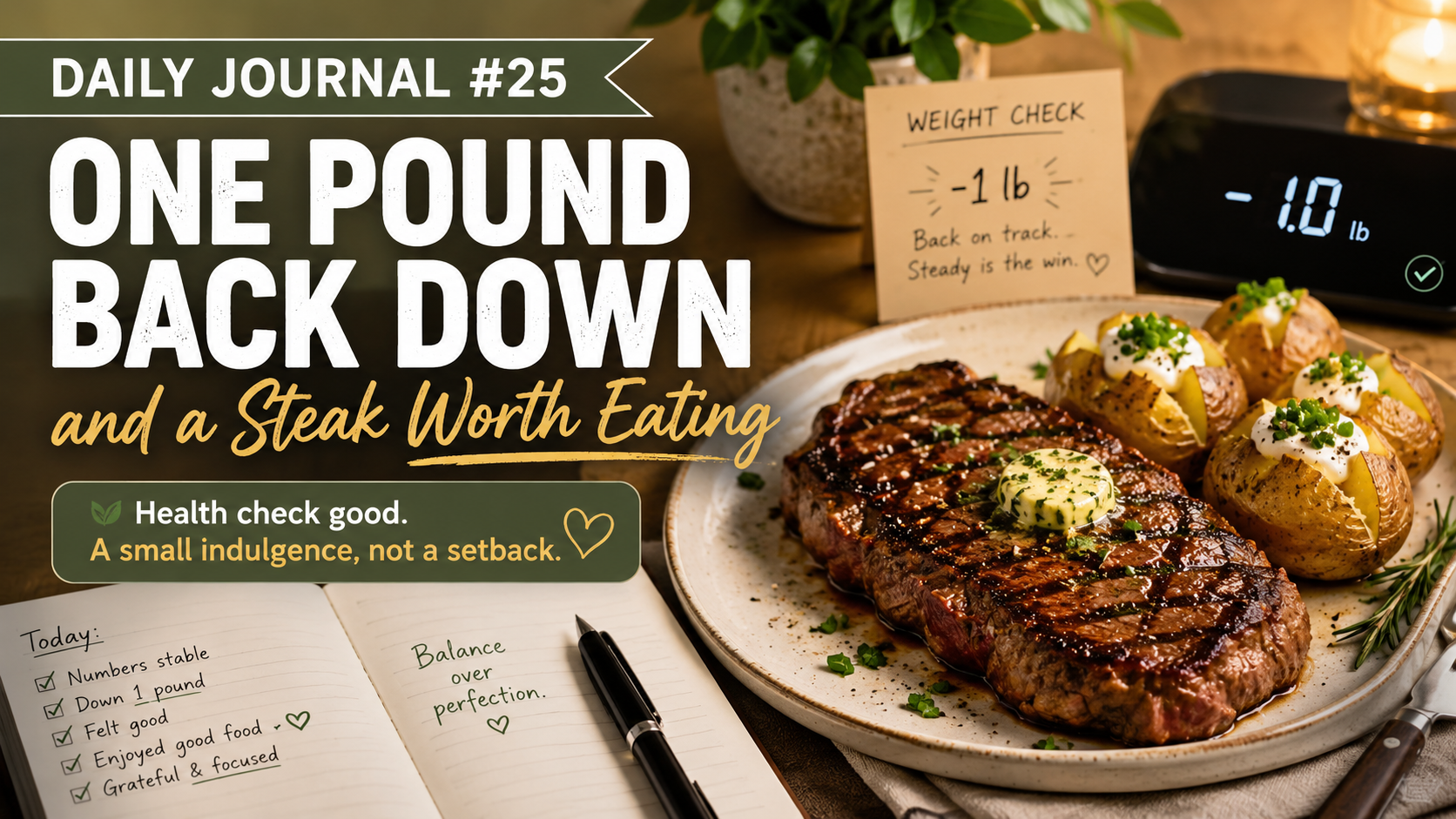
  • Daily Journal #25 — One Pound Back Down and a Steak Worth Eating

    Daily Journal #25 — One Pound Back Down and a Steak Worth Eating

    Not much going on today.

    My morning health check was good.

    Everything looked pretty normal, and I lost one of the two pounds I had put on over the last couple of days.

    At this point, I’m pretty convinced the extra weight wasn’t fluid.

    I think I just ate more than I normally do.

    Sometimes the simplest explanation really is the right one.

    The Steak Was Worth It

    The day before, we had steak and mini baked potatoes for dinner.

    We really don’t buy beef very often anymore.

    But we picked some up the other day, cooked it on the grill, and it was really good.

    I didn’t go crazy.

    It wasn’t like I ate some giant restaurant meal.

    I just ate a little more than I normally would for dinner.

    And apparently my body noticed.

    When you follow a pretty strict routine every day, even a small change stands out quickly.

    That is one of the strange benefits of tracking everything so closely.

    If my weight changes, I usually have a pretty good idea of what may have caused it.

    Sometimes You Have to Deviate

    I think every once in a while, you have to allow yourself to deviate a little.

    Not throw the whole plan away.

    Do not ignore sodium.

    Not stop paying attention.

    Just enjoy something different.

    For me, that meant having a steak.

    And honestly?

    It was worth it.

    Living with chronic illness already comes with enough restrictions.

    If I can make a reasonable choice, stay within the limits my medical team has given me, and enjoy something I don’t normally eat, I think that matters too.

    I’m not trying to be perfect.

    I’m trying to be consistent.

    There is a difference.

    The Scale Tells the Story

    The nice part is that one of those pounds is already gone again.

    My other health numbers still look good, so I’m not seeing anything that makes me think this was fluid retention.

    It looks more like a little extra food, maybe a little more sitting in my system than usual, and then things starting to settle back down.

    That’s exactly why I don’t want to panic over every single movement on the scale.

    The trend matters more than one number.

    And right now, the trend still looks fine.

    So today’s lesson is pretty simple.

    Sometimes you eat the steak.

    Sometimes the scale notices.

    And sometimes that is completely okay.

    Medical Disclaimer

    This journal reflects my personal experience managing weight, diet, sodium intake, and chronic health conditions under the guidance of my healthcare team. Nothing in this article should be considered medical or nutritional advice. Weight changes can happen for many reasons, including food intake, fluid shifts, medications, and medical conditions. If you have heart failure, kidney disease, high blood pressure, or another condition that requires dietary or fluid restrictions, follow the plan provided by your own qualified healthcare professionals and discuss unexpected or persistent weight changes with them.

  • Daily Journal #23 — Good Numbers, Less Anxiety, and a Better Day at the Beach

    Daily Journal #23 — Good Numbers, Less Anxiety, and a Better Day at the Beach

    This morning’s health checks were good.

    My blood pressure was good.

    My pulse was good.

    My weight was up 1.1 pounds, but I’m not particularly concerned about it right now.

    My body-water reading was basically the same as yesterday, which makes me think this probably isn’t fluid.

    There are a couple of pretty ordinary explanations.

    I was wearing a heavier shirt this morning than I was yesterday, and I definitely ate more for dinner last night than I normally do.

    I had a pretty good-sized salad and some of our low-sodium Mexican casserole.

    It’s kind of like beans and rice with chicken, and it is really good.

    And really filling.

    I’ll probably post that recipe in the next few days.

    So for now, I’m just going to monitor the weight and see what tomorrow looks like.

    One pound by itself doesn’t have me worried.

    Feeling Better After the Nephrologist

    I also feel better mentally today after meeting with my nephrologist.

    The appointment was very encouraging.

    Everything he told me was positive, including his explanation that the upcoming kidney MRI is really there to get a closer, more detailed look at what they already saw on the ultrasound.

    He didn’t seem overly concerned.

    That helped.

    It’s funny how much your mind can wander when you are waiting for medical tests.

    You start with one unanswered question.

    Then your brain creates ten more.

    Then twenty.

    Before long, you are mentally diagnosing yourself with every possible outcome.

    Anxiety can really take over if you let it.

    I’m still anxious about the MRI, but I’m feeling much better about it than I was a few days ago.

    Chronic Illness Doesn’t Only Affect You

    Something else I’ve been thinking about lately is how chronic illness doesn’t only affect the person who has it.

    Your family lives with it too.

    In my case, my wife has been incredibly patient with me.

    Because of my sodium and fluid restrictions, we haven’t been out to eat in quite some time.

    That used to be something we really enjoyed.

    We moved to an area with new restaurants, new foods, and tons of fresh seafood.

    Going out and trying new places was supposed to be part of living here.

    Then life changed.

    Over the last year and a half, there have been surgeries, hospital stays, tests, labs, doctors, medications, restrictions, good days, and bad days.

    And no, it isn’t over.

    Not even close.

    But that doesn’t mean we stop living and sit around waiting for whatever comes next.

    We still need to find ways to enjoy ourselves.

    So Today We Went to the Beach

    We decided to go to the beach today.

    We live about 30 minutes from Sanibel Island, which is a beautiful area with great beaches and plenty of shelling for my wife to enjoy.

    I was a little apprehensive about going.

    The last time we went to the beach, it didn’t go very well.

    I had one of my near-passing-out episodes while walking back to the car.

    It was hot.

    I was exhausted.

    The car was only about 500 feet away, but it felt considerably farther than that.

    I had to stop several times just to make it back.

    I eventually got there without passing out, but the experience stuck with me.

    So I was definitely thinking about that today.

    Today Went Better

    Today turned out okay.

    We only stayed for about two hours because it got hot pretty quickly.

    The walk back to the car was still difficult.

    The sand was really soft and fluffy, which makes walking with a walker much harder.

    Even with my homemade sand shoes.

    Yep.

    I made sand shoes for my walker on my 3D printer.

    A cane sinks right into soft sand.

    Walker legs do too.

    So I designed pieces that fit over the existing walker legs and give them a much larger footprint.

    They actually work pretty well.

    They don’t magically turn walking through beach sand into something easy, but they definitely help.

    The photo above is my walker sitting on the beach with the sand shoes attached.

    Three Stops, But I Made It

    Getting back to the car still took some effort.

    I had to stop about three times along the way.

    I was sweating pretty heavily by the time I got there.

    But there was one very important difference compared with the last trip.

    I never felt like I was going to pass out.

    No tunnel vision.

    No feeling like I was about to collapse.

    Just tired.

    And hot.

    I’ll take that.

    It probably sounds like a very small accomplishment to somebody else.

    We went to the beach for two hours and I walked back to the car.

    Big deal.

    But when your world gets smaller because of chronic illness, sometimes those small things become pretty damn important.

    Today we went to the beach.

    My wife got to do some shelling.

    I got through the walk back to the car.

    And we had something that felt a little closer to a normal day.

    That counts as a win.

    Medical Disclaimer

    This journal reflects my personal experience living with chronic health conditions and following the treatment plan developed specifically for me by my healthcare providers. Nothing in this article should be considered medical advice, diagnosis, or a recommendation to change medications, fluid intake, sodium intake, activity levels, or treatment. Symptoms such as dizziness, near-fainting, excessive sweating, rapid weight changes, swelling, or exercise intolerance can have many causes and may require medical evaluation. Heat can also place additional stress on people with certain medical conditions. Always discuss symptoms, activity limits, hydration, and exercise with your own qualified healthcare professionals.

  • Daily Journal #20 — Three Pounds Down, Missing Labs, and One Test I’m Not Looking Forward To

    Daily Journal #20 — Three Pounds Down, Missing Labs, and One Test I’m Not Looking Forward To

    This morning’s health check is moving in the right direction.

    I’m down three pounds from yesterday, which pretty much confirms what I suspected yesterday — I definitely had some fluid buildup.

    That’s good news.

    My blood pressure was still slightly high, and my pulse was significantly elevated. I’m not really sure why. I had been sitting and resting before I took the reading, so it wasn’t like I had just been walking around or doing anything strenuous.

    I’m still dealing with some anxiety about all of the testing coming up, so maybe that is playing a role. I honestly don’t know.

    For now, I’m watching it.

    Another Near-Passing-Out Episode

    I also had another episode yesterday that got my attention.

    I was getting out of my recliner to go eat dinner when I suddenly became extremely lightheaded. My vision started closing in — that tunnel-vision feeling — and for a moment I really thought I was going to pass out.

    I didn’t.

    Thankfully, this episode passed pretty quickly. Within a few moments, I was feeling better.

    It also felt different from some of the other episodes I’ve had. I wasn’t sweaty this time, and it didn’t linger nearly as long.

    My first thought was that maybe my blood pressure dropped when I stood up too quickly. That would make sense, but that is only my guess. With everything else going on, I’m not going to pretend I know exactly what caused it.

    It is another thing I’ll be mentioning to my medical team.

    These are the kinds of symptoms that make all of the tracking feel worthwhile. If something happens, I can look back at my blood pressure, pulse, weight, medications and everything else instead of trying to remember it later.

    The Blood Work Came Back… Mostly

    I received the results from my blood tests.

    Well, most of them.

    I had something like eight different tests ordered, but somehow the renal blood work wasn’t run.

    Of course.

    That’s probably the test I’m most interested in right now.

    I’m guessing the person who drew my blood somehow missed that order. I have my nephrology appointment on Thursday, so there is a pretty good chance I’ll end up having it drawn after the appointment.

    It’s frustrating because, with everything that has been going on with my kidneys, those are the numbers I really wanted to see.

    But there was another result I had been anxiously waiting for.

    My PSA.

    And thankfully, it was normal.

    One Less Thing to Freak Out About

    Prostate cancer runs in my family, so I was definitely jonesing for that PSA result.

    Between the recent acute kidney injury and the blood I had in my urine, my mind had already gone down every possible road.

    That’s what anxiety does.

    You know there are probably several explanations for something, but your brain immediately starts working its way toward the worst one.

    So seeing a normal PSA was a relief.

    One less thing to worry about.

    I still need additional testing on my bladder, though.

    And there is one procedure in particular that I am not exactly rushing to schedule.

    The Cystoscopy

    Eventually I need to have a cystoscopy.

    A cystoscopy is a procedure where a doctor uses a thin, lighted tube called a cystoscope to look inside the urethra and bladder.

    Yep.

    That means it goes from the outside into the bladder.

    There is really only one route available for that journey.

    Let’s just say I am not terribly excited about it.

    I’m planning to wait until after my hip surgery before dealing with that one.

    Is that partly because I have other medical priorities right now?

    Absolutely.

    Is it also because the procedure sounds like about as much fun as you would imagine?

    Absolutely.

    The Next Few Days

    So now the schedule looks like this:

    Nephrologist on Thursday.

    MRI on Monday.

    Hopefully, between those appointments and the missing renal blood work eventually getting done, we’ll have a much better idea of where things stand with my kidneys.

    My hope is that we can finally put this AKI behind me.

    Yesterday I was worried about fluid buildup and had another near-passing-out episode.

    Today I’m three pounds lighter.

    The PSA was normal.

    There are still unanswered questions, but at least this morning there are a couple of things moving in the right direction.

    I’ll take the wins when I can get them.

    Medical Disclaimer

    This journal documents my personal health experiences and the treatment plan developed specifically for me by my healthcare providers. Nothing in this article is medical advice or a recommendation to diagnose, treat, monitor, delay, or change the treatment of any medical condition. Symptoms such as rapid weight changes, swelling, elevated heart rate, dizziness, tunnel vision, fainting or near-fainting, blood in the urine, or changes in kidney function can have many causes, including potentially serious ones, and should be evaluated by qualified healthcare professionals. Do not assume that symptoms similar to mine have the same cause, and do not change medications or delay recommended testing or treatment based on anything you read here. Seek prompt medical attention for new, severe, persistent, or worsening symptoms, especially actual fainting, chest pain, significant shortness of breath, new neurological symptoms, or other symptoms that concern you. Always discuss your individual situation with your own healthcare team.

  • Social Media and Chronic Illness: Finding Support Without Getting Lost in the Noise

    Social Media and Chronic Illness: Finding Support Without Getting Lost in the Noise

    When I was in the hospital and found out I had congestive heart failure, I knew something wasn’t right.

    I didn’t feel good. I was having chest pains. My blood pressure was high. I already knew I had aortic stenosis and was waiting to be scheduled for surgery to replace my aortic valve.

    At the time, I thought the two things went together pretty simply.

    My valve was bad. They would replace the valve. I would recover. Then I would be fine.

    Well, apparently I misunderstood part of that conversation.

    The heart failure wasn’t necessarily going away.

    I have HFpEF — heart failure with preserved ejection fraction — and it took me about three months after having my heart valve replaced to fully understand that this was something I was going to have to manage going forward.

    That realization changes things.

    The First Thing You Do Is Google It

    Fast-forward a little bit and, like most people who suddenly find themselves diagnosed with something serious, I started reading.

    And reading.

    And reading.

    You Google congestive heart failure and eventually ask the question everyone is probably afraid to ask:

    How long am I going to live?

    Then you see statistics saying things like half of people with heart failure die within five years.

    Well, shit.

    Those aren’t exactly comforting odds when you are sitting there trying to figure out what just happened to your life.

    But statistics need context. Heart failure affects a huge range of people with different types of heart failure, different ages, different health conditions and different levels of disease.

    A statistic doesn’t know me.

    So I started trying to learn specifically about HFpEF: what it is, how people manage it and what living with it actually looks like.

    There is certainly no shortage of information online.

    There are thousands of pages from hospitals, government agencies, heart foundations, pharmaceutical companies, doctors and researchers.

    Much of that information is incredibly valuable.

    But I wanted something else too.

    I wanted to hear from people living with it.

    I wanted someone to talk about chronic illness in language I understood.

    Where Are the Regular People?

    I started searching websites and blogs for personal experiences.

    What surprised me was how difficult those could be to find.

    Most of the results took me right back to hospital websites, medical organizations, pharmaceutical companies and foundations.

    There wasn’t nearly as much from the person sitting at home trying to figure out:

    What does my life look like now?

    That’s one of the reasons I eventually started He’s Knocking on My Door.

    I’m not a medical organization.

    I’m just someone living through this stuff and trying to make sense of it.

    Then I Found the Facebook Groups

    Eventually I started looking through Facebook.

    And as everyone who has spent more than five minutes on Facebook knows, there is some good stuff there and there is some absolute garbage.

    I’ve tried quite a few groups. These are some of the ones I’ve continued to follow:

    There are tons more.

    These are simply the ones I’ve tried and, for one reason or another, continued reading.

    Hearing Other People’s Stories Helps

    My experience with the illness-specific support groups has generally been positive.

    Most people genuinely seem to care.

    Everyone is there because either they or somebody they love is dealing with an illness. People understand fear, uncertainty and frustration because they have experienced some version of it themselves.

    Sometimes you just need to hear somebody say:

    I’ve been there too.

    Those groups contain thousands of stories.

    Someone talks about being exhausted.

    Someone talks about swelling.

    Someone talks about being afraid before valve surgery.

    Someone talks about adjusting to medication.

    Someone talks about having a good day after weeks of bad ones.

    I read their experiences and sometimes see pieces of my own situation in them.

    I’m not looking for a cure from Facebook.

    I’m trying to understand the journey.

    There is a difference.

    The Dangerous Part: Everybody Becomes a Doctor

    There is also a problem with medical support groups.

    People want to help.

    Sometimes they want to help a little too much.

    You mention a symptom and suddenly people are telling you which medication you should take, which medication you should stop taking, which supplement cured their problem or what your doctor should be doing.

    That’s where you need to be careful.

    Your medical team should be the people giving you medical advice.

    What works for one person may be completely inappropriate or even dangerous for somebody else.

    The person answering your Facebook post doesn’t know your medical history, medications, kidney function, blood pressure, lab results or the hundred other things your doctors may be considering.

    I didn’t join these groups looking for strangers to treat me.

    I joined because I wanted to hear how other people were living with their conditions.

    That can be incredibly valuable.

    Medical advice from strangers?

    Not so much.

    Then There Are the Food Groups

    The food groups have been a completely different experience for me.

    I’m sure the overwhelming majority of people in them are perfectly nice.

    Unfortunately, sometimes the internet trolls are considerably louder than everybody else.

    When you’re dealing with heart failure and trying to completely change how you eat, you’re already overwhelmed.

    I’m trying to find low-sodium food that doesn’t suck.

    That’s challenging enough.

    I don’t need to post something I’m eating and have somebody tell me I’m doing everything wrong because their idea of the perfect heart-healthy diet is different from mine.

    I’ve tried several food groups and eventually left many of them.

    There can be useful information buried in there, but sometimes the negativity isn’t worth digging through.

    Chronic illness already consumes enough mental energy.

    I don’t need Facebook taking the rest.

    Podcasts, TikTok and Everything Else

    I’ve also listened to some very good podcasts about chronic illness and heart disease.

    Most of the ones I’ve found are produced by doctors, hospitals or other medical professionals.

    Again, that’s valuable information.

    What seems much harder to find are podcasts from average people simply talking about what it is like to live with these conditions every day.

    I understand why.

    Creating a podcast, website or regular video content takes a lot of work.

    I’ve seen some chronic illness content on TikTok too. A lot of it seems centered around weight loss, exercise or individual pieces of someone’s health journey.

    But I still haven’t found nearly as many people simply saying:

    Here’s what happened to me. Here’s what I’m dealing with. Here’s what worked for me. Here’s what didn’t. Here’s what today was like.

    That’s part of what I’m trying to do here.

    This Website Is Part of How I Cope

    He’s Knocking on My Door started partly because I couldn’t find exactly what I was looking for.

    I wanted the patient side of the story.

    Not another definition of HFpEF.

    Not another diagram of the heart.

    Not another medical paper that requires me to look up every third word.

    I wanted to know how people live with this stuff.

    How do you deal with the fatigue?

    How do you change your diet?

    How do you handle the fear?

    How do you adjust when you can’t physically do everything you used to do?

    How do you deal with family and friends who don’t completely understand?

    How do you keep living your life when chronic illness suddenly becomes part of it?

    Writing about those things has become a coping mechanism for me.

    If somebody else happens to find something helpful in my experience along the way, even better.

    Social Media Isn’t Medicine — But It Can Still Help

    There is an incredible amount of chronic illness information on social media.

    Some of it is helpful.

    Some of it is wrong.

    Some of it is supportive.

    Some of it will scare the hell out of you.

    And some of it should probably never have been posted in the first place.

    You have to learn to separate someone sharing their experience from someone giving you medical advice.

    Those are two very different things.

    I would never recommend changing medication, treatment, diet restrictions or anything else medically significant because somebody in a Facebook group told you to.

    That’s a conversation for your medical team.

    But I absolutely believe there is value in hearing other people’s stories.

    Sometimes those stories help you understand what questions to ask.

    Sometimes they help you realize that something you’re experiencing isn’t unique to you.

    Sometimes they help set realistic expectations.

    And sometimes they simply make you feel a little less alone.

    When you’re suddenly living with a chronic illness, that can matter more than people realize.

    Use social media as a place to listen, learn and connect. Just don’t confuse the person sitting behind a keyboard with the doctor sitting across from you.

    Disclaimer: This article is based on my personal experiences and observations while living with chronic illness. The Facebook groups, websites, podcasts, and other resources mentioned are shared for informational and community-support purposes only. I am not endorsing any medical advice, treatment, product, or recommendation made by members of these groups. Always discuss symptoms, medications, treatments, diet changes, and other medical decisions with your own healthcare team. Online support can be helpful, but it should never replace professional medical care.
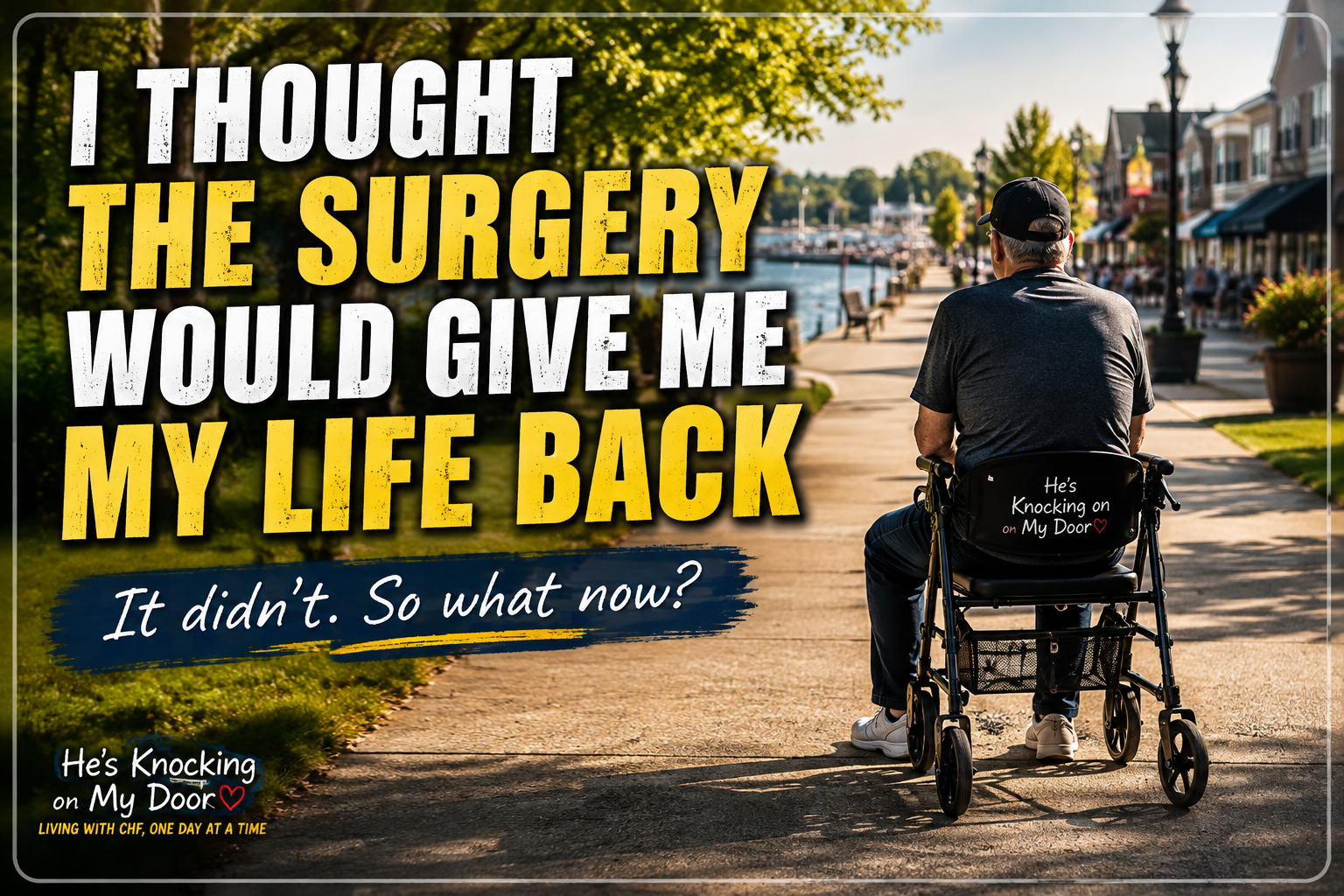
  • I Thought the Surgery Would Give Me My Life Back

    I Thought the Surgery Would Give Me My Life Back

    When I found out I needed my aortic valve replaced, I knew it was serious.

    But in my mind, there was also a pretty straightforward plan.

    My valve was bad. They were going to replace it. I would recover. And eventually, I would get my life back.

    Simple enough.

    Except chronic illness apparently didn’t get a copy of my plan.

    I Thought I Was Getting Fixed

    I had a TAVR to replace my severely narrowed aortic valve.

    Going into it, I knew recovery wasn’t going to happen overnight. I wasn’t expecting to leave the hospital and run a marathon.

    Hell, I wasn’t running one before the surgery.

    But I did expect that once my heart wasn’t trying to pump blood through a severely narrowed valve anymore, I would gradually start feeling like myself again.

    That hasn’t happened.

    The new valve is doing its job.

    Unfortunately, my heart apparently decided that wasn’t enough excitement.

    I still have atrial fibrillation. After the procedure I developed a left bundle branch block. Heart failure became part of my medical vocabulary.

    And instead of getting my old life back, I’ve had to learn how to live a very different one.

    Walking Shouldn’t Be This Hard

    Walking used to be something I never thought about.

    You wanted to go somewhere?

    You walked there.

    Now I think about distance.

    Where is the car?

    How far is the entrance?

    Is there somewhere I can sit down?

    Can I use my walker?

    How far am I going to have to walk once I get inside?

    There are times when I can walk a few hundred yards with my walker and then my body basically tells me:

    That’s enough.

    I get incredibly fatigued. Sometimes I sweat so much that my clothes are soaked. I’ve had other episodes where I’ve become lightheaded and felt like I might pass out.

    Recently, the near-fainting hasn’t been happening as much.

    I’ll take that victory.

    But the fatigue is still very real.

    The frustrating part is that mentally, I’m ready to go.

    I’ll get somewhere and think, Okay, let’s do this.

    Then reality catches up with me.

    My brain remembers the person I used to be.

    My body has other ideas.

    Maybe I’m Just Out of Shape

    I’ve asked myself that question plenty of times.

    Maybe I’m deconditioned.

    Maybe I just need to exercise more.

    And there probably is some truth to that.

    But I am exercising.

    I can do controlled exercises where I determine the pace and workload. I can stop before I overdo it. I’ve been working on getting stronger.

    Walking is different.

    Walking with a walker, bad hips and a heart that doesn’t particularly enjoy being asked to work harder can become an exercise all by itself.

    Eventually I hit a wall.

    And I’ve learned that pushing through that wall isn’t always determination.

    Sometimes it’s just stupid.

    That’s something I’m still working on.

    This Might Not Go Away

    This may be the hardest part for me to accept.

    I’m getting older.

    I have chronic medical conditions.

    Heart failure isn’t something you take an antibiotic for and it’s gone next Tuesday.

    Atrial fibrillation isn’t going anywhere at the moment.

    The electrical system in my heart isn’t working the way it used to.

    My hips aren’t magically repairing themselves.

    There are things my doctors may still be able to improve. There are medications that can be adjusted. There are still questions about why my exercise tolerance is so limited. Hopefully replacing my hip eventually makes walking considerably easier.

    I’m not giving up on getting better.

    But I’m also beginning to understand something I didn’t understand when this started:

    Getting better and getting my old life back aren’t necessarily the same thing.

    That’s a difficult realization.

    So What Do You Do With That?

    That’s the question I’ve been trying to answer.

    You can spend every day thinking about everything you can’t do anymore.

    I’ve done plenty of that.

    It’s depressing.

    There are places I don’t go because walking is too difficult. Eating at restaurants has become an exercise in studying sodium content. Things that used to be completely spontaneous now require planning.

    Even something as stupid as going to Home Depot for a part isn’t simple anymore.

    So I’ve adapted.

    I order things online.

    I use grocery pickup.

    I use a walker.

    I sit when I need to sit.

    I’m learning to stop before my body forces me to stop.

    And somewhere along the way, I started writing.

    That’s Why This Website Exists

    He’s Knocking on My Door started as a place for me to talk about what was happening to me.

    It has become something more important than I expected.

    It helps me cope.

    There are a lot of things about chronic illness that I can’t control.

    I can’t decide tomorrow morning that I’m done having atrial fibrillation.

    I can’t tell heart failure that it has overstayed its welcome.

    Believe me, I’ve considered it.

    But I can write.

    I can talk about what this actually feels like.

    I can complain about low-sodium food.

    I can share a recipe that doesn’t taste like cardboard.

    I can tell you about something I bought that made my life easier.

    I can write about the frustration of looking perfectly fine while feeling completely exhausted inside.

    And sometimes I can simply say:

    This fucking sucks today.

    Writing gives me somewhere to put all of that.

    I’m Still Trying

    Acceptance is a strange word.

    Sometimes people hear it and think it means giving up.

    I don’t think it does.

    I’m still working with my doctors.

    I’m still exercising.

    I’m still working on my weight.

    I’m still trying to get stronger.

    I’m still looking for answers.

    I absolutely want things to improve.

    But I’m also trying to stop measuring every day against the person I was before all of this happened.

    That’s an impossible competition.

    Maybe I’ll never walk through a giant store for an hour again.

    Maybe restaurants will always require planning.

    Maybe I’ll always have days when simply doing something ordinary leaves me completely wiped out.

    I don’t know.

    Nobody does.

    But I do know one thing.

    I’m still here.

    I thought surgery was going to give me my old life back.

    It didn’t.

    So now I’m figuring out what to do with the life I have.

    And strangely enough, that’s part of why you’re reading this website.

    Medical Disclaimer

    This article describes my personal experience with severe aortic stenosis, heart failure and TAVR. It is not medical advice and should not be used to decide whether TAVR, open-heart surgery or any other treatment is appropriate for you. Every patient’s heart condition, anatomy, surgical risk and medical history are different. Treatment decisions should be made with your cardiologist and heart-valve team. If you have chest pain, fainting, severe shortness of breath or symptoms that may represent a medical emergency, seek immediate medical care.

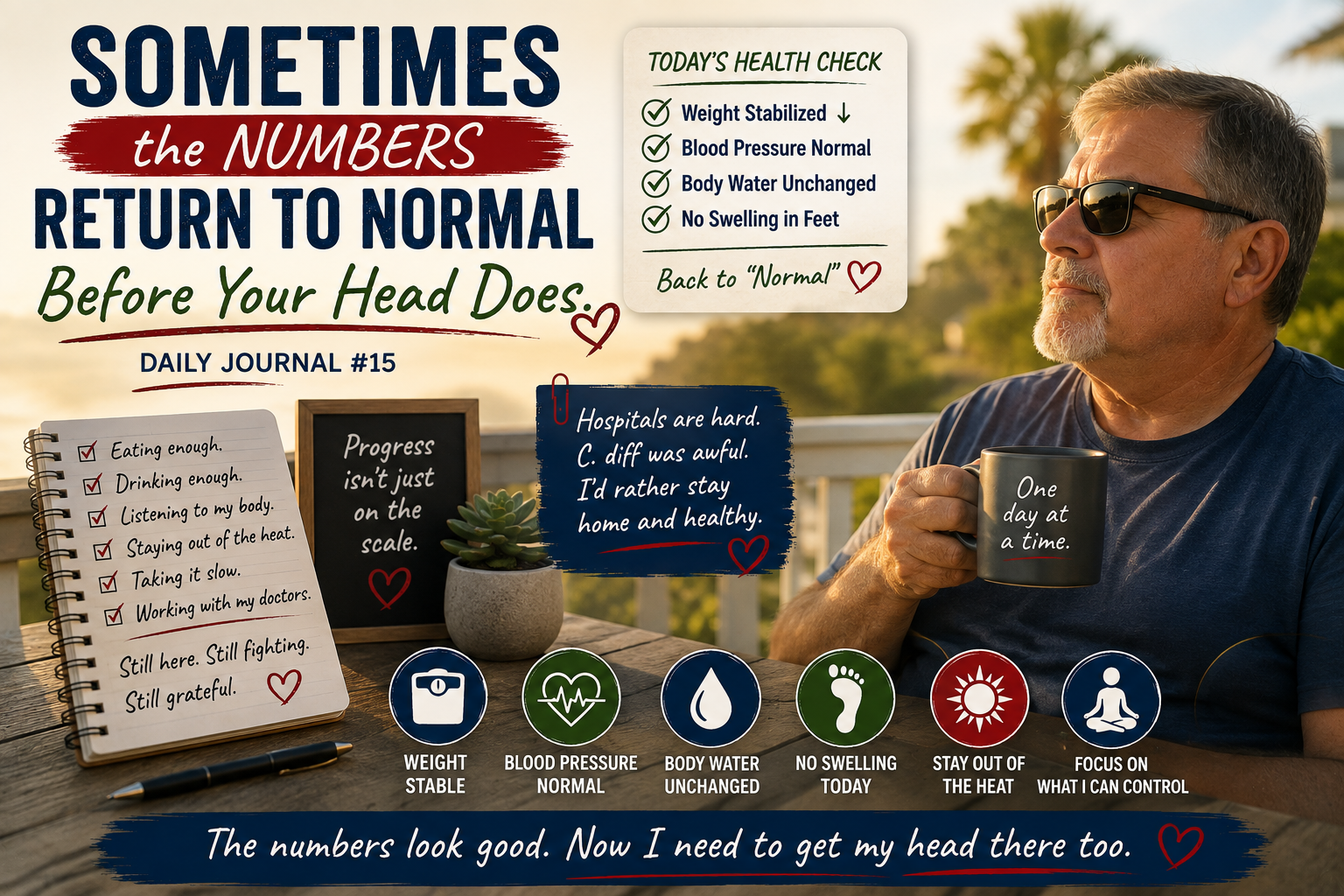
  • Daily Journal #15: My Numbers Are Better. My Head Isn’t There Yet.

    Daily Journal #15: My Numbers Are Better. My Head Isn’t There Yet.

    My morning health checks are continuing to trend in the right direction.

    Finally.

    My weight has stabilized and I’ve even lost a little more. I’m still working toward my goal of 225 pounds by April 2027, so I’ll happily take a loss when it’s the kind I’m actually trying to achieve.

    My blood pressure was normal this morning.

    My body-water percentage was unchanged from yesterday.

    And maybe most importantly after what I’ve been watching over the last few days:

    No swelling in my feet today.

    Weight stable.

    Blood pressure good.

    Body water stable.

    No swelling.

    All of those signs tell me that I’m pretty much back to my version of “normal.”

    Physically, that’s great news.

    Mentally?

    That’s a little more complicated.

    Now I Have to Convince Myself It’s Okay to Eat and Drink

    After watching my weight climb and seeing the swelling in my feet, I became extremely cautious about what I was eating and drinking.

    Maybe too cautious.

    Truth be told, I didn’t eat or drink normally yesterday.

    I drank because I know my kidneys need hydration.

    I ate because I know I need enough food to keep my blood sugar from dropping.

    But I can’t say I was comfortable doing either one.

    That’s something I’m still working on.

    Logically, I understand that my body needs food and fluid.

    Emotionally, there’s another voice saying:

    Remember what happens when this goes wrong.

    Because the thing I really want to avoid is another hospitalization.

    I Really Hate Hospitals

    I don’t just dislike being hospitalized.

    I hate it.

    It’s incredibly difficult for me to stay positive when I’m in the hospital.

    Part of that is everything that comes with being sick enough to be there in the first place.

    But there’s something else.

    I’m kind of a germ freak.

    Okay…

    I’m definitely a germ freak.

    I practiced social distancing before COVID made it fashionable.

    When I was working, I’d walk around with Lysol wipes cleaning things.

    Door knobs.

    Conference tables.

    Chairs.

    Elevator buttons.

    Handrails.

    Basically, if another human being had touched it, there was a decent chance I was coming behind them with a disinfecting wipe.

    A little insane?

    Probably.

    But I rarely got sick.

    So you can probably imagine how I feel about hospitals.

    They’re full of sick people.

    There are germs everywhere.

    There are diseases I didn’t even know existed until somebody put me in a room next to one.

    That part of being hospitalized genuinely freaks me out.

    And unfortunately, I have a pretty good reason for feeling that way.

    Then There Was C. Diff

    After one of my hospital stays, I ended up back home only to develop C. diff shortly afterward.

    At that point in my life, I was barely leaving the house because of everything else going on with my health.

    Where exactly I picked it up isn’t something I can prove, but the timing certainly made that hospital stay stand out in my mind.

    If you’ve never experienced C. diff…

    Consider yourself lucky.

    It was awful.

    It even threatened to interfere with the timing of my heart procedure.

    At the time, there was absolutely nothing funny about it.

    Now?

    Well…

    Enough time has passed that I can find some humor in the experience.

    That might eventually become a Living With It article.

    Although I’m not entirely sure the internet is ready for that one.

    So Yeah, I’m Afraid of Going Back

    All of that helps explain why a couple pounds of weight gain and some swelling can mess with my head.

    It’s not simply:

    Oh, my weight went up.

    My brain immediately starts working its way down the road:

    Weight gain.

    Fluid retention.

    Heart failure.

    Diuretics.

    Is it getting worse?

    Do I need to call somebody?

    Am I going back to the hospital?

    That’s what I’m trying to get better at managing.

    My morning health checks are supposed to give me information.

    They’re supposed to help me make informed decisions and recognize trends.

    I don’t want them to become something that makes me afraid to eat.

    There’s a balance there that I haven’t completely figured out yet.

    Meanwhile, Welcome to August in Southwest Florida

    Life itself has been pretty boring lately.

    It’s August in Southwest Florida.

    Which basically means:

    It’s hot.

    Really hot.

    And I’ve been trying to stay out of it.

    I’ve had several episodes recently where I’ve become extremely lightheaded and started sweating profusely, particularly with exertion and heat.

    One of them happened while I was simply cooking on the grill.

    I wasn’t running a marathon.

    I wasn’t doing yard work.

    I was making dinner.

    Suddenly, I became so lightheaded that I genuinely thought I might face-plant.

    When that happens, I’m done.

    I sit down.

    I cool off.

    And it can take about 20 minutes before I start feeling normal again.

    That’s something I’m already working with my doctors to understand.

    Until we have better answers, I’m not going to prove how tough I am by standing outside in the Florida heat.

    The grill will survive without me.

    ❤️ Greg’s Take

    Physically, today was a good morning.

    Actually, it was probably exactly what I wanted to see.

    My weight has stabilized.

    My blood pressure looks good.

    My body-water percentage isn’t climbing.

    And the swelling in my feet is gone.

    That’s a win.

    Now I have to work on the other part.

    Trusting my body enough to eat.

    Trusting myself enough to drink what I’m supposed to drink.

    And using my morning health checks as information rather than letting every change scare me into thinking I’m headed back to the hospital.

    That’s easier said than done.

    I’ve had enough hospital stays that avoiding another one has become a pretty powerful motivator.

    Sometimes maybe too powerful.

    But that’s part of living with all of this too.

    Not every recovery happens on a scale.

    Sometimes the numbers return to normal before your head does.

    Today, my numbers look pretty good.

    Now I need to work on catching up with them.


    Medical Disclaimer

    This daily journal describes my personal experiences managing chronic health conditions and is not medical advice. My monitoring routine, diet, fluid intake and medications are based on guidance from my own healthcare team. Everyone’s medical needs are different. If you have heart failure, kidney disease, diabetes or another chronic condition, talk with your healthcare team about appropriate fluid, nutrition, weight and symptom-monitoring goals for you.

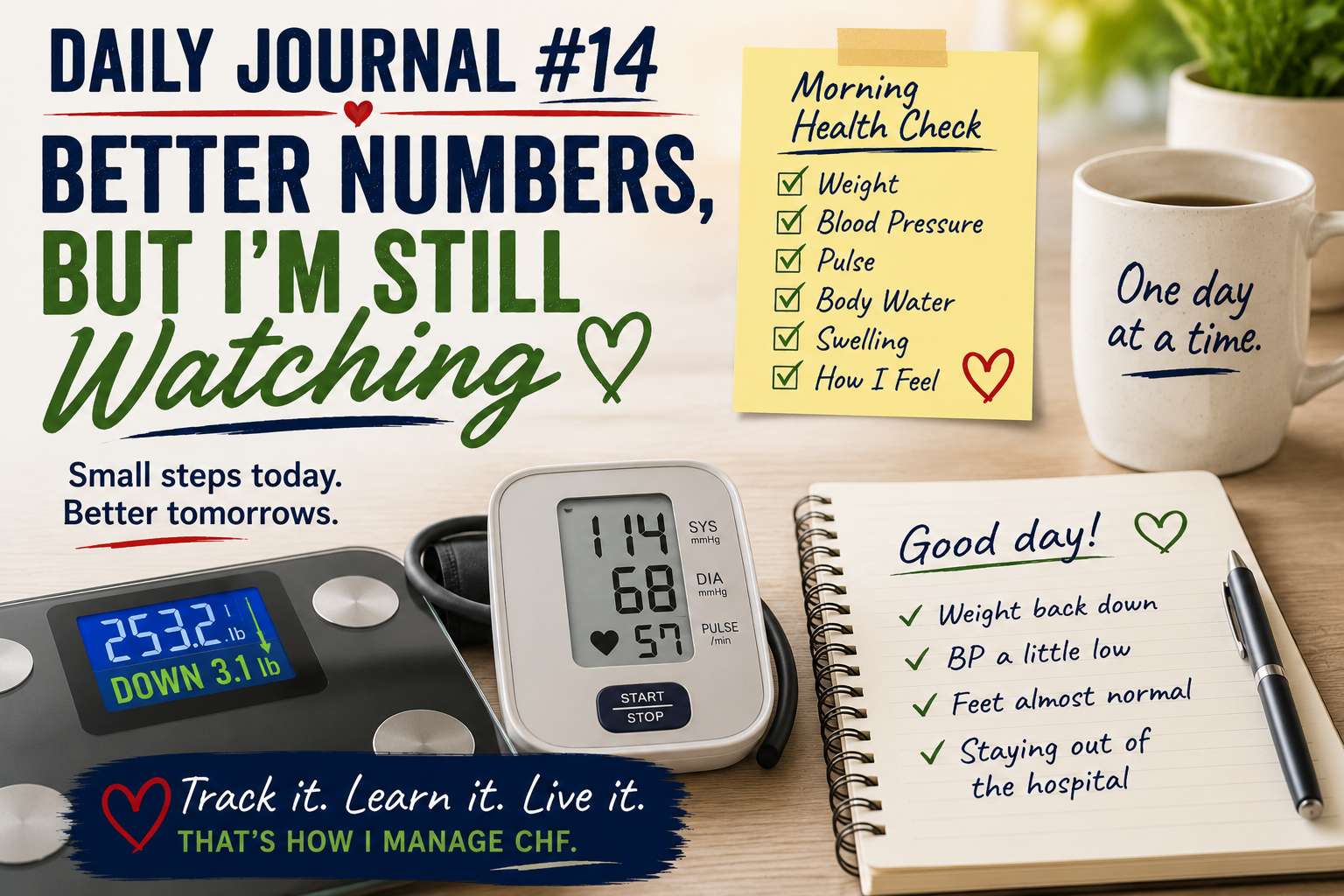
  • Daily Journal #14: Better Numbers, But I’m Still Watching

    Daily Journal #14: Better Numbers, But I’m Still Watching

    My morning health checks were much better today than they were the previous two days.

    And I’m definitely happy to see that.

    I dropped a little over three pounds since yesterday, bringing my weight back down to about where it should be. Considering the weight gain, increased body water and swelling I was seeing over the last couple of days, it certainly looks like I had been retaining fluid.

    My blood pressure was also lower this morning at 114/68 with a pulse of 57.

    That’s lower than yesterday, but not something I’m particularly concerned about based on how I’m feeling. It’s simply another number I’m going to continue watching.

    My feet also look almost normal again.

    I think there’s still a little swelling because they feel somewhat stiff, but there’s a noticeable improvement. Yesterday, they actually hurt.

    Today is definitely a better day.

    This Is Why I Do Morning Health Checks

    Days like today reinforce why I’ve become so committed to doing these checks every morning.

    It can seem like a hassle.

    Get on the scale.

    Check my blood pressure and pulse.

    Look at the body-water reading from my BIA scale.

    Check my feet and legs for swelling.

    Pay attention to how I’m feeling.

    Record everything.

    Then do it all over again tomorrow.

    But there’s a reason I do it.

    I’m trying to catch changes early rather than waiting until I’m sick enough to end up back in the hospital.

    Yesterday, several things were moving in the wrong direction at the same time.

    My weight was up for the second consecutive day. My BIA scale showed increased body water. My blood pressure was a little higher, and I could see swelling in my feet.

    Today, most of those things are moving back toward normal.

    That’s exactly the kind of trend I’m looking for.

    A Good Day Doesn’t Mean I Stop Monitoring

    It would be easy to look at today’s three-pound drop and think:

    Great. Problem solved.

    Not quite.

    My feet still appear to be slightly swollen.

    And more importantly, I still don’t know exactly what caused the fluid retention in the first place.

    Was it too much sodium?

    Was there more sodium in the shrimp I ate than I realized?

    Did the fruit I ate add enough additional fluid to make a difference?

    Was it a combination of several small things?

    Or is something happening with my heart that has absolutely nothing to do with anything I ate or drank?

    I don’t know.

    And that’s exactly why I can’t stop monitoring just because today’s numbers look better.

    Sometimes There Isn’t an Obvious Answer

    I think that’s one of the frustrating parts of managing a chronic illness.

    I want there to be a simple cause and effect.

    I did X, so Y happened.

    Unfortunately, the body doesn’t always cooperate with that logic.

    I can retrace everything I ate.

    I can look at how much I drank.

    I can check nutrition labels.

    I can look at my activity.

    And sometimes I still won’t have a definite answer.

    What I can do is continue collecting information.

    If something starts changing again tomorrow, I’ll know.

    If my weight continues downward and the swelling disappears, I’ll know that too.

    The individual number matters.

    The trend matters even more.

    The Goal Is Staying Out of the Hospital

    I’ve spent enough time in hospitals.

    If taking a few minutes every morning to check my weight, blood pressure, pulse, body water and swelling gives me a better chance of catching a problem early, those few minutes are absolutely worth it.

    Are morning health checks sometimes annoying?

    Yep.

    Would I occasionally rather just grab a cup of coffee and forget about all of it?

    Absolutely.

    But I also know the alternative.

    A few minutes checking numbers at home sounds a whole lot better than spending several days checking the ceiling from a hospital bed.

    So tomorrow morning I’ll do it all again.

    Even though today’s numbers were better.

    Especially because today’s numbers were better.

    I want to know they stay that way.

    ❤️ Greg’s Take

    Yesterday was a little concerning.

    Today was encouraging.

    But neither day tells the entire story by itself.

    That’s what I’m learning from tracking my health every morning.

    One bad number doesn’t necessarily mean disaster.

    And one good number doesn’t necessarily mean everything is fixed.

    It’s the pattern I’m watching.

    Today, I’m more comfortable knowing my weight has come back down, my feet look considerably better and most of the signs I was watching are moving in the right direction.

    I’ll take that win.

    But tomorrow morning, I’ll still step on that scale.

    I’ll still check my blood pressure.

    I’ll still look at my feet.

    And I’ll still write everything down.

    Because as much of a pain as this routine can sometimes be, I know which is worse:

    Five minutes of morning health checks or another few days in the hospital.

    That’s an easy choice.

  • Low Sodium Doesn’t Mean Unlimited

    Low Sodium Doesn’t Mean Unlimited

    One of the biggest lessons I’ve learned is that “low sodium” doesn’t automatically mean “eat as much as you want.”

    Sometimes solving one dietary problem creates another thing you still have to pay attention to.

    That has been especially true for me because I’m not managing just one chronic illness.

    I’m trying to balance congestive heart failure, chronic kidney disease, and diabetes at the same time.

    And some days, honestly, it feels like the rules contradict each other.

    Low Sodium Is Only One Piece of the Puzzle

    Because of my heart failure, sodium is something I pay very close attention to. Too much sodium can contribute to fluid retention, which is one reason people with heart failure may be advised to limit sodium and, in some cases, fluids. The exact limits should come from your healthcare team. 

    But sodium isn’t the only number that matters to me.

    Carbohydrates are another big one because I also have diabetes.

    Lately, my carbohydrate intake has actually been very well controlled.

    Unfortunately, part of the reason is something I’m not particularly proud of:

    I’m sometimes afraid to eat or drink too much.

    I know that sounds messed up.

    But after being hospitalized multiple times, the fear is real.

    Why I’m So Determined to Stay Out of the Hospital

    Hospital stays are particularly difficult for me because of my mobility problems.

    My right hip is bone-on-bone, and I use a walker. That makes me a fall risk.

    When I’m hospitalized, that usually means bed or chair alarms. If I need to get up, I’m supposed to call for assistance.

    That sounds reasonable until you’re receiving IV diuretics.

    When those medications start working and you need to use the bathroom, sometimes you need to go now.

    Waiting for someone to arrive, turn off the alarm, and help you up can be frustrating and uncomfortable.

    Yes, I could simply get up anyway, but in my experience that tends to make the stay even more unpleasant.

    So when I say I’m motivated to avoid another hospitalization, I mean it.

    That fear has definitely influenced the way I eat and drink.

    The strange side effect is that my diabetes numbers have been better because I’m controlling my portions and carbohydrates so carefully.

    That doesn’t mean fear is a good dietary strategy.

    It means I still have work to do finding a healthier balance.

    CHF, CKD and Diabetes Don’t Always Play Nicely Together

    This is where things get complicated.

    With chronic kidney disease, nutrition may involve paying attention to sodium, potassium, phosphorus, protein and sometimes fluids depending on kidney function and lab results. The National Kidney Foundation stresses that these needs vary from person to person and should be individualized. 

    Then heart failure enters the picture.

    My heart-failure plan includes careful sodium and fluid management.

    Then diabetes adds another layer.

    Carbohydrates matter because they affect blood glucose, and portion size matters even when the food itself seems “healthy.” The American Diabetes Association specifically emphasizes being mindful of carbohydrate intake and portioning carbohydrate foods appropriately. 

    That means I can’t simply look at something and ask:

    “Is it low sodium?”

    I also have to ask:

    How many carbohydrates are in it?

    How much potassium?

    How much phosphorus?

    How much fluid?

    How large is the serving?

    And how does it fit with everything else I’m eating that day?

    The Rice Example

    Rice is a perfect example.

    Plain rice is naturally very low in sodium, which makes it attractive for a low-sodium diet.

    But rice is also a carbohydrate food.

    So if I sit down with a giant bowl of rice because it’s “low sodium,” I may solve one problem while creating another for my blood sugar.

    That’s why portion control matters so much to me.

    I can still eat rice.

    I just have to respect what it is.

    Low sodium does not mean unlimited.

    There Probably Isn’t a Magical Food

    I think this is where people can get trapped.

    You find something that has almost no sodium and think:

    Finally! Something I can eat without worrying about it.

    But then you look at the rest of the nutrition label.

    Maybe it’s loaded with carbohydrates.

    Maybe it’s high in potassium.

    Maybe phosphorus becomes an issue for someone with kidney disease.

    Maybe the serving size is much smaller than you thought.

    There usually isn’t one magical food that checks every box for every medical condition.

    And even when something fits your diet beautifully, eating unlimited amounts of it probably isn’t the answer.

    I’m Still Learning

    I want to be clear about something.

    I have not mastered this.

    Not even close.

    I’m still learning how to balance all of these conditions without becoming afraid of food.

    I joke that I’m scared to eat or drink anything.

    The uncomfortable truth is that sometimes the joke isn’t very far from reality.

    That’s something I need to get better at.

    Yes, being more careful has contributed to my weight loss, and I’m happy about that.

    But the goal shouldn’t be to lose weight because I’m frightened to eat.

    The goal is to learn how to eat enough of the right foods, in the right portions, while staying within the limits my healthcare team has given me.

    That’s a much healthier goal.

    Moderation Has Become the Real Lesson

    If there is one thing I’ve learned, it’s this:

    Every food has to be looked at as part of the bigger picture.

    Something can be low sodium and still require portion control.

    Something can be good for diabetes but not ideal for someone who needs to watch potassium.

    Something can fit a kidney-friendly plan but not fit your particular fluid restriction.

    Nutrition becomes much more complicated when several chronic illnesses overlap.

    That’s why I’m trying to stop thinking in terms of:

    Good food. Bad food.

    And start thinking in terms of:

    How does this fit into my overall day?

    Because for me, that’s really what Low Sodium Living has become.

    Not eliminating everything.

    Not eating unlimited amounts of the “safe” foods.

    Just trying to find balance.

    And accepting that I’m still learning how to do it.

    ❤️ Greg’s Take

    Living with multiple chronic illnesses sometimes feels like trying to solve a puzzle where the pieces keep changing.

    CHF tells me to watch sodium and fluids.

    Diabetes tells me to watch carbohydrates.

    CKD means I may also need to pay attention to things like potassium and phosphorus depending on my labs and what my doctors recommend. 

    It can be exhausting.

    But I’m starting to understand that the answer probably isn’t finding the perfect food.

    It’s finding the right balance.

    Low sodium doesn’t mean unlimited.

    Neither does low carb.

    Neither does low potassium.

    Everything still has to fit into the bigger picture.

    And for now, that’s a skill I’m still learning.

    Medical Disclaimer: I am not a doctor or medical professional. The information on this page reflects my own personal experience living with chronic illness and managing my diet and health. What works for me may not be appropriate for someone else. Always talk with your doctor, dietitian, or other qualified healthcare professional before making changes to your diet, medications, fluid intake, or treatment plan.

    This website is intended to share my journey, not to replace professional medical advice.

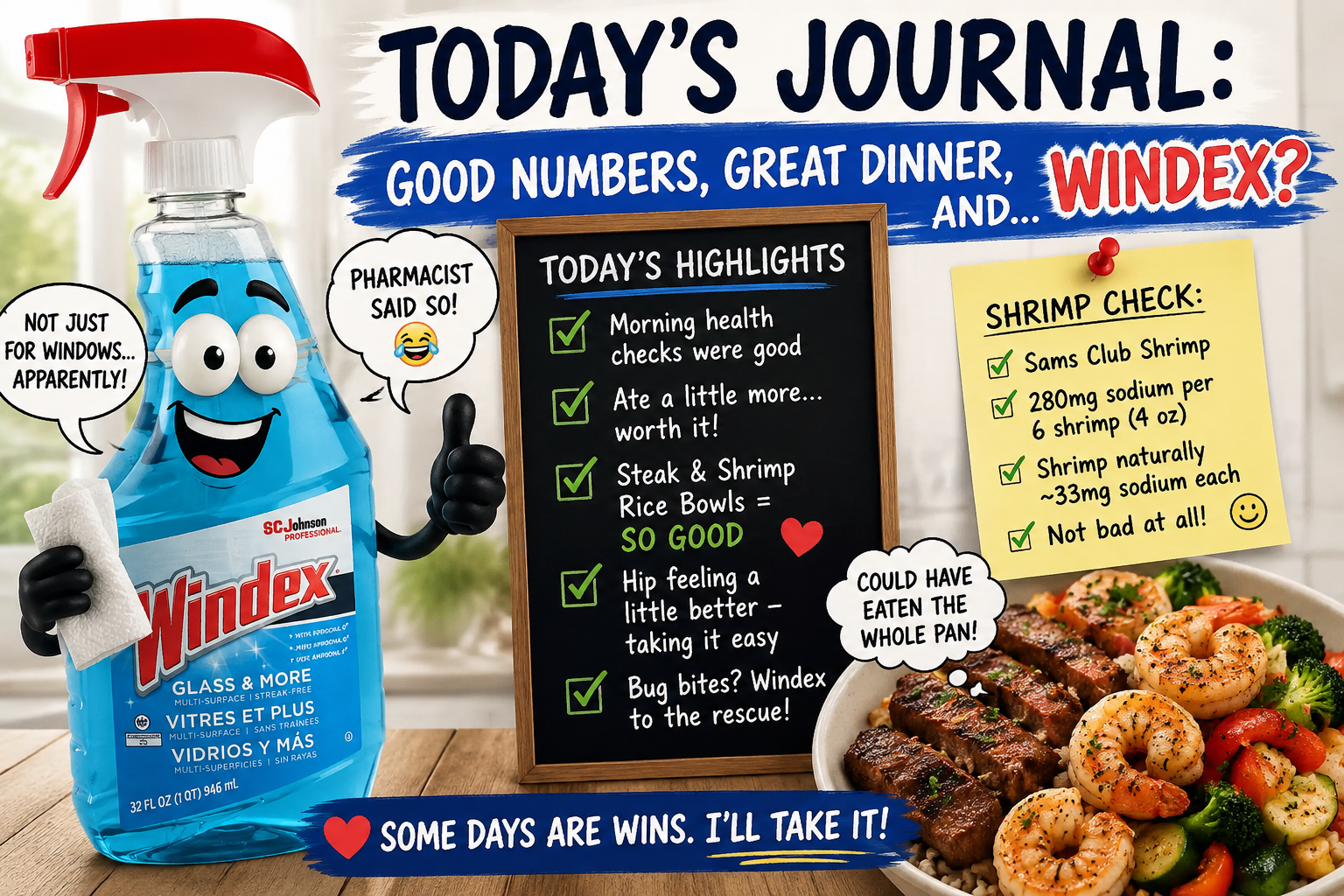
  • Daily Journal #11: A Good Meal, Better Numbers, and… Windex?

    Daily Journal #11: A Good Meal, Better Numbers, and… Windex?

    My morning health checks were good today, which honestly surprised me a little.

    I ate more than I normally do yesterday.

    But dinner was really good.

    We made one of my favorite meals: steak and shrimp rice bowls. I probably could have eaten the entire pan if I had let myself.

    I’ll be posting my version of the recipe soon because it’s another meal we’ve been able to adapt to fit my low-sodium lifestyle.

    The steak, seasoning, rice, and vegetables are all pretty easy for me to control.

    The shrimp is where I have to pay attention.

    Not All Shrimp Is the Same

    One thing I’ve learned since watching sodium so closely is that shrimp can be tricky.

    Shrimp naturally contains sodium, but some frozen shrimp can have additional sodium from the way it is processed or packaged. That means I’ve learned to check the nutrition label instead of assuming one bag of shrimp is the same as another.

    This time, I bought shrimp from Sam’s Club.

    The label showed 280 mg of sodium per 4-ounce serving, which was about six shrimp.

    Shrimp already contains naturally occurring sodium, so not all of that 280 mg is necessarily coming from processing. That’s another reason I’ve learned that the nutrition label matters more to me than trying to estimate exactly where every milligram came from.

    It’s something I’ll talk more about when I post the steak and shrimp rice bowl recipe.

    And yes, I promise I’ll try not to eat the whole pan next time.

    The Hip Is a Little Better

    My leg and hip are feeling a little better today.

    They’re certainly not back to normal, but I’ll take any improvement I can get.

    After the last few days of pretty intense pain, I’m going to make today another take-it-easy day and hopefully let things continue to settle down.

    Sometimes knowing when not to push myself is just as important as getting up and moving.

    And Then There’s the Windex…

    The bug bites are also feeling much better.

    And this is where today’s journal gets a little strange.

    We stopped at CVS and asked the pharmacist what I could do about the itching.

    The suggestion?

    Put some Windex on a paper towel and dab it on the bites.

    Yep.

    Windex.

    My first thought was pretty much:

    “You’ve got to be kidding me.”

    I honestly wondered whether everyone behind the pharmacy counter was laughing their butts off after we walked away.

    But I tried it.

    And I’ll be damned…

    It helped.

    I’m certainly not turning He’s Knocking on Your Door into a Windex medical-advice website—and I’m not recommending anyone else try it—but I have to admit that my itching improved.

    Sometimes life with chronic illness is about tracking weight, blood pressure, sodium, medications, and symptoms.

    And apparently, sometimes it’s about leaving CVS wondering how Windex just became part of the day’s story.

    ❤️ Today’s Reflection

    Good health numbers this morning.

    A little less hip pain.

    Bug bites that finally aren’t driving me crazy.

    And a fantastic dinner last night that reminded me that eating low sodium doesn’t mean giving up good food.

    I’ll take those as wins.

    Today I’m going to take it easy, enjoy feeling a little better, and start thinking about getting that steak and shrimp rice bowl recipe onto the site.

    One day at a time.

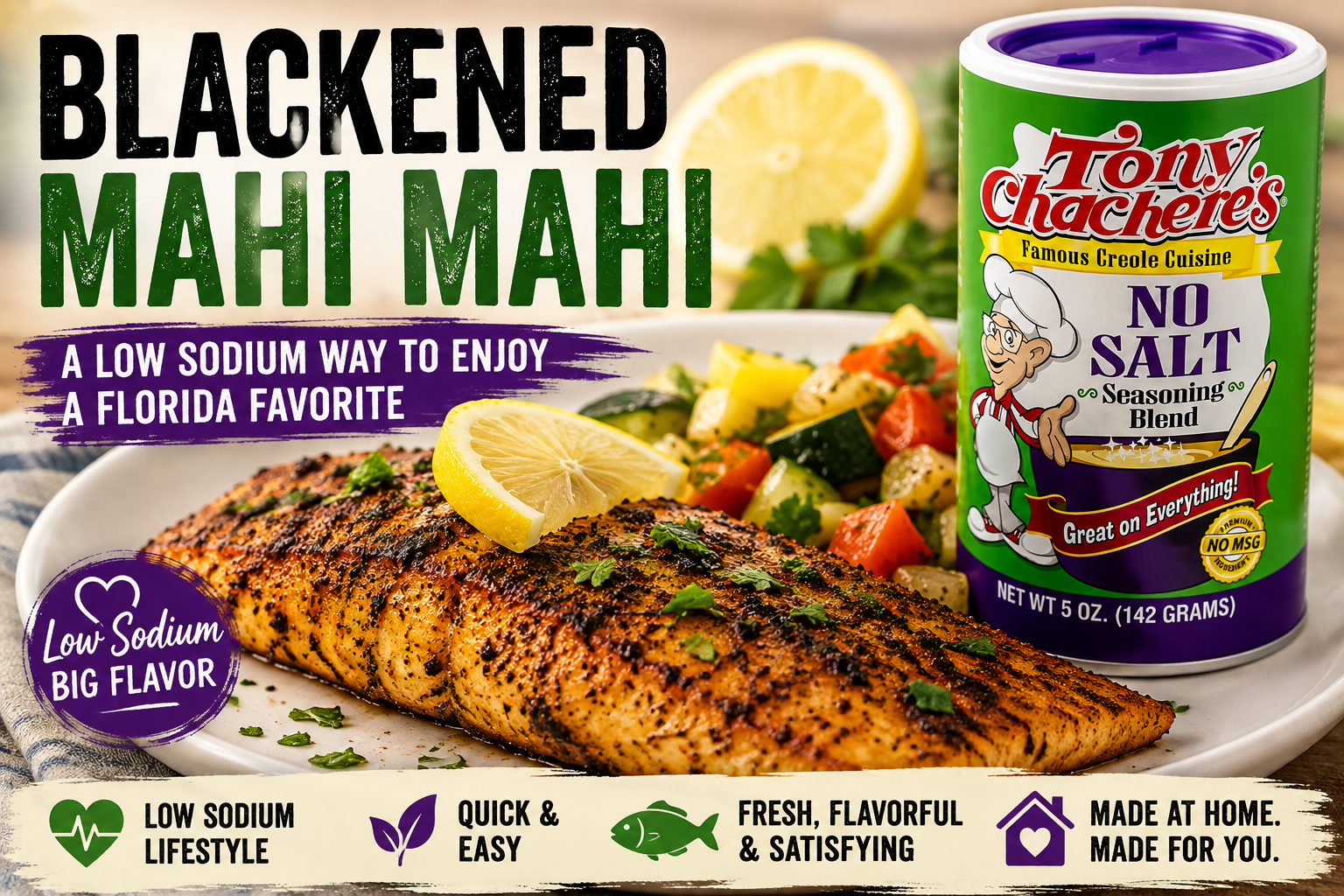
  • Blackened Mahi Mahi: Bringing One of My Favorite Foods Back

    Blackened Mahi Mahi: Bringing One of My Favorite Foods Back

    Sometimes a recipe is about more than what’s for dinner.

    For me, blackened mahi mahi is tied to a much bigger part of my story.

    After my stroke in 2020, my doctors gave me a long list of lifestyle changes to consider. Some were fairly simple, like switching to an electric razor because I was taking blood thinners and needed to reduce the chance of cutting myself.

    Others involved bigger changes—eating healthier, exercising, losing weight, and being more careful about injuries and falls.

    At the time, I was probably in the worst physical shape of my life. I was driving an hour and a half each way to and from work, spending far too much time sitting, and not taking particularly good care of myself.

    To make matters worse, my stroke recovery happened during a Midwestern winter.

    Because I was taking a blood thinner, my doctors were understandably concerned about what could happen if I slipped on the ice and hit my head. One suggestion was that I wear a bicycle helmet when I went outside.

    At first, I thought they meant during the early part of my recovery.

    Nope.

    They meant going forward.

    I understood the reasoning. A fall and head injury while taking a blood thinner can be serious.

    But I also knew myself.

    I wasn’t going to spend every Midwestern winter walking around outside wearing a bicycle helmet.

    Something had to change.

    Trading Midwest Winters for Southwest Florida

    After I recovered enough from the stroke, my wife and I made a major life decision.

    We were moving to Southwest Florida.

    It was a place we had vacationed and loved, and we decided it was where we wanted to live.

    There were plenty of reasons for the move, but I’ll admit that food was one of them.

    We love seafood.

    Fresh fish. Shrimp. Outdoor restaurants. Sitting near the water and enjoying a meal in the Florida sunshine.

    And one of our absolute favorites has always been blackened fish and blackened shrimp.

    Unfortunately, my health journey wasn’t finished with me yet.

    Several years after the stroke, congestive heart failure entered the picture, and eventually I found myself living on a very restrictive low-sodium diet.

    Suddenly, those blackened seafood dinners I loved became a thing of the past.

    Blackened Didn’t Have to Mean Gone

    Restaurant blackening seasoning is something I generally avoid now because I don’t have enough control over how the food is seasoned or how much sodium is in it.

    For a while, I thought blackened fish might simply become another food I’d have to give up.

    Then I started looking at the problem differently.

    Maybe I didn’t have to give up blackened fish. Maybe I just needed to change how I made it.

    That’s exactly what we did.

    I found a Blackened Mahi Mahi recipe from Valerie Brunmeier at Valerie’s Kitchen that we really enjoy. Her recipe uses mahi mahi cooked quickly in a hot skillet with butter and olive oil, then finished with fresh lemon juice. 

    Original Blackened Mahi Mahi Recipe at Valerie’s Kitchen

    But there’s one important change I make.

    My Low-Sodium Modification

    Valerie’s original recipe calls for a homemade Cajun seasoning mixture that includes salt. 

    Instead of making that seasoning mixture, I substitute Tony Chachere’s No Salt Seasoning Blend.

    That’s it.

    I still follow the basic cooking method from the original recipe, but replacing the blackening seasoning allows me to better control the sodium in the meal.

    I’ve already written about the seasoning and why it’s become one of my Helpful Finds:

    Tony Chachere’s No Salt Seasoning – My Helpful Find

    The original mahi mahi recipe is incredibly quick, too. Valerie lists about 10 minutes of preparation and 8 minutes of cooking time. The fish is seasoned, cooked in a hot skillet until golden and cooked through, and finished with fresh lemon. 

    It’s exactly the kind of meal I like: simple, fast and full of flavor.

    The Sodium Difference Matters to Me

    Here’s where making the meal at home really becomes important.

    The original recipe’s published nutrition information estimates 540 mg of sodium per serving, although Valerie notes that the nutrition calculation is only an estimate and actual values depend on the ingredients used. 

    By eliminating the salt-containing seasoning mixture and using my no-salt seasoning instead, I can remove a significant source of added sodium from the recipe.

    That doesn’t necessarily make the finished dish completely sodium-free—the fish, butter and other ingredients can contain naturally occurring or added sodium depending on what you buy—but it gives me much more control over the final meal.

    And control has become incredibly important to me.

    At a restaurant, I don’t know exactly what’s going onto that piece of fish.

    At home, I do.

    This Is What Low-Sodium Living Means to Me

    I’ve talked before about how frustrating a low-sodium diet can be.

    There are foods I simply don’t eat anymore.

    There are restaurants I don’t visit anymore.

    There are things I miss.

    But I’m also learning that before I put something permanently on the can’t-have-it-anymore list, it’s worth asking one question:

    Can I make it differently?

    That’s what happened with bread. Store-bought bread was difficult to fit into my sodium goals, so we bought a bread machine and started making our own.

    It’s what happened with spaghetti sauce.

    And now it’s what we’ve done with blackened seafood.

    I’m not pretending my version is identical to sitting at a waterfront restaurant in Southwest Florida and ordering a heavily seasoned piece of blackened mahi mahi.

    But I can sit at home, enjoy a piece of fish with the flavors I love, and know exactly what went into it.

    I’ll take that trade.

    ❤️ Greg’s Take

    My health has changed tremendously since that stroke in 2020.

    So has the way I live.

    And definitely the way I eat.

    But one thing I’m trying very hard not to do is look at every dietary restriction as another thing being taken away from me.

    Sometimes there’s another way.

    This blackened mahi mahi is a perfect example.

    I didn’t have to give up one of my favorite Florida meals. I just had to learn how to make it differently.

    And when you’re living with chronic illness, getting one of those little pieces of normal life back can mean an awful lot.


    Recipe Credit

    The original Blackened Mahi Mahi recipe was created by Valerie Brunmeier of Valerie’s Kitchen. I’m sharing my personal experience and the low-sodium substitution I use when making it at home. Please visit Valerie’s site for the complete ingredient list, measurements, and cooking instructions. 

    Get the Original Blackened Mahi Mahi Recipe

    Disclaimer: This article reflects my personal experience with low-sodium cooking and the modifications I make to recipes while living with chronic illness. It is not medical or nutritional advice. Sodium needs can vary from person to person, so always check ingredient labels and follow the guidance of your own doctor, dietitian, or healthcare team. Product ingredients and nutrition information can also change over time.