Tag: Stroke

  • The Stroke That Changed Everything

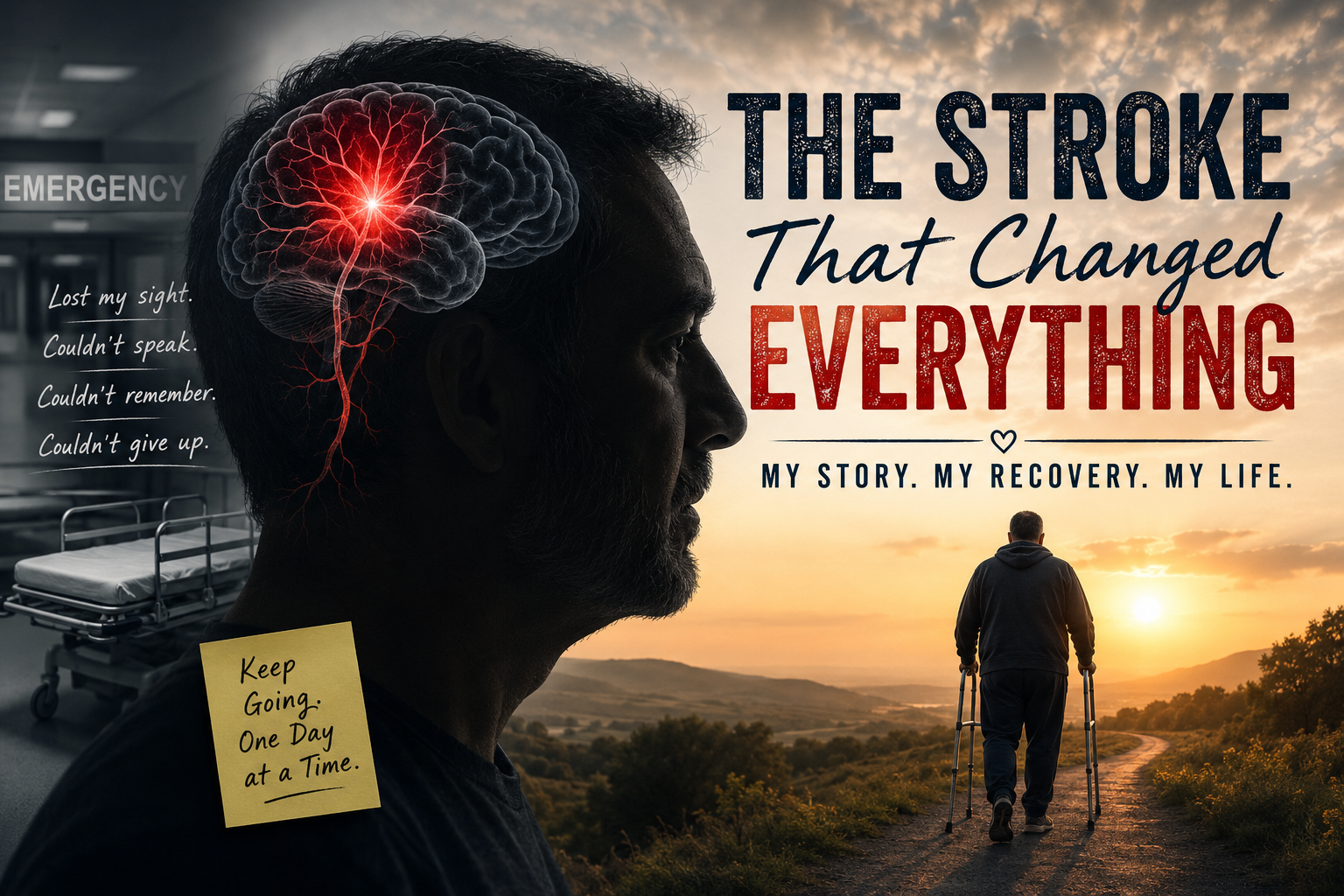
    The Stroke That Changed Everything

    My stroke happened in November 2020.

    It was during COVID, and I was still going into the office. Almost nobody else was there.

    One day I went to use the bathroom and, all of a sudden, I lost my eyesight.

    Completely.

    It came back moments later.

    And somehow my reaction was basically:

    Well, wasn’t that weird?

    Looking back now, that should have been a giant flashing warning sign.

    At the time, I shrugged it off.

    Nothing else really happened for the rest of the workday, so I drove home.

    That drive was about an hour and a half.

    Yes, I drove an hour and a half after temporarily losing my vision.

    I know.

    Not exactly one of my smarter decisions.

    Then Things Got Worse

    I got home, had dinner, and made myself a drink.

    My wife and I decided to watch a movie.

    At some point during the movie, I dropped my drink.

    I tried to pick the ice cubes up and put them back into the glass.

    I couldn’t.

    I kept missing.

    Then I tried to talk.

    What I was trying to say in my head was not what was coming out of my mouth.

    It was gibberish.

    It sounded like another language.

    My brilliant plan at that point was to go to bed.

    Thankfully, my wife had a better plan.

    She stopped me because she knew something was seriously wrong.

    She wanted to call 911.

    Somehow I managed to get the word “no” out.

    So she drove me to the hospital.

    We lived about a mile away.

    Looking back, yes, that was dumb too.

    If you think you are having a stroke, call 911.

    The Emergency Room

    My wife dropped me at the emergency room entrance and went to park the car.

    I could still walk.

    I went inside and tried to tell the person at the desk that I thought I was having a stroke.

    Unfortunately, I couldn’t talk properly, and I had alcohol on my breath from the drink I had made at home.

    So at first, they thought I was drunk.

    My wife came in a few minutes later and explained what had actually happened.

    Things moved pretty quickly after that.

    They still tested my blood alcohol level.

    Yes, I had been drinking.

    No, I was nowhere near legally intoxicated.

    They started doing neurological checks.

    Follow this with your eyes.

    Smile.

    Move this.

    Lift that.

    Then my face started drooping.

    I remember a nurse telling me to squeeze his fingers as hard as I could.

    In my head, I was yelling:

    I AM! I AM!

    But apparently my body wasn’t cooperating.

    Now several people were looking at me.

    My wife too.

    They were all trying to determine whether one side of my face was drooping.

    It was.

    I was having a stroke.

    When It Finally Hit Me

    I don’t remember the exact order of everything after that.

    There were scans.

    There were medications.

    I was given a clot-busting treatment, although I honestly don’t remember exactly which medication they used.

    I remember being told afterward that because of the bleeding risk, I was not going to be allowed to get out of bed for a while.

    That was the moment when it really sank in.

    WTF. This is serious.

    And I couldn’t communicate.

    That may have been the scariest part.

    I knew what I wanted to say.

    I knew what I wanted to ask.

    I just couldn’t get the words out.

    Luckily, the hospital staff that day was excellent.

    Between my wife recognizing something was wrong and the medical team acting quickly, I have no doubt they changed the outcome for me.

    They may have saved my life.

    Then Came All the Tests

    I had several scans of my head.

    There is nothing quite like spending a long time inside a scanner when you can’t communicate properly.

    Thankfully, I’m not claustrophobic.

    Then my kidneys decided to join the party.

    My kidney function dropped significantly while I was hospitalized.

    That was my first experience with a nephrologist.

    There were more tests.

    Eventually, my kidney function improved to around 50 percent.

    Looking back at everything I know now, I sometimes wonder if that was around the time my right kidney stopped functioning normally.

    I didn’t follow up with nephrology as well as I probably should have.

    My primary care doctor took the lead for a while.

    I had enough other problems being discovered.

    They found atrial fibrillation.

    They found sleep apnea.

    And then they tried putting me on the hospital CPAP machine.

    This thing looked like it was approximately the size of a Volkswagen.

    My CPAP today is about the size of a shoebox.

    Whatever prehistoric machine they brought into that hospital room was not happening.

    I already had so much going on that I basically said:

    We’ll deal with that later.

    I Was Also Over 400 Pounds

    Have I mentioned that I was fat?

    When all of this happened, I was tipping the scales at somewhere around 410 pounds.

    My diabetes was poorly controlled.

    My blood pressure was high.

    My cholesterol was terrible.

    My triglycerides were so high that at one point they couldn’t even calculate them normally.

    So now you have a 400-pound guy lying flat in a hospital bed while they are pumping fluids into him.

    Which means one thing.

    I had to pee.

    A lot.

    Because I had received clot-busting treatment, they weren’t letting me just get out of bed whenever I wanted.

    Try being over 400 pounds, lying nearly flat, and attempting to pee into one of those little hospital urinals.

    It wasn’t happening.

    During the day, my wife helped me.

    At night, I had to call the nurses.

    I cannot explain how humiliating that felt at the time.

    I apologized constantly.

    I was embarrassed about my weight.

    Embarrassed that I needed help.

    Embarrassed that someone had to help me do something as basic as urinating.

    Eventually, after a few days, I was allowed to get up and use the bathroom myself.

    At that point, that felt like a major victory.

    What the Stroke Did to My Brain

    The physical problems were only part of it.

    The stroke affected my ability to communicate and process information.

    At one point, I got my phone back.

    I remember wanting to dial a number.

    The problem was that I didn’t know what the number 7 was.

    I knew how to count.

    So I would start at one.

    One.

    Two.

    Three.

    Four.

    Five.

    Six.

    Seven.

    Then I would press what I thought was the seven.

    I did that for every digit.

    Eventually, I pressed send.

    Of course, the number was wrong.

    I also couldn’t remember what I had eaten for breakfast.

    It was French toast.

    I probably asked my wife a hundred times:

    What did I have for breakfast again?

    French toast.

    A few minutes later:

    What did I have for breakfast?

    French toast.

    I couldn’t remember my kids’ names.

    They managed to sneak in to see me during COVID restrictions.

    I smiled when I saw them.

    They were scared.

    They were younger then.

    And I was only 53 years old.

    Teaching Myself to Talk Again

    Once I got my phone back, I stayed awake practicing.

    For two days I worked on trying to teach myself how to speak again.

    By about the third day, I could start getting some words out.

    Not great words.

    Not necessarily the right words.

    But words.

    I still couldn’t dial a phone properly.

    But I was learning to communicate.

    Eventually I was moved out of the ICU and into a regular room.

    That felt like progress.

    Then came the next battle.

    They Wanted to Send Me to Rehabilitation

    A few days later, the hospital started talking about sending me to a rehabilitation facility.

    I wanted to go home.

    They didn’t think that was a particularly good idea.

    They asked how many stairs I had in my house.

    Like an idiot, I told them the truth.

    Thirteen.

    So they said I had to prove I could safely go up and down 13 stairs before they would let me go home.

    Great.

    I had barely walked farther than the bathroom in five or six days.

    Now I was going to climb stairs.

    At 400 pounds.

    After a stroke.

    A therapist strapped herself to me before we started.

    I remember looking at her and thinking:

    Lady, if I go down, you are coming with me.

    There was absolutely no way she was catching 400 pounds.

    I asked if we could go down first because we were already on an upper floor.

    She agreed.

    Truthfully, I don’t think anyone expected me to complete the test.

    If I couldn’t do the stairs, the decision was easy.

    Off to rehab.

    It probably took me 15 or 20 minutes just to get down.

    Then came the hard part.

    Going back up.

    I was exhausted.

    I was sweating.

    My heart rate was apparently going through the roof because people started looking for me after seeing what was happening on my heart monitor.

    But I kept going.

    One stair at a time.

    And I made it.

    All thirteen.

    I wasn’t going to rehab.

    Going Home Was Only the Beginning

    A day or so later, I was discharged.

    Then the real work started.

    I practiced walking.

    I practiced talking.

    And suddenly I had what felt like a million doctor appointments.

    I needed a cardiologist.

    A neurologist.

    A nephrologist.

    Speech therapy.

    Physical therapy.

    Occupational therapy to make sure I could safely take care of myself.

    The cardiologist explained that I had atrial fibrillation.

    I started taking Eliquis.

    His opinion was that the stroke was most likely caused by previously undiagnosed AFib.

    Sleep apnea may also have contributed to the overall cardiovascular picture.

    Unfortunately, that cardiologist and I never really clicked.

    I felt like all he saw when he looked at me was an extremely overweight guy who was lucky to still be alive.

    I was given blood thinners and metoprolol.

    We met a couple of times and then scheduled another appointment about six months later.

    During those six months, I lost around 80 pounds.

    When I went back, his reaction was basically:

    Wow. I didn’t think you would actually do that.

    Thanks for the confidence.

    By then, though, some of the treatment options for getting me back into a normal rhythm were apparently less straightforward.

    To this day, I remain in atrial fibrillation essentially all the time.

    Therapy Was Brutal

    The hardest part for me was therapy.

    Not because the exercises looked difficult.

    Quite the opposite.

    Some of them looked ridiculously simple.

    That made it even more frustrating.

    They would give me questions like:

    You walk into a building.

    Go up three floors.

    Down one floor.

    Then up three more.

    What floor are you on?

    That sounds easy.

    Before the stroke, I wouldn’t have given it a second thought.

    After the stroke, exercises like that could completely exhaust me.

    The therapy sessions where I had to really use my brain were the worst.

    I would finish completely wiped out.

    I also had to relearn how to participate in conversations.

    Talking with one person was difficult enough.

    Talking with two or three people at the same time?

    That was an entirely different skill.

    I had to learn how to follow who was talking.

    Process what they said.

    Remember what had already been said.

    Formulate my response.

    And then actually get the words out.

    It took me well over a year before I felt remotely comfortable having normal conversations again.

    Going Back to Work Showed Me How Much Had Changed

    Eventually, I tried going back to work.

    COVID was still going on, and in a strange way that probably helped me.

    For the first four to six months, I was able to work from home.

    That gave me some protection from the things I was still struggling with.

    But I still had meetings.

    And meetings became a whole different experience after the stroke.

    My memory was so bad that I sometimes couldn’t remember the names of the people I was talking to.

    These were people I worked with.

    People I knew.

    Yet during a meeting, their names could simply disappear from my brain.

    So I came up with a workaround.

    I put Post-it notes around my computer screen with people’s names on them.

    If I was in a meeting with someone, I could glance at the screen and remind myself who I was talking to.

    Before the stroke, that would have sounded ridiculous to me.

    After the stroke, it was how I got through the day.

    And those days wiped me out mentally.

    I could sit at a computer all day and look like I hadn’t done anything physically demanding, but my brain felt like it had run a marathon.

    Trying to listen.

    Trying to remember.

    Trying to follow the conversation.

    Trying to respond correctly.

    Trying not to let anyone see how hard I was working just to do things that had once been automatic.

    I desperately wanted to get back to where I had been before the stroke.

    I wanted the old me back.

    I kept thinking that if I pushed hard enough, worked hard enough, and practiced enough, eventually everything would return to normal.

    It didn’t.

    And eventually I had to accept that it wasn’t going to.

    Aphasia Never Completely Left

    I still deal with aphasia today.

    My brain mixes up letters.

    B and D are big ones.

    Throw in some P’s and G’s just to make things interesting.

    My texting skills still suck.

    Autocorrect saves me constantly.

    Just imagine trying to write these articles.

    I use voice dictation a lot.

    My wife helps me more than I could ever explain.

    She has been a godsend through all of my health problems, but especially after the stroke.

    I pushed myself very hard during therapy.

    Every day I practiced.

    I wanted to get back to the person I had been before the stroke.

    Eventually, I had to understand something much harder.

    That person was gone.

    Not dead.

    Not destroyed.

    But changed.

    I could improve.

    I could adapt.

    I could relearn things.

    But there wasn’t going to be a magical morning where I woke up and everything was exactly like it had been before November 2020.

    Learning to Do Things Again

    After a couple of months of formal therapy, I was eventually released.

    I could talk.

    I could think reasonably well.

    And eventually, I was cleared to drive again.

    Driving was a big one for me.

    For a while, I couldn’t do much of anything independently.

    And I hated asking for help.

    Absolutely hated it.

    I wanted to do everything myself.

    I laugh at that now.

    I am very much over that.

    Today, I know there are things I simply cannot do without help.

    Accepting that has been its own form of rehabilitation.

    Trying to Work Again

    I couldn’t return to the type of position I had before the stroke.

    Eventually, I took an early retirement.

    Later I tried working at a school fixing Chromebooks.

    The old version of me wanted to do more.

    Looking back, I probably should have been satisfied that I was able to work at all.

    But while I was working there, another problem began showing itself.

    My hips started hurting badly.

    Years of carrying more than 400 pounds had taken a toll.

    Today, both hips are severely arthritic.

    Both are essentially bone-on-bone.

    The right is worse than the left.

    I now use a walker to get around.

    Around the same time, I noticed something else.

    Walking to a classroom would leave me sweating profusely.

    Not a little sweaty.

    Buckets.

    Then I started noticing chest pain.

    That eventually opened the door to everything that came next with my heart.

    If you’ve read other articles on this site, you already know where that road eventually led.

    More doctors.

    More diagnoses.

    Aortic stenosis.

    Heart failure.

    A valve replacement.

    Kidney problems.

    And plenty of things I never expected to be dealing with before I turned 60.

    The Stroke Was the Beginning of a Different Life

    When I look back now, November 2020 feels like the point where my old life ended and this one began.

    At the time, I thought surviving the stroke was the finish line.

    It wasn’t.

    It was the starting line.

    I had to relearn how to talk.

    How to think.

    How to communicate.

    How to trust my body.

    How to ask for help.

    And eventually, how to accept that recovery doesn’t always mean becoming exactly who you were before.

    I still have aphasia.

    My left foot still doesn’t work normally.

    I still become mentally exhausted when I push my brain too hard.

    I still type the wrong letters.

    I still occasionally know exactly what I want to say and can’t find the damn word.

    But I’m still here.

    I’m writing.

    I’m talking.

    I’m driving.

    I’m learning.

    And somehow, almost six years later, I can look back at the guy who couldn’t remember what he had for breakfast and realize just how far he came.

    French toast, by the way.

    I finally remembered.

    Medical Disclaimer

    This article describes my personal experience with an ischemic stroke, atrial fibrillation, rehabilitation, and other medical conditions. It is not medical advice and should not be used to diagnose or treat stroke symptoms or any other condition. Stroke is a medical emergency. Sudden trouble speaking, facial drooping, arm or leg weakness or numbness, vision loss, severe dizziness, loss of coordination, or other sudden neurological changes require immediate emergency evaluation. Do not drive yourself or have someone else drive you if a stroke is suspected; call emergency services so treatment can begin as quickly as possible. Individual treatment, recovery, and long-term outcomes vary, and medical decisions should be made with qualified healthcare professionals.

  • Living With Blood Thinners: The Cuts, Bruises and Why I Still Take Them

    Living With Blood Thinners: The Cuts, Bruises and Why I Still Take Them

    I never expected a dropped drink to change my life.

    It was 2020, and I was sitting at home watching a movie with my wife when I dropped what I was drinking.

    I bent over and tried to put the ice cubes back into the cup.

    I couldn’t do it.

    I kept missing.

    I remember thinking:

    That’s weird.

    Then I tried to say something to my wife.

    I knew exactly what I wanted to say. The words were perfectly clear in my head.

    But what came out of my mouth was garbled and made absolutely no sense.

    My wife immediately knew something was wrong.

    She wanted to call 911.

    I refused.

    Yes, I know. She was right.

    I’m a guy. Going to the hospital was apparently the compromise I was willing to make at the time.

    Another story for another day.

    Fortunately, we lived less than a mile from the hospital. It was basically down the street and a left at the next stoplight.

    I was having a stroke.

    That’s When I Found Out I Had AFib

    During everything that followed, I learned something else:

    I had atrial fibrillation, commonly called AFib.

    AFib is an abnormal heart rhythm in which the heart’s upper chambers—the atria—don’t beat in a normal, coordinated rhythm. Instead, the electrical activity becomes irregular.

    One of the serious risks associated with AFib is stroke.

    When blood isn’t moving normally through the atria, it can pool and form a clot. If a clot leaves the heart and travels to the brain, it can block blood flow and cause an ischemic stroke.

    That was suddenly no longer an abstract medical explanation to me.

    I had lived it.

    I was fortunate that I was sitting at home when my stroke happened.

    I sometimes think about what could have happened if I’d been driving instead.

    Another Medication Gets Added to the List

    After some time in the hospital, I learned that I was going to need an anticoagulant—what most of us simply call a blood thinner.

    At that point, medications weren’t exactly new to me.

    I was already taking medications for diabetes, blood pressure and cholesterol.

    Now I had another one.

    Eliquis.

    I take it twice a day.

    One dose is part of my morning routine, and the other is part of my evening routine. Everything is organized in my pill box, and after doing it for years, taking my medications has become almost automatic.

    It’s simply part of my day.

    Why I Take It

    This is the part that makes everything else I’m about to complain about worthwhile.

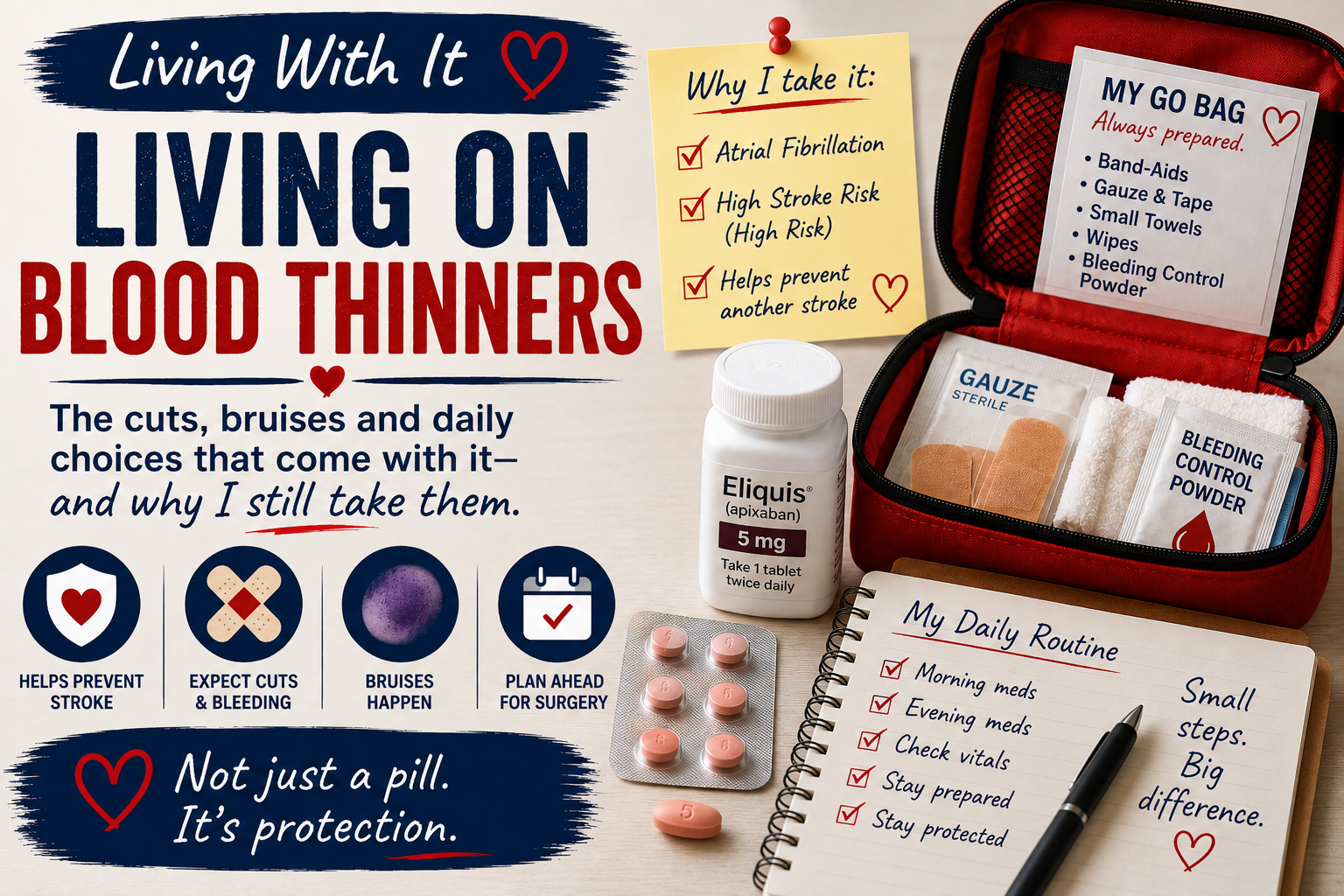
    The purpose of my anticoagulant is to reduce my risk of another stroke from AFib.

    My CHA₂DS₂-VASc score, which is one of the tools used to estimate stroke risk in people with AFib, is high enough that stroke prevention is something I take very seriously.

    I’ve already had one.

    I don’t want another.

    And that’s the perspective I try to keep when dealing with the annoying parts of living on a blood thinner.

    Because there definitely are annoying parts.

    A Tiny Cut Isn’t Always a Tiny Event

    I have somehow developed an amazing ability to cut myself doing ordinary things.

    Maybe I’m trimming something outside.

    Maybe I’m moving something around in the garage.

    Maybe I bump into something.

    I’ll look down and think:

    Where did that come from?

    Then I notice blood running down my hand or arm.

    Anticoagulants don’t literally make your blood thinner. They interfere with the body’s clotting process, which is exactly why they help prevent dangerous clots—but it also means bleeding can take longer to stop.

    I’ve learned that even a relatively minor cut sometimes requires patience, pressure and a Band-Aid.

    Or two.

    Or five.

    The Truck Stop Incident

    I learned the Band-Aid lesson while traveling.

    We stopped at a Love’s truck stop. I went inside to use the restroom before getting gas.

    Apparently, I bumped my arm against the corner of a door while walking in.

    I barely thought about it.

    I went back outside and started pumping gas.

    A little while later, some of the employees or security staff came over and asked:

    “Are you okay?”

    I was confused.

    “Yeah. Why?”

    Then they told me to look at my arm.

    Blood was running down it.

    Apparently, my insignificant little bump had opened my skin enough that I had bled while walking through the store and hadn’t even realized it.

    That was the day I learned an important lesson:

    Carry Band-Aids.

    My Little Blood-Thinner Go Bag

    Actually, I’ve gone considerably beyond Band-Aids now.

    We carry a small go bag with us almost everywhere.

    Mine includes things that can help deal with minor cuts and scrapes:

    Hopefully I don’t need any of it.

    But I’ve learned that being prepared is considerably easier than standing in a parking lot bleeding while wondering if anyone has a Band-Aid.

    It’s just part of life now.

    For anything that won’t stop bleeding with firm pressure, is deep or serious, or involves significant injury, that’s obviously beyond the job of my little go bag.

    And Then There Are the Bruises

    Bruising has become another normal part of life.

    Bump my arm?

    Bruise.

    Get blood drawn?

    Bruise.

    Have an IV in the hospital?

    There’s a pretty good chance I’ll have a colorful reminder of exactly where it was for days afterward.

    I also occasionally notice small discolored spots on my arms that come and go.

    As I get older, I expect skin changes may make some of this even more noticeable.

    I’ve seen protective sleeves designed for the arms, and that’s something I may eventually consider.

    For now, I’ve mostly accepted that unexplained bruises are occasionally going to be part of the scenery.

    Surgery Requires More Planning

    Blood thinners also make surgery and some medical procedures more complicated.

    It’s not necessarily a reason you can’t have them.

    It just means everybody involved needs to know you’re taking an anticoagulant.

    Depending on the procedure and the person’s individual risks, a doctor may instruct someone to temporarily stop an anticoagulant beforehand. Exactly when—or whether—to stop it depends on the medication, procedure, kidney function, bleeding risk and risk of developing a clot.

    That’s why this isn’t something I decide on my own.

    If I’m having surgery or a procedure, the physicians involved—including the doctor managing my anticoagulation—need to coordinate the plan.

    I don’t just stop taking Eliquis because surgery is coming up.

    The same goes for restarting it afterward.

    I follow the instructions I’m given.

    The Inconveniences Are Worth It

    I’ve mentioned quite a few negatives.

    Cuts bleed more.

    Bruises appear more easily.

    Blood draws can leave impressive marks.

    I carry first-aid supplies.

    Medical procedures require additional planning.

    And I have another medication that I need to remember twice every single day.

    But here’s the thing:

    I’ll take all of that over another stroke.

    My stroke was one of the worst experiences of my life.

    I was 53.

    I had a great job.

    I had a woodworking side hustle that I loved.

    I had great neighbors and a ton of friends.

    I was independent.

    I was self-sufficient.

    And then, sitting on the couch watching a movie, my life changed.

    The Lesson I Wish I’d Learned Earlier

    Before my stroke, I wasn’t exactly great about going to doctors.

    That’s something I look back on very differently now.

    Afterward, I also learned that I had sleep apnea. Sleep apnea is associated with AFib, and treating underlying health problems is another piece of managing cardiovascular risk.

    Could things have gone differently if I’d been getting regular medical care and my AFib had been discovered before the stroke?

    I’ll never know exactly what would have happened.

    But I certainly wish we’d had the opportunity to find it first.

    Being proactive sounds a whole lot better to me now than being reactive.

    That’s one of the biggest lessons I’ve taken from all of this.

    Go for the checkup.

    Get your blood pressure checked.

    Talk to someone about the snoring.

    Don’t ignore something because you feel fine.

    Sometimes the first sign that something is wrong is a sign you really don’t want.

    ❤️ Greg’s Take

    I’ve seen people talk about not wanting to take blood thinners because of the bleeding, bruising and inconvenience.

    I understand it.

    Nobody gets excited about adding another medication to their life.

    And anticoagulants aren’t medications to take casually. They have real risks that need to be discussed with the person prescribing them.

    But I can only speak from my experience.

    I’ve had the cuts.

    I’ve had the bruises.

    I’ve bled through a truck stop without realizing it.

    I carry Band-Aids everywhere.

    I’ve turned taking Eliquis twice a day into a ritual.

    And I’ll keep doing it.

    Because I’ve also had a stroke.

    The Band-Aids are easier.

    If taking a couple of pills every day, carrying some first-aid supplies and dealing with an occasional ugly bruise helps reduce my risk of going through that again, I know which one I’m choosing.

    Every single time.


    Affiliate Disclosure

    This article contains Amazon affiliate links. If you purchase something through one of these links, I may earn a small commission at no additional cost to you. I personally use the products I’ve linked in this article and am sharing them because they’ve been useful to me. I have purchased these with my own money. Purchasing through my links helps support He’s Knocking on My Door and allows me to continue creating content.

    Medical Disclaimer

    This article describes my personal experience with atrial fibrillation, stroke and anticoagulant medication. It is not medical advice. Anticoagulants can cause serious bleeding and should be taken exactly as prescribed. Never stop, skip, restart or change an anticoagulant because of something you read here. If you’re preparing for surgery or another procedure, your healthcare team should provide specific instructions about your medication. Seek urgent medical attention for serious or uncontrolled bleeding, a significant head injury, or symptoms of a possible stroke.

  • Blackened Mahi Mahi: Bringing One of My Favorite Foods Back

    Blackened Mahi Mahi: Bringing One of My Favorite Foods Back

    Sometimes a recipe is about more than what’s for dinner.

    For me, blackened mahi mahi is tied to a much bigger part of my story.

    After my stroke in 2020, my doctors gave me a long list of lifestyle changes to consider. Some were fairly simple, like switching to an electric razor because I was taking blood thinners and needed to reduce the chance of cutting myself.

    Others involved bigger changes—eating healthier, exercising, losing weight, and being more careful about injuries and falls.

    At the time, I was probably in the worst physical shape of my life. I was driving an hour and a half each way to and from work, spending far too much time sitting, and not taking particularly good care of myself.

    To make matters worse, my stroke recovery happened during a Midwestern winter.

    Because I was taking a blood thinner, my doctors were understandably concerned about what could happen if I slipped on the ice and hit my head. One suggestion was that I wear a bicycle helmet when I went outside.

    At first, I thought they meant during the early part of my recovery.

    Nope.

    They meant going forward.

    I understood the reasoning. A fall and head injury while taking a blood thinner can be serious.

    But I also knew myself.

    I wasn’t going to spend every Midwestern winter walking around outside wearing a bicycle helmet.

    Something had to change.

    Trading Midwest Winters for Southwest Florida

    After I recovered enough from the stroke, my wife and I made a major life decision.

    We were moving to Southwest Florida.

    It was a place we had vacationed and loved, and we decided it was where we wanted to live.

    There were plenty of reasons for the move, but I’ll admit that food was one of them.

    We love seafood.

    Fresh fish. Shrimp. Outdoor restaurants. Sitting near the water and enjoying a meal in the Florida sunshine.

    And one of our absolute favorites has always been blackened fish and blackened shrimp.

    Unfortunately, my health journey wasn’t finished with me yet.

    Several years after the stroke, congestive heart failure entered the picture, and eventually I found myself living on a very restrictive low-sodium diet.

    Suddenly, those blackened seafood dinners I loved became a thing of the past.

    Blackened Didn’t Have to Mean Gone

    Restaurant blackening seasoning is something I generally avoid now because I don’t have enough control over how the food is seasoned or how much sodium is in it.

    For a while, I thought blackened fish might simply become another food I’d have to give up.

    Then I started looking at the problem differently.

    Maybe I didn’t have to give up blackened fish. Maybe I just needed to change how I made it.

    That’s exactly what we did.

    I found a Blackened Mahi Mahi recipe from Valerie Brunmeier at Valerie’s Kitchen that we really enjoy. Her recipe uses mahi mahi cooked quickly in a hot skillet with butter and olive oil, then finished with fresh lemon juice. 

    Original Blackened Mahi Mahi Recipe at Valerie’s Kitchen

    But there’s one important change I make.

    My Low-Sodium Modification

    Valerie’s original recipe calls for a homemade Cajun seasoning mixture that includes salt. 

    Instead of making that seasoning mixture, I substitute Tony Chachere’s No Salt Seasoning Blend.

    That’s it.

    I still follow the basic cooking method from the original recipe, but replacing the blackening seasoning allows me to better control the sodium in the meal.

    I’ve already written about the seasoning and why it’s become one of my Helpful Finds:

    Tony Chachere’s No Salt Seasoning – My Helpful Find

    The original mahi mahi recipe is incredibly quick, too. Valerie lists about 10 minutes of preparation and 8 minutes of cooking time. The fish is seasoned, cooked in a hot skillet until golden and cooked through, and finished with fresh lemon. 

    It’s exactly the kind of meal I like: simple, fast and full of flavor.

    The Sodium Difference Matters to Me

    Here’s where making the meal at home really becomes important.

    The original recipe’s published nutrition information estimates 540 mg of sodium per serving, although Valerie notes that the nutrition calculation is only an estimate and actual values depend on the ingredients used. 

    By eliminating the salt-containing seasoning mixture and using my no-salt seasoning instead, I can remove a significant source of added sodium from the recipe.

    That doesn’t necessarily make the finished dish completely sodium-free—the fish, butter and other ingredients can contain naturally occurring or added sodium depending on what you buy—but it gives me much more control over the final meal.

    And control has become incredibly important to me.

    At a restaurant, I don’t know exactly what’s going onto that piece of fish.

    At home, I do.

    This Is What Low-Sodium Living Means to Me

    I’ve talked before about how frustrating a low-sodium diet can be.

    There are foods I simply don’t eat anymore.

    There are restaurants I don’t visit anymore.

    There are things I miss.

    But I’m also learning that before I put something permanently on the can’t-have-it-anymore list, it’s worth asking one question:

    Can I make it differently?

    That’s what happened with bread. Store-bought bread was difficult to fit into my sodium goals, so we bought a bread machine and started making our own.

    It’s what happened with spaghetti sauce.

    And now it’s what we’ve done with blackened seafood.

    I’m not pretending my version is identical to sitting at a waterfront restaurant in Southwest Florida and ordering a heavily seasoned piece of blackened mahi mahi.

    But I can sit at home, enjoy a piece of fish with the flavors I love, and know exactly what went into it.

    I’ll take that trade.

    ❤️ Greg’s Take

    My health has changed tremendously since that stroke in 2020.

    So has the way I live.

    And definitely the way I eat.

    But one thing I’m trying very hard not to do is look at every dietary restriction as another thing being taken away from me.

    Sometimes there’s another way.

    This blackened mahi mahi is a perfect example.

    I didn’t have to give up one of my favorite Florida meals. I just had to learn how to make it differently.

    And when you’re living with chronic illness, getting one of those little pieces of normal life back can mean an awful lot.


    Recipe Credit

    The original Blackened Mahi Mahi recipe was created by Valerie Brunmeier of Valerie’s Kitchen. I’m sharing my personal experience and the low-sodium substitution I use when making it at home. Please visit Valerie’s site for the complete ingredient list, measurements, and cooking instructions. 

    Get the Original Blackened Mahi Mahi Recipe

    Disclaimer: This article reflects my personal experience with low-sodium cooking and the modifications I make to recipes while living with chronic illness. It is not medical or nutritional advice. Sodium needs can vary from person to person, so always check ingredient labels and follow the guidance of your own doctor, dietitian, or healthcare team. Product ingredients and nutrition information can also change over time.

  • You Are Your Best Advocate

    You Are Your Best Advocate

    You Are Your Best Advocate

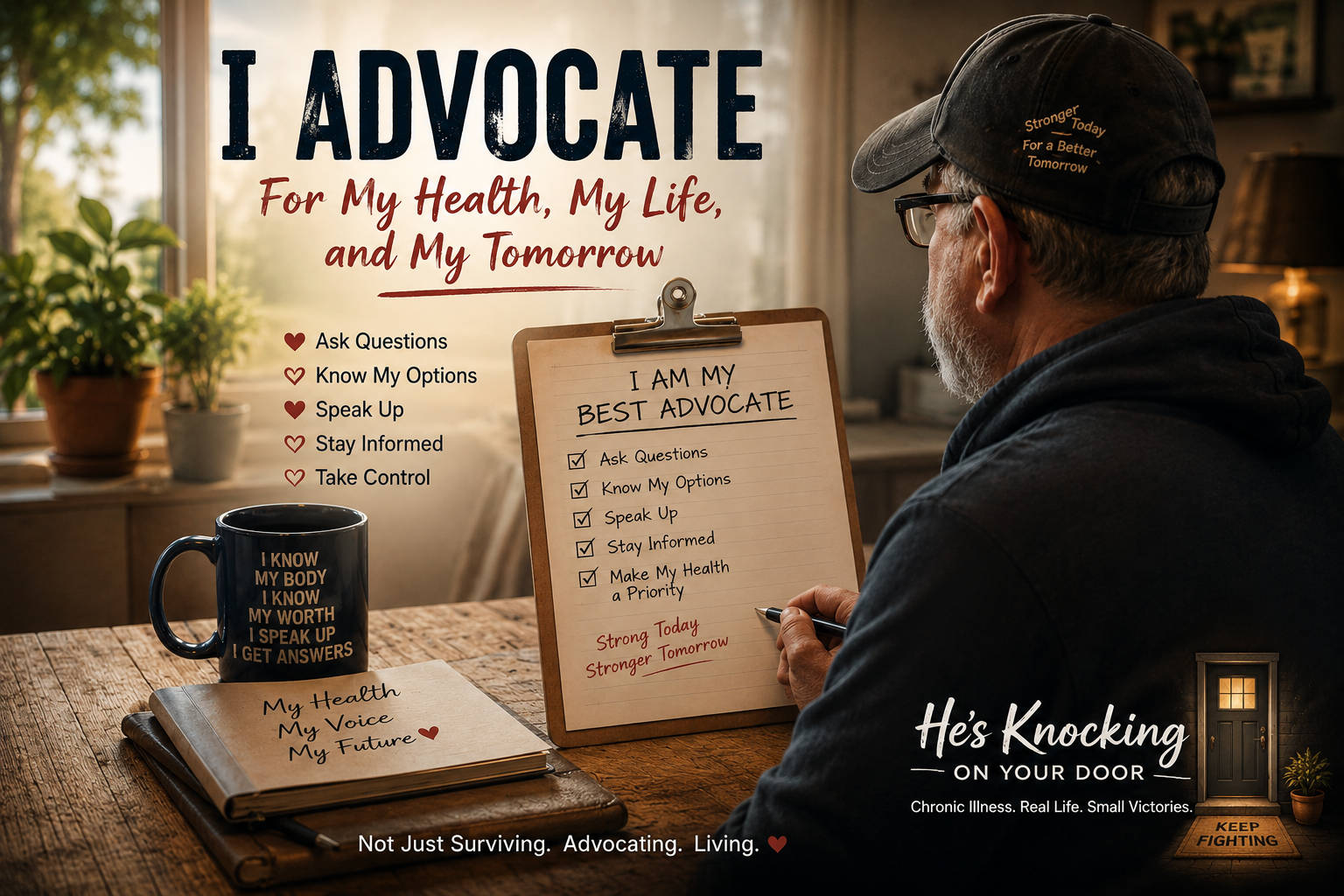
    One thing I’ve learned through this journey is that no one is going to advocate for my health more than I will.

    Living with chronic illnesses means I don’t just have one doctor. I have a cardiologist, nephrologist, primary care physician, specialists, nurses, technicians, pharmacists, therapists, and the occasional emergency room physician. Every one of them is an important part of my healthcare team.

    But they’re exactly that—a team.

    Each of them sees only a piece of the puzzle.

    They may have access to my medical records, but they don’t live in my body. They don’t know how I felt when I walked across the grocery store yesterday. They don’t know that I woke up at 12:30 this morning and never got back to sleep. They don’t know the subtle changes I’ve noticed over the past week unless I tell them.

    That’s why I’ve learned to speak up.

    When I was first diagnosed with congestive heart failure (CHF), atrial fibrillation (AFib), chronic kidney disease (CKD), diabetes, and arthritis, the medical terminology felt like learning a foreign language. I assumed the doctors would simply tell me what to do and everything would work out.

    It doesn’t work that way.

    Healthcare is often a partnership, and partnerships only work when both sides participate.

    I’ve spent countless hours learning about my conditions. I read. I ask questions. I research. Before appointments, I often use ChatGPT to help me understand medical terms, learn about upcoming tests, organize my thoughts, and build a list of questions I want to ask. It doesn’t replace my doctors or medical advice, but it helps me have more informed conversations with them.

    I’ve found that understanding why something is being recommended is just as important as knowing what is being recommended.

    One experience really drove this lesson home.

    During a recent trip to the emergency room, the staff was preparing to start intravenous fluids. That’s a routine treatment for many patients, but because I have congestive heart failure and carefully monitor my fluid intake, I stopped them and explained my situation.

    They listened.

    They reviewed my history.

    The plan changed.

    No one was upset. In fact, it became a reminder that even excellent healthcare professionals are caring for many patients, each with unique medical histories. They simply can’t know every detail unless we tell them.

    That’s why our voice matters.

    Advocating for yourself doesn’t mean arguing with your doctor or pretending you know more than they do. It doesn’t mean refusing treatment because you read something on the internet.

    It means asking questions.

    It means saying, “Can you help me understand why we’re doing this?”

    It means telling them when something doesn’t feel right.

    It means making sure they know about every condition, every medication, every symptom, and every concern.

    I’ve also learned there is a fine line to walk.

    Some medical professionals welcome questions. Others may seem rushed or uncomfortable when patients ask too many. I’ve experienced both. My goal has never been to challenge someone’s expertise or prove them wrong. My goal is much simpler than that.

    I want to understand the decisions being made about my body.

    Because at the end of the day, I live with the consequences—not my doctor.

    If you are living with one chronic illness—or several—don’t be afraid to become a student of your own health. Learn the terminology. Keep good records. Ask respectful questions. Speak up when something doesn’t seem right.

    One habit that has helped me tremendously is keeping notes on my iPhone. Whenever I think of a question, notice a new symptom, experience a side effect, or want to remember something for my next appointment, I open the Notes app and write it down.

    I’ve learned that I never trust my memory anymore. If I don’t write it down, there’s a good chance I’ll forget it when I’m sitting in the exam room. That’s not because I’m getting older—it’s because living with multiple chronic illnesses means there are simply too many things to keep straight in my head.

    By the time I see my doctor, I have an organized list instead of trying to remember everything from memory.

    The same notes are invaluable when a doctor’s office calls unexpectedly. Instead of scrambling to remember what I wanted to ask, I already have my questions, symptoms, medications, and concerns right in front of me. It helps me stay focused and makes sure I don’t forget something important once the conversation starts.

    I’ve found that walking into an appointment prepared not only helps me, but it helps my doctors too. Our conversations become more productive because we’re discussing facts instead of trying to remember details from weeks ago.

    Bring someone with you if it helps, especially if you’re facing an important diagnosis or a difficult decision. Another set of ears can catch details you might miss and help you remember what was discussed after the appointment is over.

    Being your own advocate isn’t about distrusting doctors or challenging every recommendation. It’s about partnership. The best care happens when knowledgeable medical professionals and informed patients work together toward the same goal.

    Your doctors bring years of education and experience.

    You bring the one thing no one else can.

    You live this life every single day.

    That makes your voice one of the most important ones in the room.

    If there’s one thing I hope you take away from my story, it’s this:

    No one will ever care more about your health than you do.

    So ask the question.

    Take the note.

    Speak up.

    Because your voice matters.