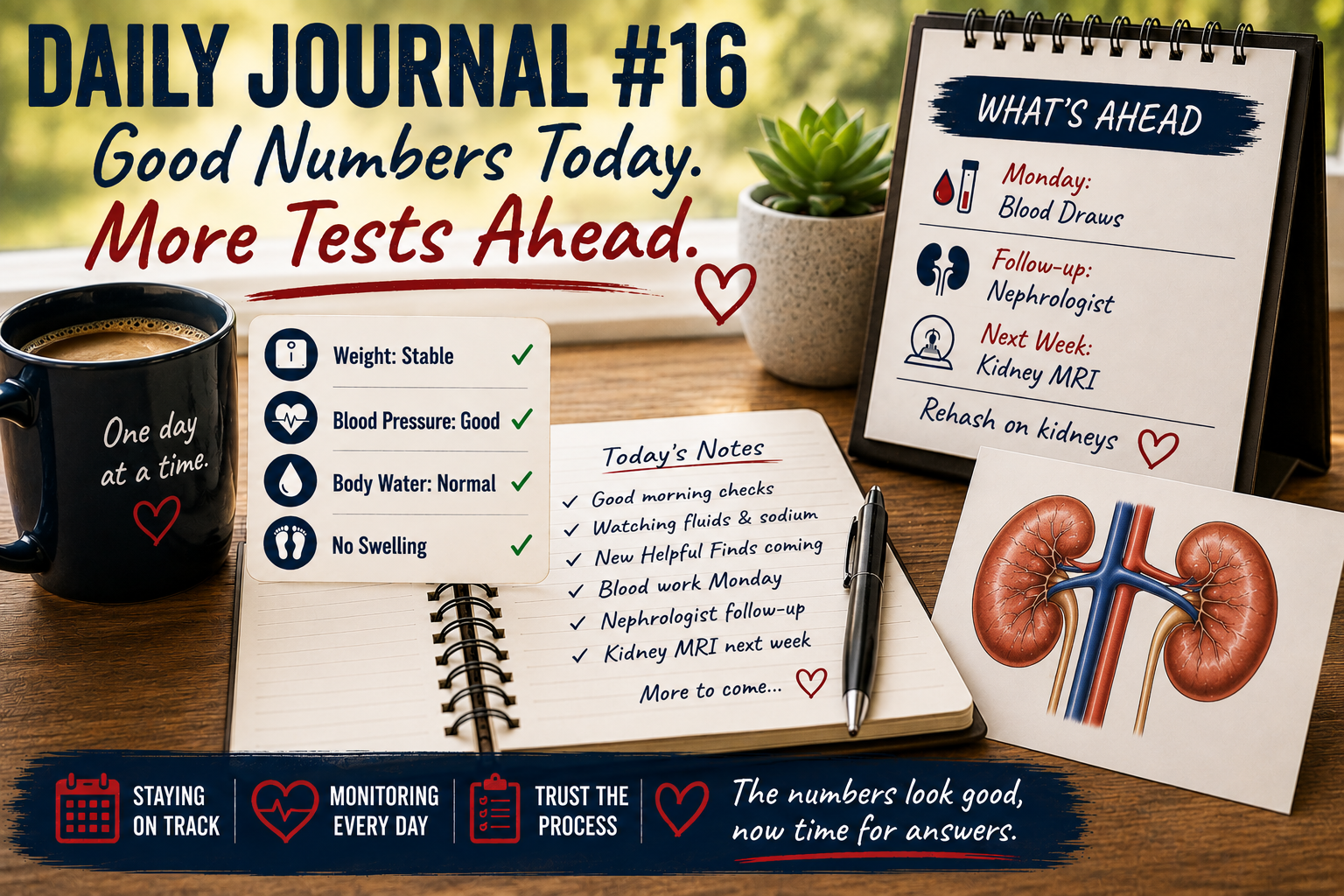
This morning’s health numbers were good.
Actually, they were all pretty much spot on.
My blood pressure looked good.
My heart rate looked good.
My glucose looked good.
And I even dropped a little more weight.
After all of the ups and downs lately, I’ll take a morning like that without complaint.
Nephrologist Appointment Today
I had my nephrology appointment today, and it was very encouraging.
He examined me and didn’t see any signs of fluid retention.
That is definitely a plus.
After the recent weight fluctuations, swelling, and concern about whether I was holding onto fluid again, hearing that was reassuring.
We also talked about the MRI I have scheduled for Monday.
I’ve obviously been anxious about it.
He reviewed my kidney ultrasound again and told me not to sweat it.
His explanation actually helped.
He compared the ultrasound to looking at something from a distance.
You can see the general picture, but you can’t necessarily see all of the fine details.
The MRI is more like getting up close.
It will allow them to look at everything in much greater detail and hopefully answer the remaining questions.
That made the whole thing feel a little less ominous.
It sounds like the MRI is really about making sure they have the clearest possible picture.
Either way, I get it done Monday.
Hopefully, after that, we can finally start putting this whole AKI episode behind me.
I Want to Write More About the AKI
Once I get through all of this, I’m planning to write a full article about my acute kidney injury.
Not because I think everyone’s experience will be the same as mine.
It won’t.
But I think there is value in explaining what happened to me, how quickly my kidney numbers changed, what contributed to it, what my doctors looked for, and what I learned from the experience.
Before this happened, I knew what an AKI was in general terms.
I didn’t really understand how quickly it could happen or how something being used to help one medical condition could potentially create a problem somewhere else.
That balancing act has probably been one of the biggest lessons of this entire experience.
The Radiology Instructions
The radiology department also called with instructions for Monday.
One of the instructions is that I need to drink 32 ounces of water about 30 minutes before the MRI.
That kind of sucks.
With the fluid limit I normally follow, 32 ounces is a huge chunk of my daily allowance.
It’s a little over 60 percent of what I normally drink in an entire day.
So I’m going to have to plan around that.
This isn’t me deciding to suddenly increase my fluid intake. These are the instructions I was given for the test, and I’ll follow the instructions from the people taking care of me.
At this point, I just want to get the MRI done and get some answers.
Anxious and Optimistic
Even with a very reassuring appointment today, I’m still anxious.
I think that is probably going to be there until the MRI is finished and someone tells me exactly what they see.
But I’m also optimistic.
My health numbers were good this morning.
My weight is still moving in the right direction.
My nephrologist didn’t see any signs of fluid retention.
And he didn’t seem overly concerned about what he saw on the ultrasound.
Those are all positives.
So Monday is the next hurdle.
Get the MRI.
Get the results.
And hopefully put one more medical scare in the rearview mirror.
Medical Disclaimer
This journal reflects my personal health experience and the treatment and testing plan developed specifically for me by my healthcare providers. Nothing in this article should be considered medical advice, diagnosis, or a recommendation to change your medications, fluid intake, sodium intake, testing, or treatment. Instructions for imaging studies, including how much fluid to drink before an MRI or other procedure, may vary depending on the test and the individual patient. Always follow the instructions provided by your own healthcare team and radiology department. Acute kidney injury, fluid retention, changes in kidney function, and related symptoms can have many different causes and should be evaluated by qualified healthcare professionals.