Sometimes a recipe is about more than what’s for dinner.
For me, blackened mahi mahi is tied to a much bigger part of my story.
After my stroke in 2020, my doctors gave me a long list of lifestyle changes to consider. Some were fairly simple, like switching to an electric razor because I was taking blood thinners and needed to reduce the chance of cutting myself.
Others involved bigger changes—eating healthier, exercising, losing weight, and being more careful about injuries and falls.
At the time, I was probably in the worst physical shape of my life. I was driving an hour and a half each way to and from work, spending far too much time sitting, and not taking particularly good care of myself.
To make matters worse, my stroke recovery happened during a Midwestern winter.
Because I was taking a blood thinner, my doctors were understandably concerned about what could happen if I slipped on the ice and hit my head. One suggestion was that I wear a bicycle helmet when I went outside.
At first, I thought they meant during the early part of my recovery.
Nope.
They meant going forward.
I understood the reasoning. A fall and head injury while taking a blood thinner can be serious.
But I also knew myself.
I wasn’t going to spend every Midwestern winter walking around outside wearing a bicycle helmet.
Something had to change.
Trading Midwest Winters for Southwest Florida
After I recovered enough from the stroke, my wife and I made a major life decision.
We were moving to Southwest Florida.
It was a place we had vacationed and loved, and we decided it was where we wanted to live.
There were plenty of reasons for the move, but I’ll admit that food was one of them.
We love seafood.
Fresh fish. Shrimp. Outdoor restaurants. Sitting near the water and enjoying a meal in the Florida sunshine.
And one of our absolute favorites has always been blackened fish and blackened shrimp.
Unfortunately, my health journey wasn’t finished with me yet.
Several years after the stroke, congestive heart failure entered the picture, and eventually I found myself living on a very restrictive low-sodium diet.
Suddenly, those blackened seafood dinners I loved became a thing of the past.
Blackened Didn’t Have to Mean Gone
Restaurant blackening seasoning is something I generally avoid now because I don’t have enough control over how the food is seasoned or how much sodium is in it.
For a while, I thought blackened fish might simply become another food I’d have to give up.
Then I started looking at the problem differently.
Maybe I didn’t have to give up blackened fish. Maybe I just needed to change how I made it.
That’s exactly what we did.
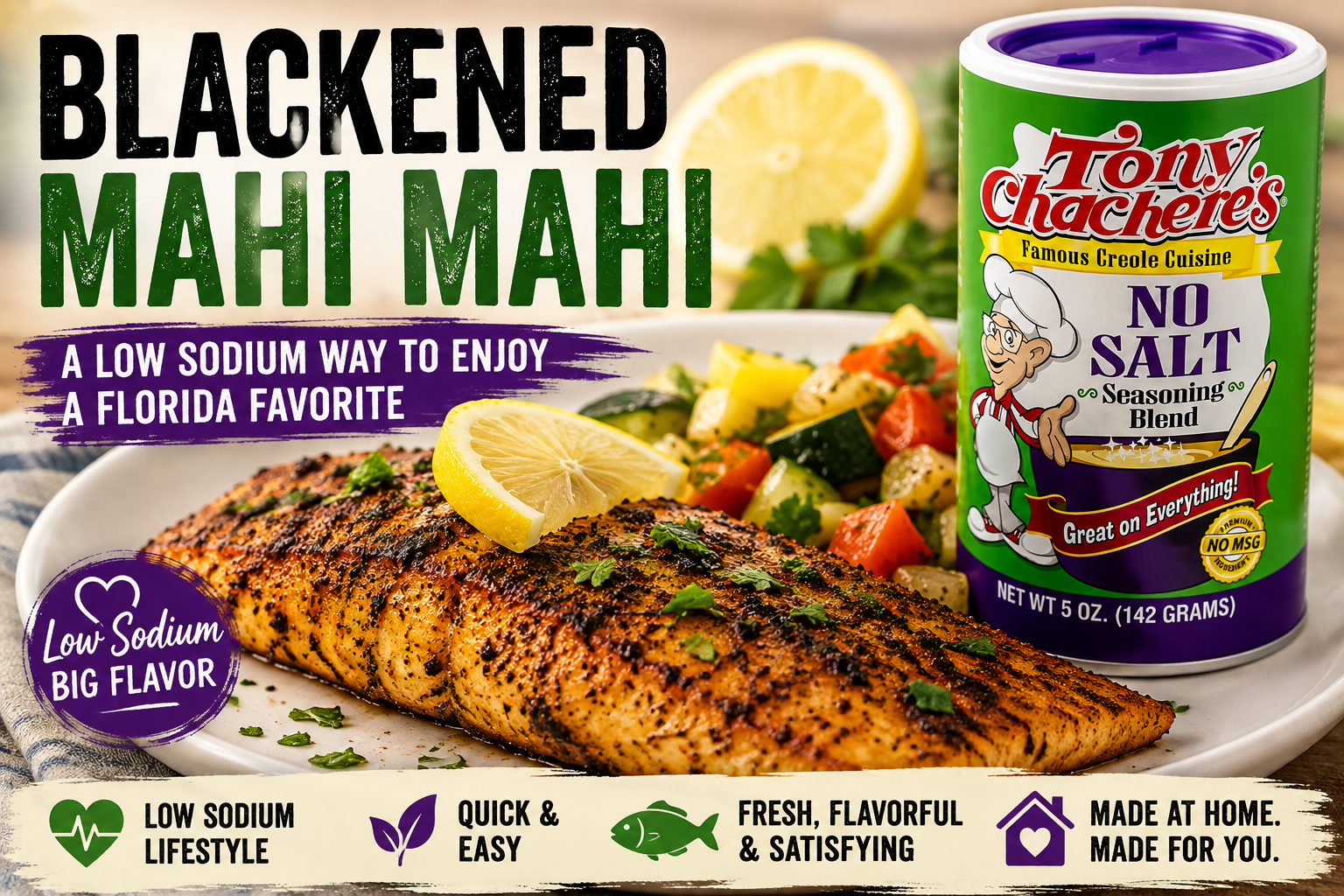
I found a Blackened Mahi Mahi recipe from Valerie Brunmeier at Valerie’s Kitchen that we really enjoy. Her recipe uses mahi mahi cooked quickly in a hot skillet with butter and olive oil, then finished with fresh lemon juice.
Original Blackened Mahi Mahi Recipe at Valerie’s Kitchen
But there’s one important change I make.
My Low-Sodium Modification
Valerie’s original recipe calls for a homemade Cajun seasoning mixture that includes salt.
Instead of making that seasoning mixture, I substitute Tony Chachere’s No Salt Seasoning Blend.
That’s it.
I still follow the basic cooking method from the original recipe, but replacing the blackening seasoning allows me to better control the sodium in the meal.
I’ve already written about the seasoning and why it’s become one of my Helpful Finds:
Tony Chachere’s No Salt Seasoning – My Helpful Find
The original mahi mahi recipe is incredibly quick, too. Valerie lists about 10 minutes of preparation and 8 minutes of cooking time. The fish is seasoned, cooked in a hot skillet until golden and cooked through, and finished with fresh lemon.
It’s exactly the kind of meal I like: simple, fast and full of flavor.
The Sodium Difference Matters to Me
Here’s where making the meal at home really becomes important.
The original recipe’s published nutrition information estimates 540 mg of sodium per serving, although Valerie notes that the nutrition calculation is only an estimate and actual values depend on the ingredients used.
By eliminating the salt-containing seasoning mixture and using my no-salt seasoning instead, I can remove a significant source of added sodium from the recipe.
That doesn’t necessarily make the finished dish completely sodium-free—the fish, butter and other ingredients can contain naturally occurring or added sodium depending on what you buy—but it gives me much more control over the final meal.
And control has become incredibly important to me.
At a restaurant, I don’t know exactly what’s going onto that piece of fish.
At home, I do.
This Is What Low-Sodium Living Means to Me
I’ve talked before about how frustrating a low-sodium diet can be.
There are foods I simply don’t eat anymore.
There are restaurants I don’t visit anymore.
There are things I miss.
But I’m also learning that before I put something permanently on the can’t-have-it-anymore list, it’s worth asking one question:
Can I make it differently?
That’s what happened with bread. Store-bought bread was difficult to fit into my sodium goals, so we bought a bread machine and started making our own.
It’s what happened with spaghetti sauce.
And now it’s what we’ve done with blackened seafood.
I’m not pretending my version is identical to sitting at a waterfront restaurant in Southwest Florida and ordering a heavily seasoned piece of blackened mahi mahi.
But I can sit at home, enjoy a piece of fish with the flavors I love, and know exactly what went into it.
I’ll take that trade.
❤️ Greg’s Take
My health has changed tremendously since that stroke in 2020.
So has the way I live.
And definitely the way I eat.
But one thing I’m trying very hard not to do is look at every dietary restriction as another thing being taken away from me.
Sometimes there’s another way.
This blackened mahi mahi is a perfect example.
I didn’t have to give up one of my favorite Florida meals. I just had to learn how to make it differently.
And when you’re living with chronic illness, getting one of those little pieces of normal life back can mean an awful lot.
Recipe Credit
The original Blackened Mahi Mahi recipe was created by Valerie Brunmeier of Valerie’s Kitchen. I’m sharing my personal experience and the low-sodium substitution I use when making it at home. Please visit Valerie’s site for the complete ingredient list, measurements, and cooking instructions.
Get the Original Blackened Mahi Mahi Recipe
Disclaimer: This article reflects my personal experience with low-sodium cooking and the modifications I make to recipes while living with chronic illness. It is not medical or nutritional advice. Sodium needs can vary from person to person, so always check ingredient labels and follow the guidance of your own doctor, dietitian, or healthcare team. Product ingredients and nutrition information can also change over time.