Category: Featured Article

  • The Things I Took for Granted

    The Things I Took for Granted

    Walking through Home Depot.

    Grocery shopping.

    Standing in the kitchen.

    Fixing something around the house.

    Going out for dinner with friends.

    These are not exactly bucket-list activities.

    Before I got sick, I wouldn’t have given any of them a second thought.

    Now?

    They are some of the things I miss the most.

    I Thought I Was Invincible

    Before all of this happened, I thought I was pretty much invincible.

    I was always a bigger guy, but I never really let that stop me from doing anything.

    I had a full-time day job, but I almost always had some kind of side hustle going too.

    My last one became a pretty successful woodworking business.

    I made small furniture, mostly farmhouse-style pieces.

    I also had a CNC machine that I used to make signs, plaques, games, decorative pieces, and details for some of the furniture.

    So I would work my regular job during the day and then spend nights and weekends in the shop.

    I didn’t sleep much.

    Not because I couldn’t.

    Because I was always doing something.

    Looking back now, it feels like that guy lived somebody else’s life.

    Then COVID Changed Everything

    COVID slowed the woodworking business down considerably.

    A lot of things were shut down, customers weren’t spending the same way, and eventually I scaled the business back.

    I moved out of my shop and back into my garage.

    Then, in late 2020, I had a stroke.

    That changed everything.

    I had to learn how to communicate again.

    My brain still works differently today.

    I have trouble finding the right words.

    I know what I want to say, but sometimes the word just isn’t there.

    I try to type something and something completely different appears on the screen.

    Even writing these articles is exercise for my brain.

    I use voice dictation a lot.

    Then I go back and edit what came out.

    Sometimes I use AI afterward to help clean up the spelling and grammar because I still mix up letters and my spelling sucks.

    Although, to be fair, maybe my spelling always sucked.

    The stroke made it impossible for me to continue doing the kind of work I had done before.

    Eventually, I took an early retirement.

    I still had kids at home.

    I still needed to help provide for my family.

    At the time, retirement was the best option I had.

    I tried other jobs afterward.

    Then the heart problems started.

    If you’ve read the other stories in the Living With It section of this website, you already know where that road went.

    First a Limp. Then a Cane. Then a Walker.

    Eventually, my hips started giving out too.

    First came the limp.

    Then the cane.

    Now I use a walker.

    I have tried walking through a grocery store using a shopping cart for support.

    At first I’m usually okay.

    By the time I get toward the end of the store, the pain can become brutal.

    Both hips are in terrible shape.

    So even when my heart might cooperate, my hips sometimes don’t.

    And when my hips cooperate?

    My heart may decide it is its turn.

    That is one of the frustrating parts about having multiple chronic conditions.

    There is always somebody waiting to tag in.

    My Heart Changed What Walking Means

    Over time, my heart problems progressively got worse.

    I have now had my aortic valve replaced.

    I have persistent atrial fibrillation.

    I developed a left bundle branch block.

    And I have HFpEF, a form of heart failure.

    Put all of that together and physical activity is not what it used to be.

    Sitting down, I can feel relatively normal.

    Then I start walking.

    Especially if it is hot and humid.

    Sometimes I become very lightheaded.

    There have been times where I have felt like I was going to pass out.

    Then comes the sweating.

    Not a little perspiration.

    I’m talking buckets.

    Then anxiety joins the party.

    That makes everything feel worse.

    Thankfully, I have been through enough cardiac testing that I understand more about what is happening to me, and I know when I need to stop and rest.

    Usually, after sitting for a while, things settle down and I can move again.

    But sometimes a walk of only 500 or 750 feet in Florida heat can completely wipe me out.

    Think about that.

    Not five miles.

    Not even one mile.

    A few hundred feet.

    I Became a Prisoner in My Own Home

    When you live with chronic illness and mobility problems, your world slowly gets smaller.

    That is one of the hardest parts to explain to somebody who has never experienced it.

    I sometimes call it being a prisoner in my own home.

    Something breaks around the house?

    Before, I would jump in the car and run to the hardware store.

    Leaky sink?

    Broken toilet valve?

    Need a piece of wire or a fitting?

    No big deal.

    Home Depot.

    Done.

    Now there are calculations involved.

    Can I walk through the store?

    How far is the parking spot?

    Will there be somewhere to sit?

    How hot is it?

    How bad are my hips today?

    Can I actually do the repair once I get home?

    So instead, I use curbside pickup.

    Or Amazon.

    Lots and lots of Amazon.

    Even doing the actual repair can be a challenge.

    Changing a toilet valve?

    Maybe.

    As long as I don’t have to get on the floor.

    Because getting down is one problem.

    Getting back up is a completely different one.

    The other day, I had to get on the floor to move some wires that the vacuum had pulled out.

    I managed to get down there.

    Getting back up?

    Not so much.

    I’m still nursing the pulled muscle from that brilliant decision.

    There are days when I just want to be normal again.

    Yes, I Know Grocery Stores Have Scooters

    Whenever I talk about not being able to walk through stores, somebody inevitably says:

    Why don’t you use one of those electric scooters?

    I do.

    They work pretty well.

    The problem is everybody else.

    Something happens when you sit down on one of those scooters.

    Apparently, you become invisible.

    People walk directly in front of you.

    They stop in the middle of an aisle.

    They cut you off.

    They stand in front of something you are clearly trying to reach.

    And unlike somebody standing there, you can’t necessarily just step around them or reach over and grab what you need.

    You are stuck.

    I understand that most people probably don’t even realize they’re doing it.

    There was probably a time when I didn’t either.

    But common courtesy seems to disappear quickly when you are the person sitting on the mobility scooter.

    Costco and Sam’s Club are probably the worst.

    If you ever hear some guy on a scooter muttering obscenities as people continually walk in front of him…

    There is a decent chance you found me.

    LOL.

    I’m honestly surprised I haven’t been kicked out yet.

    I Miss Going Out to Eat More Than I Expected

    One of the biggest things I took for granted was simply being able to eat and drink whatever I wanted.

    I was fat.

    At one point I weighed more than 400 pounds.

    So clearly, I enjoyed food.

    But food was never only about eating.

    For me, it was social.

    Meeting friends.

    Having dinner.

    Having a drink.

    Talking.

    Laughing.

    Trying a new restaurant.

    Trying food I had never had before.

    Those things were part of my life.

    Now I have HFpEF.

    My heart doesn’t relax normally, and one of the things I have to manage is fluid retention.

    Part of my treatment plan involves controlling both my sodium and fluid intake.

    Sodium makes the body hold onto water.

    That means restaurant food can be incredibly difficult for me.

    And restaurants love sodium.

    Lots of it.

    Even foods that sound harmless can have an enormous amount.

    Chicken.

    Shrimp.

    Salad dressing.

    Bread.

    Sauces.

    Seasonings.

    Soup.

    Vegetables that have already been seasoned.

    Sometimes there isn’t a realistic way for me to know exactly what I’m getting.

    So we rarely go out to eat anymore.

    And that has taken away something much bigger than restaurant food.

    It took away a social activity.

    Dinner with friends.

    Dinner with family.

    Trying a new place.

    Sitting around the table and laughing.

    That is what I miss.

    The Mundane Things Become the Important Things

    Before chronic illness, walking through Home Depot was nothing.

    Going grocery shopping was a chore.

    Standing in the kitchen cooking dinner was normal.

    Meeting somebody at a restaurant was just Tuesday night.

    I never stopped and thought:

    I should appreciate being able to do this.

    Who would?

    You don’t appreciate being able to stand at a kitchen counter until standing at a kitchen counter hurts.

    You don’t appreciate walking across a parking lot until you have to calculate whether you can make it.

    You don’t appreciate wandering through a hardware store until wandering becomes impossible.

    You don’t appreciate dinner with friends until your diet makes dinner with friends incredibly complicated.

    That is probably one of the strangest lessons chronic illness has taught me.

    The things you miss most are not always the big things.

    Sometimes you just want to walk through Home Depot.

    Will I Ever Be the Old Me Again?

    Probably not.

    That is something I am still learning to accept.

    I am hoping to get my hips replaced.

    They have been bad for a long time, and I am hoping surgery eventually allows me to walk without a cane or walker again.

    Right now, I own four walkers and a motorized scooter.

    I would love to make all of them unnecessary.

    But fixing my hips won’t fix everything.

    Heart failure is still there.

    The atrial fibrillation is still there.

    The sodium restrictions are still there.

    The fluid restrictions are still there.

    Those things have to be managed.

    And this is where I still struggle.

    If I control everything incredibly tightly, physically I may do better.

    But there is another side to living.

    Enjoyment.

    Food.

    Friends.

    Going somewhere.

    Laughing.

    Being spontaneous.

    Having a life that isn’t completely centered around medical numbers.

    That is the compromise I am still trying to figure out.

    How do you protect your health without giving up every part of life that made you happy?

    I don’t have the answer yet.

    Maybe I never will.

    But I know sitting at home waiting for the end isn’t the answer either.

    So I keep trying.

    A trip to the beach.

    Furniture store.

    Small project around the house.

    A meal I actually enjoy.

    Whatever I can manage.

    Because I may never get my old life back.

    But that doesn’t mean I’m done trying to build a life with the one I have now.

    Medical Disclaimer

    This article reflects my personal experience living with multiple chronic medical conditions and mobility limitations. It is not medical advice and should not be used to diagnose, treat, or make decisions about heart failure, atrial fibrillation, mobility problems, sodium or fluid restrictions, exercise, medications, or any other medical condition. Individual symptoms, physical limitations, and treatment plans vary significantly. If you experience chest pain, fainting or near-fainting, severe shortness of breath, new or worsening swelling, significant dizziness, or other concerning symptoms, seek appropriate medical care. Always discuss activity levels, diet, fluid restrictions, medications, and treatment decisions with your own qualified healthcare professionals.
  • The Stroke That Changed Everything

    The Stroke That Changed Everything

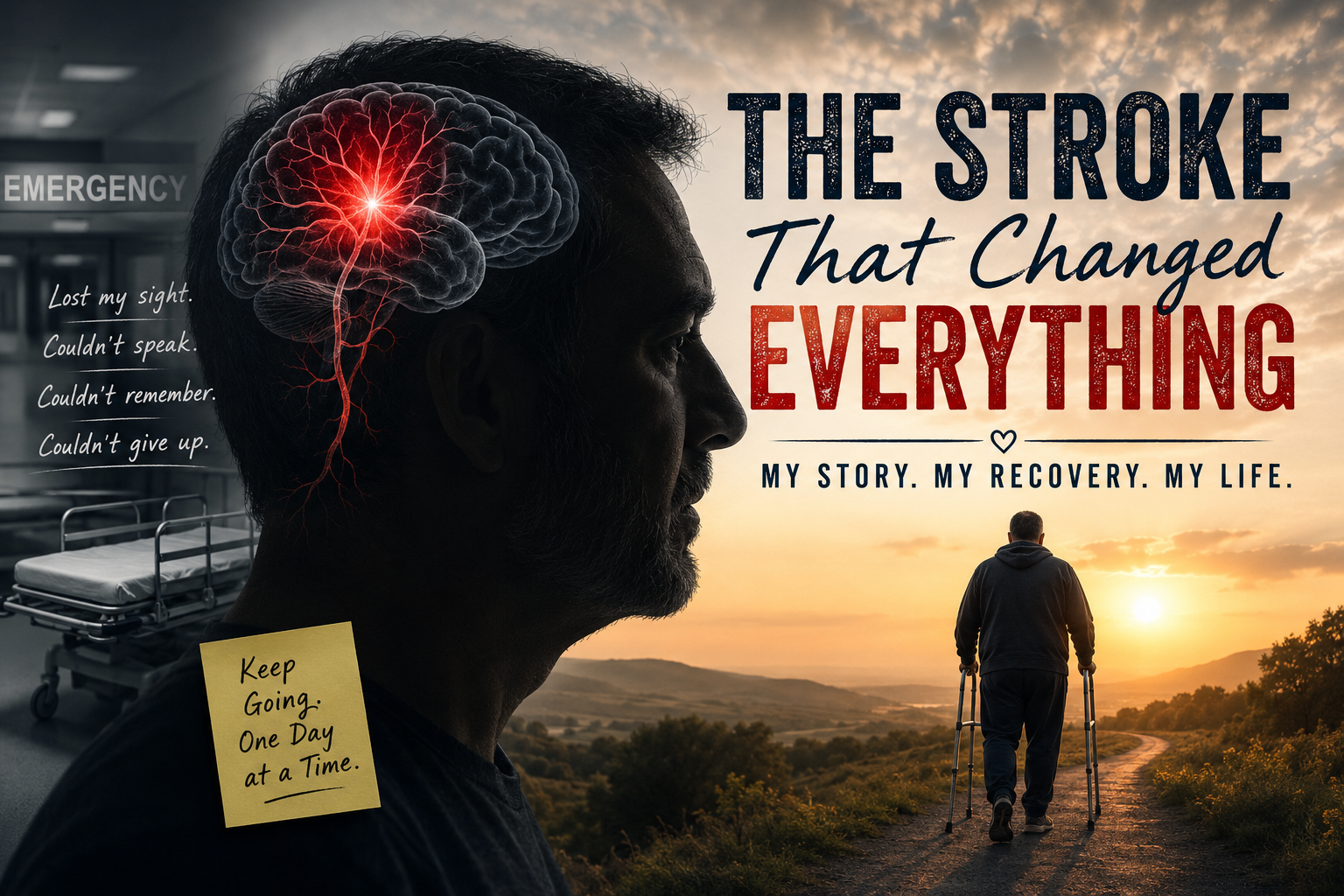
    My stroke happened in November 2020.

    It was during COVID, and I was still going into the office. Almost nobody else was there.

    One day I went to use the bathroom and, all of a sudden, I lost my eyesight.

    Completely.

    It came back moments later.

    And somehow my reaction was basically:

    Well, wasn’t that weird?

    Looking back now, that should have been a giant flashing warning sign.

    At the time, I shrugged it off.

    Nothing else really happened for the rest of the workday, so I drove home.

    That drive was about an hour and a half.

    Yes, I drove an hour and a half after temporarily losing my vision.

    I know.

    Not exactly one of my smarter decisions.

    Then Things Got Worse

    I got home, had dinner, and made myself a drink.

    My wife and I decided to watch a movie.

    At some point during the movie, I dropped my drink.

    I tried to pick the ice cubes up and put them back into the glass.

    I couldn’t.

    I kept missing.

    Then I tried to talk.

    What I was trying to say in my head was not what was coming out of my mouth.

    It was gibberish.

    It sounded like another language.

    My brilliant plan at that point was to go to bed.

    Thankfully, my wife had a better plan.

    She stopped me because she knew something was seriously wrong.

    She wanted to call 911.

    Somehow I managed to get the word “no” out.

    So she drove me to the hospital.

    We lived about a mile away.

    Looking back, yes, that was dumb too.

    If you think you are having a stroke, call 911.

    The Emergency Room

    My wife dropped me at the emergency room entrance and went to park the car.

    I could still walk.

    I went inside and tried to tell the person at the desk that I thought I was having a stroke.

    Unfortunately, I couldn’t talk properly, and I had alcohol on my breath from the drink I had made at home.

    So at first, they thought I was drunk.

    My wife came in a few minutes later and explained what had actually happened.

    Things moved pretty quickly after that.

    They still tested my blood alcohol level.

    Yes, I had been drinking.

    No, I was nowhere near legally intoxicated.

    They started doing neurological checks.

    Follow this with your eyes.

    Smile.

    Move this.

    Lift that.

    Then my face started drooping.

    I remember a nurse telling me to squeeze his fingers as hard as I could.

    In my head, I was yelling:

    I AM! I AM!

    But apparently my body wasn’t cooperating.

    Now several people were looking at me.

    My wife too.

    They were all trying to determine whether one side of my face was drooping.

    It was.

    I was having a stroke.

    When It Finally Hit Me

    I don’t remember the exact order of everything after that.

    There were scans.

    There were medications.

    I was given a clot-busting treatment, although I honestly don’t remember exactly which medication they used.

    I remember being told afterward that because of the bleeding risk, I was not going to be allowed to get out of bed for a while.

    That was the moment when it really sank in.

    WTF. This is serious.

    And I couldn’t communicate.

    That may have been the scariest part.

    I knew what I wanted to say.

    I knew what I wanted to ask.

    I just couldn’t get the words out.

    Luckily, the hospital staff that day was excellent.

    Between my wife recognizing something was wrong and the medical team acting quickly, I have no doubt they changed the outcome for me.

    They may have saved my life.

    Then Came All the Tests

    I had several scans of my head.

    There is nothing quite like spending a long time inside a scanner when you can’t communicate properly.

    Thankfully, I’m not claustrophobic.

    Then my kidneys decided to join the party.

    My kidney function dropped significantly while I was hospitalized.

    That was my first experience with a nephrologist.

    There were more tests.

    Eventually, my kidney function improved to around 50 percent.

    Looking back at everything I know now, I sometimes wonder if that was around the time my right kidney stopped functioning normally.

    I didn’t follow up with nephrology as well as I probably should have.

    My primary care doctor took the lead for a while.

    I had enough other problems being discovered.

    They found atrial fibrillation.

    They found sleep apnea.

    And then they tried putting me on the hospital CPAP machine.

    This thing looked like it was approximately the size of a Volkswagen.

    My CPAP today is about the size of a shoebox.

    Whatever prehistoric machine they brought into that hospital room was not happening.

    I already had so much going on that I basically said:

    We’ll deal with that later.

    I Was Also Over 400 Pounds

    Have I mentioned that I was fat?

    When all of this happened, I was tipping the scales at somewhere around 410 pounds.

    My diabetes was poorly controlled.

    My blood pressure was high.

    My cholesterol was terrible.

    My triglycerides were so high that at one point they couldn’t even calculate them normally.

    So now you have a 400-pound guy lying flat in a hospital bed while they are pumping fluids into him.

    Which means one thing.

    I had to pee.

    A lot.

    Because I had received clot-busting treatment, they weren’t letting me just get out of bed whenever I wanted.

    Try being over 400 pounds, lying nearly flat, and attempting to pee into one of those little hospital urinals.

    It wasn’t happening.

    During the day, my wife helped me.

    At night, I had to call the nurses.

    I cannot explain how humiliating that felt at the time.

    I apologized constantly.

    I was embarrassed about my weight.

    Embarrassed that I needed help.

    Embarrassed that someone had to help me do something as basic as urinating.

    Eventually, after a few days, I was allowed to get up and use the bathroom myself.

    At that point, that felt like a major victory.

    What the Stroke Did to My Brain

    The physical problems were only part of it.

    The stroke affected my ability to communicate and process information.

    At one point, I got my phone back.

    I remember wanting to dial a number.

    The problem was that I didn’t know what the number 7 was.

    I knew how to count.

    So I would start at one.

    One.

    Two.

    Three.

    Four.

    Five.

    Six.

    Seven.

    Then I would press what I thought was the seven.

    I did that for every digit.

    Eventually, I pressed send.

    Of course, the number was wrong.

    I also couldn’t remember what I had eaten for breakfast.

    It was French toast.

    I probably asked my wife a hundred times:

    What did I have for breakfast again?

    French toast.

    A few minutes later:

    What did I have for breakfast?

    French toast.

    I couldn’t remember my kids’ names.

    They managed to sneak in to see me during COVID restrictions.

    I smiled when I saw them.

    They were scared.

    They were younger then.

    And I was only 53 years old.

    Teaching Myself to Talk Again

    Once I got my phone back, I stayed awake practicing.

    For two days I worked on trying to teach myself how to speak again.

    By about the third day, I could start getting some words out.

    Not great words.

    Not necessarily the right words.

    But words.

    I still couldn’t dial a phone properly.

    But I was learning to communicate.

    Eventually I was moved out of the ICU and into a regular room.

    That felt like progress.

    Then came the next battle.

    They Wanted to Send Me to Rehabilitation

    A few days later, the hospital started talking about sending me to a rehabilitation facility.

    I wanted to go home.

    They didn’t think that was a particularly good idea.

    They asked how many stairs I had in my house.

    Like an idiot, I told them the truth.

    Thirteen.

    So they said I had to prove I could safely go up and down 13 stairs before they would let me go home.

    Great.

    I had barely walked farther than the bathroom in five or six days.

    Now I was going to climb stairs.

    At 400 pounds.

    After a stroke.

    A therapist strapped herself to me before we started.

    I remember looking at her and thinking:

    Lady, if I go down, you are coming with me.

    There was absolutely no way she was catching 400 pounds.

    I asked if we could go down first because we were already on an upper floor.

    She agreed.

    Truthfully, I don’t think anyone expected me to complete the test.

    If I couldn’t do the stairs, the decision was easy.

    Off to rehab.

    It probably took me 15 or 20 minutes just to get down.

    Then came the hard part.

    Going back up.

    I was exhausted.

    I was sweating.

    My heart rate was apparently going through the roof because people started looking for me after seeing what was happening on my heart monitor.

    But I kept going.

    One stair at a time.

    And I made it.

    All thirteen.

    I wasn’t going to rehab.

    Going Home Was Only the Beginning

    A day or so later, I was discharged.

    Then the real work started.

    I practiced walking.

    I practiced talking.

    And suddenly I had what felt like a million doctor appointments.

    I needed a cardiologist.

    A neurologist.

    A nephrologist.

    Speech therapy.

    Physical therapy.

    Occupational therapy to make sure I could safely take care of myself.

    The cardiologist explained that I had atrial fibrillation.

    I started taking Eliquis.

    His opinion was that the stroke was most likely caused by previously undiagnosed AFib.

    Sleep apnea may also have contributed to the overall cardiovascular picture.

    Unfortunately, that cardiologist and I never really clicked.

    I felt like all he saw when he looked at me was an extremely overweight guy who was lucky to still be alive.

    I was given blood thinners and metoprolol.

    We met a couple of times and then scheduled another appointment about six months later.

    During those six months, I lost around 80 pounds.

    When I went back, his reaction was basically:

    Wow. I didn’t think you would actually do that.

    Thanks for the confidence.

    By then, though, some of the treatment options for getting me back into a normal rhythm were apparently less straightforward.

    To this day, I remain in atrial fibrillation essentially all the time.

    Therapy Was Brutal

    The hardest part for me was therapy.

    Not because the exercises looked difficult.

    Quite the opposite.

    Some of them looked ridiculously simple.

    That made it even more frustrating.

    They would give me questions like:

    You walk into a building.

    Go up three floors.

    Down one floor.

    Then up three more.

    What floor are you on?

    That sounds easy.

    Before the stroke, I wouldn’t have given it a second thought.

    After the stroke, exercises like that could completely exhaust me.

    The therapy sessions where I had to really use my brain were the worst.

    I would finish completely wiped out.

    I also had to relearn how to participate in conversations.

    Talking with one person was difficult enough.

    Talking with two or three people at the same time?

    That was an entirely different skill.

    I had to learn how to follow who was talking.

    Process what they said.

    Remember what had already been said.

    Formulate my response.

    And then actually get the words out.

    It took me well over a year before I felt remotely comfortable having normal conversations again.

    Going Back to Work Showed Me How Much Had Changed

    Eventually, I tried going back to work.

    COVID was still going on, and in a strange way that probably helped me.

    For the first four to six months, I was able to work from home.

    That gave me some protection from the things I was still struggling with.

    But I still had meetings.

    And meetings became a whole different experience after the stroke.

    My memory was so bad that I sometimes couldn’t remember the names of the people I was talking to.

    These were people I worked with.

    People I knew.

    Yet during a meeting, their names could simply disappear from my brain.

    So I came up with a workaround.

    I put Post-it notes around my computer screen with people’s names on them.

    If I was in a meeting with someone, I could glance at the screen and remind myself who I was talking to.

    Before the stroke, that would have sounded ridiculous to me.

    After the stroke, it was how I got through the day.

    And those days wiped me out mentally.

    I could sit at a computer all day and look like I hadn’t done anything physically demanding, but my brain felt like it had run a marathon.

    Trying to listen.

    Trying to remember.

    Trying to follow the conversation.

    Trying to respond correctly.

    Trying not to let anyone see how hard I was working just to do things that had once been automatic.

    I desperately wanted to get back to where I had been before the stroke.

    I wanted the old me back.

    I kept thinking that if I pushed hard enough, worked hard enough, and practiced enough, eventually everything would return to normal.

    It didn’t.

    And eventually I had to accept that it wasn’t going to.

    Aphasia Never Completely Left

    I still deal with aphasia today.

    My brain mixes up letters.

    B and D are big ones.

    Throw in some P’s and G’s just to make things interesting.

    My texting skills still suck.

    Autocorrect saves me constantly.

    Just imagine trying to write these articles.

    I use voice dictation a lot.

    My wife helps me more than I could ever explain.

    She has been a godsend through all of my health problems, but especially after the stroke.

    I pushed myself very hard during therapy.

    Every day I practiced.

    I wanted to get back to the person I had been before the stroke.

    Eventually, I had to understand something much harder.

    That person was gone.

    Not dead.

    Not destroyed.

    But changed.

    I could improve.

    I could adapt.

    I could relearn things.

    But there wasn’t going to be a magical morning where I woke up and everything was exactly like it had been before November 2020.

    Learning to Do Things Again

    After a couple of months of formal therapy, I was eventually released.

    I could talk.

    I could think reasonably well.

    And eventually, I was cleared to drive again.

    Driving was a big one for me.

    For a while, I couldn’t do much of anything independently.

    And I hated asking for help.

    Absolutely hated it.

    I wanted to do everything myself.

    I laugh at that now.

    I am very much over that.

    Today, I know there are things I simply cannot do without help.

    Accepting that has been its own form of rehabilitation.

    Trying to Work Again

    I couldn’t return to the type of position I had before the stroke.

    Eventually, I took an early retirement.

    Later I tried working at a school fixing Chromebooks.

    The old version of me wanted to do more.

    Looking back, I probably should have been satisfied that I was able to work at all.

    But while I was working there, another problem began showing itself.

    My hips started hurting badly.

    Years of carrying more than 400 pounds had taken a toll.

    Today, both hips are severely arthritic.

    Both are essentially bone-on-bone.

    The right is worse than the left.

    I now use a walker to get around.

    Around the same time, I noticed something else.

    Walking to a classroom would leave me sweating profusely.

    Not a little sweaty.

    Buckets.

    Then I started noticing chest pain.

    That eventually opened the door to everything that came next with my heart.

    If you’ve read other articles on this site, you already know where that road eventually led.

    More doctors.

    More diagnoses.

    Aortic stenosis.

    Heart failure.

    A valve replacement.

    Kidney problems.

    And plenty of things I never expected to be dealing with before I turned 60.

    The Stroke Was the Beginning of a Different Life

    When I look back now, November 2020 feels like the point where my old life ended and this one began.

    At the time, I thought surviving the stroke was the finish line.

    It wasn’t.

    It was the starting line.

    I had to relearn how to talk.

    How to think.

    How to communicate.

    How to trust my body.

    How to ask for help.

    And eventually, how to accept that recovery doesn’t always mean becoming exactly who you were before.

    I still have aphasia.

    My left foot still doesn’t work normally.

    I still become mentally exhausted when I push my brain too hard.

    I still type the wrong letters.

    I still occasionally know exactly what I want to say and can’t find the damn word.

    But I’m still here.

    I’m writing.

    I’m talking.

    I’m driving.

    I’m learning.

    And somehow, almost six years later, I can look back at the guy who couldn’t remember what he had for breakfast and realize just how far he came.

    French toast, by the way.

    I finally remembered.

    Medical Disclaimer

    This article describes my personal experience with an ischemic stroke, atrial fibrillation, rehabilitation, and other medical conditions. It is not medical advice and should not be used to diagnose or treat stroke symptoms or any other condition. Stroke is a medical emergency. Sudden trouble speaking, facial drooping, arm or leg weakness or numbness, vision loss, severe dizziness, loss of coordination, or other sudden neurological changes require immediate emergency evaluation. Do not drive yourself or have someone else drive you if a stroke is suspected; call emergency services so treatment can begin as quickly as possible. Individual treatment, recovery, and long-term outcomes vary, and medical decisions should be made with qualified healthcare professionals.
  • TAVR: The Heart Valve That Changed My Life

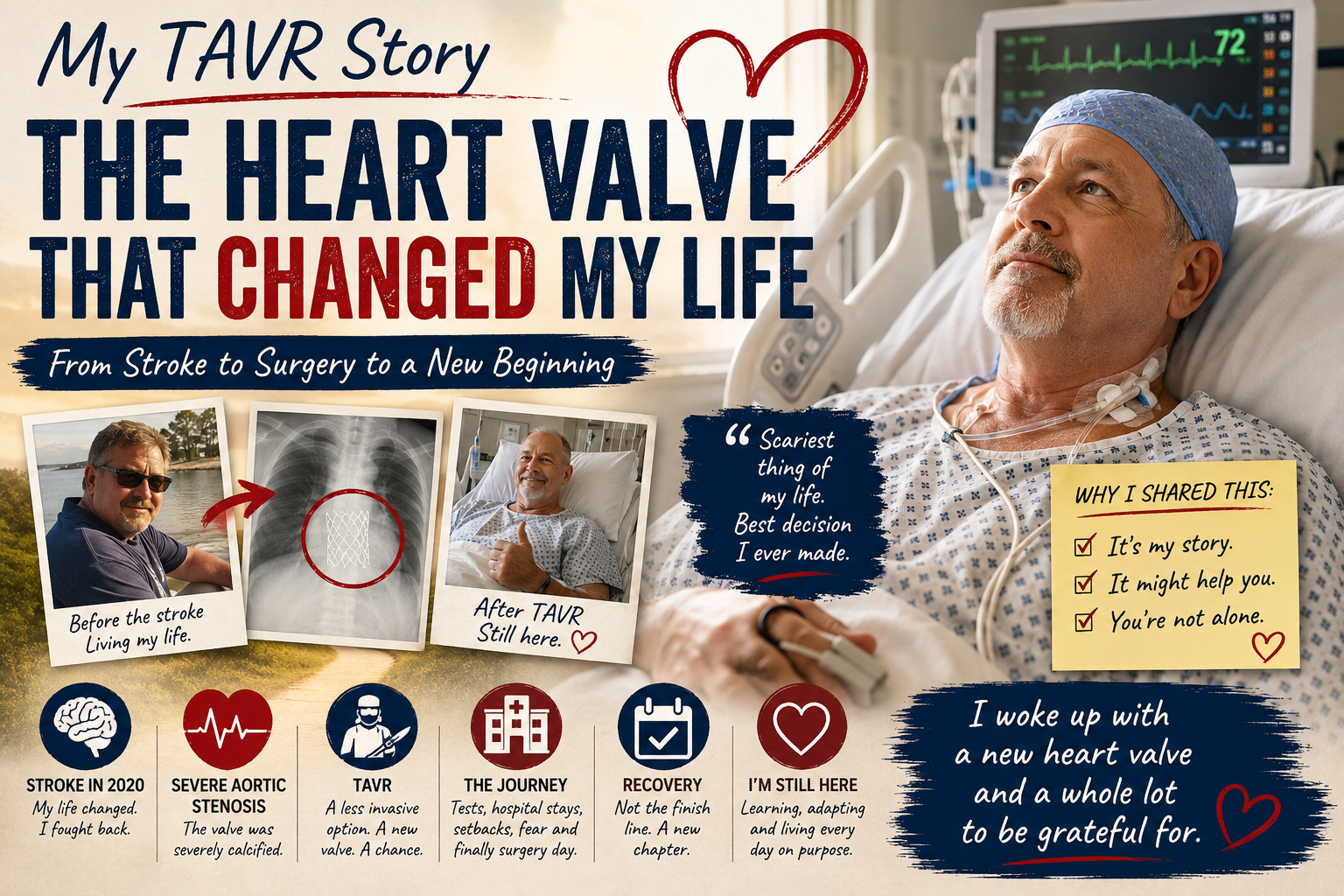
    TAVR: The Heart Valve That Changed My Life

    This is probably the hardest thing I’ve ever written about.

    I’ve talked about pieces of my health story before. I’ve written about heart failure, LBBB, medications, hospital stays, daily health checks and what it’s like trying to live with all of this.

    But this is the story that connects most of those pieces.

    My TAVR.

    And to really explain how I got there, I have to go back a little further.

    I Thought I Was Pretty Healthy

    I’ve been overweight pretty much my entire life.

    I’m not going to sugarcoat that.

    But until 2020, I considered myself relatively healthy and surprisingly limber for a big guy.

    I mean, I wasn’t Chris Farley limber, but I could hold my own.

    I took some preventative medications. I worked. I drove an hour and a half each way to work. I had hobbies. I did woodworking. I took care of things around the house.

    I lived my life.

    Then, in 2020, I had a stroke.

    Everything changed.

    The First Time My Body Changed the Rules

    Recovering from my stroke required some major lifestyle changes.

    Exercise.

    Eating better.

    No more alcohol.

    And suddenly, a whole lot more doctors.

    Did it suck?

    Hell yeah, it did.

    But there was one thing I didn’t have to do.

    I didn’t need surgery.

    I needed rehabilitation and a tremendous amount of work.

    I still remember sitting at my computer playing that card-matching game we played as kids. Two cards flip over. Try to remember where the matching card is.

    I did it for hours. It was so frustrating. I couldn’t match a card if my life depended on it.

    I was exercising my brain because I wanted it to come back faster.

    It didn’t come back faster.

    That’s another lesson I’ve learned through all of this. You can push your body as hard as you want, but sometimes your body has its own schedule.

    I desperately wanted to get back to being the person I was before the stroke.

    Eventually, I had to understand that some things had changed.

    But again:

    No surgery.

    That distinction was going to become pretty important a few years later.

    Then Came the Chest Pain

    After we moved to Southwest Florida, I had some chest pain and went to the emergency room.

    We’d only been living here for a few months, and I didn’t even have all my doctors established yet.

    Eventually, I got in with a cardiologist.

    He wanted tests.

    Lots of tests.

    One test led to another, which led to another.

    Eventually, I got the answer.

    Severe aortic stenosis.

    The aortic valve is essentially the doorway that allows blood to leave the heart and enter the body’s main artery, the aorta. With aortic stenosis, that doorway becomes narrowed. In my case, the valve had become severely calcified and wasn’t opening properly.

    This wasn’t something I could fix by eating better.

    There wasn’t a pill that was going to make my severely calcified valve normal again.

    I needed a valve replacement.

    My reaction was basically:

    Fuck. I have to have heart surgery.

    And Then I Learned I Had Heart Failure

    The testing continued.

    One piece of good news surprised the hell out of me.

    I didn’t have the coronary plaque buildup I expected.

    I’ve eaten plenty of terrible food in my lifetime.

    And plenty of bacon.

    So I’ll take the win.

    But there was another finding that wasn’t so great.

    I had heart failure—more specifically, heart failure with preserved ejection fraction, or HFpEF.

    At the time, my thinking was pretty simple:

    Fix the valve.

    Fix the problem.

    Go back to normal.

    Unfortunately, my heart had apparently not read the same brochure I had.

    I Was Terrified of Open-Heart Surgery

    I keep using the word surgery because you have to understand something about me.

    I’d never really had surgery.

    The worst things I’d dealt with were stitches and a broken hand.

    Easy fixes compared with someone opening my chest and operating on my heart.

    Then there was another complication.

    I already had significant trouble walking.

    My doctors and I discussed what recovery from open-heart surgery could look like for me. Because of my mobility problems, there was a real possibility that I would need rehabilitation afterward before I could safely manage at home.

    So now, in my head, this wasn’t just:

    Heart surgery.

    It was:

    Heart surgery + hospital + rehabilitation facility + who knows what comes after that.

    Emotionally, I was thinking:

    WTF. I’m not doing this.

    The problem was that doing nothing wasn’t exactly a great alternative.

    My father died at 54.

    I was 58.

    I’d beaten him by four years.

    That puts things into perspective pretty quickly.

    Eventually, the decision becomes remarkably simple:

    Deal with it or eventually let it kill you.

    Then We Started Talking About TAVR

    My doctors discussed another possibility with me:

    TAVR — Transcatheter Aortic Valve Replacement.

    Instead of opening the chest to replace the valve surgically, TAVR allows doctors to deliver a replacement valve through a catheter, commonly through an artery in the groin, and expand it inside the diseased aortic valve.

    It is still a major heart procedure.

    But it isn’t the same operation or recovery as traditional open-heart valve replacement.

    Because of my overall situation—including my mobility limitations—my heart team considered whether TAVR was an appropriate option.

    Then came more testing.

    Would my anatomy work?

    Were my blood vessels suitable?

    What size valve would I need?

    Was I an appropriate candidate?

    Fortunately, those answers came back in my favor.

    After the heart team reviewed everything, I was approved for TAVR.

    For the first time in a while, I felt like maybe there was a path through this.

    But First, I Had to Wait

    Living in Southwest Florida means there are plenty of people with heart problems.

    I wasn’t the only person who needed a valve.

    My procedure got pushed back.

    More than once.

    Meanwhile, my health continued deteriorating.

    I was hospitalized several times with heart-failure problems.

    My blood pressure could get extremely low.

    I struggled to manage my fluid levels.

    Diuretics created their own problems, including episodes involving my kidneys.

    I became unbelievably fatigued.

    I had episodes where I felt like I might pass out.

    Eventually, simply getting to the bathroom became an accomplishment.

    Driving was out of the question.

    I had originally been told we were looking at around June 2025.

    I finally got my new valve on:

    December 16, 2025.

    That was a long wait.

    And it gave me plenty of time to think about absolutely everything that could possibly go wrong.

    Surgery Day

    By the time December 16 arrived, I had been carrying around anxiety about this for months.

    Then suddenly it was real.

    I was scared to death.

    I was emotional.

    All sorts of thoughts were going through my head.

    Is this the last time I’m going to see my wife?

    Am I going to see my kids again?

    What if something goes wrong?

    I’m tearing up even writing this now.

    Eventually, there’s nothing left to do except put on your big-boy pants and go to the hospital.

    So that’s what I did.

    There Is No Modesty in a Hospital

    First, everything comes off.

    You get the gown.

    Then people start coming in.

    Vitals.

    Questions.

    Preparation.

    Of course, one of the nurses taking care of me was extremely attractive.

    Because why wouldn’t she be?

    Then another person comes in to shave me.

    Chest.

    Armpits.

    Down below.

    Meanwhile, the attractive nurse just keeps doing her job like absolutely nothing unusual is happening.

    There is no modesty in a hospital.

    At some point you just accept that your dignity has left the building and hope somebody gives it back at discharge.

    Heck of as first experience, naked, shaven and scared.

    Then Came the IV Disaster

    This was where my fear temporarily turned into anger.

    I’ve had trouble with IVs before, so I asked them from the beginning to use ultrasound guidance.

    They were confident they wouldn’t need it.

    Fine.

    There was supposedly a rule: two unsuccessful attempts and somebody else tries.

    Well…

    Person number one.

    Person number two.

    Person number three.

    By the time we got to person number four, I had been stuck eight times.

    These weren’t tiny little blood-draw pokes either. They needed substantial IV access for the procedure.

    My arms were up in the air.

    People were slapping them, searching for veins.

    I was pissed.

    And I wasn’t exactly keeping my opinion to myself.

    My doctors walked in while this was happening.

    They looked at me.

    Looked at each other.

    And essentially decided:

    We’ll see you in there.

    Eventually somebody brought out the ultrasound.

    They found the vein.

    I remember someone saying something along the lines of:

    “Oh, look. We were close.”

    That did not improve my mood.

    Then My Wife Came In

    Eventually, the chaos stopped.

    My wife came in.

    We talked.

    We said what we needed to say.

    And once again that thought entered my head:

    What if this is the last time I see her?

    Then she left.

    And not long after that…

    I was out.

    Apparently, I Went to Visit SpongeBob

    I don’t do recreational drugs.

    But whatever they gave me for this procedure?

    Wow.

    My memory of it is bizarre.

    I was hanging out with SpongeBob SquarePants. It must have been on the TV. I don’t even watch the show.

    Colors everywhere.

    Having a great time.

    Apparently my brain decided that if we were going to have heart surgery, we might as well spend part of it in Bikini Bottom.

    Then suddenly…

    I woke up.

    There was something like a sheet or drape over my head.

    My first thought was:

    Holy crap. Am I dead?

    So I yelled:

    “Hello?”

    I tried moving my arms.

    Couldn’t.

    Then I heard voices.

    My doctors were still there.

    They had just finished the procedure.

    I remember saying:

    “There’s a sheet over my head.”

    Then:

    “Are my hands tied?”

    There were other people in the room too.

    Here’s the important part:

    I apparently wasn’t supposed to be awake yet.

    They gave me some more medication.

    And off I went.

    Back to SpongeBob.

    Unfortunately, round two hit me considerably harder.

    I was nauseated for about three days afterward.

    “Does That Happen Often?”

    The next day I needed an echocardiogram.

    I asked the person performing it whether they had been in the room when I woke up.

    They had.

    First thing they said, “Wow, you remember that?”

    Naturally, my first question was:

    “Did I say anything bad?” I am kind of a jokester and very sarcastic.

    Because if I’m going to wake up unexpectedly while still under the influence of whatever they gave me, this seems like useful information.

    Apparently I behaved myself.

    Later I asked my surgeon whether people wake up like that very often.

    He told me he’d never personally seen it happen before.

    I was his first.

    Lucky me.

    Yet another reason I apparently need to start buying lottery tickets.

    The Valve Was In — But We Weren’t Done

    One of the attractions of TAVR is that many patients can go home relatively quickly after an uncomplicated procedure.

    That wasn’t going to be me.

    Afterward, I had to remain flat for hours while they monitored the access sites and allowed the medications used during the procedure to wear off.

    I also had temporary pacing available after the procedure.

    At this hospital, the pacing wire was through my neck.

    For a day?

    Okay.

    For several days?

    Pretty freaking uncomfortable.

    And I needed it because my heart’s electrical system wasn’t particularly happy about its new neighbor.

    My Heart Started Pausing

    After the TAVR, I developed a new electrical conduction problem:

    Left bundle branch block, or LBBB.

    I’ve written an entire article about that because it deserves its own explanation.

    The short version is that the heart’s electrical conduction system runs very close to the aortic valve. Implanting a replacement valve can sometimes disturb that system.

    My heart also started having pauses.

    Basically, there were periods when the electrical activity wasn’t doing what it was supposed to do.

    That’s why I stayed in the hospital for four days instead of heading home the next day.

    The question became:

    Do I need a permanent pacemaker?

    Fortunately, after several days of monitoring, my doctors decided I didn’t need one at that point.

    But they weren’t going to send me home and simply hope everything behaved.

    Meet My Loop Recorder

    I was given a choice about longer-term monitoring.

    I decided to have an implantable loop recorder placed under the skin in my chest.

    A loop recorder isn’t a pacemaker.

    It doesn’t pace my heart.

    It doesn’t shock me like a defibrillator.

    It watches.

    Mine communicates with my phone and allows heart-rhythm information to be transmitted for review.

    I get reports showing unusual events, including pauses and rhythm abnormalities.

    I can also mark symptoms when something unusual happens so the event can be correlated with what my heart was doing around that time.

    My heart still has pauses.

    So far, based on the monitoring and my doctors’ assessment, they haven’t resulted in a recommendation for a permanent pacemaker.

    That could change someday.

    For now?

    We watch.

    So I Got the New Valve. Am I Fixed?

    This is where reality didn’t quite match what I expected.

    The good news is very good:

    My replacement aortic valve is working well.

    Follow-up imaging has shown that the valve is functioning properly.

    That’s a huge win.

    But I still have HFpEF.

    For whatever reason, I had come away from some of those early conversations believing that replacing the valve might essentially resolve the heart failure.

    That wasn’t what happened.

    Whether I misunderstood, heard what I wanted to hear, or simply couldn’t process the enormous amount of information being thrown at me at the time, I don’t know.

    And that’s another lesson:

    Bring somebody with you.

    Appointments and hospital stays can involve an overwhelming amount of information.

    Medications.

    Numbers.

    Procedures.

    Risks.

    Options.

    Follow-ups.

    You’re scared, tired, uncomfortable and trying to remember everything someone just said.

    Having another set of ears in the room is incredibly valuable.

    Eight Months Later

    As I write this, I’m about eight months out from TAVR.

    The valve is doing its job.

    But I still have LBBB.

    I still have HFpEF.

    I still have episodes where I become extremely lightheaded and feel like I might pass out.

    Sometimes I sweat profusely.

    I’ve noticed that exertion and heat seem to play a role.

    I’m working with my doctors to understand exactly what’s happening.

    We’ve adjusted medications.

    My loop recorder continues watching my rhythm.

    When I experience something unusual, I can mark the event so there’s information available to review later.

    This isn’t something I’m trying to diagnose myself.

    That’s what my doctors and the monitoring are for.

    If you want to follow that part of the story as it happens, that’s really what my Daily Journal has become.

    Would I Do It Again?

    This was the scariest medical experience of my life.

    And this article is still the abridged version.

    There are pieces of this story that deserve their own articles, and I’ll eventually write them.

    But would I have the TAVR again?

    That’s kind of a funny question.

    Because someday, I may actually have to.

    Bioprosthetic replacement valves don’t necessarily last forever. How long an individual TAVR valve lasts depends on many factors, and because TAVR is relatively newer than surgical valve replacement, long-term durability continues to be studied.

    I’m younger than the traditional TAVR patient.

    I was 58 when mine was implanted.

    Fortunately, my anatomy and the size of the valve that was implanted may leave options if the valve eventually deteriorates.

    One possibility in selected patients is another transcatheter valve placed inside the first one—sometimes called TAVR-in-TAVR or valve-in-valve TAVR.

    Whether that’s what happens to me someday?

    Who knows.

    That’s a conversation for future me and whatever heart team is taking care of me at that point.

    Medicine changes.

    Technology changes.

    Procedures improve.

    There are treatments available today that weren’t available a generation ago.

    I’m not going to spend the next decade worrying about what valve technology might look like when I’m in my 70s.

    I’ll deal with that when I get there.

    ❤️ Greg’s Take

    I went into this thinking the new valve was going to fix me.

    That’s probably the biggest misconception I carried through the whole process.

    I imagined a finish line.

    Get the valve. Recover. Go back to normal.

    Instead, the TAVR became another starting line.

    My valve works.

    That’s something I’m incredibly grateful for.

    But I still have heart failure.

    I still have LBBB.

    I still have a loop recorder watching my heart.

    I still have pauses.

    I still have symptoms we’re trying to understand.

    I still have good days and bad days.

    And I’m still here.

    That’s really what this website is about.

    It isn’t about somebody who got sick, found the magical treatment and went back to exactly the life he had before.

    That isn’t my story.

    My story is learning how to live when the finish line keeps moving.

    It is learning what I can control and what I can’t.

    It’s learning to ask questions.

    It’s learning to bring someone with me when there are too many answers to remember.

    It’s learning that sometimes the thing you’re absolutely terrified of doing is also the thing that gives you the chance to keep going.

    On December 16, 2025, I walked—or more accurately, was wheeled—into a hospital terrified that I might never see my wife and kids again.

    I woke up with a new heart valve.

    Okay…

    I woke up with a new heart valve and apparently spent some quality time with SpongeBob SquarePants.

    Eight months later, life still isn’t easy.

    I’m not fixed.

    I’m not the person I was before my stroke.

    I’m not even the person I thought I’d be after TAVR.

    But I’m still here.

    And for now?

    That’s enough.


    Medical Disclaimer

    This article describes my personal experience with severe aortic stenosis, heart failure and TAVR. It is not medical advice and should not be used to decide whether TAVR, open-heart surgery or any other treatment is appropriate for you. Every patient’s heart condition, anatomy, surgical risk and medical history are different. Treatment decisions should be made with your cardiologist and heart-valve team. If you have chest pain, fainting, severe shortness of breath or symptoms that may represent a medical emergency, seek immediate medical care.

  • Living With Blood Thinners: The Cuts, Bruises and Why I Still Take Them

    Living With Blood Thinners: The Cuts, Bruises and Why I Still Take Them

    I never expected a dropped drink to change my life.

    It was 2020, and I was sitting at home watching a movie with my wife when I dropped what I was drinking.

    I bent over and tried to put the ice cubes back into the cup.

    I couldn’t do it.

    I kept missing.

    I remember thinking:

    That’s weird.

    Then I tried to say something to my wife.

    I knew exactly what I wanted to say. The words were perfectly clear in my head.

    But what came out of my mouth was garbled and made absolutely no sense.

    My wife immediately knew something was wrong.

    She wanted to call 911.

    I refused.

    Yes, I know. She was right.

    I’m a guy. Going to the hospital was apparently the compromise I was willing to make at the time.

    Another story for another day.

    Fortunately, we lived less than a mile from the hospital. It was basically down the street and a left at the next stoplight.

    I was having a stroke.

    That’s When I Found Out I Had AFib

    During everything that followed, I learned something else:

    I had atrial fibrillation, commonly called AFib.

    AFib is an abnormal heart rhythm in which the heart’s upper chambers—the atria—don’t beat in a normal, coordinated rhythm. Instead, the electrical activity becomes irregular.

    One of the serious risks associated with AFib is stroke.

    When blood isn’t moving normally through the atria, it can pool and form a clot. If a clot leaves the heart and travels to the brain, it can block blood flow and cause an ischemic stroke.

    That was suddenly no longer an abstract medical explanation to me.

    I had lived it.

    I was fortunate that I was sitting at home when my stroke happened.

    I sometimes think about what could have happened if I’d been driving instead.

    Another Medication Gets Added to the List

    After some time in the hospital, I learned that I was going to need an anticoagulant—what most of us simply call a blood thinner.

    At that point, medications weren’t exactly new to me.

    I was already taking medications for diabetes, blood pressure and cholesterol.

    Now I had another one.

    Eliquis.

    I take it twice a day.

    One dose is part of my morning routine, and the other is part of my evening routine. Everything is organized in my pill box, and after doing it for years, taking my medications has become almost automatic.

    It’s simply part of my day.

    Why I Take It

    This is the part that makes everything else I’m about to complain about worthwhile.

    The purpose of my anticoagulant is to reduce my risk of another stroke from AFib.

    My CHA₂DS₂-VASc score, which is one of the tools used to estimate stroke risk in people with AFib, is high enough that stroke prevention is something I take very seriously.

    I’ve already had one.

    I don’t want another.

    And that’s the perspective I try to keep when dealing with the annoying parts of living on a blood thinner.

    Because there definitely are annoying parts.

    A Tiny Cut Isn’t Always a Tiny Event

    I have somehow developed an amazing ability to cut myself doing ordinary things.

    Maybe I’m trimming something outside.

    Maybe I’m moving something around in the garage.

    Maybe I bump into something.

    I’ll look down and think:

    Where did that come from?

    Then I notice blood running down my hand or arm.

    Anticoagulants don’t literally make your blood thinner. They interfere with the body’s clotting process, which is exactly why they help prevent dangerous clots—but it also means bleeding can take longer to stop.

    I’ve learned that even a relatively minor cut sometimes requires patience, pressure and a Band-Aid.

    Or two.

    Or five.

    The Truck Stop Incident

    I learned the Band-Aid lesson while traveling.

    We stopped at a Love’s truck stop. I went inside to use the restroom before getting gas.

    Apparently, I bumped my arm against the corner of a door while walking in.

    I barely thought about it.

    I went back outside and started pumping gas.

    A little while later, some of the employees or security staff came over and asked:

    “Are you okay?”

    I was confused.

    “Yeah. Why?”

    Then they told me to look at my arm.

    Blood was running down it.

    Apparently, my insignificant little bump had opened my skin enough that I had bled while walking through the store and hadn’t even realized it.

    That was the day I learned an important lesson:

    Carry Band-Aids.

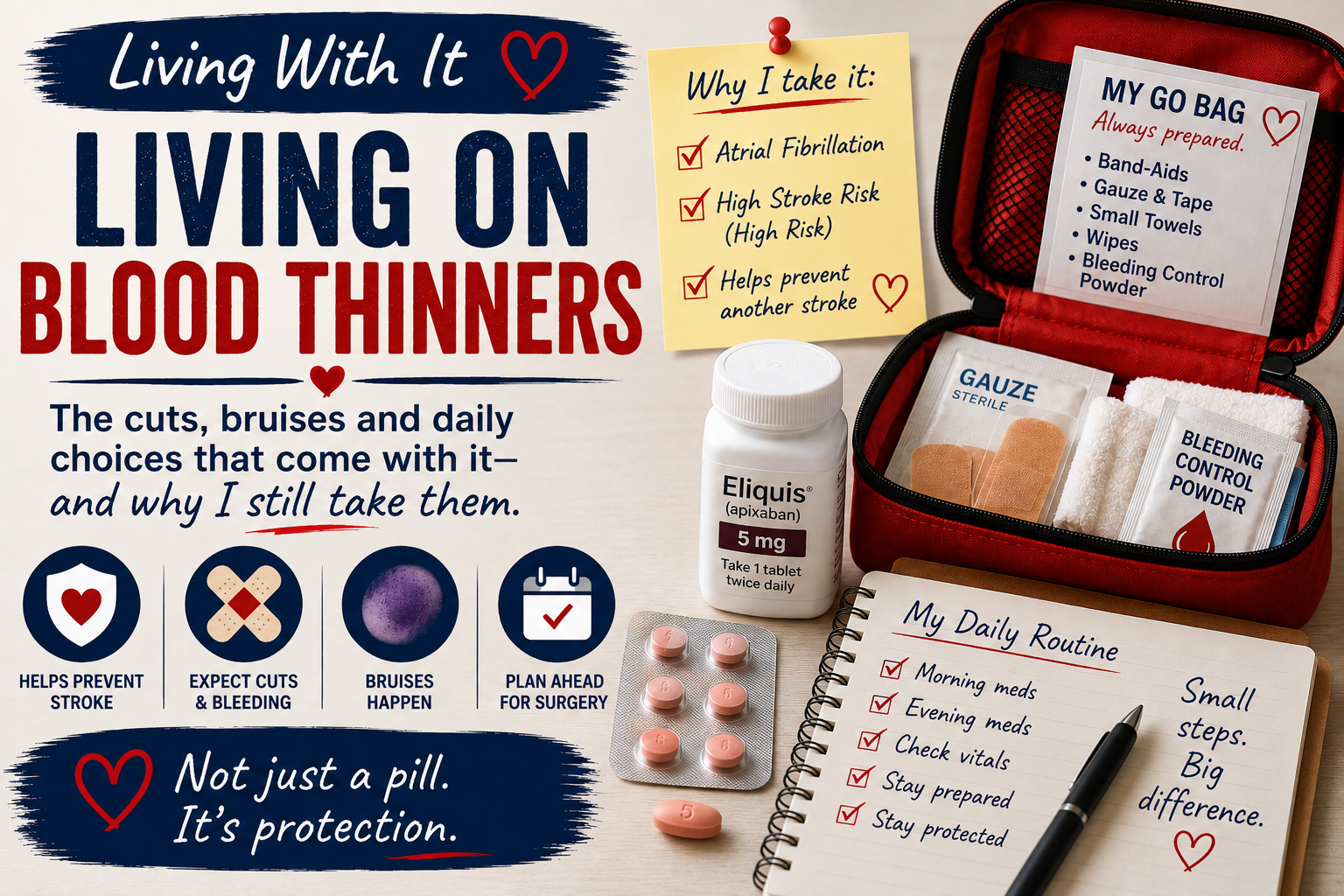
    My Little Blood-Thinner Go Bag

    Actually, I’ve gone considerably beyond Band-Aids now.

    We carry a small go bag with us almost everywhere.

    Mine includes things that can help deal with minor cuts and scrapes:

    Hopefully I don’t need any of it.

    But I’ve learned that being prepared is considerably easier than standing in a parking lot bleeding while wondering if anyone has a Band-Aid.

    It’s just part of life now.

    For anything that won’t stop bleeding with firm pressure, is deep or serious, or involves significant injury, that’s obviously beyond the job of my little go bag.

    And Then There Are the Bruises

    Bruising has become another normal part of life.

    Bump my arm?

    Bruise.

    Get blood drawn?

    Bruise.

    Have an IV in the hospital?

    There’s a pretty good chance I’ll have a colorful reminder of exactly where it was for days afterward.

    I also occasionally notice small discolored spots on my arms that come and go.

    As I get older, I expect skin changes may make some of this even more noticeable.

    I’ve seen protective sleeves designed for the arms, and that’s something I may eventually consider.

    For now, I’ve mostly accepted that unexplained bruises are occasionally going to be part of the scenery.

    Surgery Requires More Planning

    Blood thinners also make surgery and some medical procedures more complicated.

    It’s not necessarily a reason you can’t have them.

    It just means everybody involved needs to know you’re taking an anticoagulant.

    Depending on the procedure and the person’s individual risks, a doctor may instruct someone to temporarily stop an anticoagulant beforehand. Exactly when—or whether—to stop it depends on the medication, procedure, kidney function, bleeding risk and risk of developing a clot.

    That’s why this isn’t something I decide on my own.

    If I’m having surgery or a procedure, the physicians involved—including the doctor managing my anticoagulation—need to coordinate the plan.

    I don’t just stop taking Eliquis because surgery is coming up.

    The same goes for restarting it afterward.

    I follow the instructions I’m given.

    The Inconveniences Are Worth It

    I’ve mentioned quite a few negatives.

    Cuts bleed more.

    Bruises appear more easily.

    Blood draws can leave impressive marks.

    I carry first-aid supplies.

    Medical procedures require additional planning.

    And I have another medication that I need to remember twice every single day.

    But here’s the thing:

    I’ll take all of that over another stroke.

    My stroke was one of the worst experiences of my life.

    I was 53.

    I had a great job.

    I had a woodworking side hustle that I loved.

    I had great neighbors and a ton of friends.

    I was independent.

    I was self-sufficient.

    And then, sitting on the couch watching a movie, my life changed.

    The Lesson I Wish I’d Learned Earlier

    Before my stroke, I wasn’t exactly great about going to doctors.

    That’s something I look back on very differently now.

    Afterward, I also learned that I had sleep apnea. Sleep apnea is associated with AFib, and treating underlying health problems is another piece of managing cardiovascular risk.

    Could things have gone differently if I’d been getting regular medical care and my AFib had been discovered before the stroke?

    I’ll never know exactly what would have happened.

    But I certainly wish we’d had the opportunity to find it first.

    Being proactive sounds a whole lot better to me now than being reactive.

    That’s one of the biggest lessons I’ve taken from all of this.

    Go for the checkup.

    Get your blood pressure checked.

    Talk to someone about the snoring.

    Don’t ignore something because you feel fine.

    Sometimes the first sign that something is wrong is a sign you really don’t want.

    ❤️ Greg’s Take

    I’ve seen people talk about not wanting to take blood thinners because of the bleeding, bruising and inconvenience.

    I understand it.

    Nobody gets excited about adding another medication to their life.

    And anticoagulants aren’t medications to take casually. They have real risks that need to be discussed with the person prescribing them.

    But I can only speak from my experience.

    I’ve had the cuts.

    I’ve had the bruises.

    I’ve bled through a truck stop without realizing it.

    I carry Band-Aids everywhere.

    I’ve turned taking Eliquis twice a day into a ritual.

    And I’ll keep doing it.

    Because I’ve also had a stroke.

    The Band-Aids are easier.

    If taking a couple of pills every day, carrying some first-aid supplies and dealing with an occasional ugly bruise helps reduce my risk of going through that again, I know which one I’m choosing.

    Every single time.


    Affiliate Disclosure

    This article contains Amazon affiliate links. If you purchase something through one of these links, I may earn a small commission at no additional cost to you. I personally use the products I’ve linked in this article and am sharing them because they’ve been useful to me. I have purchased these with my own money. Purchasing through my links helps support He’s Knocking on My Door and allows me to continue creating content.

    Medical Disclaimer

    This article describes my personal experience with atrial fibrillation, stroke and anticoagulant medication. It is not medical advice. Anticoagulants can cause serious bleeding and should be taken exactly as prescribed. Never stop, skip, restart or change an anticoagulant because of something you read here. If you’re preparing for surgery or another procedure, your healthcare team should provide specific instructions about your medication. Seek urgent medical attention for serious or uncontrolled bleeding, a significant head injury, or symptoms of a possible stroke.

  • Eating Out with CHF Isn’t Easy

    Eating Out with CHF Isn’t Easy

    Finding a Balance Between Protecting Your Health and Living Your Life

    One of the biggest changes I wasn’t prepared for after being diagnosed with congestive heart failure wasn’t taking medication or weighing myself every morning.

    It was eating out.

    For most people, going to a restaurant is just another meal.

    For me, it became a decision.

    Is this restaurant going to have something I can safely eat?

    How much sodium is hidden in the food?

    Will this one meal cause me to retain fluid for the next two days?

    Those questions have changed the way I look at restaurants forever.

    The hardest part isn’t actually the food.

    It’s what restaurants represent.

    Restaurants are where families celebrate birthdays.

    They’re where friends catch up over lunch.

    They’re where couples enjoy date nights.

    Sharing a meal is one of the ways we stay connected to one another, and when chronic illness forces you to think twice about every menu, it can feel like you’re slowly becoming disconnected from that part of life.

    I’ve experienced that feeling more than once.

    There have been times when I’ve simply decided it was easier to stay home than spend the entire meal worrying about sodium.

    While that protects my heart, it also means saying no to moments with family and friends.

    That isn’t an easy trade-off.

    Some of My Favorite Foods Are Now Memories

    One of the reasons my wife and I moved to Southwest Florida was the seafood.

    We couldn’t wait to enjoy fresh fish, shrimp, and all of the wonderful waterfront restaurants this area has to offer.

    One of my favorite meals was blackened fish or blackened shrimp.

    Today, those meals are mostly memories.

    The seasonings that give blackened seafood its incredible flavor also bring a tremendous amount of sodium. While there may be exceptions, I’ve learned that it’s usually not a risk worth taking.

    Another favorite of mine has always been clam chowder.

    I honestly can’t remember the last time I had a bowl.

    Restaurant soups are often loaded with sodium, and clam chowder is probably one of those foods I’ll simply never enjoy again.

    Those may seem like small sacrifices to some people.

    But they’re reminders that chronic illness changes more than your health.

    It changes traditions.

    It changes favorite meals.

    It changes experiences you once took for granted.

    Preparation Starts Before I Leave Home

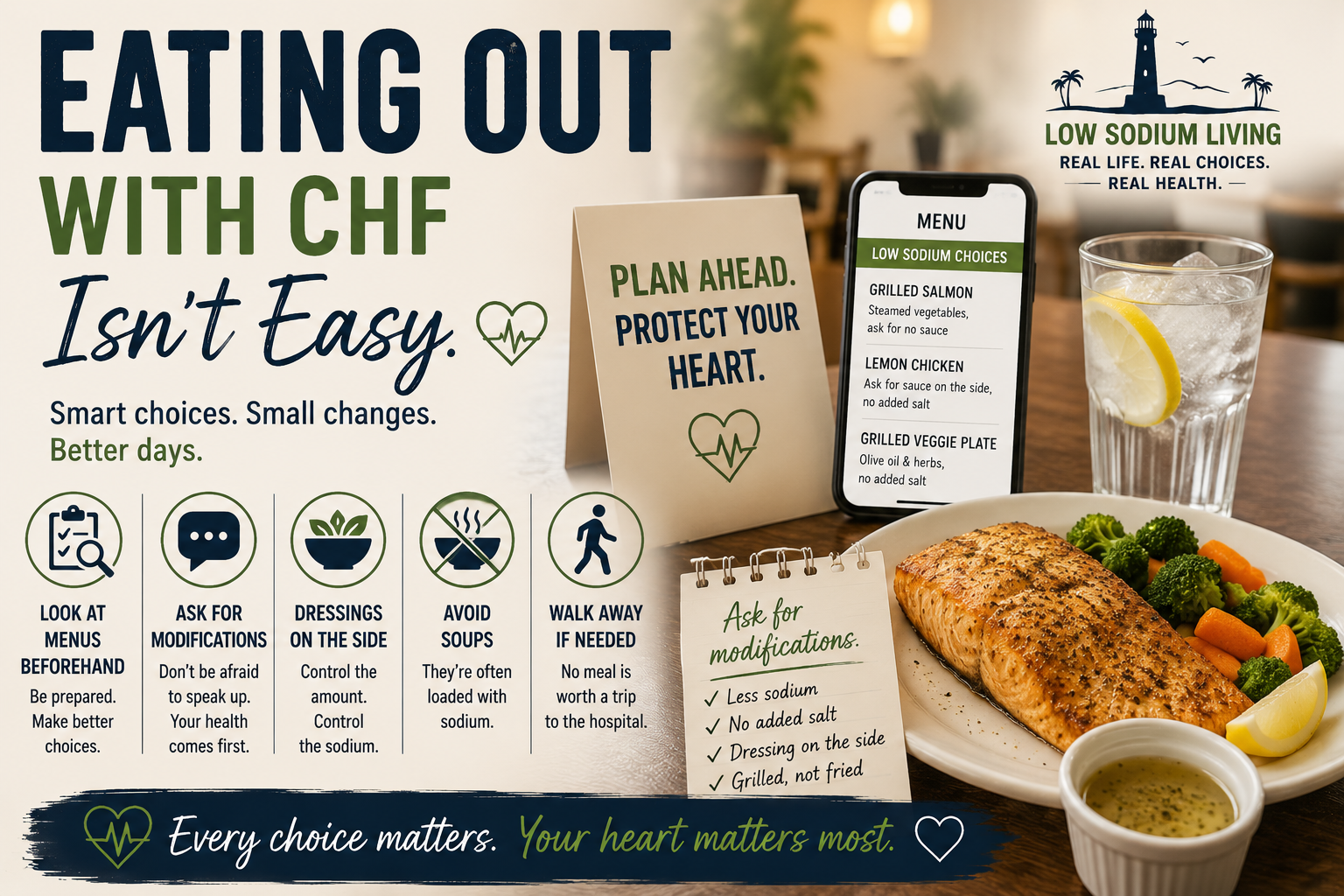
    One of the best habits I’ve developed is looking at the restaurant’s menu before I ever get in the car.

    Many restaurants now publish their menus online, and some even provide nutrition information. That gives me the opportunity to look for grilled foods, fresh vegetables, simple salads, or meals that can be modified before I ever sit down.

    Walking into a restaurant with a plan removes a lot of the stress.

    Sometimes I already know exactly what I’m going to order before I walk through the front door.

    Don’t Be Afraid to Ask Questions

    I’ve learned that it’s okay to ask.

    Can the chicken be grilled without seasoning?

    Can the vegetables be prepared without added salt?

    Can the sauce be served on the side?

    Most servers genuinely want to help if they understand why you’re asking.

    You’re not being difficult.

    You’re simply trying to take care of your health.

    Dressing on the Side

    Salads seem like the obvious healthy choice.

    Unfortunately, many bottled dressings contain surprising amounts of sodium.

    I’ll often order my dressing on the side so I can control how much I use.

    I’ll admit something else.

    There have even been times when I’ve quietly brought my own homemade low-sodium dressing with me.

    Some restaurants don’t allow outside food because they can’t guarantee its safety or accept responsibility if someone becomes ill. I completely understand and respect their position.

    When I can’t bring my own dressing, I’ll often ask for olive oil and lemon wedges instead.

    It’s a simple solution that still lets me enjoy the salad.

    Soup Is Usually Off My List

    This one still bothers me.

    I love soup.

    Unfortunately, soup is one of the biggest hidden sources of sodium in many restaurants.

    Even a small bowl can contain more sodium than I’d like to eat in an entire day.

    As much as I enjoy it, soup has become something I almost always skip.

    It’s Not Just the Sodium

    One thing people often don’t realize is that my challenge isn’t only sodium.

    It’s fluids too.

    Because of my heart failure, I’m limited to about 1.5 liters of fluid each day.

    That means every drink counts.

    Water.

    Coffee.

    Tea.

    Soft drinks.

    Even healthy beverages.

    They’re all part of the same daily limit.

    Then there’s alcohol.

    For many people, meeting friends for a drink is just another way to socialize.

    For me, alcohol is no longer part of the equation.

    When friends gather around a table with drinks in hand, it reminds me that chronic illness changes more than what you eat.

    Sometimes it changes how you participate in life’s social moments.

    I’ll be honest…

    That’s something I still haven’t learned how to manage very well.

    Sometimes the Best Decision Is to Walk Away

    This has probably been the hardest lesson.

    There have been times when I looked over a menu and realized there simply wasn’t a good option.

    Instead of convincing myself that “one meal won’t matter,” I’ve learned it’s okay to leave and find another restaurant.

    Years ago, I probably wouldn’t have done that.

    Today, I remind myself that protecting my health is more important than protecting my pride.

    I’m Still Learning

    If I’m being completely honest…

    I haven’t figured this out yet.

    Eating out with CHF remains one of the biggest challenges in my life.

    I still miss the freedom of ordering whatever sounds good.

    I miss seafood dinners without worrying about sodium.

    I miss a bowl of clam chowder on a cool afternoon.

    I miss walking into a restaurant without studying the menu before I leave home.

    But I’m learning that living with chronic illness isn’t about finding perfect solutions.

    It’s about making the best decisions you can with the information you have.

    Most days that means eating at home.

    Some days it means asking a dozen questions before ordering.

    And sometimes…

    It means deciding that spending time with the people you love is worth the extra effort it takes to find a meal you can enjoy safely.

    I still believe there has to be a compromise.

    A way to protect my health without completely giving up one of the most important ways people connect with each other.

    I haven’t found that balance yet.

    But I’m still looking.

    Screen capture this and carry it with you when you go out

    🍽️ My Restaurant Checklist

    ✔️ Read the menu online first.

    ✔️ Look for grilled or baked options.

    ✔️ Ask for sauces and dressings on the side.

    ✔️ Skip soups and heavily seasoned foods.

    ✔️ Watch both sodium and fluids.

    ✔️ Don’t be afraid to ask questions.

    ✔️ If there isn’t a good option, choose another restaurant.