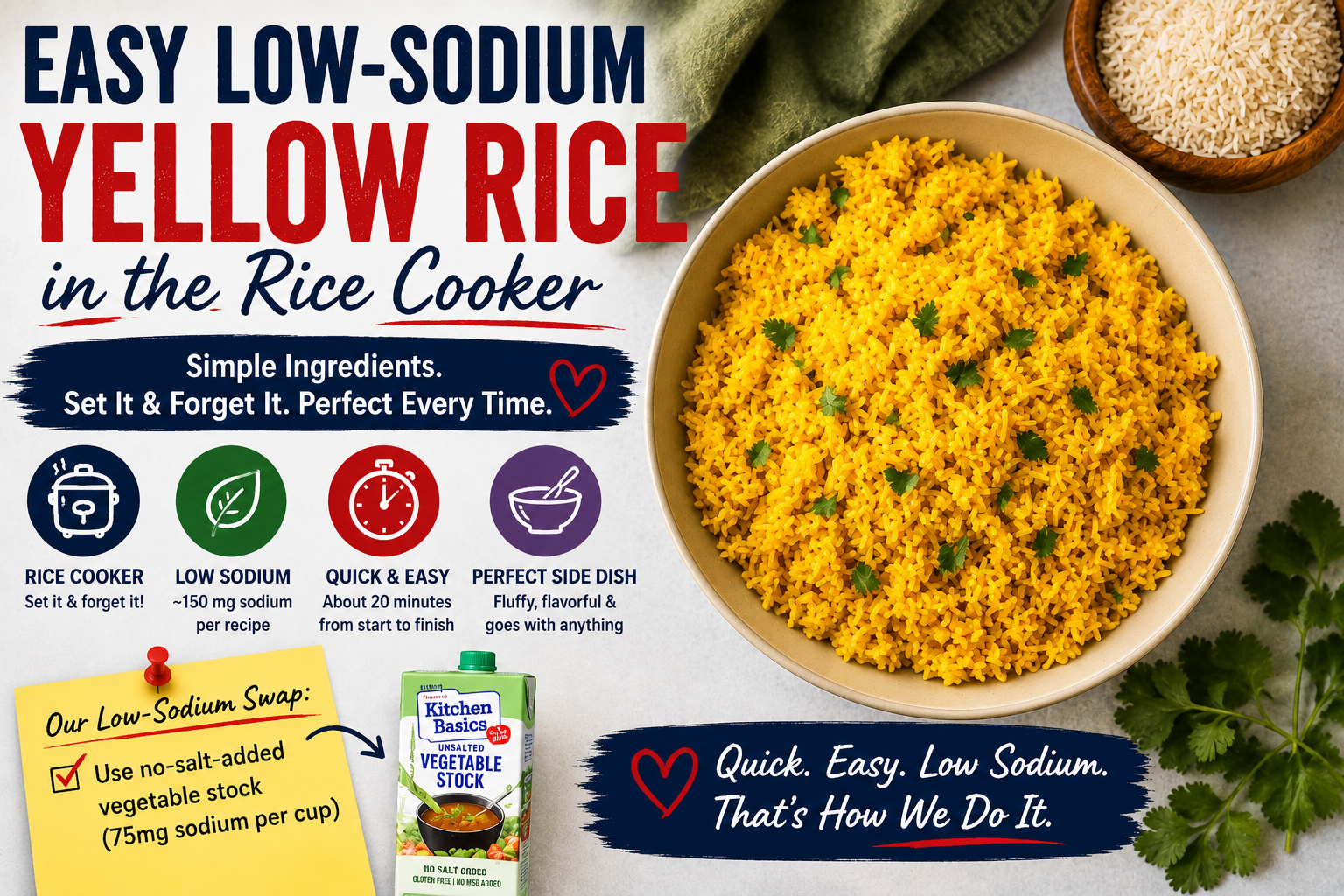
This has become one of our favorite easy side dishes.
We originally found this Yellow Rice in a Rice Cooker recipe from I Heart Vegetables, and it’s good, simple and incredibly easy to make.
Original Yellow Rice Recipe from I Heart Vegetables
And when I say easy, I mean easy.
Rinse the rice, put everything in the rice cooker, push the button and basically forget about it.
About 20 minutes later, you have a flavorful yellow rice that works as a side dish or as the base for a meal. The original recipe lists about 5 minutes of prep and 15 minutes of cooking time.
How We Make It Lower in Sodium
The original recipe uses vegetable broth and mentions Better Than Bouillon vegetable base as the author’s choice.
That’s where we make our biggest change.
Instead, we use Kitchen Basics Unsalted Vegetable Stock. Walmart currently lists it as having no added salt.
Kitchen Basics Unsalted Vegetable Stock at Walmart
The carton we use lists 75 mg of sodium per cup. Since the recipe requires two cups, that’s about:
75 mg × 2 cups = 150 mg of sodium
That’s roughly 150 mg of sodium from the stock in the entire batch of rice, not per serving.
We also leave out the additional salt called for in the original recipe.
Of course, the exact sodium in your finished rice depends on the specific brands and ingredients you use, so always check your own labels.
Our Version
For our lower-sodium version, we use:
- 1 cup white rice
- 2 cups no-salt-added vegetable stock
- 1 teaspoon ground turmeric
- 1/2 teaspoon onion powder
- 1/2 teaspoon garlic powder
- We omit the salt
The ingredient proportions, other than our stock substitution and omission of added salt, come from the original I Heart Vegetables recipe.
I rinse the rice, put everything into the rice cooker, give it a stir and start the normal white-rice cycle.
That’s about it.
When it’s finished, fluff it with a fork and serve.
Quick. Easy. And very little cleanup.
This Is Why I Love the Rice Cooker
This recipe is a perfect example of why we bought our rice cooker in the first place.
There’s no standing over the stove watching a pot.
There’s no wondering whether the rice is done.
I put everything in, start it and move on to whatever else we’re making.
The rice cooker handles the rest.
And the rice comes out consistently good.
Why We Finally Bought a Rice Cooker
Don’t Forget About Serving Size
Here’s where I’m going to sound like a broken record.
Just because I reduced the sodium doesn’t mean I should sit down and eat the entire rice cooker.
Low sodium doesn’t mean unlimited.
Rice still contains carbohydrates, so portion size matters to me for reasons beyond sodium.
It’s also exactly why I wrote my article about reading nutrition labels.
❤️ Greg’s Take
This is exactly the kind of recipe I’ve been looking for since changing the way I eat.
I don’t necessarily need to reinvent every recipe.
Sometimes I just need to find the ingredient that’s causing me trouble and replace it with something that works better for me.
In this case, swapping the vegetable bouillon/broth for an unsalted vegetable stock and skipping the additional salt gives us a version that fits much better into the way we’re eating now.
And I don’t feel like I’m eating bland “diet food.”
It’s yellow rice.
It’s flavorful.
It goes with a ton of different meals.
And the rice cooker does almost all the work.
Drop it in. Push the button. Go make the rest of dinner.
That’s my kind of recipe.
Recipe Credit
This recipe is adapted from I Heart Vegetables — How to Make Yellow Rice in a Rice Cooker. I use their recipe as the starting point and modify it to reduce the sodium by using unsalted vegetable stock and omitting the added salt.
View the Original Recipe at I Heart Vegetables
Disclaimer: This article reflects my personal experience with low-sodium cooking and the modifications I make to recipes while living with chronic illness. It is not medical or nutritional advice. Sodium needs can vary from person to person, so always check ingredient labels and follow the guidance of your own doctor, dietitian, or healthcare team. Product ingredients and nutrition information can also change over time.