When I went into the hospital for my TAVR procedure, my attention was focused on one thing: my aortic valve.
I had severe aortic stenosis, and the goal was to replace the failing valve and get my heart working better.
What I didn’t fully appreciate beforehand was just how close the heart’s electrical system is to where that new valve would be placed.
I learned about that very quickly.
After my TAVR, I developed something called a left bundle branch block, or LBBB.
And before anyone scheduled for a TAVR starts worrying, let me make something clear:
Not everyone who has a TAVR develops LBBB.
It is a known complication of the procedure, but it certainly isn’t something that happens to everyone. In one large U.S. registry analysis involving more than 200,000 TAVR patients, about 16% developed a new LBBB after the procedure. The exact risk can vary depending on the patient, the valve and other factors.
Apparently, I was one of the lucky ones.
Maybe I should start buying lottery tickets too.
What Is a Left Bundle Branch Block?
Before all of this happened, “left bundle branch block” wasn’t exactly something that came up in everyday conversation.
The easiest way I’ve learned to think about it is that the heart doesn’t just pump—it also has its own electrical wiring system.
Electrical signals travel through pathways in the heart that tell the chambers when to contract. Part of that electrical system divides into a right bundle branch and a left bundle branch.
Normally, the electrical signal travels through these pathways in a coordinated way.
With LBBB, the electrical signal doesn’t travel normally through the left bundle. Instead, the impulse has to take a different route to activate the left ventricle.
The result is that the ventricles don’t receive their electrical signal in quite the same synchronized way they normally would.
I tend to think of it as an electrical detour.
The signal still gets there, but it isn’t traveling down the normal road.
Why Can LBBB Happen After TAVR?
My doctors gave me a pretty simple explanation.
The replacement aortic valve sits very close to some of the heart’s electrical conduction system.
When the new valve is placed, that nearby electrical system can sometimes be disturbed. That’s why conduction problems such as LBBB are recognized complications following TAVR.
That’s what happened to me.
My new valve addressed one major problem, but I left the procedure with a new electrical issue that needed to be monitored.
Chronic illness seems to have a sense of humor like that.
They Saw Something Different on My ECG
After my TAVR, my doctors noticed that my heartbeat looked different on the ECG.
That was the first indication that something had changed electrically.
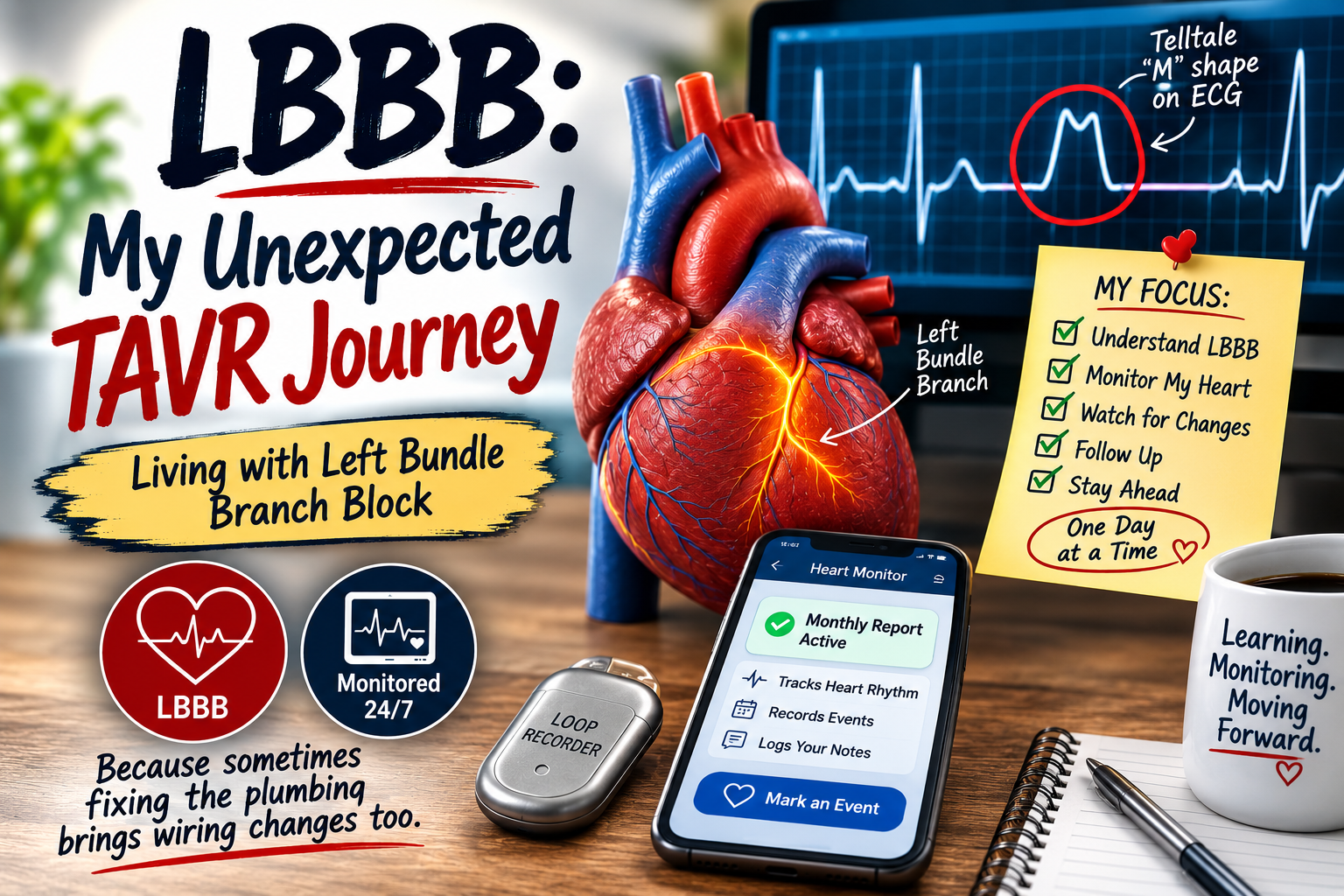
When LBBB is present, the electrical delay changes the shape and duration of the QRS complex on an ECG. One characteristic that can appear is a broad or notched, sometimes M-shaped, pattern in certain leads. That’s one of the things that was pointed out to me on my ECG.
The American Heart Association also describes this characteristic M-shaped appearance in its educational material about LBBB.
That doesn’t mean you can look for an “M” on an ECG and diagnose yourself with LBBB. Doctors use several ECG measurements and characteristics to make the diagnosis.
For me, the important part was much simpler:
That electrical pattern wasn’t there before my TAVR. Now it was.
My Hospital Stay Just Got Four Days Longer
I certainly wasn’t expecting that.
Instead of going home and beginning my recovery, I ended up staying in the hospital for four additional days while they monitored my heart.
The concern was whether this new conduction problem would progress.
Would my electrical system stabilize?
Would it get worse?
Would I need a pacemaker?
Those weren’t questions anyone could answer immediately.
So we waited and watched.
Pacemaker or Monitoring?
Ultimately, I didn’t receive a permanent pacemaker at that time.
Instead, I was given a choice about continued heart-rhythm monitoring.
One option was an external heart monitor that I would wear for a period of time.
The other was an implantable loop recorder.
I chose the loop recorder.
For me, I liked the idea of having something continuously monitoring my heart over the long term rather than wearing an external monitor temporarily.
The loop recorder is a small device implanted under the skin that records information about my heart rhythm.
And now it has become another part of my everyday life.
My Heart Sends in a Monthly Report Card
I receive a report each month showing anything unusual the monitoring system has detected.
That can include things such as pauses or unusual rhythms.
And yes, apparently my heart occasionally likes submitting some interesting material for the report.
I’ve had pauses detected, which is one of the reasons this continued monitoring is important.
The system also gives me another useful feature.
If I’m experiencing something unusual—maybe I’m lightheaded or just feel that something isn’t right—I can use my phone to mark the event.
I can enter what I was doing and describe what I’m experiencing.
That creates a record associated with the event so it can be reviewed later.
I really like having that ability because it provides context.
Instead of simply saying at my next appointment, “I felt really strange one afternoon a few weeks ago,” there can be a record of when it happened and information about what I was experiencing.
What My Loop Recorder Does NOT Do
This is an important distinction.
My loop recorder is a monitoring device. It is not a treatment device.
It isn’t a pacemaker.
It isn’t an implanted defibrillator.
And it isn’t going to shock my heart or correct a dangerous rhythm if something happens.
It records information.
If I’m experiencing what could be a medical emergency, pressing a button on my phone isn’t a substitute for getting emergency medical care.
An emergency still means getting emergency help.
The recorder’s job is to help capture information that my doctors can use to understand what’s happening with my heart.
I Still Have Pauses
Since the loop recorder was implanted, it has detected pauses in my heartbeat.
That obviously gets my attention.
A pause doesn’t automatically mean that I need a pacemaker, but it’s one of the electrical findings my doctors can follow along with everything else that’s happening.
That’s especially important because I also experience symptoms.
The Lightheadedness Is What Concerns Me
There are periods when I become extremely lightheaded.
Sometimes I get the feeling that I’m getting close to passing out.
I haven’t completely lost consciousness, but I’ve experienced that tunnel-vision, I’m-about-to-black-out feeling.
That’s difficult to ignore.
Bundle branch block itself may cause no symptoms, but fainting or feeling as though you’re going to faint can occur in some people with conduction problems and deserves medical evaluation.
But there’s an important distinction in my situation:
We don’t know that my LBBB is causing these episodes.
I have several things happening with my heart.
I have persistent atrial fibrillation.
I have heart failure.
I have LBBB.
I’ve had pauses recorded.
There are also medications and blood-pressure changes that can potentially affect how I feel.
So I’m not going to pick one condition and declare that I’ve found the culprit.
That’s exactly why having long-term rhythm monitoring can be useful.
If I report an episode and there’s a corresponding rhythm abnormality at the same time, that’s useful information for my doctors.
Then There’s the Sweating
Another strange symptom I’ve been experiencing is profuse sweating, particularly with exertion or heat.
And I don’t mean getting a little sweaty because it’s hot outside.
Sometimes I’m drenched.
Is that LBBB?
Heart failure?
Medication?
Blood pressure?
Something completely different?
I don’t know.
And I’m deliberately not going to claim that LBBB causes it just because LBBB happens to be one of my diagnoses.
One thing chronic illness has taught me is:
Having a symptom and having a diagnosis doesn’t necessarily mean the diagnosis caused the symptom.
Sometimes figuring out that connection is the hardest part.
Will I Eventually Need a Pacemaker?
That’s the question hanging over all of this.
The answer right now is:
Maybe.
Developing LBBB after TAVR doesn’t automatically mean someone needs a pacemaker.
Guidance from the American College of Cardiology describes monitoring patients who develop new conduction disturbances following TAVR and considering additional testing or a permanent pacemaker depending on how those abnormalities progress.
My doctors are monitoring the electrical activity of my heart, the pauses, my symptoms and whether anything changes.
If the conduction system deteriorates further, or if my doctors determine that the electrical abnormalities and symptoms warrant pacing, then a pacemaker could become part of my future.
But we’re not there yet.
For now, I have the loop recorder.
We collect information.
We watch.
And we make decisions based on what that information shows.
❤️ Greg’s Take
When I went in for my TAVR, my thinking was pretty straightforward:
Bad valve. New valve. Recover. Move on.
Yeah.
It didn’t exactly work that way.
The new valve addressed the severe aortic stenosis, but somewhere along the way the electrical wiring of my heart decided it wanted to join the story.
I developed LBBB.
My hospital stay became four days longer.
I had to make a decision about long-term heart monitoring.
I chose a loop recorder.
Now my heart essentially sends in a monthly report card, I’ve had pauses recorded, and I have a way to mark the times when I’m experiencing something unusual.
And someday I may need a pacemaker.
Or maybe I won’t.
That’s one of the frustrating things about chronic illness. Sometimes there isn’t an immediate answer.
Sometimes the answer is:
We’re going to watch it.
Before all of this, I probably would have found that incredibly frustrating.
Now I’m beginning to understand it.
Not every decision needs to be made today.
Sometimes collecting information is the next step.
So my loop recorder keeps watching.
My doctors keep monitoring.
And I keep learning more about the electrical system of a heart that I never expected to know this much about.
Apparently replacing the plumbing wasn’t enough. I needed to learn about the wiring too.
Learn More About LBBB and TAVR
These are some good resources if you’d like to learn more about LBBB, heart conduction problems and what can happen after TAVR:
Mayo Clinic — Bundle Branch Block: Symptoms & Causes
A straightforward explanation of bundle branch block, the heart’s electrical system and possible symptoms.
Mayo Clinic: Bundle Branch Block Symptoms & Causes
Mayo Clinic — Bundle Branch Block: Diagnosis & Treatment
Information about diagnosing bundle branch block and situations in which treatment such as a pacemaker may be considered.
Mayo Clinic: Bundle Branch Block Diagnosis & Treatment
American College of Cardiology — Conduction Disturbances After TAVR
A more technical resource discussing monitoring and management of conduction problems that develop following TAVR.
ACC: Conduction Disturbances After TAVR
American College of Cardiology — New LBBB After TAVR
Information from a large registry analysis looking specifically at patients who developed new LBBB after TAVR.
ACC: New LBBB After TAVR
Medical Disclaimer: I am not a doctor or medical professional. This article describes my personal experience with TAVR, left bundle branch block, heart-rhythm monitoring and chronic illness. Everyone’s medical situation is different, and my experience should not be used to diagnose or treat a medical condition or determine whether someone needs a pacemaker or other treatment. Always discuss symptoms, test results and treatment decisions with your doctor or other qualified healthcare professional. If you experience symptoms that may represent a medical emergency, seek emergency medical care rather than relying on a monitoring device or information on this website.