Affiliate Disclosure: This post contains an Amazon affiliate link. As an Amazon Associate, I may earn from qualifying purchases made through this link at no additional cost to you. I personally use the MyID product featured in this article. My opinions and experiences are my own.
When I first became chronically ill, I didn’t want everyone to know.
I didn’t want people looking at me and immediately seeing someone who was sick or disabled. I didn’t want my medical conditions to become my identity.
For a while, I wanted to keep as much of it private as possible.
But eventually I had to ask myself a pretty important question:
What happens if something happens to me and I can’t speak for myself?
That’s when privacy started taking a back seat to safety.
It Only Takes One Emergency
Most of the time, I can explain my medical history myself.
I can tell someone about my conditions. I can tell them what medications I take. I can explain important parts of my medical history and give them my emergency contacts.
But an emergency is different.
What if I’m unconscious?
What if I’m confused or unable to communicate?
What if I’m alone?
In those circumstances, emergency personnel may have very little information about the person they’re trying to help.
With my medical history, I decided that wasn’t a chance I wanted to take.
I knew I needed some type of medical ID.
I Didn’t Want a Traditional Medical Bracelet
I’ll admit that I was picky about this.
I didn’t want one of those traditional medical bracelets with something dangling from my wrist.
I didn’t want something hanging around my neck either.
I already wear my watch every day. What I really wanted was something that could become part of something I was already wearing.
That’s when I found MyID.
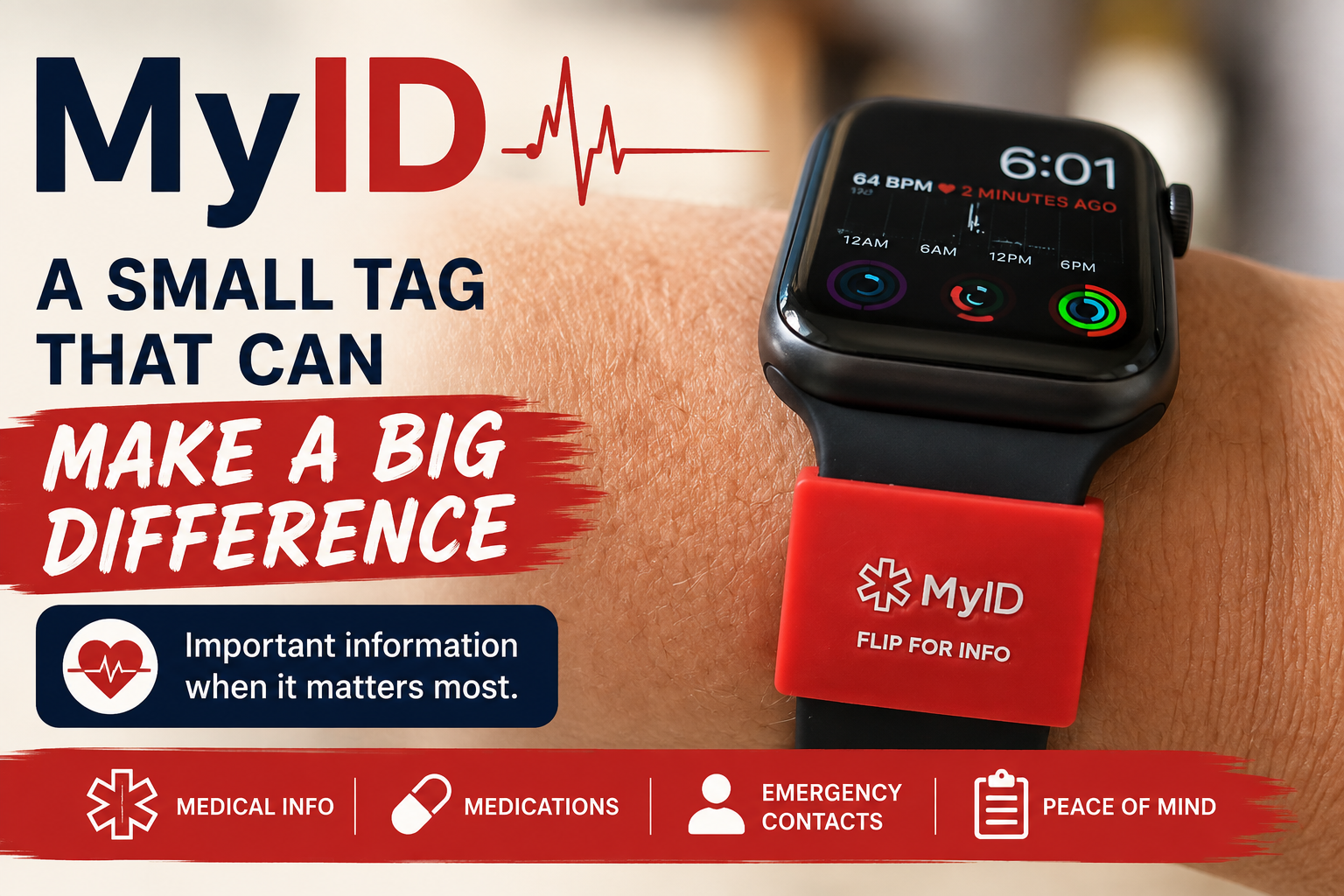
The version I chose is a small sleeve that slides directly onto my watch band.
It’s unobtrusive. There’s nothing dangling from my wrist, nothing around my neck, and I don’t have another item I have to remember to put on every morning.
If I’m wearing my watch, I’m wearing my medical ID.
For me, that was exactly what I wanted.
A Small Tag With a Lot of Information
The MyID sleeve has the recognizable medical ID symbol on the outside.
On the back is a QR code that can be scanned to access the emergency medical profile I created.
That profile can contain the information I choose to provide, including things such as:
- Medical conditions
- Medications
- Allergies
- Personal information
- Emergency contacts
- Other important health information
I like this approach because I’m not trying to cram my entire medical history onto a tiny metal bracelet.
The tag is simply the doorway to the information.
The Star of Life Matters
One thing I especially like about MyID is that it isn’t just a random QR code sitting on my watch band.
The sleeve displays the Star of Life, the familiar medical identification symbol.
According to MyID, EMTs are trained to look for this universal medical ID symbol during an emergency assessment. When they see it on a MyID product, it alerts them that medical information may be available through the QR code.
That was important to me.
Having all of my information stored in a profile doesn’t do much good if no one knows it’s there.
The symbol identifies the sleeve as a medical ID, and the QR code provides access to the information I’ve chosen to make available.
If I can’t speak for myself, the hope is that my MyID can help speak for me.
Setting It Up Was Easy
Setting up my profile only took me a few minutes.
I entered the medical information I wanted available and added my emergency contacts.
And there’s something about this system that I particularly like:
If something changes, I don’t need to buy another medical ID.
I can update the information in my online profile.
New medication?
Update it.
Medication discontinued?
Update it.
New diagnosis or important change in my medical history?
Update it.
That’s a big advantage over a traditional engraved medical bracelet where the information printed on the bracelet can eventually become outdated.
Of course, there’s a responsibility that comes with that convenience.
The information is only as accurate as I make it.
If something changes and I don’t update my profile, that’s on me.
There Are More Options Than the One I Chose
The watch sleeve happened to be the best choice for me, but that isn’t the only style available.
MyID offers different types of wearable and attachable medical IDs, including bracelets, silicone bands, decorative styles, tags, wristlets, stickers, IDs, and sleeves like the one I use.
That’s important because not everyone wants to wear the same thing.
Someone might prefer a traditional bracelet.
Someone else might want something attached to an item they carry.
I wanted something on my watch.
The important part isn’t which style you choose.
It’s having important information available when you might not be able to provide it yourself.
Privacy vs. Safety
This was probably the biggest hurdle for me.
I spent a lot of time after becoming chronically ill not wanting the world to know that anything was wrong with me.
I understand that feeling.
But I’ve also realized that there’s a difference between keeping my health information private from the general public and making sure critical information is available during an emergency.
I don’t need every person I meet to know my medical history.
But if I’m lying unconscious somewhere, I absolutely want the people trying to save my life to have as much useful information as possible.
That changed the way I looked at wearing a medical ID.
It stopped feeling like a sign announcing that I was sick.
It became another tool I use to protect myself.
Interested in MyID?
The MyID watch sleeve shown in this article is the one I personally use every day. I like that it fits directly on my watch band, stays out of the way, and gives me a way to make important medical and emergency-contact information available if I’m ever unable to provide it myself. If you’d like to take a look at MyID and the options available, you can view it here on Amazon. There are different styles available, so you can choose the type of medical ID that works best for you.
❤️ Greg’s Take
Hopefully, my MyID is something I’ll wear for years and never actually need in an emergency.
That’s the best possible outcome.
But I also wear a seat belt every time I get into a car hoping I’ll never need that either.
For me, this is similar.
I already wear my watch every day. Sliding a small medical ID onto the band doesn’t inconvenience me, and after a while I barely notice that it’s there.
But if the day ever comes when I’m unable to speak for myself, that little red sleeve could help point emergency personnel toward information I’ve decided they should know.
I’d rather have it and never need it than need it once and not have it.
Suggested Internal Links
Product Note
This article reflects my personal experience with MyID and why I chose to use it. Features, services, product styles, and access methods can change over time, so I recommend checking MyID’s current product information directly before purchasing or relying on any specific feature.