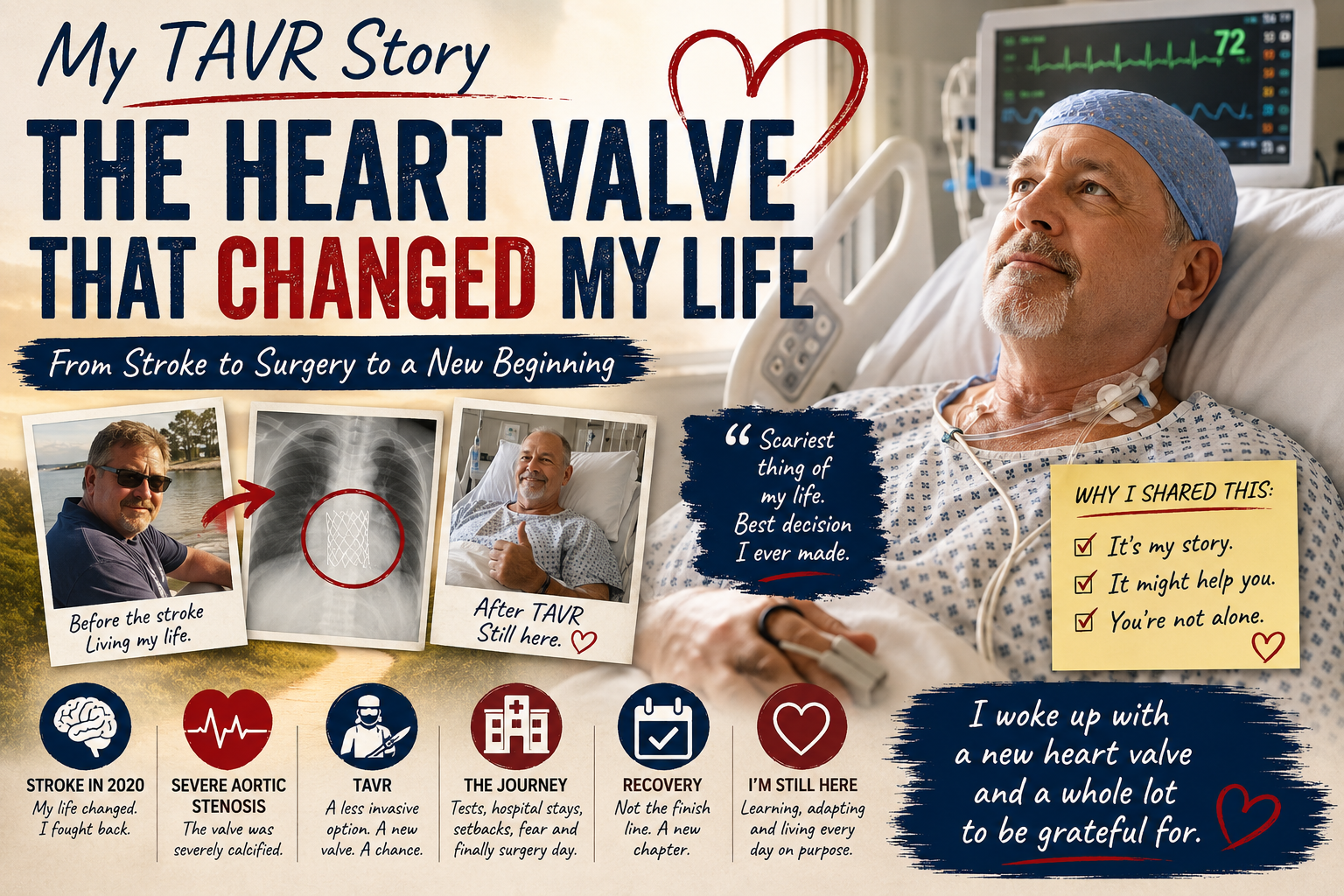
This is probably the hardest thing I’ve ever written about.
I’ve talked about pieces of my health story before. I’ve written about heart failure, LBBB, medications, hospital stays, daily health checks and what it’s like trying to live with all of this.
But this is the story that connects most of those pieces.
My TAVR.
And to really explain how I got there, I have to go back a little further.
I Thought I Was Pretty Healthy
I’ve been overweight pretty much my entire life.
I’m not going to sugarcoat that.
But until 2020, I considered myself relatively healthy and surprisingly limber for a big guy.
I mean, I wasn’t Chris Farley limber, but I could hold my own.
I took some preventative medications. I worked. I drove an hour and a half each way to work. I had hobbies. I did woodworking. I took care of things around the house.
I lived my life.
Then, in 2020, I had a stroke.
Everything changed.
The First Time My Body Changed the Rules
Recovering from my stroke required some major lifestyle changes.
Exercise.
Eating better.
No more alcohol.
And suddenly, a whole lot more doctors.
Did it suck?
Hell yeah, it did.
But there was one thing I didn’t have to do.
I didn’t need surgery.
I needed rehabilitation and a tremendous amount of work.
I still remember sitting at my computer playing that card-matching game we played as kids. Two cards flip over. Try to remember where the matching card is.
I did it for hours. It was so frustrating. I couldn’t match a card if my life depended on it.
I was exercising my brain because I wanted it to come back faster.
It didn’t come back faster.
That’s another lesson I’ve learned through all of this. You can push your body as hard as you want, but sometimes your body has its own schedule.
I desperately wanted to get back to being the person I was before the stroke.
Eventually, I had to understand that some things had changed.
But again:
No surgery.
That distinction was going to become pretty important a few years later.
Then Came the Chest Pain
After we moved to Southwest Florida, I had some chest pain and went to the emergency room.
We’d only been living here for a few months, and I didn’t even have all my doctors established yet.
Eventually, I got in with a cardiologist.
He wanted tests.
Lots of tests.
One test led to another, which led to another.
Eventually, I got the answer.
Severe aortic stenosis.
The aortic valve is essentially the doorway that allows blood to leave the heart and enter the body’s main artery, the aorta. With aortic stenosis, that doorway becomes narrowed. In my case, the valve had become severely calcified and wasn’t opening properly.
This wasn’t something I could fix by eating better.
There wasn’t a pill that was going to make my severely calcified valve normal again.
I needed a valve replacement.
My reaction was basically:
Fuck. I have to have heart surgery.
And Then I Learned I Had Heart Failure
The testing continued.
One piece of good news surprised the hell out of me.
I didn’t have the coronary plaque buildup I expected.
I’ve eaten plenty of terrible food in my lifetime.
And plenty of bacon.
So I’ll take the win.
But there was another finding that wasn’t so great.
I had heart failure—more specifically, heart failure with preserved ejection fraction, or HFpEF.
At the time, my thinking was pretty simple:
Fix the valve.
Fix the problem.
Go back to normal.
Unfortunately, my heart had apparently not read the same brochure I had.
I Was Terrified of Open-Heart Surgery
I keep using the word surgery because you have to understand something about me.
I’d never really had surgery.
The worst things I’d dealt with were stitches and a broken hand.
Easy fixes compared with someone opening my chest and operating on my heart.
Then there was another complication.
I already had significant trouble walking.
My doctors and I discussed what recovery from open-heart surgery could look like for me. Because of my mobility problems, there was a real possibility that I would need rehabilitation afterward before I could safely manage at home.
So now, in my head, this wasn’t just:
Heart surgery.
It was:
Heart surgery + hospital + rehabilitation facility + who knows what comes after that.
Emotionally, I was thinking:
WTF. I’m not doing this.
The problem was that doing nothing wasn’t exactly a great alternative.
My father died at 54.
I was 58.
I’d beaten him by four years.
That puts things into perspective pretty quickly.
Eventually, the decision becomes remarkably simple:
Deal with it or eventually let it kill you.
Then We Started Talking About TAVR
My doctors discussed another possibility with me:
TAVR — Transcatheter Aortic Valve Replacement.
Instead of opening the chest to replace the valve surgically, TAVR allows doctors to deliver a replacement valve through a catheter, commonly through an artery in the groin, and expand it inside the diseased aortic valve.
It is still a major heart procedure.
But it isn’t the same operation or recovery as traditional open-heart valve replacement.
Because of my overall situation—including my mobility limitations—my heart team considered whether TAVR was an appropriate option.
Then came more testing.
Would my anatomy work?
Were my blood vessels suitable?
What size valve would I need?
Was I an appropriate candidate?
Fortunately, those answers came back in my favor.
After the heart team reviewed everything, I was approved for TAVR.
For the first time in a while, I felt like maybe there was a path through this.
But First, I Had to Wait
Living in Southwest Florida means there are plenty of people with heart problems.
I wasn’t the only person who needed a valve.
My procedure got pushed back.
More than once.
Meanwhile, my health continued deteriorating.
I was hospitalized several times with heart-failure problems.
My blood pressure could get extremely low.
I struggled to manage my fluid levels.
Diuretics created their own problems, including episodes involving my kidneys.
I became unbelievably fatigued.
I had episodes where I felt like I might pass out.
Eventually, simply getting to the bathroom became an accomplishment.
Driving was out of the question.
I had originally been told we were looking at around June 2025.
I finally got my new valve on:
December 16, 2025.
That was a long wait.
And it gave me plenty of time to think about absolutely everything that could possibly go wrong.
Surgery Day
By the time December 16 arrived, I had been carrying around anxiety about this for months.
Then suddenly it was real.
I was scared to death.
I was emotional.
All sorts of thoughts were going through my head.
Is this the last time I’m going to see my wife?
Am I going to see my kids again?
What if something goes wrong?
I’m tearing up even writing this now.
Eventually, there’s nothing left to do except put on your big-boy pants and go to the hospital.
So that’s what I did.
There Is No Modesty in a Hospital
First, everything comes off.
You get the gown.
Then people start coming in.
Vitals.
Questions.
Preparation.
Of course, one of the nurses taking care of me was extremely attractive.
Because why wouldn’t she be?
Then another person comes in to shave me.
Chest.
Armpits.
Down below.
Meanwhile, the attractive nurse just keeps doing her job like absolutely nothing unusual is happening.
There is no modesty in a hospital.
At some point you just accept that your dignity has left the building and hope somebody gives it back at discharge.
Heck of as first experience, naked, shaven and scared.
Then Came the IV Disaster
This was where my fear temporarily turned into anger.
I’ve had trouble with IVs before, so I asked them from the beginning to use ultrasound guidance.
They were confident they wouldn’t need it.
Fine.
There was supposedly a rule: two unsuccessful attempts and somebody else tries.
Well…
Person number one.
Person number two.
Person number three.
By the time we got to person number four, I had been stuck eight times.
These weren’t tiny little blood-draw pokes either. They needed substantial IV access for the procedure.
My arms were up in the air.
People were slapping them, searching for veins.
I was pissed.
And I wasn’t exactly keeping my opinion to myself.
My doctors walked in while this was happening.
They looked at me.
Looked at each other.
And essentially decided:
We’ll see you in there.
Eventually somebody brought out the ultrasound.
They found the vein.
I remember someone saying something along the lines of:
“Oh, look. We were close.”
That did not improve my mood.
Then My Wife Came In
Eventually, the chaos stopped.
My wife came in.
We talked.
We said what we needed to say.
And once again that thought entered my head:
What if this is the last time I see her?
Then she left.
And not long after that…
I was out.
Apparently, I Went to Visit SpongeBob
I don’t do recreational drugs.
But whatever they gave me for this procedure?
Wow.
My memory of it is bizarre.
I was hanging out with SpongeBob SquarePants. It must have been on the TV. I don’t even watch the show.
Colors everywhere.
Having a great time.
Apparently my brain decided that if we were going to have heart surgery, we might as well spend part of it in Bikini Bottom.
Then suddenly…
I woke up.
There was something like a sheet or drape over my head.
My first thought was:
Holy crap. Am I dead?
So I yelled:
“Hello?”
I tried moving my arms.
Couldn’t.
Then I heard voices.
My doctors were still there.
They had just finished the procedure.
I remember saying:
“There’s a sheet over my head.”
Then:
“Are my hands tied?”
There were other people in the room too.
Here’s the important part:
I apparently wasn’t supposed to be awake yet.
They gave me some more medication.
And off I went.
Back to SpongeBob.
Unfortunately, round two hit me considerably harder.
I was nauseated for about three days afterward.
“Does That Happen Often?”
The next day I needed an echocardiogram.
I asked the person performing it whether they had been in the room when I woke up.
They had.
First thing they said, “Wow, you remember that?”
Naturally, my first question was:
“Did I say anything bad?” I am kind of a jokester and very sarcastic.
Because if I’m going to wake up unexpectedly while still under the influence of whatever they gave me, this seems like useful information.
Apparently I behaved myself.
Later I asked my surgeon whether people wake up like that very often.
He told me he’d never personally seen it happen before.
I was his first.
Lucky me.
Yet another reason I apparently need to start buying lottery tickets.
The Valve Was In — But We Weren’t Done
One of the attractions of TAVR is that many patients can go home relatively quickly after an uncomplicated procedure.
That wasn’t going to be me.
Afterward, I had to remain flat for hours while they monitored the access sites and allowed the medications used during the procedure to wear off.
I also had temporary pacing available after the procedure.
At this hospital, the pacing wire was through my neck.
For a day?
Okay.
For several days?
Pretty freaking uncomfortable.
And I needed it because my heart’s electrical system wasn’t particularly happy about its new neighbor.
My Heart Started Pausing
After the TAVR, I developed a new electrical conduction problem:
Left bundle branch block, or LBBB.
I’ve written an entire article about that because it deserves its own explanation.
The short version is that the heart’s electrical conduction system runs very close to the aortic valve. Implanting a replacement valve can sometimes disturb that system.
My heart also started having pauses.
Basically, there were periods when the electrical activity wasn’t doing what it was supposed to do.
That’s why I stayed in the hospital for four days instead of heading home the next day.
The question became:
Do I need a permanent pacemaker?
Fortunately, after several days of monitoring, my doctors decided I didn’t need one at that point.
But they weren’t going to send me home and simply hope everything behaved.
Meet My Loop Recorder
I was given a choice about longer-term monitoring.
I decided to have an implantable loop recorder placed under the skin in my chest.
A loop recorder isn’t a pacemaker.
It doesn’t pace my heart.
It doesn’t shock me like a defibrillator.
It watches.
Mine communicates with my phone and allows heart-rhythm information to be transmitted for review.
I get reports showing unusual events, including pauses and rhythm abnormalities.
I can also mark symptoms when something unusual happens so the event can be correlated with what my heart was doing around that time.
My heart still has pauses.
So far, based on the monitoring and my doctors’ assessment, they haven’t resulted in a recommendation for a permanent pacemaker.
That could change someday.
For now?
We watch.
So I Got the New Valve. Am I Fixed?
This is where reality didn’t quite match what I expected.
The good news is very good:
My replacement aortic valve is working well.
Follow-up imaging has shown that the valve is functioning properly.
That’s a huge win.
But I still have HFpEF.
For whatever reason, I had come away from some of those early conversations believing that replacing the valve might essentially resolve the heart failure.
That wasn’t what happened.
Whether I misunderstood, heard what I wanted to hear, or simply couldn’t process the enormous amount of information being thrown at me at the time, I don’t know.
And that’s another lesson:
Bring somebody with you.
Appointments and hospital stays can involve an overwhelming amount of information.
Medications.
Numbers.
Procedures.
Risks.
Options.
Follow-ups.
You’re scared, tired, uncomfortable and trying to remember everything someone just said.
Having another set of ears in the room is incredibly valuable.
Eight Months Later
As I write this, I’m about eight months out from TAVR.
The valve is doing its job.
But I still have LBBB.
I still have HFpEF.
I still have episodes where I become extremely lightheaded and feel like I might pass out.
Sometimes I sweat profusely.
I’ve noticed that exertion and heat seem to play a role.
I’m working with my doctors to understand exactly what’s happening.
We’ve adjusted medications.
My loop recorder continues watching my rhythm.
When I experience something unusual, I can mark the event so there’s information available to review later.
This isn’t something I’m trying to diagnose myself.
That’s what my doctors and the monitoring are for.
If you want to follow that part of the story as it happens, that’s really what my Daily Journal has become.
Would I Do It Again?
This was the scariest medical experience of my life.
And this article is still the abridged version.
There are pieces of this story that deserve their own articles, and I’ll eventually write them.
But would I have the TAVR again?
That’s kind of a funny question.
Because someday, I may actually have to.
Bioprosthetic replacement valves don’t necessarily last forever. How long an individual TAVR valve lasts depends on many factors, and because TAVR is relatively newer than surgical valve replacement, long-term durability continues to be studied.
I’m younger than the traditional TAVR patient.
I was 58 when mine was implanted.
Fortunately, my anatomy and the size of the valve that was implanted may leave options if the valve eventually deteriorates.
One possibility in selected patients is another transcatheter valve placed inside the first one—sometimes called TAVR-in-TAVR or valve-in-valve TAVR.
Whether that’s what happens to me someday?
Who knows.
That’s a conversation for future me and whatever heart team is taking care of me at that point.
Medicine changes.
Technology changes.
Procedures improve.
There are treatments available today that weren’t available a generation ago.
I’m not going to spend the next decade worrying about what valve technology might look like when I’m in my 70s.
I’ll deal with that when I get there.
❤️ Greg’s Take
I went into this thinking the new valve was going to fix me.
That’s probably the biggest misconception I carried through the whole process.
I imagined a finish line.
Get the valve. Recover. Go back to normal.
Instead, the TAVR became another starting line.
My valve works.
That’s something I’m incredibly grateful for.
But I still have heart failure.
I still have LBBB.
I still have a loop recorder watching my heart.
I still have pauses.
I still have symptoms we’re trying to understand.
I still have good days and bad days.
And I’m still here.
That’s really what this website is about.
It isn’t about somebody who got sick, found the magical treatment and went back to exactly the life he had before.
That isn’t my story.
My story is learning how to live when the finish line keeps moving.
It is learning what I can control and what I can’t.
It’s learning to ask questions.
It’s learning to bring someone with me when there are too many answers to remember.
It’s learning that sometimes the thing you’re absolutely terrified of doing is also the thing that gives you the chance to keep going.
On December 16, 2025, I walked—or more accurately, was wheeled—into a hospital terrified that I might never see my wife and kids again.
I woke up with a new heart valve.
Okay…
I woke up with a new heart valve and apparently spent some quality time with SpongeBob SquarePants.
Eight months later, life still isn’t easy.
I’m not fixed.
I’m not the person I was before my stroke.
I’m not even the person I thought I’d be after TAVR.
But I’m still here.
And for now?
That’s enough.
Medical Disclaimer
This article describes my personal experience with severe aortic stenosis, heart failure and TAVR. It is not medical advice and should not be used to decide whether TAVR, open-heart surgery or any other treatment is appropriate for you. Every patient’s heart condition, anatomy, surgical risk and medical history are different. Treatment decisions should be made with your cardiologist and heart-valve team. If you have chest pain, fainting, severe shortness of breath or symptoms that may represent a medical emergency, seek immediate medical care.