Tag: HFpEF

  • Daily Journal #22 — Good Numbers, an Encouraging Kidney Appointment, and MRI Monday

    Daily Journal #22 — Good Numbers, an Encouraging Kidney Appointment, and MRI Monday

    This morning’s health numbers were good.

    Actually, they were all pretty much spot on.

    My blood pressure looked good.

    My heart rate looked good.

    My glucose looked good.

    And I even dropped a little more weight.

    After all of the ups and downs lately, I’ll take a morning like that without complaint.

    Nephrologist Appointment Today

    I had my nephrology appointment today, and it was very encouraging.

    He examined me and didn’t see any signs of fluid retention.

    That is definitely a plus.

    After the recent weight fluctuations, swelling, and concern about whether I was holding onto fluid again, hearing that was reassuring.

    We also talked about the MRI I have scheduled for Monday.

    I’ve obviously been anxious about it.

    He reviewed my kidney ultrasound again and told me not to sweat it.

    His explanation actually helped.

    He compared the ultrasound to looking at something from a distance.

    You can see the general picture, but you can’t necessarily see all of the fine details.

    The MRI is more like getting up close.

    It will allow them to look at everything in much greater detail and hopefully answer the remaining questions.

    That made the whole thing feel a little less ominous.

    It sounds like the MRI is really about making sure they have the clearest possible picture.

    Either way, I get it done Monday.

    Hopefully, after that, we can finally start putting this whole AKI episode behind me.

    I Want to Write More About the AKI

    Once I get through all of this, I’m planning to write a full article about my acute kidney injury.

    Not because I think everyone’s experience will be the same as mine.

    It won’t.

    But I think there is value in explaining what happened to me, how quickly my kidney numbers changed, what contributed to it, what my doctors looked for, and what I learned from the experience.

    Before this happened, I knew what an AKI was in general terms.

    I didn’t really understand how quickly it could happen or how something being used to help one medical condition could potentially create a problem somewhere else.

    That balancing act has probably been one of the biggest lessons of this entire experience.

    The Radiology Instructions

    The radiology department also called with instructions for Monday.

    One of the instructions is that I need to drink 32 ounces of water about 30 minutes before the MRI.

    That kind of sucks.

    With the fluid limit I normally follow, 32 ounces is a huge chunk of my daily allowance.

    It’s a little over 60 percent of what I normally drink in an entire day.

    So I’m going to have to plan around that.

    This isn’t me deciding to suddenly increase my fluid intake. These are the instructions I was given for the test, and I’ll follow the instructions from the people taking care of me.

    At this point, I just want to get the MRI done and get some answers.

    Anxious and Optimistic

    Even with a very reassuring appointment today, I’m still anxious.

    I think that is probably going to be there until the MRI is finished and someone tells me exactly what they see.

    But I’m also optimistic.

    My health numbers were good this morning.

    My weight is still moving in the right direction.

    My nephrologist didn’t see any signs of fluid retention.

    And he didn’t seem overly concerned about what he saw on the ultrasound.

    Those are all positives.

    So Monday is the next hurdle.

    Get the MRI.

    Get the results.

    And hopefully put one more medical scare in the rearview mirror.

    Medical Disclaimer

    This journal reflects my personal health experience and the treatment and testing plan developed specifically for me by my healthcare providers. Nothing in this article should be considered medical advice, diagnosis, or a recommendation to change your medications, fluid intake, sodium intake, testing, or treatment. Instructions for imaging studies, including how much fluid to drink before an MRI or other procedure, may vary depending on the test and the individual patient. Always follow the instructions provided by your own healthcare team and radiology department. Acute kidney injury, fluid retention, changes in kidney function, and related symptoms can have many different causes and should be evaluated by qualified healthcare professionals.

  • Daily Journal #21 — 250 Pounds, Better Numbers, and a New Way to Track What I Eat

    Daily Journal #21 — 250 Pounds, Better Numbers, and a New Way to Track What I Eat

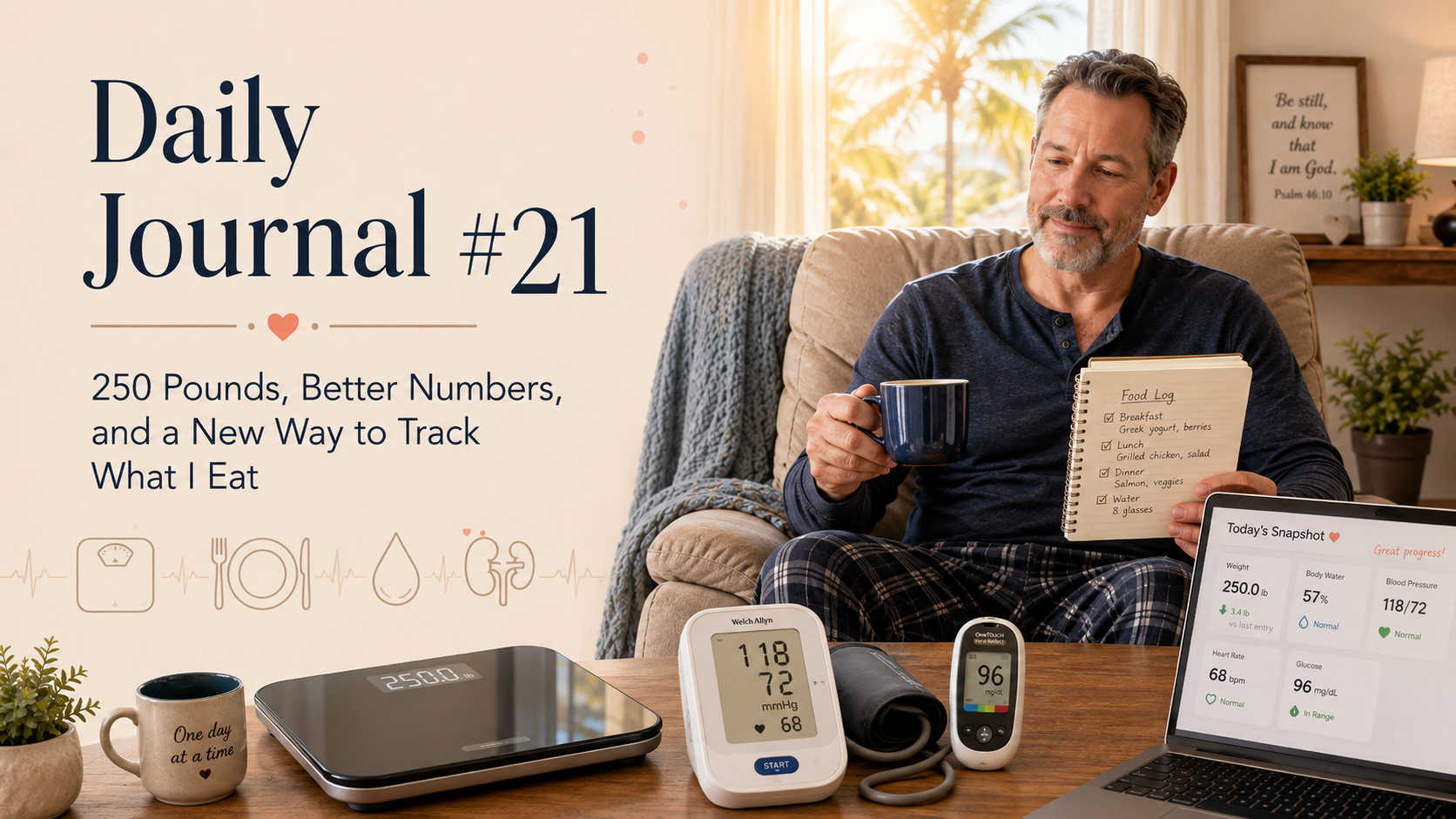
    This morning’s health checks were great.

    I’m down to 250 pounds.

    That puts me just 25 pounds away from my goal of 225 by April.

    After the fluid issues I was watching over the last few days, it was also reassuring to see my body-water measurement back in its normal range.

    My blood pressure was good.

    My heart rate was good.

    My glucose was good.

    For once, everything seemed to be cooperating.

    I’ll take that kind of morning anytime.

    I’m Going to Start Tracking My Food Here

    I think I’m going to make a small change to the Daily Journal going forward.

    I want to start adding a section where I record what I ate during the previous day.

    I’m not trying to calculate every calorie or milligram of sodium with laboratory precision. What I really want is a simple record I can go back and look at.

    If I suddenly gain two or three pounds, my feet swell, or my body-water reading jumps, I want to be able to look back and say:

    What did I eat yesterday?

    Was there something unusually high in sodium?

    Did I eat something different?

    Was there a restaurant meal, sauce, dressing, packaged food, or something else I didn’t think about at the time?

    That’s really all I need.

    Something close enough to help me identify patterns.

    I’ve Tried the Food Tracking Apps

    I’ve tried quite a few food-tracking apps over the years.

    Some are pretty good.

    Some are not.

    And some, in my experience, have been a complete waste of money.

    My worst experience was with CAL AI.

    When I first started using it, I actually liked it.

    It worked well.

    I could enter what I was eating, and it gave me the kind of quick estimate I was looking for.

    Then, about 30 days into using it, the app suddenly stopped working properly.

    It would no longer record the food I entered.

    I contacted the company for support.

    That didn’t get me very far.

    My experience was basically an AI support bot giving me the same response over and over again without actually fixing the problem.

    I eventually asked for a refund.

    That didn’t happen either.

    So I disputed the charge with my credit card company.

    The company challenged the dispute, and in the end I was left without a refund and without a working application.

    So that was fun.

    The really funny part is that I wouldn’t be shocked if I somehow get charged again when the membership renews.

    At this point, I think keeping my own simple food record right here might actually work better for what I need.

    Yesterday’s Food

    Going forward, I think I’ll keep this part intentionally simple.

    Breakfast:
    Strawberries & Blueberries

    Lunch:
    Peach & pineapple

    Dinner:
    Salad, pork tenderloin & sweet potato

    Snacks:
    Peach & Plum

    I’m not trying to turn this into a calorie-counting diary.

    I just want another piece of information I can compare with my weight, swelling, blood pressure, body-water readings, and how I’m feeling.

    Over time, maybe I’ll start seeing patterns that aren’t obvious in the moment.

    Still Staying Out of the Heat

    It’s still hot here.

    Another heat advisory today.

    So I’m continuing to stay inside and out of the heat as much as possible.

    With the lightheadedness and near-passing-out episodes I’ve had, I don’t see any reason to tempt fate by spending time outside when the temperature and humidity are brutal.

    There will be plenty of time to go outside when Florida decides to stop trying to cook us.

    Kidney Appointment Tomorrow

    Tomorrow is my nephrology appointment.

    Since the renal blood work somehow wasn’t done with the rest of my labs, I’m expecting there’s a pretty good chance I’ll need another blood draw.

    That may be especially important because my MRI on Monday is scheduled with contrast, and they may want updated kidney-function numbers before giving it to me.

    So I’m guessing there are probably a few more needles in my immediate future.

    At this point, I should probably start earning frequent-flyer miles for blood draws.

    Still, today started on a good note.

    250 pounds.

    Body water back to normal.

    Good blood pressure.

    Good heart rate.

    Good glucose.

    Tomorrow we deal with the kidneys.

    Today, I’m enjoying the good numbers.

    Medical Disclaimer

    This journal reflects my personal experiences managing multiple chronic health conditions and the treatment plan developed specifically for me by my healthcare providers. Nothing in this article should be considered medical advice, diagnosis, or a recommendation to change your diet, medications, fluid intake, testing, or treatment plan. Weight changes, swelling, abnormal heart rate or blood pressure, changes in kidney function, and other symptoms can have many different causes. Dietary sodium and fluid recommendations can also vary significantly from person to person depending on their medical conditions and medications. Always discuss symptoms, medication changes, dietary restrictions, imaging with contrast, and other medical decisions with your own qualified healthcare professionals.

  • Social Media and Chronic Illness: Finding Support Without Getting Lost in the Noise

    Social Media and Chronic Illness: Finding Support Without Getting Lost in the Noise

    When I was in the hospital and found out I had congestive heart failure, I knew something wasn’t right.

    I didn’t feel good. I was having chest pains. My blood pressure was high. I already knew I had aortic stenosis and was waiting to be scheduled for surgery to replace my aortic valve.

    At the time, I thought the two things went together pretty simply.

    My valve was bad. They would replace the valve. I would recover. Then I would be fine.

    Well, apparently I misunderstood part of that conversation.

    The heart failure wasn’t necessarily going away.

    I have HFpEF — heart failure with preserved ejection fraction — and it took me about three months after having my heart valve replaced to fully understand that this was something I was going to have to manage going forward.

    That realization changes things.

    The First Thing You Do Is Google It

    Fast-forward a little bit and, like most people who suddenly find themselves diagnosed with something serious, I started reading.

    And reading.

    And reading.

    You Google congestive heart failure and eventually ask the question everyone is probably afraid to ask:

    How long am I going to live?

    Then you see statistics saying things like half of people with heart failure die within five years.

    Well, shit.

    Those aren’t exactly comforting odds when you are sitting there trying to figure out what just happened to your life.

    But statistics need context. Heart failure affects a huge range of people with different types of heart failure, different ages, different health conditions and different levels of disease.

    A statistic doesn’t know me.

    So I started trying to learn specifically about HFpEF: what it is, how people manage it and what living with it actually looks like.

    There is certainly no shortage of information online.

    There are thousands of pages from hospitals, government agencies, heart foundations, pharmaceutical companies, doctors and researchers.

    Much of that information is incredibly valuable.

    But I wanted something else too.

    I wanted to hear from people living with it.

    I wanted someone to talk about chronic illness in language I understood.

    Where Are the Regular People?

    I started searching websites and blogs for personal experiences.

    What surprised me was how difficult those could be to find.

    Most of the results took me right back to hospital websites, medical organizations, pharmaceutical companies and foundations.

    There wasn’t nearly as much from the person sitting at home trying to figure out:

    What does my life look like now?

    That’s one of the reasons I eventually started He’s Knocking on My Door.

    I’m not a medical organization.

    I’m just someone living through this stuff and trying to make sense of it.

    Then I Found the Facebook Groups

    Eventually I started looking through Facebook.

    And as everyone who has spent more than five minutes on Facebook knows, there is some good stuff there and there is some absolute garbage.

    I’ve tried quite a few groups. These are some of the ones I’ve continued to follow:

    There are tons more.

    These are simply the ones I’ve tried and, for one reason or another, continued reading.

    Hearing Other People’s Stories Helps

    My experience with the illness-specific support groups has generally been positive.

    Most people genuinely seem to care.

    Everyone is there because either they or somebody they love is dealing with an illness. People understand fear, uncertainty and frustration because they have experienced some version of it themselves.

    Sometimes you just need to hear somebody say:

    I’ve been there too.

    Those groups contain thousands of stories.

    Someone talks about being exhausted.

    Someone talks about swelling.

    Someone talks about being afraid before valve surgery.

    Someone talks about adjusting to medication.

    Someone talks about having a good day after weeks of bad ones.

    I read their experiences and sometimes see pieces of my own situation in them.

    I’m not looking for a cure from Facebook.

    I’m trying to understand the journey.

    There is a difference.

    The Dangerous Part: Everybody Becomes a Doctor

    There is also a problem with medical support groups.

    People want to help.

    Sometimes they want to help a little too much.

    You mention a symptom and suddenly people are telling you which medication you should take, which medication you should stop taking, which supplement cured their problem or what your doctor should be doing.

    That’s where you need to be careful.

    Your medical team should be the people giving you medical advice.

    What works for one person may be completely inappropriate or even dangerous for somebody else.

    The person answering your Facebook post doesn’t know your medical history, medications, kidney function, blood pressure, lab results or the hundred other things your doctors may be considering.

    I didn’t join these groups looking for strangers to treat me.

    I joined because I wanted to hear how other people were living with their conditions.

    That can be incredibly valuable.

    Medical advice from strangers?

    Not so much.

    Then There Are the Food Groups

    The food groups have been a completely different experience for me.

    I’m sure the overwhelming majority of people in them are perfectly nice.

    Unfortunately, sometimes the internet trolls are considerably louder than everybody else.

    When you’re dealing with heart failure and trying to completely change how you eat, you’re already overwhelmed.

    I’m trying to find low-sodium food that doesn’t suck.

    That’s challenging enough.

    I don’t need to post something I’m eating and have somebody tell me I’m doing everything wrong because their idea of the perfect heart-healthy diet is different from mine.

    I’ve tried several food groups and eventually left many of them.

    There can be useful information buried in there, but sometimes the negativity isn’t worth digging through.

    Chronic illness already consumes enough mental energy.

    I don’t need Facebook taking the rest.

    Podcasts, TikTok and Everything Else

    I’ve also listened to some very good podcasts about chronic illness and heart disease.

    Most of the ones I’ve found are produced by doctors, hospitals or other medical professionals.

    Again, that’s valuable information.

    What seems much harder to find are podcasts from average people simply talking about what it is like to live with these conditions every day.

    I understand why.

    Creating a podcast, website or regular video content takes a lot of work.

    I’ve seen some chronic illness content on TikTok too. A lot of it seems centered around weight loss, exercise or individual pieces of someone’s health journey.

    But I still haven’t found nearly as many people simply saying:

    Here’s what happened to me. Here’s what I’m dealing with. Here’s what worked for me. Here’s what didn’t. Here’s what today was like.

    That’s part of what I’m trying to do here.

    This Website Is Part of How I Cope

    He’s Knocking on My Door started partly because I couldn’t find exactly what I was looking for.

    I wanted the patient side of the story.

    Not another definition of HFpEF.

    Not another diagram of the heart.

    Not another medical paper that requires me to look up every third word.

    I wanted to know how people live with this stuff.

    How do you deal with the fatigue?

    How do you change your diet?

    How do you handle the fear?

    How do you adjust when you can’t physically do everything you used to do?

    How do you deal with family and friends who don’t completely understand?

    How do you keep living your life when chronic illness suddenly becomes part of it?

    Writing about those things has become a coping mechanism for me.

    If somebody else happens to find something helpful in my experience along the way, even better.

    Social Media Isn’t Medicine — But It Can Still Help

    There is an incredible amount of chronic illness information on social media.

    Some of it is helpful.

    Some of it is wrong.

    Some of it is supportive.

    Some of it will scare the hell out of you.

    And some of it should probably never have been posted in the first place.

    You have to learn to separate someone sharing their experience from someone giving you medical advice.

    Those are two very different things.

    I would never recommend changing medication, treatment, diet restrictions or anything else medically significant because somebody in a Facebook group told you to.

    That’s a conversation for your medical team.

    But I absolutely believe there is value in hearing other people’s stories.

    Sometimes those stories help you understand what questions to ask.

    Sometimes they help you realize that something you’re experiencing isn’t unique to you.

    Sometimes they help set realistic expectations.

    And sometimes they simply make you feel a little less alone.

    When you’re suddenly living with a chronic illness, that can matter more than people realize.

    Use social media as a place to listen, learn and connect. Just don’t confuse the person sitting behind a keyboard with the doctor sitting across from you.

    Disclaimer: This article is based on my personal experiences and observations while living with chronic illness. The Facebook groups, websites, podcasts, and other resources mentioned are shared for informational and community-support purposes only. I am not endorsing any medical advice, treatment, product, or recommendation made by members of these groups. Always discuss symptoms, medications, treatments, diet changes, and other medical decisions with your own healthcare team. Online support can be helpful, but it should never replace professional medical care.

  • I Thought the Surgery Would Give Me My Life Back

    I Thought the Surgery Would Give Me My Life Back

    When I found out I needed my aortic valve replaced, I knew it was serious.

    But in my mind, there was also a pretty straightforward plan.

    My valve was bad. They were going to replace it. I would recover. And eventually, I would get my life back.

    Simple enough.

    Except chronic illness apparently didn’t get a copy of my plan.

    I Thought I Was Getting Fixed

    I had a TAVR to replace my severely narrowed aortic valve.

    Going into it, I knew recovery wasn’t going to happen overnight. I wasn’t expecting to leave the hospital and run a marathon.

    Hell, I wasn’t running one before the surgery.

    But I did expect that once my heart wasn’t trying to pump blood through a severely narrowed valve anymore, I would gradually start feeling like myself again.

    That hasn’t happened.

    The new valve is doing its job.

    Unfortunately, my heart apparently decided that wasn’t enough excitement.

    I still have atrial fibrillation. After the procedure I developed a left bundle branch block. Heart failure became part of my medical vocabulary.

    And instead of getting my old life back, I’ve had to learn how to live a very different one.

    Walking Shouldn’t Be This Hard

    Walking used to be something I never thought about.

    You wanted to go somewhere?

    You walked there.

    Now I think about distance.

    Where is the car?

    How far is the entrance?

    Is there somewhere I can sit down?

    Can I use my walker?

    How far am I going to have to walk once I get inside?

    There are times when I can walk a few hundred yards with my walker and then my body basically tells me:

    That’s enough.

    I get incredibly fatigued. Sometimes I sweat so much that my clothes are soaked. I’ve had other episodes where I’ve become lightheaded and felt like I might pass out.

    Recently, the near-fainting hasn’t been happening as much.

    I’ll take that victory.

    But the fatigue is still very real.

    The frustrating part is that mentally, I’m ready to go.

    I’ll get somewhere and think, Okay, let’s do this.

    Then reality catches up with me.

    My brain remembers the person I used to be.

    My body has other ideas.

    Maybe I’m Just Out of Shape

    I’ve asked myself that question plenty of times.

    Maybe I’m deconditioned.

    Maybe I just need to exercise more.

    And there probably is some truth to that.

    But I am exercising.

    I can do controlled exercises where I determine the pace and workload. I can stop before I overdo it. I’ve been working on getting stronger.

    Walking is different.

    Walking with a walker, bad hips and a heart that doesn’t particularly enjoy being asked to work harder can become an exercise all by itself.

    Eventually I hit a wall.

    And I’ve learned that pushing through that wall isn’t always determination.

    Sometimes it’s just stupid.

    That’s something I’m still working on.

    This Might Not Go Away

    This may be the hardest part for me to accept.

    I’m getting older.

    I have chronic medical conditions.

    Heart failure isn’t something you take an antibiotic for and it’s gone next Tuesday.

    Atrial fibrillation isn’t going anywhere at the moment.

    The electrical system in my heart isn’t working the way it used to.

    My hips aren’t magically repairing themselves.

    There are things my doctors may still be able to improve. There are medications that can be adjusted. There are still questions about why my exercise tolerance is so limited. Hopefully replacing my hip eventually makes walking considerably easier.

    I’m not giving up on getting better.

    But I’m also beginning to understand something I didn’t understand when this started:

    Getting better and getting my old life back aren’t necessarily the same thing.

    That’s a difficult realization.

    So What Do You Do With That?

    That’s the question I’ve been trying to answer.

    You can spend every day thinking about everything you can’t do anymore.

    I’ve done plenty of that.

    It’s depressing.

    There are places I don’t go because walking is too difficult. Eating at restaurants has become an exercise in studying sodium content. Things that used to be completely spontaneous now require planning.

    Even something as stupid as going to Home Depot for a part isn’t simple anymore.

    So I’ve adapted.

    I order things online.

    I use grocery pickup.

    I use a walker.

    I sit when I need to sit.

    I’m learning to stop before my body forces me to stop.

    And somewhere along the way, I started writing.

    That’s Why This Website Exists

    He’s Knocking on My Door started as a place for me to talk about what was happening to me.

    It has become something more important than I expected.

    It helps me cope.

    There are a lot of things about chronic illness that I can’t control.

    I can’t decide tomorrow morning that I’m done having atrial fibrillation.

    I can’t tell heart failure that it has overstayed its welcome.

    Believe me, I’ve considered it.

    But I can write.

    I can talk about what this actually feels like.

    I can complain about low-sodium food.

    I can share a recipe that doesn’t taste like cardboard.

    I can tell you about something I bought that made my life easier.

    I can write about the frustration of looking perfectly fine while feeling completely exhausted inside.

    And sometimes I can simply say:

    This fucking sucks today.

    Writing gives me somewhere to put all of that.

    I’m Still Trying

    Acceptance is a strange word.

    Sometimes people hear it and think it means giving up.

    I don’t think it does.

    I’m still working with my doctors.

    I’m still exercising.

    I’m still working on my weight.

    I’m still trying to get stronger.

    I’m still looking for answers.

    I absolutely want things to improve.

    But I’m also trying to stop measuring every day against the person I was before all of this happened.

    That’s an impossible competition.

    Maybe I’ll never walk through a giant store for an hour again.

    Maybe restaurants will always require planning.

    Maybe I’ll always have days when simply doing something ordinary leaves me completely wiped out.

    I don’t know.

    Nobody does.

    But I do know one thing.

    I’m still here.

    I thought surgery was going to give me my old life back.

    It didn’t.

    So now I’m figuring out what to do with the life I have.

    And strangely enough, that’s part of why you’re reading this website.

    Medical Disclaimer

    This article describes my personal experience with severe aortic stenosis, heart failure and TAVR. It is not medical advice and should not be used to decide whether TAVR, open-heart surgery or any other treatment is appropriate for you. Every patient’s heart condition, anatomy, surgical risk and medical history are different. Treatment decisions should be made with your cardiologist and heart-valve team. If you have chest pain, fainting, severe shortness of breath or symptoms that may represent a medical emergency, seek immediate medical care.

  • TAVR: The Heart Valve That Changed My Life

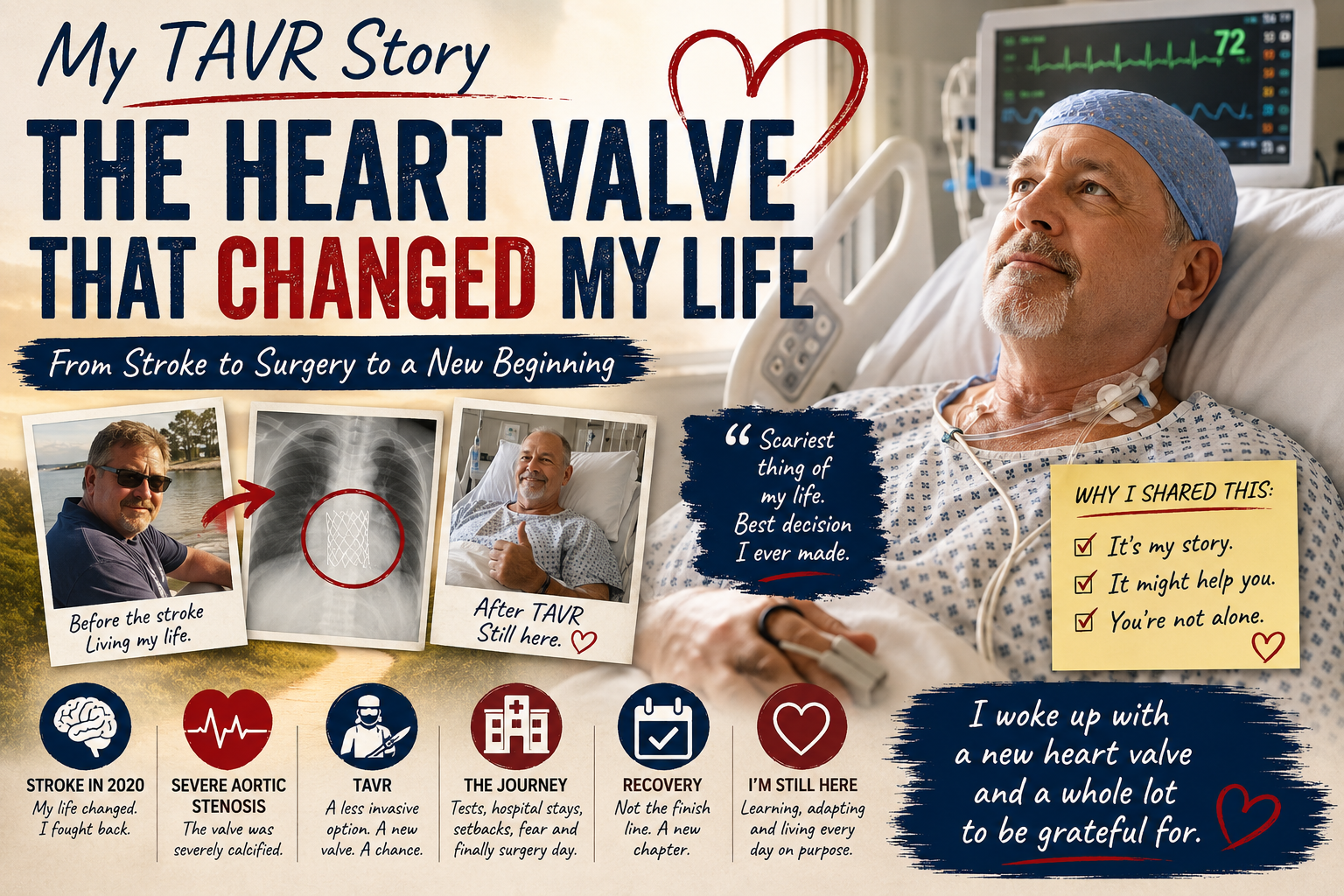
    TAVR: The Heart Valve That Changed My Life

    This is probably the hardest thing I’ve ever written about.

    I’ve talked about pieces of my health story before. I’ve written about heart failure, LBBB, medications, hospital stays, daily health checks and what it’s like trying to live with all of this.

    But this is the story that connects most of those pieces.

    My TAVR.

    And to really explain how I got there, I have to go back a little further.

    I Thought I Was Pretty Healthy

    I’ve been overweight pretty much my entire life.

    I’m not going to sugarcoat that.

    But until 2020, I considered myself relatively healthy and surprisingly limber for a big guy.

    I mean, I wasn’t Chris Farley limber, but I could hold my own.

    I took some preventative medications. I worked. I drove an hour and a half each way to work. I had hobbies. I did woodworking. I took care of things around the house.

    I lived my life.

    Then, in 2020, I had a stroke.

    Everything changed.

    The First Time My Body Changed the Rules

    Recovering from my stroke required some major lifestyle changes.

    Exercise.

    Eating better.

    No more alcohol.

    And suddenly, a whole lot more doctors.

    Did it suck?

    Hell yeah, it did.

    But there was one thing I didn’t have to do.

    I didn’t need surgery.

    I needed rehabilitation and a tremendous amount of work.

    I still remember sitting at my computer playing that card-matching game we played as kids. Two cards flip over. Try to remember where the matching card is.

    I did it for hours. It was so frustrating. I couldn’t match a card if my life depended on it.

    I was exercising my brain because I wanted it to come back faster.

    It didn’t come back faster.

    That’s another lesson I’ve learned through all of this. You can push your body as hard as you want, but sometimes your body has its own schedule.

    I desperately wanted to get back to being the person I was before the stroke.

    Eventually, I had to understand that some things had changed.

    But again:

    No surgery.

    That distinction was going to become pretty important a few years later.

    Then Came the Chest Pain

    After we moved to Southwest Florida, I had some chest pain and went to the emergency room.

    We’d only been living here for a few months, and I didn’t even have all my doctors established yet.

    Eventually, I got in with a cardiologist.

    He wanted tests.

    Lots of tests.

    One test led to another, which led to another.

    Eventually, I got the answer.

    Severe aortic stenosis.

    The aortic valve is essentially the doorway that allows blood to leave the heart and enter the body’s main artery, the aorta. With aortic stenosis, that doorway becomes narrowed. In my case, the valve had become severely calcified and wasn’t opening properly.

    This wasn’t something I could fix by eating better.

    There wasn’t a pill that was going to make my severely calcified valve normal again.

    I needed a valve replacement.

    My reaction was basically:

    Fuck. I have to have heart surgery.

    And Then I Learned I Had Heart Failure

    The testing continued.

    One piece of good news surprised the hell out of me.

    I didn’t have the coronary plaque buildup I expected.

    I’ve eaten plenty of terrible food in my lifetime.

    And plenty of bacon.

    So I’ll take the win.

    But there was another finding that wasn’t so great.

    I had heart failure—more specifically, heart failure with preserved ejection fraction, or HFpEF.

    At the time, my thinking was pretty simple:

    Fix the valve.

    Fix the problem.

    Go back to normal.

    Unfortunately, my heart had apparently not read the same brochure I had.

    I Was Terrified of Open-Heart Surgery

    I keep using the word surgery because you have to understand something about me.

    I’d never really had surgery.

    The worst things I’d dealt with were stitches and a broken hand.

    Easy fixes compared with someone opening my chest and operating on my heart.

    Then there was another complication.

    I already had significant trouble walking.

    My doctors and I discussed what recovery from open-heart surgery could look like for me. Because of my mobility problems, there was a real possibility that I would need rehabilitation afterward before I could safely manage at home.

    So now, in my head, this wasn’t just:

    Heart surgery.

    It was:

    Heart surgery + hospital + rehabilitation facility + who knows what comes after that.

    Emotionally, I was thinking:

    WTF. I’m not doing this.

    The problem was that doing nothing wasn’t exactly a great alternative.

    My father died at 54.

    I was 58.

    I’d beaten him by four years.

    That puts things into perspective pretty quickly.

    Eventually, the decision becomes remarkably simple:

    Deal with it or eventually let it kill you.

    Then We Started Talking About TAVR

    My doctors discussed another possibility with me:

    TAVR — Transcatheter Aortic Valve Replacement.

    Instead of opening the chest to replace the valve surgically, TAVR allows doctors to deliver a replacement valve through a catheter, commonly through an artery in the groin, and expand it inside the diseased aortic valve.

    It is still a major heart procedure.

    But it isn’t the same operation or recovery as traditional open-heart valve replacement.

    Because of my overall situation—including my mobility limitations—my heart team considered whether TAVR was an appropriate option.

    Then came more testing.

    Would my anatomy work?

    Were my blood vessels suitable?

    What size valve would I need?

    Was I an appropriate candidate?

    Fortunately, those answers came back in my favor.

    After the heart team reviewed everything, I was approved for TAVR.

    For the first time in a while, I felt like maybe there was a path through this.

    But First, I Had to Wait

    Living in Southwest Florida means there are plenty of people with heart problems.

    I wasn’t the only person who needed a valve.

    My procedure got pushed back.

    More than once.

    Meanwhile, my health continued deteriorating.

    I was hospitalized several times with heart-failure problems.

    My blood pressure could get extremely low.

    I struggled to manage my fluid levels.

    Diuretics created their own problems, including episodes involving my kidneys.

    I became unbelievably fatigued.

    I had episodes where I felt like I might pass out.

    Eventually, simply getting to the bathroom became an accomplishment.

    Driving was out of the question.

    I had originally been told we were looking at around June 2025.

    I finally got my new valve on:

    December 16, 2025.

    That was a long wait.

    And it gave me plenty of time to think about absolutely everything that could possibly go wrong.

    Surgery Day

    By the time December 16 arrived, I had been carrying around anxiety about this for months.

    Then suddenly it was real.

    I was scared to death.

    I was emotional.

    All sorts of thoughts were going through my head.

    Is this the last time I’m going to see my wife?

    Am I going to see my kids again?

    What if something goes wrong?

    I’m tearing up even writing this now.

    Eventually, there’s nothing left to do except put on your big-boy pants and go to the hospital.

    So that’s what I did.

    There Is No Modesty in a Hospital

    First, everything comes off.

    You get the gown.

    Then people start coming in.

    Vitals.

    Questions.

    Preparation.

    Of course, one of the nurses taking care of me was extremely attractive.

    Because why wouldn’t she be?

    Then another person comes in to shave me.

    Chest.

    Armpits.

    Down below.

    Meanwhile, the attractive nurse just keeps doing her job like absolutely nothing unusual is happening.

    There is no modesty in a hospital.

    At some point you just accept that your dignity has left the building and hope somebody gives it back at discharge.

    Heck of as first experience, naked, shaven and scared.

    Then Came the IV Disaster

    This was where my fear temporarily turned into anger.

    I’ve had trouble with IVs before, so I asked them from the beginning to use ultrasound guidance.

    They were confident they wouldn’t need it.

    Fine.

    There was supposedly a rule: two unsuccessful attempts and somebody else tries.

    Well…

    Person number one.

    Person number two.

    Person number three.

    By the time we got to person number four, I had been stuck eight times.

    These weren’t tiny little blood-draw pokes either. They needed substantial IV access for the procedure.

    My arms were up in the air.

    People were slapping them, searching for veins.

    I was pissed.

    And I wasn’t exactly keeping my opinion to myself.

    My doctors walked in while this was happening.

    They looked at me.

    Looked at each other.

    And essentially decided:

    We’ll see you in there.

    Eventually somebody brought out the ultrasound.

    They found the vein.

    I remember someone saying something along the lines of:

    “Oh, look. We were close.”

    That did not improve my mood.

    Then My Wife Came In

    Eventually, the chaos stopped.

    My wife came in.

    We talked.

    We said what we needed to say.

    And once again that thought entered my head:

    What if this is the last time I see her?

    Then she left.

    And not long after that…

    I was out.

    Apparently, I Went to Visit SpongeBob

    I don’t do recreational drugs.

    But whatever they gave me for this procedure?

    Wow.

    My memory of it is bizarre.

    I was hanging out with SpongeBob SquarePants. It must have been on the TV. I don’t even watch the show.

    Colors everywhere.

    Having a great time.

    Apparently my brain decided that if we were going to have heart surgery, we might as well spend part of it in Bikini Bottom.

    Then suddenly…

    I woke up.

    There was something like a sheet or drape over my head.

    My first thought was:

    Holy crap. Am I dead?

    So I yelled:

    “Hello?”

    I tried moving my arms.

    Couldn’t.

    Then I heard voices.

    My doctors were still there.

    They had just finished the procedure.

    I remember saying:

    “There’s a sheet over my head.”

    Then:

    “Are my hands tied?”

    There were other people in the room too.

    Here’s the important part:

    I apparently wasn’t supposed to be awake yet.

    They gave me some more medication.

    And off I went.

    Back to SpongeBob.

    Unfortunately, round two hit me considerably harder.

    I was nauseated for about three days afterward.

    “Does That Happen Often?”

    The next day I needed an echocardiogram.

    I asked the person performing it whether they had been in the room when I woke up.

    They had.

    First thing they said, “Wow, you remember that?”

    Naturally, my first question was:

    “Did I say anything bad?” I am kind of a jokester and very sarcastic.

    Because if I’m going to wake up unexpectedly while still under the influence of whatever they gave me, this seems like useful information.

    Apparently I behaved myself.

    Later I asked my surgeon whether people wake up like that very often.

    He told me he’d never personally seen it happen before.

    I was his first.

    Lucky me.

    Yet another reason I apparently need to start buying lottery tickets.

    The Valve Was In — But We Weren’t Done

    One of the attractions of TAVR is that many patients can go home relatively quickly after an uncomplicated procedure.

    That wasn’t going to be me.

    Afterward, I had to remain flat for hours while they monitored the access sites and allowed the medications used during the procedure to wear off.

    I also had temporary pacing available after the procedure.

    At this hospital, the pacing wire was through my neck.

    For a day?

    Okay.

    For several days?

    Pretty freaking uncomfortable.

    And I needed it because my heart’s electrical system wasn’t particularly happy about its new neighbor.

    My Heart Started Pausing

    After the TAVR, I developed a new electrical conduction problem:

    Left bundle branch block, or LBBB.

    I’ve written an entire article about that because it deserves its own explanation.

    The short version is that the heart’s electrical conduction system runs very close to the aortic valve. Implanting a replacement valve can sometimes disturb that system.

    My heart also started having pauses.

    Basically, there were periods when the electrical activity wasn’t doing what it was supposed to do.

    That’s why I stayed in the hospital for four days instead of heading home the next day.

    The question became:

    Do I need a permanent pacemaker?

    Fortunately, after several days of monitoring, my doctors decided I didn’t need one at that point.

    But they weren’t going to send me home and simply hope everything behaved.

    Meet My Loop Recorder

    I was given a choice about longer-term monitoring.

    I decided to have an implantable loop recorder placed under the skin in my chest.

    A loop recorder isn’t a pacemaker.

    It doesn’t pace my heart.

    It doesn’t shock me like a defibrillator.

    It watches.

    Mine communicates with my phone and allows heart-rhythm information to be transmitted for review.

    I get reports showing unusual events, including pauses and rhythm abnormalities.

    I can also mark symptoms when something unusual happens so the event can be correlated with what my heart was doing around that time.

    My heart still has pauses.

    So far, based on the monitoring and my doctors’ assessment, they haven’t resulted in a recommendation for a permanent pacemaker.

    That could change someday.

    For now?

    We watch.

    So I Got the New Valve. Am I Fixed?

    This is where reality didn’t quite match what I expected.

    The good news is very good:

    My replacement aortic valve is working well.

    Follow-up imaging has shown that the valve is functioning properly.

    That’s a huge win.

    But I still have HFpEF.

    For whatever reason, I had come away from some of those early conversations believing that replacing the valve might essentially resolve the heart failure.

    That wasn’t what happened.

    Whether I misunderstood, heard what I wanted to hear, or simply couldn’t process the enormous amount of information being thrown at me at the time, I don’t know.

    And that’s another lesson:

    Bring somebody with you.

    Appointments and hospital stays can involve an overwhelming amount of information.

    Medications.

    Numbers.

    Procedures.

    Risks.

    Options.

    Follow-ups.

    You’re scared, tired, uncomfortable and trying to remember everything someone just said.

    Having another set of ears in the room is incredibly valuable.

    Eight Months Later

    As I write this, I’m about eight months out from TAVR.

    The valve is doing its job.

    But I still have LBBB.

    I still have HFpEF.

    I still have episodes where I become extremely lightheaded and feel like I might pass out.

    Sometimes I sweat profusely.

    I’ve noticed that exertion and heat seem to play a role.

    I’m working with my doctors to understand exactly what’s happening.

    We’ve adjusted medications.

    My loop recorder continues watching my rhythm.

    When I experience something unusual, I can mark the event so there’s information available to review later.

    This isn’t something I’m trying to diagnose myself.

    That’s what my doctors and the monitoring are for.

    If you want to follow that part of the story as it happens, that’s really what my Daily Journal has become.

    Would I Do It Again?

    This was the scariest medical experience of my life.

    And this article is still the abridged version.

    There are pieces of this story that deserve their own articles, and I’ll eventually write them.

    But would I have the TAVR again?

    That’s kind of a funny question.

    Because someday, I may actually have to.

    Bioprosthetic replacement valves don’t necessarily last forever. How long an individual TAVR valve lasts depends on many factors, and because TAVR is relatively newer than surgical valve replacement, long-term durability continues to be studied.

    I’m younger than the traditional TAVR patient.

    I was 58 when mine was implanted.

    Fortunately, my anatomy and the size of the valve that was implanted may leave options if the valve eventually deteriorates.

    One possibility in selected patients is another transcatheter valve placed inside the first one—sometimes called TAVR-in-TAVR or valve-in-valve TAVR.

    Whether that’s what happens to me someday?

    Who knows.

    That’s a conversation for future me and whatever heart team is taking care of me at that point.

    Medicine changes.

    Technology changes.

    Procedures improve.

    There are treatments available today that weren’t available a generation ago.

    I’m not going to spend the next decade worrying about what valve technology might look like when I’m in my 70s.

    I’ll deal with that when I get there.

    ❤️ Greg’s Take

    I went into this thinking the new valve was going to fix me.

    That’s probably the biggest misconception I carried through the whole process.

    I imagined a finish line.

    Get the valve. Recover. Go back to normal.

    Instead, the TAVR became another starting line.

    My valve works.

    That’s something I’m incredibly grateful for.

    But I still have heart failure.

    I still have LBBB.

    I still have a loop recorder watching my heart.

    I still have pauses.

    I still have symptoms we’re trying to understand.

    I still have good days and bad days.

    And I’m still here.

    That’s really what this website is about.

    It isn’t about somebody who got sick, found the magical treatment and went back to exactly the life he had before.

    That isn’t my story.

    My story is learning how to live when the finish line keeps moving.

    It is learning what I can control and what I can’t.

    It’s learning to ask questions.

    It’s learning to bring someone with me when there are too many answers to remember.

    It’s learning that sometimes the thing you’re absolutely terrified of doing is also the thing that gives you the chance to keep going.

    On December 16, 2025, I walked—or more accurately, was wheeled—into a hospital terrified that I might never see my wife and kids again.

    I woke up with a new heart valve.

    Okay…

    I woke up with a new heart valve and apparently spent some quality time with SpongeBob SquarePants.

    Eight months later, life still isn’t easy.

    I’m not fixed.

    I’m not the person I was before my stroke.

    I’m not even the person I thought I’d be after TAVR.

    But I’m still here.

    And for now?

    That’s enough.


    Medical Disclaimer

    This article describes my personal experience with severe aortic stenosis, heart failure and TAVR. It is not medical advice and should not be used to decide whether TAVR, open-heart surgery or any other treatment is appropriate for you. Every patient’s heart condition, anatomy, surgical risk and medical history are different. Treatment decisions should be made with your cardiologist and heart-valve team. If you have chest pain, fainting, severe shortness of breath or symptoms that may represent a medical emergency, seek immediate medical care.

  • What Is HFpEF?

    What Is HFpEF?

    How Can I Have Heart Failure If My Heart Is Pumping Normally?

    That was one of my first questions after learning that I had heart failure with preserved ejection fraction, commonly called HFpEF.

    My echocardiogram showed that my ejection fraction was in the normal range. If my heart was still pumping normally, how could I possibly have heart failure?

    The answer is that ejection fraction tells only part of the story. HFpEF is not primarily a problem with how forcefully the heart squeezes. It is a problem with how well the heart relaxes and fills between beats.

    It is also important to distinguish a normal ejection fraction from a normal heartbeat. A person can have a preserved ejection fraction while also having an abnormal rhythm, valve disease, conduction problems, or other cardiac conditions, like me.

    What Does “Preserved Ejection Fraction” Mean?

    Ejection fraction measures the percentage of blood that the left ventricle pumps out with each contraction. In HFpEF, that percentage is generally 50% or higher.

    However, a normal percentage does not necessarily mean that the heart is moving a normal total amount of blood.

    Imagine a flexible balloon that expands easily and fills completely. Now imagine a thick, stiff balloon that can hold only a smaller amount. Both balloons might empty the same percentage of their contents, but the stiff balloon starts with less inside it.

    Something similar can happen with HFpEF. The heart may eject a normal percentage of the blood inside the ventricle, but because the ventricle cannot relax and fill properly, the total amount of blood pumped may still be insufficient—especially during physical activity.

    The National Heart, Lung, and Blood Institute describes HFpEF as a condition in which the left side of the heart becomes too stiff to relax fully between beats. That stiffness prevents it from filling with enough blood to meet the body’s needs efficiently.

    What Is a “Stiff Heart”?

    The heart works in two main phases:

    • During systole, the heart contracts and pushes blood forward.
    • During diastole, the heart relaxes so its chambers can refill.

    With HFpEF, the squeezing phase may remain relatively strong, but the relaxation phase is impaired. The left ventricle does not expand as easily as it should. More pressure is therefore required to push blood into it.

    This is why HFpEF was once commonly called diastolic heart failure.

    The problem may become more noticeable during exercise or other activity. The body needs more oxygen-rich blood, the heart rate increases, and the ventricle has less time to fill. A stiff heart may not be able to increase its output enough to meet that demand.

    This can contribute to symptoms such as mine:

    • Fatigue
    • Shortness of breath
    • Reduced exercise tolerance
    • Lightheadedness
    • Swelling
    • Rapid weight gain
    • Difficulty breathing while lying flat

    How Does Pressure Build Up?

    When the left ventricle cannot fill easily, pressure begins to rise inside it. That increased pressure can travel backward into the left atrium and then into the blood vessels in the lungs.

    As pressure rises in those vessels, fluid can move out of the bloodstream and into surrounding tissue. In the lungs, this congestion can cause shortness of breath, coughing, reduced oxygen levels, and difficulty breathing while lying down.

    Congestion can also affect the right side of the heart and the veins returning blood from the rest of the body. Fluid may then collect in several places, including:

    • Feet and ankles
    • Lower legs
    • Abdomen
    • Lungs
    • Tissues around internal organs

    Some people first notice tighter shoes, sock marks, swollen ankles, abdominal fullness, or an unexplained increase in weight. Others experience worsening shortness of breath before obvious swelling appears.

    How Is Excess Fluid Removed at Home?

    For many people with heart failure, fluid management begins at home. The exact plan should be developed with a cardiologist or other healthcare professional and may include:

    • Limiting sodium, mine is around 1200mg a day
    • Following a prescribed fluid limit, mine is 1.5 liters a day
    • Taking an oral diuretic, sometimes called a water pill
    • Monitoring weight, blood pressure, symptoms, and swelling daily
    • Contacting the healthcare team when warning signs appear

    Diuretics help the kidneys remove extra sodium and water through urination. This can reduce congestion and make it easier for the heart to work. It also make you having to use the washroom much more frequently.

    A person should not begin taking extra diuretic medication or change the dose unless their clinician has provided specific instructions for doing so. Too much diuretic can cause dehydration, low blood pressure, electrolyte abnormalities, or worsening kidney function. I’ve been in the hospital for this.

    What Happens If Home Treatment Does Not Work?

    If oral medication is not removing enough fluid—or symptoms are becoming severe—hospital treatment may be necessary.

    In the hospital, clinicians can give diuretics intravenously. IV medication enters the bloodstream directly and may work more quickly and reliably than oral medication.

    The healthcare team may also:

    • Measure urine output
    • Monitor daily weight
    • Check kidney function
    • Check sodium, potassium, and other electrolytes
    • Monitor blood pressure and oxygen levels
    • Adjust heart failure medications
    • Treat the condition that triggered the worsening congestion

    In uncommon, severe cases where medications are not effective, a specialized filtration procedure may be considered to remove excess fluid. Most episodes, however, are treated with carefully monitored IV diuretics.

    Why Daily Monitoring Matters

    Fluid can accumulate before it becomes obvious in the feet or ankles. For that reason, daily weight is one of the most useful early-warning tools for someone living with heart failure.

    Weight should generally be checked:

    • Every morning
    • After using the bathroom
    • Before eating or drinking
    • On the same scale
    • In similar clothing

    The American Heart Association advises contacting the healthcare team about a sudden gain of approximately 2–3 pounds in one day or 5 pounds in one week, because it may indicate fluid retention. These are general guidelines; each person should follow the limits established by their own healthcare team. These are the thresholds I have also established with my doctors.

    Blood pressure should also be recorded regularly, but there is no single blood-pressure threshold that applies to everyone with HFpEF. Both high and low blood pressure can create problems. The appropriate range depends on medications, kidney function, symptoms, and other medical conditions.

    A useful daily record can include:

    • Weight
    • Blood pressure
    • Heart rate
    • Swelling in the feet or legs
    • Shortness of breath
    • Ability to lie flat comfortably
    • Fatigue or lightheadedness
    • Diuretic use
    • Sodium and fluid intake, when directed

    The trend often matters more than a single number. A gradual weight increase, falling blood pressure accompanied by dizziness, or steadily worsening breathing deserves attention even when no individual reading appears extreme. I track these daily in an Excel spreadsheet. I will make a post and explain how and what I track.

    A Normal Ejection Fraction Does Not Mean a Normal Heart

    HFpEF can be confusing because the heart may still appear to squeeze normally on an echocardiogram. But the heart must do more than squeeze—it must also relax, fill, and respond when the body requires additional blood flow.

    A stiff ventricle cannot perform those jobs efficiently. Pressure rises, blood backs up, fluid accumulates, and symptoms develop. That is genuine heart failure, even when the ejection fraction remains preserved.

    Living with HFpEF means learning to notice small changes before they become emergencies. Daily monitoring, medication, sodium awareness, and communication with the healthcare team all play important roles in keeping fluid and symptoms under control.

    This article is based on personal experience and general educational information. It is not medical advice. Medication doses, fluid limits, sodium goals, and warning thresholds should be established with a qualified healthcare professional.