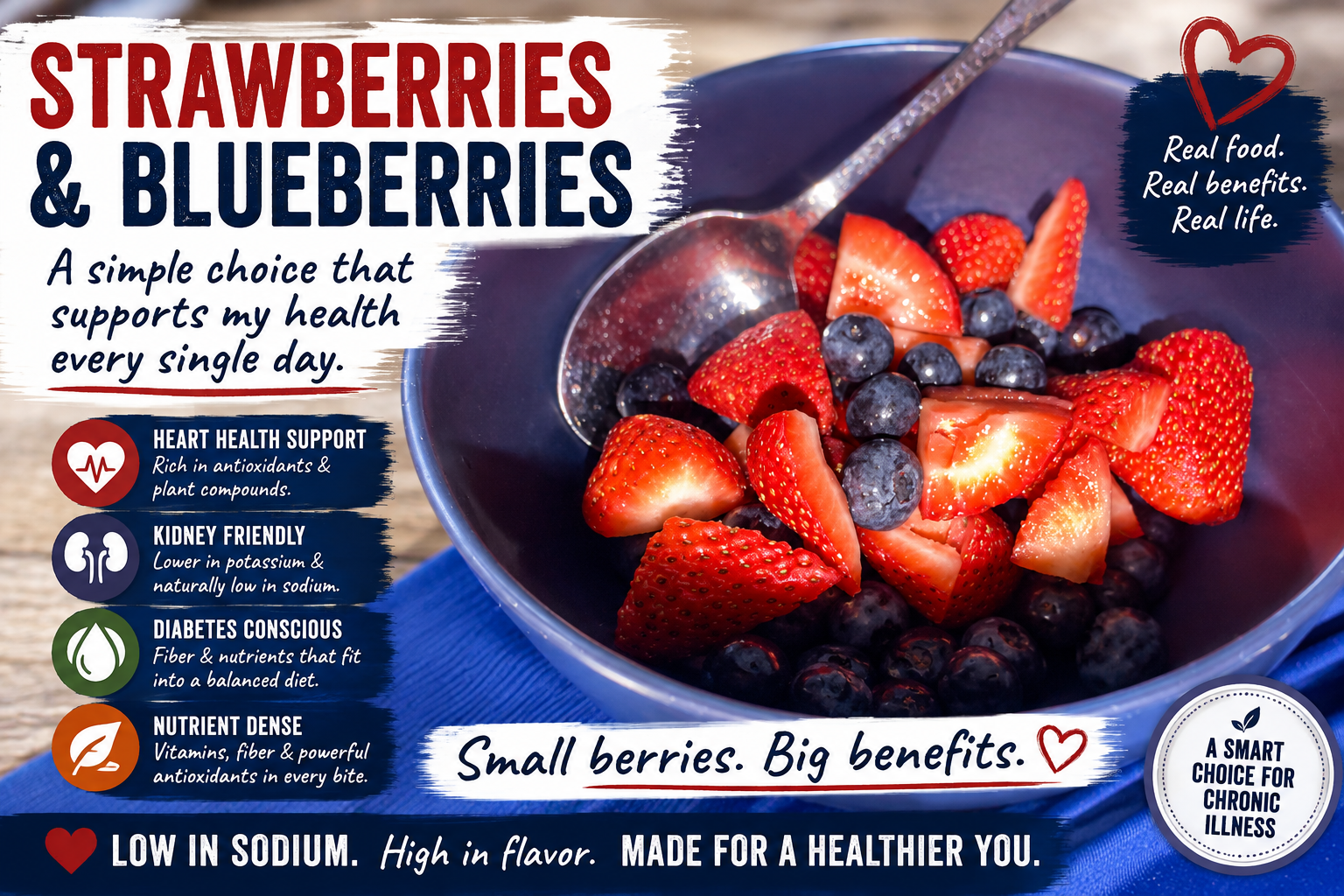
When you start living with chronic illness, food gets complicated.
Really complicated.
Something can be low in sodium but high in potassium. Something else might be great for your heart but loaded with carbohydrates. Then there are calories, phosphorus, fluid, added sugar and about a dozen other things somebody tells you that you should be watching.
Some days it feels like you need a chemistry degree just to make breakfast.
That’s one reason strawberries and blueberries have become a regular part of my mornings.
I eat them all the time, and initially I wasn’t eating them because I’d researched every possible health benefit. I ate them because I like them.
It turns out they aren’t a bad choice for me either.
First Things First: Berries Aren’t Medicine
I want to get this out of the way before going any further.
I’m not suggesting that eating a bowl of blueberries is going to cure heart failure, fix kidney disease or make diabetes disappear.
I wish it worked that way.
What I’m talking about is something much simpler: finding foods that fit reasonably well into the nutritional puzzle that comes with my chronic illnesses.
For me, strawberries and blueberries check quite a few boxes.
Almost No Sodium — That’s an Easy Win
Obviously, sodium is a big deal around here.
I’ve written plenty about how closely I watch it, and one of the nice things about fresh fruit is that I don’t have to start doing sodium mathematics before taking a bite.
Fresh strawberries and blueberries are naturally extremely low in sodium.
The National Kidney Foundation notes that strawberries are low in sodium, phosphorus and potassium while providing fiber and vitamin C.
That’s the kind of nutritional label I like to see.
No negotiating.
No “I’ll just eat half.”
No wondering how somebody managed to cram 600 milligrams of sodium into something that shouldn’t need salt in the first place.
They’re just berries.
They’re Pretty Kidney-Friendly Too
Kidney disease has added another wrinkle to how I think about food.
It’s no longer enough for me to look only at sodium. Potassium matters too.
That’s another place where berries can fit nicely.
According to the National Kidney Foundation, a half-cup serving of strawberries contains about 130 mg of potassium, while a half cup of blueberries contains less than 150 mg.
Both are considered lower-potassium fruit choices.
That doesn’t mean I can eat unlimited amounts. Portion size still matters, especially when you’re balancing multiple health issues.
But compared with some other fruits, berries can be a pretty comfortable fit.
Blueberries Pack a Lot Into a Little Berry
The dark blue color of blueberries isn’t just there to make them look good on top of breakfast.
Blueberries contain plant compounds called anthocyanins, which belong to a larger group of compounds called flavonoids.
Researchers have been particularly interested in anthocyanins because of their potential effects on cardiovascular and metabolic health.
Research on blueberries has suggested potential benefits involving vascular function and other cardiovascular risk factors. There’s also research examining anthocyanins and glucose metabolism.
That doesn’t translate into “blueberries prevent heart disease” or “blueberries treat diabetes.”
Nutrition research is rarely that simple.
What it does tell me is that blueberries are a nutrient-rich whole food that makes sense as part of the type of diet I’m trying to follow.
And unlike a lot of things marketed as “heart healthy,” nobody had to manufacture them in a factory and print a giant red heart on the package.
Strawberries Deserve Some Credit Too
Blueberries seem to get most of the superfood publicity, but strawberries aren’t exactly sitting around doing nothing.
They’re a good source of vitamin C and fiber and contain numerous plant compounds, including anthocyanins.
Researchers have studied strawberries for possible effects on cardiovascular risk factors and inflammation as well.
A meta-analysis of randomized controlled trials found that strawberry interventions reduced C-reactive protein (CRP), a marker of inflammation. The overall effects on things such as blood pressure, glucose and cholesterol weren’t consistently significant, although some subgroups did show improvements.
That’s an important distinction.
It’s easy to turn nutrition research into headlines like:
“EAT STRAWBERRIES AND SAVE YOUR HEART!”
That’s not what the research says.
What it suggests is much less exciting—but much more useful: strawberries can be part of an overall healthy dietary pattern.
I’m perfectly happy with that.
What About Diabetes?
Fruit contains sugar.
That’s something I have to remember with type 2 diabetes, regardless of how healthy the fruit might be.
But whole berries also provide fiber, and you’re eating the intact fruit rather than drinking its sugar as juice.
A half cup of strawberries provides roughly 2 grams of fiber, according to the National Kidney Foundation. A half cup of blueberries provides about the same.
That fiber is one reason I’d much rather eat the actual berries than drink strawberry or blueberry juice.
It also brings me back to something I’ve learned repeatedly while managing chronic illness:
Healthy doesn’t mean unlimited.
I’m still eating carbohydrates. I’m still consuming calories. The berries contain water, which technically contributes to overall fluid intake too.
My illnesses didn’t suddenly stop keeping score because I picked something nutritious.
Portions still matter.
It’s Nice to Find Something I Don’t Have to Fight With
Maybe that’s what I like most about strawberries and blueberries.
So much of eating with chronic illness feels like giving something up.
I miss foods I used to eat without thinking twice. Restaurant meals have become difficult. Grocery shopping involves reading labels. Recipes get modified. Sodium gets calculated.
Sometimes I find something I want to eat and discover that one serving contains half the sodium I’d like to consume in an entire day.
Berries aren’t like that.
I can put some strawberries and blueberries into my morning routine and know I’m getting fruit, fiber, vitamins and beneficial plant compounds without adding a meaningful sodium load.
They’re colorful.
They taste good.
They’re easy.
And most importantly, I actually enjoy eating them.
The Bigger Lesson I’ve Learned
Living with chronic illness has changed my relationship with food.
I used to think mostly about whether something tasted good.
Now I’m thinking about sodium, carbohydrates, potassium, fluid and how a particular food fits into everything else I’m eating that day.
It can become exhausting.
So when I find simple whole foods that work for me, I hang onto them.
Strawberries and blueberries aren’t miracle foods.
They’re not treating my heart failure. They’re not repairing my kidneys. They’re not curing my diabetes.
They’re simply two foods that fit surprisingly well into the complicated balancing act my health requires.
And sometimes that’s enough.
Tomorrow morning, I’ll probably eat some more.
Sources & Further Reading
National Kidney Foundation — Strawberries
Information about potassium, sodium, phosphorus, fiber and other nutrients in strawberries.
National Kidney Foundation: Strawberries
National Kidney Foundation — Blueberries
Nutritional information and discussion of blueberries as a lower-potassium fruit choice for people with kidney disease.
National Kidney Foundation: Blueberries
National Library of Medicine / PubMed — Recent Research on the Health Benefits of Blueberries and Their Anthocyanins
Review of research involving blueberries, anthocyanins and cardiovascular and metabolic health.
PubMed: Health Benefits of Blueberries and Their Anthocyanins
National Library of Medicine / PubMed — Effects of Strawberry Intervention on Cardiovascular Risk Factors
Systematic review and meta-analysis of randomized controlled trials examining strawberries and cardiovascular risk factors.
PubMed: Strawberry Intervention and Cardiovascular Risk Factors
Note: This article describes my personal experience living with chronic illness and the dietary choices I make. It isn’t medical advice. Dietary needs can vary significantly, particularly for people with heart failure, kidney disease or diabetes. Talk with your healthcare team or a registered dietitian about what’s appropriate for you.