I never expected a dropped drink to change my life.
It was 2020, and I was sitting at home watching a movie with my wife when I dropped what I was drinking.
I bent over and tried to put the ice cubes back into the cup.
I couldn’t do it.
I kept missing.
I remember thinking:
That’s weird.
Then I tried to say something to my wife.
I knew exactly what I wanted to say. The words were perfectly clear in my head.
But what came out of my mouth was garbled and made absolutely no sense.
My wife immediately knew something was wrong.
She wanted to call 911.
I refused.
Yes, I know. She was right.
I’m a guy. Going to the hospital was apparently the compromise I was willing to make at the time.
Another story for another day.
Fortunately, we lived less than a mile from the hospital. It was basically down the street and a left at the next stoplight.
I was having a stroke.
That’s When I Found Out I Had AFib
During everything that followed, I learned something else:
I had atrial fibrillation, commonly called AFib.
AFib is an abnormal heart rhythm in which the heart’s upper chambers—the atria—don’t beat in a normal, coordinated rhythm. Instead, the electrical activity becomes irregular.
One of the serious risks associated with AFib is stroke.
When blood isn’t moving normally through the atria, it can pool and form a clot. If a clot leaves the heart and travels to the brain, it can block blood flow and cause an ischemic stroke.
That was suddenly no longer an abstract medical explanation to me.
I had lived it.
I was fortunate that I was sitting at home when my stroke happened.
I sometimes think about what could have happened if I’d been driving instead.
Another Medication Gets Added to the List
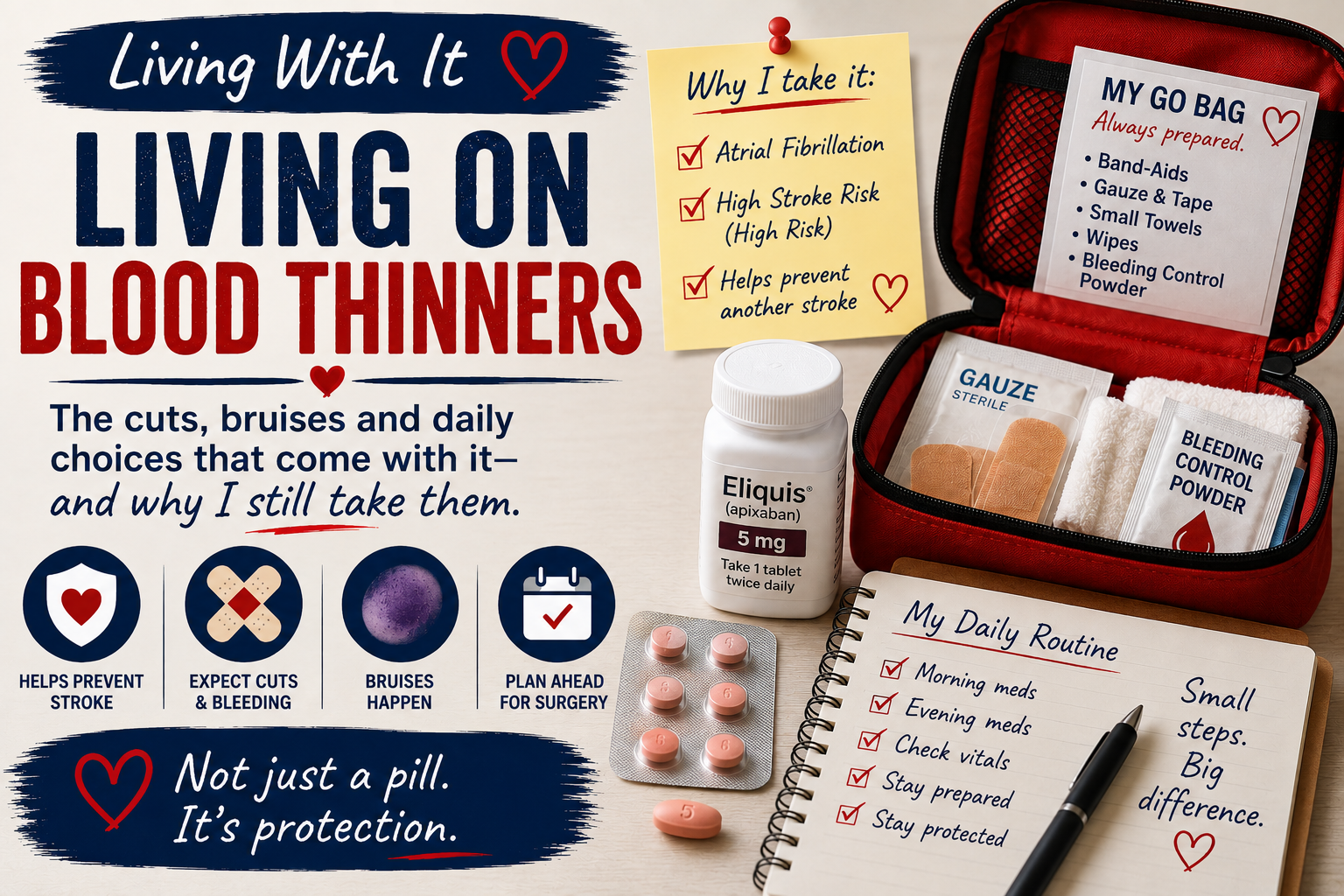
After some time in the hospital, I learned that I was going to need an anticoagulant—what most of us simply call a blood thinner.
At that point, medications weren’t exactly new to me.
I was already taking medications for diabetes, blood pressure and cholesterol.
Now I had another one.
Eliquis.
I take it twice a day.
One dose is part of my morning routine, and the other is part of my evening routine. Everything is organized in my pill box, and after doing it for years, taking my medications has become almost automatic.
It’s simply part of my day.
Why I Take It
This is the part that makes everything else I’m about to complain about worthwhile.
The purpose of my anticoagulant is to reduce my risk of another stroke from AFib.
My CHA₂DS₂-VASc score, which is one of the tools used to estimate stroke risk in people with AFib, is high enough that stroke prevention is something I take very seriously.
I’ve already had one.
I don’t want another.
And that’s the perspective I try to keep when dealing with the annoying parts of living on a blood thinner.
Because there definitely are annoying parts.
A Tiny Cut Isn’t Always a Tiny Event
I have somehow developed an amazing ability to cut myself doing ordinary things.
Maybe I’m trimming something outside.
Maybe I’m moving something around in the garage.
Maybe I bump into something.
I’ll look down and think:
Where did that come from?
Then I notice blood running down my hand or arm.
Anticoagulants don’t literally make your blood thinner. They interfere with the body’s clotting process, which is exactly why they help prevent dangerous clots—but it also means bleeding can take longer to stop.
I’ve learned that even a relatively minor cut sometimes requires patience, pressure and a Band-Aid.
Or two.
Or five.
The Truck Stop Incident
I learned the Band-Aid lesson while traveling.
We stopped at a Love’s truck stop. I went inside to use the restroom before getting gas.
Apparently, I bumped my arm against the corner of a door while walking in.
I barely thought about it.
I went back outside and started pumping gas.
A little while later, some of the employees or security staff came over and asked:
“Are you okay?”
I was confused.
“Yeah. Why?”
Then they told me to look at my arm.
Blood was running down it.
Apparently, my insignificant little bump had opened my skin enough that I had bled while walking through the store and hadn’t even realized it.
That was the day I learned an important lesson:
Carry Band-Aids.
My Little Blood-Thinner Go Bag
Actually, I’ve gone considerably beyond Band-Aids now.
We carry a small go bag with us almost everywhere.
Mine includes things that can help deal with minor cuts and scrapes:
- Bandages in several sizes
- Gauze
- Medical tape
- Small towels or something absorbent
- Supplies for cleaning minor cuts
- A bleeding-control product
Hopefully I don’t need any of it.
But I’ve learned that being prepared is considerably easier than standing in a parking lot bleeding while wondering if anyone has a Band-Aid.
It’s just part of life now.
For anything that won’t stop bleeding with firm pressure, is deep or serious, or involves significant injury, that’s obviously beyond the job of my little go bag.
And Then There Are the Bruises
Bruising has become another normal part of life.
Bump my arm?
Bruise.
Get blood drawn?
Bruise.
Have an IV in the hospital?
There’s a pretty good chance I’ll have a colorful reminder of exactly where it was for days afterward.
I also occasionally notice small discolored spots on my arms that come and go.
As I get older, I expect skin changes may make some of this even more noticeable.
I’ve seen protective sleeves designed for the arms, and that’s something I may eventually consider.
For now, I’ve mostly accepted that unexplained bruises are occasionally going to be part of the scenery.
Surgery Requires More Planning
Blood thinners also make surgery and some medical procedures more complicated.
It’s not necessarily a reason you can’t have them.
It just means everybody involved needs to know you’re taking an anticoagulant.
Depending on the procedure and the person’s individual risks, a doctor may instruct someone to temporarily stop an anticoagulant beforehand. Exactly when—or whether—to stop it depends on the medication, procedure, kidney function, bleeding risk and risk of developing a clot.
That’s why this isn’t something I decide on my own.
If I’m having surgery or a procedure, the physicians involved—including the doctor managing my anticoagulation—need to coordinate the plan.
I don’t just stop taking Eliquis because surgery is coming up.
The same goes for restarting it afterward.
I follow the instructions I’m given.
The Inconveniences Are Worth It
I’ve mentioned quite a few negatives.
Cuts bleed more.
Bruises appear more easily.
Blood draws can leave impressive marks.
I carry first-aid supplies.
Medical procedures require additional planning.
And I have another medication that I need to remember twice every single day.
But here’s the thing:
I’ll take all of that over another stroke.
My stroke was one of the worst experiences of my life.
I was 53.
I had a great job.
I had a woodworking side hustle that I loved.
I had great neighbors and a ton of friends.
I was independent.
I was self-sufficient.
And then, sitting on the couch watching a movie, my life changed.
The Lesson I Wish I’d Learned Earlier
Before my stroke, I wasn’t exactly great about going to doctors.
That’s something I look back on very differently now.
Afterward, I also learned that I had sleep apnea. Sleep apnea is associated with AFib, and treating underlying health problems is another piece of managing cardiovascular risk.
Could things have gone differently if I’d been getting regular medical care and my AFib had been discovered before the stroke?
I’ll never know exactly what would have happened.
But I certainly wish we’d had the opportunity to find it first.
Being proactive sounds a whole lot better to me now than being reactive.
That’s one of the biggest lessons I’ve taken from all of this.
Go for the checkup.
Get your blood pressure checked.
Talk to someone about the snoring.
Don’t ignore something because you feel fine.
Sometimes the first sign that something is wrong is a sign you really don’t want.
❤️ Greg’s Take
I’ve seen people talk about not wanting to take blood thinners because of the bleeding, bruising and inconvenience.
I understand it.
Nobody gets excited about adding another medication to their life.
And anticoagulants aren’t medications to take casually. They have real risks that need to be discussed with the person prescribing them.
But I can only speak from my experience.
I’ve had the cuts.
I’ve had the bruises.
I’ve bled through a truck stop without realizing it.
I carry Band-Aids everywhere.
I’ve turned taking Eliquis twice a day into a ritual.
And I’ll keep doing it.
Because I’ve also had a stroke.
The Band-Aids are easier.
If taking a couple of pills every day, carrying some first-aid supplies and dealing with an occasional ugly bruise helps reduce my risk of going through that again, I know which one I’m choosing.
Every single time.
Affiliate Disclosure
This article contains Amazon affiliate links. If you purchase something through one of these links, I may earn a small commission at no additional cost to you. I personally use the products I’ve linked in this article and am sharing them because they’ve been useful to me. I have purchased these with my own money. Purchasing through my links helps support He’s Knocking on My Door and allows me to continue creating content.
Medical Disclaimer
This article describes my personal experience with atrial fibrillation, stroke and anticoagulant medication. It is not medical advice. Anticoagulants can cause serious bleeding and should be taken exactly as prescribed. Never stop, skip, restart or change an anticoagulant because of something you read here. If you’re preparing for surgery or another procedure, your healthcare team should provide specific instructions about your medication. Seek urgent medical attention for serious or uncontrolled bleeding, a significant head injury, or symptoms of a possible stroke.